[NA] Practical tariff impact

So.. a fully automated society, UBI, everyone is living a life of leisure.. one massive solar flare latter society collapses and the Amish inherent the world.
We're kinda there already. Anything that takes out the power grid or the transportation system would likely result in the deaths of the majority of humans. Not kidding. As soon as the stores are emptied of non-perishable goods, there will be rampant starvation and likely an awful lot of violence to go along with it.

So, I have been working on and off on an always in progress possibly never to be finished sci-fi novel and while not all of this stuff is directly in the book, I have a lot of 'universe design' relevant to this discussion. This is sort of my idea of how things might work in the semi-distant future and while it's absolutely fiction I think something similar might be how things turn out. If you're not interested in speculative sci-fi fantasy concepts scroll on.
I hope you finish... I'd read it!

My theme here if it's not obvious is that advancements in technolgy are what will make these sorts of things possible or even inevitable moreso than any political/social movement.
That's kinda what I'm getting at. UBI isn't going to happen because people are clamoring for it. It's going to happen because we'll be automated to 80% unemployment in a relatively short timeframe and UBI is probably the easiest way (despite its difficulty!) to maintain social order.

I do kind of like the idea that one form of entertainment might be going on deep space missions though. That could be a thing! Especially with the medical problems solved.
We already have "shallow space" missions with rich celebrities. Hi, Katy Perry.

Easy. They must be enrolled in some form of education program until, let's say, age 30. Some courses are mandatory, most are optional. Pick whatever you're interested in. Get passing grades on the exams, if not, take another course and pass it. If forces you to open your mind instead of doing nothing.
I dunno if going all the way to 30 is necessary, but education is definitely going to be very important still.

So far no one (except 172and you) has mentioned the one industry that just might get the biggest benefit from the no-work concept. Entertainment. Singing, dancing, acting, symphonies, and so on. But wait! There must be theaters, sound, light, props, etc to support all this. Which means factories to produce the infrastructure, people to design everything and how are people going to learn to design? Someone's got to teach them, ChatGPT isn't viable for everything.
I'm not sure it'd change much. Maybe there'd be more entertainers, but there will always need to be consumers of entertainment. As far as teaching people, that's a job that would still exist.

What about that plumbing leak in the kitchen...what type of robot is going to fix it?
I don't see that as particularly difficult? You could have a plumbing robot that can sense leaks, pressure and flow issues, etc and can always make a perfect repair. What am I missing?
 
Nope. That's not at all what I'm saying. UBI isn't there so that nobody works. UBI is there so nobody HAS TO work. It would be set at roughly the poverty level. If you do nothing, you get just enough to be able to eat, have health care, and live in the most basic housing.

This is a point that I just can't get beyond.

It's not at all realistic that this mythical UBI would get limited to just those "poverty level" things. Someone, everyone, will be pushing to expand it a little here, a little there. and pretty soon it'll be a monster. (explaining in more detail how and why it would grow would lead us down the SZ path).

Or, look at my point this way: one time at work an engineer was proposing a system that was built on a specific radio frequency. He couldn't get it through his head that his idea was a non-starter because there was no way on this earth that every country in the world would allocate that much of a suitable band. It didn't matter that it was a pretty good concept, it was DOA because it wasn't going to get the requisite bandwidth world-wide, it just wasn't going to happen.
 
…UBI is there so nobody HAS TO work. It would be set at roughly the poverty level. If you do nothing, you get just enough to be able to eat, have health care, and live in the most basic housing….
Interesting concept. Who gets to decide what that means, because I have specific dietary desires, need 4,000sf on the coast in San Diego to be mentally healthy, and my esteem requires a high maintenance cosmetic health care regime.

If those needs are met for me, I might as well not be alive. The thought of work causes too much stress, so that’s out, too.
 
Nope. That's not at all what I'm saying. UBI isn't there so that nobody works. UBI is there so nobody HAS TO work. It would be set at roughly the poverty level. If you do nothing, you get just enough to be able to eat, have health care, and live in the most basic housing.
It won't be poverty level. It will be much better than that. There is no reason this has to be a race to the bottom. Remember, the machines will be more capable than todays workers. They will be smarter than todays workers. They will be more productive than todays workers.

The result won't be that they produce 100 million cars (approx the number of cars made in a year today) that are hoarded by a handful of people. The result will be that everyone can have a car without the toil of working.

And then, if you want more, you get a job, or you create one!
Doing what? Remember, the machines are smarter, faster and more capable the humans. Human labor has no value. So what would a human do for work in this scenario that would be worth being paid for?

I would expect it'd be about 50/50, workers vs. non-workers. However, I would expect that a significant portion of the workers will be less than full-time (by today's standards), or possibly do multiple part-time gigs. If I could create cool gadgets Monday and Tuesday, fly on Wednesday, volunteer on Thursday, and play music on Friday, that would be great! Or do something completely different. And I'd likely experiment some because I wouldn't have to worry about failure putting me on the street.
This is closer to the truth. Good friend of mine has never had to work. But he's had 3-4 jobs over the years because he want to deep dive into something and learn about it. Most notably becoming a somalier because he wanted to understand wines more.

But, again, make no mistake, these will be hobbies, not jobs.

Think of it like this. One of my hobbies is woodworking. I enjoy going out to my shop and making things. I'm decent at it, but no one is going to pay me because there are thousands of craftsmen out there that have more experience and do better work. So, I still do it, but it will always be a hobby.

Now, replace craftsmen with craftsrobots. The robots will be able to do anything a craftsman can do better, faster and cheaper. So, no need for craftsmen.

Now, replace woodworking with any job. The robots will be able to do accounting, programming, business development, factory working, drawing, designing, piloting and anything else that can be imagined better, faster and cheaper than humans.

Also not true. There are still corporations. There's still property and real estate. There's still investors and capital gains. There's still trade and tariffs. How do you think we got on before the 16th amendment was passed in 1913?
Yes, exactly.

Again, that's not how it works. You can still have all those people, they're just not slaves to a job. Automation will never replace 100% of humans.
I agree. But 95%, probably. And I have no idea what the 5% will be other than human oversight of the machines.

First of all, that's much higher than UBI would be. Like I said, poverty level. And you can absolutely have a job and work harder and be rewarded for it.
Doing what? Name one job that humans will be able to do better than machines to the point that a human could work harder and be rewarded when the machine is faster, smart and cheaper than the human.

There are OODLES of places I'd love to travel, and not just for a weekend/week vacation, but enough time to really experience them and get a feel for the place. I was lucky enough to live in the Netherlands for a year when I was growing up. I went to first grade there and learned how to read and speak Dutch with other kids my age and it was a wonderful experience. I have many fond memories of that year, and we went to lots of other places in Europe because of the luxury of proximity. I got to see the crown jewels, Big Ben, the Eiffel Tower, Anne Frank's hiding spot, windmills, castles, museums of many kinds, ride on a hovercraft and a hydrofoil that were both big enough to ferry cars (both across the English Channel, before the Chunnel), and experience other cultures.

If I had the time (and money...), I'd love to spend some time in Japan, South Korea and other "western" Asian countries, Australia and New Zealand, parts of South America (my family lived in Brazil for a few months before I was born and my BIL lived in Chile for a while), Puerto Rico and the rest of the Caribbean... I could easily take five years of my life just for travel and nothing else.

Exactly. I think some people, particularly americans due to the paucity of vacation time compared to the rest of the developed world, just can't wrap their minds around travel as anything but a week a year going to Paris or Disney or Tokyo.

We already have a small class of people that RV full time and spend months at a time at locations. Many of them make YT content to support their habit. The future of travel will likely look more like that than vacations. Just without the need to make YT content unless you want to do it as a hobby.

So far no one (except 172and you) has mentioned the one industry that just might get the biggest benefit from the no-work concept. Entertainment. Singing, dancing, acting, symphonies, and so on. But wait! There must be theaters, sound, light, props, etc to support all this. Which means factories to produce the infrastructure, people to design everything and how are people going to learn to design? Someone's got to teach them, ChatGPT isn't viable for everything.
Why on earth would people be needed to "design everything"? Creative work is rapidly being displaced by LLMs and we're only in the first hours of the revolution. This is only going to increase as the years tick by and automation improves both objectively and subjectively.

Objectively, I doubt anyone would get on a plane designed by todays AI. But that's not because AI isn't capable of it, it's because we're in the first hours so that particular flavor of AI doesn't exit yet. Airplane design is massively automated with CAD and physics sims that prevent companies from having to build prototypes until the final stages of design/verification. Indeed AI is already used in things like turbofan blade design. What hasn't happened yet is to create a system that brings those technologies together to create an entire engine. Or an entire plane. But it would be a mistake to think that it won't happen. It will.
What about that plumbing leak in the kitchen...what type of robot is going to fix it?
One that can fit into spaces too tight for a human without having to tear open walls. One that doesn't get grossed out or made sick by dealing with waste water. One that doesn't have to be dragged out of bed at 2am when a pipe bursts. One that isn't limited by its own personal experience and can instead draw upon all plumbing knowledge from lead to cast iron to copper to PEX to ABS to PVC rather than only being effective at a subset. One that is every bit as good as any other one, instead of having to get references to make sure you hire one that knows how to do the needed work properly. One that can be packed, along with a thousand of its clones, into the back of some jets and flown into a disaster area after an earthquake without having to leave family behind and demand both hardship pay and hazard pay. That type.

 
Last edited:
And you can absolutely have a job and work harder and be rewarded for it. There's still a deduction for destructive behavior, but it just makes you go back to the starting square, it doesn't kick you out of the game.
Remember most of the reason we're discussing an "inevitable" UBI is that many (if not most) people will eventually be workplace-displaced, unable to compete with automation/machines, so they will not be able to get jobs.
In my "Family UBI" hypothetical that's what we're simulating: no job availability. You're telling your kids take the money and go be happy without a job. It's not hard to envision how deeply unhappy they're going to be after the initial mirage of freedom wears off.

And how is that different from all the kids who are living in their parents' homes right now because they've figured out that the world sucks and they don't want to play the game?
The world does not suck :)
And in my view there's nothing enlightened about sitting at home playing video games, going drinking with your friends, taking little road trips and living recklessly and responsibility-free -- meanwhile absorbing all the amenities made possible by your hardworking parents.
That's not fighting the economic system by refusing to participate in "the game," it's called being "lazy AF" while enabled by spineless parents.

I don't think that working has given me any of the things you think it has. Wisdom comes with experience, but not just WORK experience. In fact, most of the wisdom I have comes from experience interacting with people. Some of them were coworkers, but I think I've gotten more wisdom from those who weren't.
That's fair, and I'm the same. But I know that wisdom/experience is not something you have until you've lived a good amount of life.
You give most people w/o life experience a "get-out-of-work" free card and tell them they can collect a check into perpetuity without maintaining any structure or discipline in their life and you're going to see all manner of negative outcomes.

I vehemently disagree.

There are OODLES of places I'd love to travel, and not just for a weekend/week vacation, but enough time to really experience them and get a feel for the place. I was lucky enough to live in the Netherlands for a year when I was growing up. I went to first grade there and learned how to read and speak Dutch with other kids my age and it was a wonderful experience. I have many fond memories of that year, and we went to lots of other places in Europe because of the luxury of proximity. I got to see the crown jewels, Big Ben, the Eiffel Tower, Anne Frank's hiding spot, windmills, castles, museums of many kinds, ride on a hovercraft and a hydrofoil that were both big enough to ferry cars (both across the English Channel, before the Chunnel), and experience other cultures.

If I had the time (and money...), I'd love to spend some time in Japan, South Korea and other "western" Asian countries, Australia and New Zealand, parts of South America (my family lived in Brazil for a few months before I was born and my BIL lived in Chile for a while), Puerto Rico and the rest of the Caribbean... I could easily take five years of my life just for travel and nothing else.

As it is, right now I'm down to playing with a quartet for an hour maybe once a month on average. I'd much prefer an hour or two a week, and to have time available to do more arranging for the group... Or even just arranging for other types of groups and learning other musical instruments so I could overdub and create recordings on my own.

I would like to fly all the airplanes to all the places.

I could be granted an entire second lifetime and never get bored.
Great! Go do it!
(... I've done it, and it's fun for a time, but it gets old :))
 
Last edited:
I am looking at tariff thing as though it has a double edge blade... there is some good that may come of it, and there are some downsides.

What good is less efficient, higher costs to consumers? Why has domestic auto companies focused on light trucks? They are protected by the chicken tax (25% tariff) enacted in the 60s.

The reality, tariffs generally are bad for any open economy. Where tariffs excel, is selective application to convince a counter party to open markets to free trade. Note the term: selective. This requires years of negotiation, relationship building, and trust for it to happen.

Tim

The chicken tax was only for the light duty trucks that came from the EU... and Ford found away around the chicken tax with the Transit Connect for a while... but in the end it cost them.. MBZ and Volvo have been making light duty trucks in Mexico to get around the chicken tax..

As for light trucks, Ford who enjoys the #1 spot and is hearing Toyota knocking at the their front door. There were boatloads of light trucks coming in from Japan... Thank goodness we didn't have a sushi tax :D :)
 
Interesting concept. Who gets to decide what that means, because I have specific dietary desires, need 4,000sf on the coast in San Diego to be mentally healthy, and my esteem requires a high maintenance cosmetic health care regime.
Then you need a job. Sorry.

It won't be poverty level. It will be much better than that. There is no reason this has to be a race to the bottom. Remember, the machines will be more capable than todays workers. They will be smarter than todays workers. They will be more productive than todays workers.
You are either talking much farther into the future than I am, or you've already figured out how to fund it?

I think you still need there to be an incentive for part of the population to work. I do not think we're going to have entrepreneur robots who are going to come up with new products to make life better for the humans.

And if you need some of the humans to be working, there needs to be a reward.

Doing what? Remember, the machines are smarter, faster and more capable the humans. Human labor has no value. So what would a human do for work in this scenario that would be worth being paid for?
Any of the stuff I mentioned. Volunteering, creating, inventing, doing things that humans are best at.

Yes, it'll be different - I don't envision giant corporations with tens of thousands of employees being at thing any more. The big corporations will be the ones that have figured out a way to satisfy a need via automation. To get a "job" you'll probably have to start your own business, or work for another small business nearby.

Now, replace woodworking with any job. The robots will be able to do accounting, programming, business development, factory working, drawing, designing, piloting and anything else that can be imagined better, faster and cheaper than humans.
I don't think we're that close to replacing the creativity of humans. Everything we're calling "AI" today requires the input of many, many humans. If humans aren't there to create the things the AI learns from, there's no AI.

Doing what? Name one job that humans will be able to do better than machines to the point that a human could work harder and be rewarded when the machine is faster, smart and cheaper than the human.
The one that the human creates for themselves by envisioning a product they want to create that people want to buy.

Exactly. I think some people, particularly americans due to the paucity of vacation time compared to the rest of the developed world, just can't wrap their minds around travel as anything but a week a year going to Paris or Disney or Tokyo.
It's hard to do for most Americans. Many Americans get no PTO and are living paycheck to paycheck, so a long weekend to the nearest water park is as good as it gets.

Remember most of the reason we're discussing an "inevitable" UBI is that many (if not most) people will eventually be workplace-displaced, unable to compete with automation/machines, so they will not be able to get jobs.
Not the typical "cog in the giant corporate machine" jobs. They'll need to create their own jobs, but that will be made far easier by the fact that they won't need to worry about food and health insurance while they're figuring it out.

The world does not suck :)
Yeah, for some of us, the world is great. I mean, I own my own dang airplane! Doesn't get much cooler than that. And I am married to an awesome woman who has made me a couple of great kids and we live well in a neighborhood with wide open spaces that's far from crime and poverty and all the other bad parts of reality.

But, that places us in the VERY lucky minority. For the vast majority of the world's citizens, the world does suck. But in terms of the specifics of the point I was making that you were replying to, it seems that the pandemic has made a lot of people, especially younger ones, question whether there's any meaning in going off to be a tiny cog in a behemoth of a corporate machine just to barely be able to scrape by.

Great! Go do it!
(... I've done it, and it's fun for a time, but it gets old :))
I wish. Sounds great for retirement, but it's very difficult to have both the time and the money to do such things for those lengths of time. And my youngest won't be out of college until I'm at least 70, so "retirement" in the sense of being able to travel for leisure months at a time isn't gonna last particularly long for me! I probably don't have much hope beyond the "Redneck Retirement Plan" (aka PowerBall/MegaMillions).
 
You are either talking much farther into the future than I am, or you've already figured out how to fund it?
I have intentionally not put a precise timeline on it. I'm only observing that the assembly line was about a hundred years ago and the world today is unrecognizable in comparison. The first impactful AI was a couple years ago and I'm predicting will make the world similarly unrecognizable. If I'm guessing, I would say it's unlikely that old grey pilots will live to see it, and that it's super unlikely that the great grandchildren of those pilots will not live to see it. Where in the middle it happens, I haven't a clue.

I've similarly not only not speculated how funding will be done, but have pointed out that this will be a culture defining moment as we move from an economy that places value on human labor to one in which human labor is unnecessary.
 
Except that avoids answering the question. Who gets to make the decision that you have to get a job to meet your basic needs?
Yes, that's the question. In this future world it seems very likely that governments become much more powerful. Some won't like that idea, but in the absence of human labor having value, it's hard to see how capitalism maintains an ability to be the driving economic force. How this transition happens is the test that humanity faces going forward.
 
About three decades ago in college I took a sociology class. One of the aspects taught has always stuck with me. I am going on memory, so the numbers are suspect. But you get the idea.
Before the industrial age we required something like the following:
89% unskilled labor
10% managers
1% thinkers

With the industrial revolution the ratio changed:
80% unskilled label
10% managers
10% thinkers

With the advent of the information age the ratio is changing again:
10% unskilled label
10% managers
80% thinkers

However, our education systems have not changed, neither has our society. e.g. Summer vacation hurts kids ability to learn. Summer break was not for vacation, it was for pulling in the harvest. How many kids today help pull in the harvest?

Tim
 
You do realize Boeing does not need a PMA for any part it puts on their aircraft. They could easily select any switch anywhere and install it or sell it. Same way Piper runs over to the nearest NAPA grabs a Gates brand V-belt, then slaps a Piper sticker over the Gates and triples the price. No different. PMAs are needed by every else outside an OEM like Boeing or Piper. On the flip side, you as an A&P can go to the same NAPA, buy the same V-belt for $15 and legally install it on any appropriate Piper. No PMA needed.
That wasn't the original statement. Boeing outsourced that switch. 'designed and tested electrical switches for Boeing'. That is not an in house/OEM product. So my response still stands. If 'Joes *****'n switches' wants to supply Boeing, then launch the paperwork missiles.

As for your gates belt, do you mean VARMA? If so then that's a fairly new rule and covers non-critical, mostly benign parts. You can't put an Bob's House of Bearings parts in that same Piper without someone saying its OK.
 
About three decades ago in college I took a sociology class. One of the aspects taught has always stuck with me. I am going on memory, so the numbers are suspect. But you get the idea.
Before the industrial age we required something like the following:
89% unskilled labor
10% managers
1% thinkers

With the industrial revolution the ratio changed:
80% unskilled label
10% managers
10% thinkers

With the advent of the information age the ratio is changing again:
10% unskilled label
10% managers
80% thinkers

However, our education systems have not changed, neither has our society. e.g. Summer vacation hurts kids ability to learn. Summer break was not for vacation, it was for pulling in the harvest. How many kids today help pull in the harvest?
Good stuff.

Summer vacation is one thing that has remained oddly static over the years. But, really, the entire educational system is one of the only things you can think of that looks so similar to the way it operated 125 years ago. You see a photo of a classroom from 1900 and one from 2025 and they are both obviously doing the same job.

To follow your ratios, the next one might be something like:

0% unskilled labor
5% AI/Robotics oversight
5% policy makers
 
What's interesting to me in this discussion is how much of it is about small potatoes. I mean it's a lot of "my view", "my experience" and so on. The economy is a larger beast then any one person or company.

What I do know is that USA was at 4% unemployment and that's consider full employment. I also know that as senior management that my job (lol small view) isn't to do the work but to enable others to do it, and that is what I am suppose to bring value to. To me (again lol), this means I don't see how USA intents to staff it's newly open factories with such low employment. And I know some people would say automation but honestly there's a reason why no one is fully automated. And it also strike me as interesting that bringing the jobs back is the only concerns. There's that constant refrain in this thread about how big corp is taking all the money (which they are to some extent), but no one seems to have thought about how having others do stuff you don't want to or don't have the people to, means achieving more overall. With 4% unemployment bringing all that factory jobs back will maybe create new jobs, but at the expense of other industries? Wages will go up but then so will prices. Overall wealth creation will not be greater if we assume 1 human's worth of work is equal in all industry. All the tariffs would have done is eliminated the work of humans outside the USA and that contribution to the wealth of the USA. I'll wait and see what happens but I suspect it's going to be a negative out come.

I also read this and thought it was interesting: https://arstechnica.com/tech-policy...trumps-tariffs-wont-bring-manufacturing-back/
 
From what I've been told, select manufacturing has been returning to the US since covid. And from what I've been told about the tariffs in general its more a leverage play on several different levels. Whether it will work across the board is unknown, but some believe it will work within various industries. The business owners in my circles have been affected but not fatally and they remain optimistic on the end result.
 
Boeing outsourced that switch. 'designed and tested electrical switches for Boeing'. That is not an in house/OEM product. So my response still stands.
And still not correct. Boeing doesn't need a PMA because their type certificates and production certificates give them the ability to take any part from anywhere and make it a Boeing part. Or a Cessna part. Or a Bell part. Been that way for decades. Its the same reason an OEM modification needs no additional "approvals" to install on the aircraft.

You can't put an Bob's House of Bearings parts in that same Piper without someone saying its OK.
Why not? An A&P can legally install a bearing from Bob's House of Bearings on a TC aircraft as an alteration. If the bearing install falls under a major alteration that he determines, then he needs approved data. No different than installing a Cobra marine radio in an aircraft. So I don't see your issue. As for VARMA its useless in my book without any FAA guidance issued. Besides an A&P could install any part under VARMA as an alteration as well.
 
Last edited:
From what I've been told, select manufacturing has been returning to the US since covid. And from what I've been told about the tariffs in general its more a leverage play on several different levels. Whether it will work across the board is unknown, but some believe it will work within various industries. The business owners in my circles have been affected but not fatally and they remain optimistic on the end result.
Across the board tariffs isn't unknown. They have been tried before. They failed spectacularly.

Targeted tariffs can be a very useful tool.
 
Except that avoids answering the question. Who gets to make the decision that you have to get a job to meet your basic needs?
Living in a 4,000 sqft house is not a "basic need".

If you feel you need to do that, then you decide that you need a job so that you have the money.
 
Across the board tariffs isn't unknown. They have been tried before. They failed spectacularly.
Maybe. I think the answers are more subjective to the person. At least from what I've seen and heard since the tariff discussions start last year.
 
Living in a 4,000 sqft house is not a "basic need".

If you feel you need to do that, then you decide that you need a job so that you have the money.

You’re still avoiding answering the question. Who gets to define what a “basic” need is and how is that quantified in monetary terms.

Yes, I seriously ask this question because I have been provided by the US government bivy sacks and MREs to weatherized cardboard boxes and canned rations to tents and fresh cooked meals to in communal settings to containerized housing units and single hotel room and cash per diem. In all these variations, the food and accommodations were deemed appropriate for long term living arrangements.

I lived the same cardboard box in Kuwait four times across a three year period. At least my roommates changed over time.

Other than being in a hotel room, I never had a latrine or shower facility in the same facility I slept in.

ETA: the military housing allowance is set to 85% of the locality’s rate for shelter & utilities. Pentagom dwellers get way more of a housing allowance than those guys at Fort Polk in Leesville, LA.
 
So UBI would fluctuate based on geography and COL?
Excellent question!

Another will be: What drives COL when human labor is no longer necessary?

Today COL is hugely manipulated by demand to live in areas with job opportunities. When that ceases to be a thing, what will cause one area to cost more to live in than another? Will demand be basically defined by people who want to live near other people, or not? Or people who want to live in mountains? Or people who prefer very mild climates? Or people who demand four seasons a year and lakes?

Maybe. I think the answers are more subjective to the person. At least from what I've seen and heard since the tariff discussions start last year.
Well, that can be the answer to just about every question. There will always be someone who does well in a situation. RV makers were practically printing money during covid. Weapons manufacturers get rich during war.

I don't think most people argue that war and pestilence are good things.

I'm sure there will be people who make a killing on blanket tariffs. My comment was about the national and global economy. Not about the profiteers.
 
The reality, tariffs generally are bad for any open economy. Where tariffs excel, is selective application to convince a counter party to open markets to free trade.
True.

We have several trading "partners" (adversaries) who dump their goods below total cost, manipulate their currencies, and place legal retail price controls on our exports (think pharmaceuticals, but it's not limited to this market segment).

These are precisely the sort of issues that tariffs are effective in addressing. Are they the right choice today? Maybe, maybe not.

I will point out, though, that some tariffs were enacted between 2017 and 2020, and have remained in place, all while political control of the various government branches has shifted back and forth. If those tariffs were truly as damaging as some are asserting, why weren't they rolled back when others had the opportunity to do so?

IMO, the problem with these trade policy changes is more about the "who" and how it is being publicly blasted out in a ham-fisted manner, than it is about the substance of the policies.
 
So UBI would fluctuate based on geography and COL?
Maybe... But @172andyou makes a good point. Silicon Valley is expensive because you can make a crapton of money there. Would that still be true in a UBI world? Who knows.

I also don't pretend to have all the answers. What I do know is that if we just bury our heads in the sand because "it's hard" and do nothing, we will be FAR worse off than if we ask these questions and attempt to come up with the best answers for them.

You’re still avoiding answering the question. Who gets to define what a “basic” need is and how is that quantified in monetary terms.

Yes, I seriously ask this question because I have been provided by the US government bivy sacks and MREs to weatherized cardboard boxes and canned rations to tents and fresh cooked meals to in communal settings to containerized housing units and single hotel room and cash per diem. In all these variations, the food and accommodations were deemed appropriate for long term living arrangements.

I lived the same cardboard box in Kuwait four times across a three year period. At least my roommates changed over time.

Other than being in a hotel room, I never had a latrine or shower facility in the same facility I slept in.

ETA: the military housing allowance is set to 85% of the locality’s rate for shelter & utilities. Pentagom dwellers get way more of a housing allowance than those guys at Fort Polk in Leesville, LA.
Excellent points. However, it shouldn't be too difficult to define just based on what is typical in America: A dwelling whose purpose is to house a single person or an immediate family, with a kitchen, a full bathroom, and a bedroom per person/couple or so, maybe a certain square footage per person or couple, without leaks that allow water, bugs or critters in. (I'm just spitballing here.)
 
I will point out, though, that some tariffs were enacted between 2017 and 2020, and have remained in place, all while political control of the various government branches has shifted back and forth. If those tariffs were truly as damaging as some are asserting, why weren't they rolled back when others had the opportunity to do so?
Some of them remained in place because they were targeted.

Some were increased on a targeted basis.

Some of them remained in place because, even though they were blanket, they were low enough to represent sane policy.

Some of them were removed.

Blanket tariffs created by taking a trade deficit dividing it by 2 and setting a floor of 10% are not targeted and not low enough to be sane. That position was abandoned within about 48 hours IIRC, but would certainly have been removed by the next administration.
 
Well, that can be the answer to just about every question.
Not really. Its the same answer I gave earlier in this thread on the topic and it had zero to do about people “make a killing” or “profiteers.” Given these tariffs were known to be in play last year, the effects of the tariffs are very subjective to the individual businesses on a number of levels. Especially since it was also known the tariffs would be used for more than just economic reasons.
 
The short version of the summary of my research on tariff's, which was also pretty short is that say a 200% increase makes a great headline, but has almost no meaning.
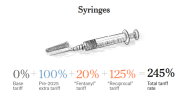
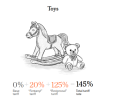
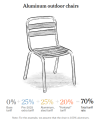
in reality if you look a 100 items from a specific country they each probably have their own tariff rate from 0% to 500%, two different items leaving the country at $10 each with a 200% increase might not change the 1st items price at all and the other item might go to $50.
I am also sure with the list of that 100 items the rate on each item the rates are probably changing weekly for all kinds of reasons. I suspect the sub category rates will get sufficiently adjusted to account to for the 200% increase.
More specific Tariff like on whole cars are probably the more concern issues, but I suspect a lot of that has already or will be quickly adjusted for either by importing lesser taxed parts and assembly or redirecting them and production through other countries.

Probably not accurate, but that is what it looked like to me when I started my limited google research.

Brian
You are correct on the variation.
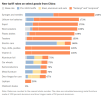
Here's 1 example of that from an analysis article I read in NYT.
But the average level is so staggering that it is effectively a trade-killer for a vast swath of products.
1745277037346.png
1745277060357.png
1745277072445.png
1745277083538.png
 
When the stocks, bonds, and the value of the dollar are all three dropping at the same time it’s not good. Normal the drop of one willl increase the others as money is shifted around. Not now, there is a very large amount of capital “disappearing” and being shifted to other markets and safe assets.
 
When the stocks, bonds, and the value of the dollar are all three dropping at the same time it’s not good. Normal the drop of one willl increase the others as money is shifted around. Not now, there is a very large amount of capital “disappearing” and being shifted to other markets and safe assets.

This is highly understated; and is a major threat to the USD being the "global reserve currency". The reserve currency status allows the USA to borrow money significantly cheaper than any other country; both private equity and government equity are affected by this. If the USA loses this status, effective interest rates will go up a lot, some pundits are predicting another three to four percent.

And recent threats to the Charman of the Federal Reserve do more to threaten the status of the global reserve currency than anything else in the last week.

Tim
 
This is highly understated; and is a major threat to the USD being the "global reserve currency". …
While I concur with most of your whole statement, the bigger issue is where do the G8/G20 countries go for their financing needs? The Pound, Euro, Yen, and Renminbi can’t fill that gap.

Want to talk about a global depression? Try watching this play out.
 
I read that the US represents 25% or so of global gdp but the stock markets was 65% of global valuations.

This means lots of money been invested in the US. With the turmoil of late maybe what we are seeing is money going elsewhere for safety and better returns.

I for one am moving my retirement savings of of US stocks and into other investments.
 
While I concur with most of your whole statement, the bigger issue is where do the G8/G20 countries go for their financing needs?
Have you been watching the metals markets? This might be a case where the ones with the money just cash out into physical assets and wait out the storm. (The amount of physically deliverable silver compared to the amount traded in the futures is a ratio that would make the hunt brother blush, if I was a billionaire or a decision maker of a nationalized investment program I absolutely would be buying silver delivery contracts and filling up a Scrooge mcduck style “money bin”.
 
While I concur with most of your whole statement, the bigger issue is where do the G8/G20 countries go for their financing needs? The Pound, Euro, Yen, and Renminbi can’t fill that gap.

Want to talk about a global depression? Try watching this play out.

Euro, and Yen can easily. The return has sucked for those compared to the USA. And with the uncertainty caused by the current administration, the comparative risk level might actually be lower.

Tim
 
Euro, and Yen can easily. The return has sucked for those compared to the USA. And with the uncertainty caused by the current administration, the comparative risk level might actually be lower.

Tim

I don’t see China buying Yen and the EU can’t absorb all of China’s need for convertible currency.

In a perverse sort of way, the tariff decisions may be a play to force other countries to choose to align with the US or align with China in a new bi-polar world.

The problem China faces (economically) is they have so much tied up in US treasury notes that America going bankrupt hurts us but destroys China.
 
The problem China faces (economically) is they have so much tied up in US treasury notes that America going bankrupt hurts us but destroys China.
I think it is unwise to underestimate effect of the difference in their governance format and their historical willingness to do exactly that if leaderships decides it is in their long term best interests. (I’m probably wrong, definitely would be the first time).
 
Back
Top