Mixture cable failure goes to full rich or not?

Trogdor

Pre-takeoff checklist
Joined
Apr 10, 2014
Messages
448
Location
NJ
Display Name
Trogdor
Home Airfield
N51
Had a scare: The mixture cable broke off the carburetor control arm (looks like a paper clip was snapped) in a C182 with an O470 (R or Q maybe) while I leaned it out for taxi after landing. I do plan to play the lottery soon.

Anyway, shouldn't it fail rich to begin with? There seems to be conflicting advice on this topic on Google: I read that a spring CAN BE installed so it goes full rich, but this maybe aftermarket (technically "illegal" outside of an STC). Or on some it does come with a spring from the OEM? Help!
 
A spring for Full Rich would be a good idea but I don’t recall ever actually

see in one.

My understanding is Cessna and the Marvel-Schebler folks are still debating

who eliminated the Throttle Spring on the 10-4894 Carb ( C-150) circa 1969.

I put them on anyway.
 
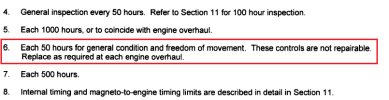
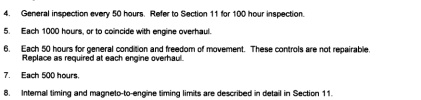
As is almost always the case, poor inspection and maintenance results in stuff like failed controls. These things are not designed to last the life of the airplane. They do fatigue and corrode and wear out. From a Cessna 182 service manual:

1749663093357.png
1749662688172.png
So, Cessna recommends inspection of that stuff every 50 hours. At every oil change, basically. It's so critical that it needs monitoring. Now, note that "6" in the Special Inspection Item column:

1749662768867.png

Replace at each engine overhaul. Again, they are as critical as the engine itself, right? If a control fails, it might easy have the same result as an engine failure.

Cessna doesn't recommend this stuff just to sell more parts.

There are no springs on mixture controls, and very rarely on throttle controls. Good maintenance is the key here, not band-aid solutions. A broken throttle cable with a spring to full throttle could turn deadly for someone on the ground.
 

Attachments

  • 1749662715241.png
    1749662715241.png
    41.2 KB · Views: 9
Last edited:
Can you put on a spring to fail full rich even if it didn't come with one as a safety precaution?

@Magman Can you clarify your statement?
 
A common reason for failure is the drilled bolt ( Cessna calls it a Clamp)

is not swiveling with Control movement. Improper amount of washers will

cause the wire to flex rather than swivel.

C-150’s of 1968 and 69 were delivered without the Throttle Spring.

IIRC earlier and later years had this feature. Supposedly Cessna & MS

blamed the other for not specking it out. Why =??

It requires no internal disassembly and it easy to install.

I would insist on it. It’s not very powerful so opening the Throttle

would not be instantaneous. Still better than closed though.
 
@Magman Can this be retrofitted on all carbs for an O470 in a C182?

I assume its part of the Marvel Schebler Quick Kits?

And btw, this was the mixture cable not the throttle if that makes any difference.
 
Last edited:
As is almost always the case, poor inspection and maintenance results in stuff like failed controls. These things are not designed to last the life of the airplane. They do fatigue and corrode and wear out. From a Cessna 182 service manual:

View attachment 141839
View attachment 141836
So, Cessna recommends inspection of that stuff every 50 hours. At every oil change, basically. It's so critical that it needs monitoring. Now, note that "6" in the Special Inspection Item column:

View attachment 141838

Replace at each engine overhaul. Again, they are as critical as the engine itself, right? If a control fails, it might easy have the same result as an engine failure.

Cessna doesn't recommend this stuff just to sell more parts.

There are no springs on mixture controls, and very rarely on throttle controls. Good maintenance is the key here, not band-aid solutions. A broken throttle cable with a spring to full throttle could turn deadly for someone on the ground.
A HA! The plane is about 100 hours from just having an overhaul. So this cable was touched, right?
 
A HA! The plane is about 100 hours from just having an overhaul. So this cable was touched, right?
Sure. Disconnected and reconnected, but not likely replaced. Might be as old as the airplane. Or might have been incorrectly reconnected. Got any pictures?
 
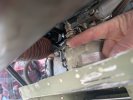
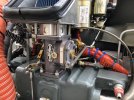
Here you go: Snapped in that L-shape curve.

Btw, I do go to the gym but I am not that strong. Honest.
 

Attachments

  • PXL_20250604_170820635.jpg
    PXL_20250604_170820635.jpg
    961.4 KB · Views: 51
Last edited:
A common reason for failure is the drilled bolt ( Cessna calls it a Clamp)

is not swiveling with Control movement. Improper amount of washers will

cause the wire to flex rather than swivel.

Yeah, drilled bolts for cable terminations are a bit crude. There are some better hardware solutions now. I think this is called a B-nut? Takes the guesswork out of it.

For throttles and props, threaded rod ends are more robust and reliable.

PXL_20231106_195718727 (1).jpg
 
Had a scare: The mixture cable broke off the carburetor control arm (looks like a paper clip was snapped) in a C182 with an O470 (R or Q maybe) while I leaned it out for taxi after landing. I do plan to play the lottery soon.

Anyway, shouldn't it fail rich to begin with? There seems to be conflicting advice on this topic on Google: I read that a spring CAN BE installed so it goes full rich, but this maybe aftermarket (technically "illegal" outside of an STC). Or on some it does come with a spring from the OEM? Help!


A broken mixture cable would not usually be an emergency. In most phases of flight it would be an annoyance, but you should be able to safely descend and land once you figured it out. Might be a bad day if it broke after leaning for ground ops and before taking off, but otherwise mostly a non-event.

That's why Bowden Cables are acceptable instead of a more robust cable with a threaded stud on the end, like your throttle and prop probably uses.
 
Anyway, shouldn't it fail rich to begin with?
As mentioned, not a standard thing for most small pistons, however, on some large radials and turbines have seen spring loaded levers with most of those cammed where the spring only comes into effect once the control lever is positioned to more than half-way travel. A better route may be to upgrade the cable type and/or adopt a more frequent inspection of all control cables.
 
A broken Mixture Control May present in the event of a go - around

with insufficient power.

The item Ed referred to is used on Pipers and often called a “ Bug-nut”.

It is nicer but incorrect install can still bind and flex the wire.

I’ve met some where a Vernier Mixture Control was added.

It’s a problem because you have a small diameter threaded Stud that

now needs a larger hole for the wire.

No “ meat” left!
 
The Spring mentioned is a Coil Spring that wraps around the Throttle Shaft

on many MS carbs. Not one size fits all. See Parts Manual.


Yet another issue is Controls clamped to the Engine Mount.

The good set- up is a bracket on the Engine itself.

The Engine does move around in operation and Controls will

not stop it.
 
This isn't the throttle this is the mixture cable that broke
 
A broken mixture cable would not usually be an emergency. In most phases of flight it would be an annoyance, but you should be able to safely descend and land once you figured it out. Might be a bad day if it broke after leaning for ground ops and before taking off, but otherwise mostly a non-event.

That's why Bowden Cables are acceptable instead of a more robust cable with a threaded stud on the end, like your throttle and prop probably uses.

Imagine leaning out a bit too much at altitude (the whole lean out when its rough then push it back in) and snap! OR on a go around (could be death). I think maybe not engine out scary but not alternator fails in VMC annoyance either.
 
Last edited:
That looks like a nylock nut. I didn't think those were supposed to be used on the engine or accessories.

On my plane, I don't have nylocks anywhere in the engine compartment.

Part was furnished by the TC holder, so I'll go with it.
 
Appears the break came from bending as the connector couldn't rotate. Better hardware is available ...
Judging by the curvature of that wire, that clamp bolt was not rotating in the mixture lever. If so, some mechanic did not know what he was doing.

And that cable wasn't replaced at engine overhaul, either.

There's also a vertical alignment problem. Looks like the cable comes forward under that fuel line fitting on the carb, then has to reach up sharply to get to the lever. More stress.

Those cable "clamp" bolts work just fine and reliably if they're installed properly, but too many mechanics get the washers wrong or overtighten the nut and stretch the bolt almost to the breaking point at the hole through the bolt. Or the wire gets kinked at the bolt's hole.

In Canada, using a nylock on a control like that will get you into trouble with the inspectors. The nylon is known to deteriorate with heat and will eventually let go. Standard practice on any rotating bolt is to use a castellated nut and cotter pin. That's even in AC43.13.
 
Can this be converted to a rod style vs this flimsy cable for the mixture like the prop/mixture? Someone else says it can but I am trouble figuring out if that is an STC or something else entirely.
 
No rod-style available, and also totally unnecessary. The load is tiny. If it's replaced and installed and inspected as it should be, failure is extremely unlikely.

McFarlane sells a beefy vernier-style control PMA'd for Cessnas. Its wire is larger so you have to very carefully drill the clamp bolt hole to just big enough for the wire, and watch that you don't overtighten the nut.

That cable housing clamp should also be replaced they can let the housing slip and you lose control of the mixture. I also ran lockwire around the housing at both sides of the clamp to prevent slipping.
 
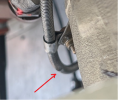
Also, what's going on here?

1749749142563.png

It looks like the cable housing has been chafing on something. That housing is just one wire wrapped into a tight coil, and if it chafes one little section enough, that wire can break. The aft section then can move back and pull the mixture lean, and there's nothing you can do about it. Running old cables to failure is false economy.

McFarlane's cable: https://www.mcfarlaneaviation.com/products/MC600-72/?q=mixture control&search_type=product&index=3&page=1

On that same page are "Related" items such as cable clamps. Judging by the washer stackup on your clamp bolt, the wrong clamp might be installed.

The installation instructions (under "Documents") suggest matching the old cable against the new and cutting the new one to the same length. Don't do that. Your old one might have already been shortened because of a failing wire end, and now it is too short to curve around properly to get a straight shot at the mixture lever. The housing clamp parts might also be in the wrong location to accommodate the shortened cable. Better to install it and then see where it needs to be cut.
 
That's even in AC43.13.

Not quite. AC43.13 says that fiber or nylon lock nuts should not be used where temperature exceeds 250 F. It says nothing about engine compartments.

In this case, the control wire swivel clamp specified by the TC holder does not have a drilled shank to accept a cotter pin. The part is stainless, so using an all metal lock nut might gall the threads on the stud. The nut is not a standard AN365 lock nut rated to 250 F; it is a stainless polymer lock nut rated to a higher temperature. For those reasons the aircraft manufacturer and TC holder specifies that hardware, including the lock nut, in the drawings which are part of the aircraft type certificate. So the inspector would be wrong to reject it.
 
No rod-style available, and also totally unnecessary. The load is tiny. If it's replaced and installed and inspected as it should be, failure is extremely unlikely.

McFarlane sells a beefy vernier-style control PMA'd for Cessnas. Its wire is larger so you have to very carefully drill the clamp bolt hole to just big enough for the wire, and watch that you don't overtighten the nut.

That cable housing clamp should also be replaced they can let the housing slip and you lose control of the mixture. I also ran lockwire around the housing at both sides of the clamp to prevent slipping.
Thanks Dan. But it happened, so I'm trying to understand why. My guess is a poor installation of the replacement cable or it was just old?
 
Thanks Dan. But it happened, so I'm trying to understand why. My guess is a poor installation of the replacement cable or it was just old?
Both old and improper installation. I think it should be routed above the fuel inlet. It depends on the lever configuration. Some are straight, some offset upward to clear that fitting. I think your cable is probably short and they bent stuff around to make it fit.
 
Last edited:
Not quite. AC43.13 says that fiber or nylon lock nuts should not be used where temperature exceeds 250 F. It says nothing about engine compartments.

In this case, the control wire swivel clamp specified by the TC holder does not have a drilled shank to accept a cotter pin. The part is stainless, so using an all metal lock nut might gall the threads on the stud. The nut is not a standard AN365 lock nut rated to 250 F; it is a stainless polymer lock nut rated to a higher temperature. For those reasons the aircraft manufacturer and TC holder specifies that hardware, including the lock nut, in the drawings which are part of the aircraft type certificate. So the inspector would be wrong to reject it.
Got that. Thanks.
 
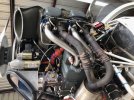
Not a carburetor-equipped engine, but mine (on an IO360-M1A) does have a spring to pull the mixture lever to full rich if the cable breaks. Not really well engineered, though, because if the locking nut backs all the way off and the cable eye slips off, nothing is holding the spring on the lever other than friction. The throttle lever (on the left in the first photo) has a similar arrangement:


IMG_4838.jpegIMG_4837.jpeg
 
Last edited:
A broken mixture cable would not usually be an emergency. In most phases of flight it would be an annoyance, but you should be able to safely descend and land once you figured it out. Might be a bad day if it broke after leaning for ground ops and before taking off, but otherwise mostly a non-event.
In an injected airplane, a broken mixture cable could lead to a condition in flight or on approach where the mixture was too lean or too rich, causing loss of power. So could absolutely be an emergency. Plus there's an assumption that the mixture will stay where it was when broken, which may be generally true, but not absolutely.

All this speaks to using the right hardware, and replacing it more often than when it breaks. I'll see an airplane with what appears to be a decades old cable and there's still resistance to replacing it even when it has kinks, looks and feels tired, or more importantly has been buggered up at the attachment end. All of that applies to the rod ends on airplanes that use them - they get tired too and should have a big back up washer in case the moving bit decides to leave the rod end.

The drilled bolt with the hole below the head rather than at the end of the shank is in fact a "clamp" and must be somewhat special since it costs about $20 for the bolt. Doubt it's ok to enlarge that hole for a large diameter wire, but who knows.

Was not aware that stainless polymer lock nuts have a higher temp rating than cadmium coating steel ones. Thought it was the nylon that limited the temp limit. That said, there are nylocs used in places like the one shown that are on the TC even though adjacent to a hot engine, albeit in a pretty cool part of the cowl enclosure.
 
In an injected airplane, a broken mixture cable could lead to a condition in flight or on approach where the mixture was too lean or too rich, causing loss of power. So could absolutely be an emergency. Plus there's an assumption that the mixture will stay where it was when broken, which may be generally true, but not absolutely.
That mixture control level moves easily and could vibrate to whatever position it feels like taking. A broken cable is a Very Bad Thing.
All this speaks to using the right hardware, and replacing it more often than when it breaks. I'll see an airplane with what appears to be a decades old cable and there's still resistance to replacing it even when it has kinks, looks and feels tired, or more importantly has been buggered up at the attachment end. All of that applies to the rod ends on airplanes that use them - they get tired too and should have a big back up washer in case the moving bit decides to leave the rod end.
There was a Cessna SB on that large washer requirement, and it turned into an AD. I can't find either of them at the moment, being retired and not having corporate access to the Cessna SB stuff anymore, but AD 86-24-07 demands that the throttle hardware be replaced with a drilled bolt, castellated nut and cotter pin. No nylocks or even all-metal locknuts.
The drilled bolt with the hole below the head rather than at the end of the shank is in fact a "clamp" and must be somewhat special since it costs about $20 for the bolt. Doubt it's ok to enlarge that hole for a large diameter wire, but who knows.
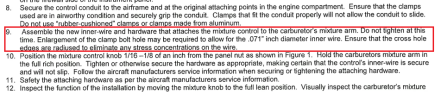
McFarlane's PMA's vernier mixture control has a large wire, .071" as opposed to the OEM .063", and they talk about enlarging that clamp bolt hole in their instructions:

1750093854310.png

From https://media.mcfarlaneaviation.com/documents/doc-1390_RUUgwih.pdf
 
I don't know the answer but, having spent 20 years in Colorado where "mixture full rich" is generally a bad thing, I'm not sure I'd want it to automatically go there if the cable broke.
Fair. I would say in my neck of the woods, full rich would be fine.
 
Back
Top