
rotormatic1
Pre-takeoff checklist
- Joined
- Jul 26, 2020
- Messages
- 161
- Display Name
- Rotormatic1



Usual low estimate on money required.
Their estimate doesn’t include the extra work that usually is needed especially the well since we are in here.What do you propose they should use?
They can't as the cost estimates are part of the required NPRM process. However, keep in mind those costs only apply to the labor and part cost specific to the AD. There are a number of guidance docs that explain how they calculate those costs. Regardless, you also have the ability to make comments on those costs during the AD NPRM process but prior to it reaches the final rule like this one.Maybe just leave the cost estimates out of report.
What Lycoming engine do you have with numerous cams?Their estimate doesn’t include the extra work that usually is needed especially the well since we are in here.
pulling cylinders will find numerous pitted cams I bet.
Maybe just leave the cost estimates out of report.
I said I bet. Don’t you hear pre buy guys say they want a cylinder pulled to inspect cams for corrosion?What Lycoming engine do you have with numerous cams?
I understand but how many jobs come in at or under AD estimated costs?They can't as the cost estimates are part of the required NPRM process. However, keep in mind those costs only apply to the labor and part cost specific to the AD. There are a number of guidance docs that explain how they calculate those costs. Regardless, you also have the ability to make comments on those costs during the AD NPRM process but prior to it reaches the final rule like this one.

So you would rather not know that your camshaft is pitted?pulling cylinders will find numerous pitted cams I bet.
So you would rather not know that your camshaft is pitted?
The Lycoming engine has one camshaft (cam) and pulling one cylinder will not allow for a complete inspection of the camshaft because the engine crankcase features internal structural bearing saddles and webs that separate the case into distinct compartments,I said I bet. Don’t you hear pre buy guys say they want a cylinder pulled to inspect cams for corrosion?
Cams don’t go bad from corrosion in Lycoming engines?
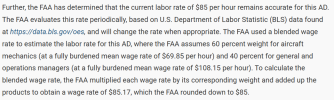
None. But if you understand the process you’ll know it’s only an administrative cost calculation per the requirements of the APA Act. Its not a job quote or estimate that also includes shop overhead, profit, etc. and is unique to each shop or service provider. So no comparison. Below is one explanation of how the AD labor rate is calculated from a Boeing 787 AD NPRM as someone had questioned the rate during the comment phase of the NPRM.I understand but how many jobs come in at or under AD estimated costs? What shop rate they using?

 username checks. Point being, it's not exactly zero either.
If one end of that camshaft is corroded, the other will be, too. One can check for internal corrosion just by taking off a mag and looking at its drive coupling or gear, and the gears visible in the accessory case. They're all steel and they all corrode if moisture is present in that engine.The Lycoming engine has one camshaft (cam) and pulling one cylinder will not allow for a complete inspection of the camshaft because the engine crankcase features internal structural bearing saddles and webs that separate the case into distinct compartments,
What does finding unrelated issues have to do with the piston pin? It’s impossible to estimate what else will be found.Their estimate doesn’t include the extra work that usually is needed especially the well since we are in here.
pulling cylinders will find numerous pitted cams I bet.
Maybe just leave the cost estimates out of report.

Has anyone here seen an hourly shop rate of $85 in the last 5 years?Usual low estimate on money required.

Probably...based on the date you mention and no subsequent engine work. But if your engine is listed in AD applicability statement or Table 2 or 3 for the stated MSB, you'll still need an N/A sign off for the AD in the book.So if my engine was rebuilt with non Lycoming cylinder kits, I exempt from this, or in another case, rebuilt 12 yeas ago?
what Does that have to do with the AD? The AD didn’t pit the cam. Not having the AD doesn’t make the cam not pitted. The mechanic could have a heart attack when pulling the cylinder, do they need to add his healthcare to the estimate?Their estimate doesn’t include the extra work that usually is needed especially the well since we are in here.
pulling cylinders will find numerous pitted cams I bet.
Maybe just leave the cost estimates out of report.
Collateral damage I think is what is being referenced. For example, know of a small Lyc that stuck a valve. Cylinder needed to come off. Cam shot, overhaul time. It happens.what Does that have to do with the AD? The AD didn’t pit the cam. Not having the AD doesn’t make the cam not pitted. The mechanic could have a heart attack when pulling the cylinder, do they need to add his healthcare to the estimate?
You can put the cylinder back on and be right back where you were.Collateral damage I think is what is being referenced. For example, know of a small Lyc that stuck a valve. Cylinder needed to come off. Cam shot, overhaul time. It happens.
Will the A&P sign off the repair? What has been seen can not be unseen.You can put the cylinder back on and be right back where you were.
I acknowledge that logic is hard for some.Will the A&P sign off the repair? What has been seen can not be unseen.
Depends. Changing a piston pin hardly requires looking deep inside the engine especially if the owner only wants the AD complied with. Second, when you sign off the AD under Part 43.9 you're only taking responsibility for the work performed and not what you saw. Regardless, it still falls to the owner what is accomplished and what is not. But for context, if I noted a flight safety issue in the middle of a mx task that would be covered up once completed, which the owner chose not to address, I would politely stop work, sign off what I had performed, and walk away.Will the A&P sign off the repair? What has been seen can not be unseen.

correct. Most folks are not affected this time.If I'm understanding the proposed AD correctly...
This only hits engines if a piston pin P/N LW-13445 manufactured between January 7, 2021 to December 15, 2025? So if an engine's last overhaul was prior to that 2021 manufacture date and the piston pins haven't been touched since this would not apply, correct?
Technically, its applicable to the engine models listed on the AD with serial numbers listed in the MSB and any installed piston pin LW13445 with the stated dates. So if your engine is outside those two defining requirements its not applicable. And to add, this not a proposed AD but a final rule and goes into effect on Sept 14, 2026.If I'm understanding the proposed AD correctly... This only hits engines if a piston pin P/N LW-13445 manufactured between January 7, 2021 to December 15, 2025? So if an engine's last overhaul was prior to that 2021 manufacture date and the piston pins haven't been touched since this would not apply, correct?
Not if I’m signing it.You can put the cylinder back on and be right back where you were.
Then it needed to be dealt with before the ADNot if I’m signing it.
Wasn't known until the AD forced the cylinder pull. One of those weird things - if it's there but you haven't seen metal in the oil, you don't know. Once you see it, you can't unsee it. And since this is Lycoming, I don't think there is guidance for how much pitting or spalling is too much - Continental does have information as to such in the M0 manual.Then it needed to be dealt with before the AD
