Light jets

Unless I'm not thinking correctly, the practical problem here is how to progress to PIC of a jet in this scenario. You can fly with the pro, but he will be PIC and you guys can't log anything in a single pilot jet. I suppose you could go with a 500 or 550 citation that's not an ISP which would require two pilots as long as your pro doesn't have a SPW, but there are ways to get by that. Then you two would have to go to FlightSafety or equivalent to get a type rating with and SIC limitation, but you're going to have to fly the sim to ATP standards and be instrument proficient. Then if you keep that plane you're going to have to accumulate a minimum of 500 hours of turbine time to qualify for the SPW or switch airframes. All of that is going to get very convoluted insurance is going to be interesting.

I agree with the posts above that buy an SR22 and fly the hell out of it until you get your instrument rating and a few hundred hours. Then you could probably reasonably step up to a VisionJet, but I'd still have a mentor along for a good chunk of time, and you will still need that type rating and the flying ability that requires. Then after 500 hours of turbine time you can move into something with longer legs and more speed.

Somebody please correct me if I messed any of that up.
Cirrus has set up with insurance companies a route, with an experienced pilot in the right seat for "supervised operational experience", if I recall the term correctly. Basically, you have a professional co-pilot for the first xx hours until you have enough turbine time.

I spoke with the Cirrus guys at Airventure, and they have a plan for almost anyone who can stroke a check for the plane.
 
As an owner of both a 300 and a 400 series airplane, I am well aware of the parts support unfortunately.

Another huge problem of the 400 series Cessnas is maintenance. Many were maintained by shops not particularly equipped or trained on these airplanes and under an annual/100 hour program rather than a factory progressive inspection program. Thus lots of items have been ignored over the life of the airframe now making them extremely expensive to bring into compliance.
You asked what "larger aircraft" and I provided examples. Pick an 8 place airplane and for the most part you are limited to a 35-40+ year old aircraft. The C560 I fly sometimes is 36 years old for that matter.

I dunno. There is lots of EMB Phenom 100 and 300’s , Hondajet, latest generation of Citations, Pilatus and a few others.

The people that are “limited” choose to be.
 
10K to FL350 are some of the worse areas to be in during convective weather. Older turboprops like C90's and Cheyenne's place you right in the lower side from 10 to 20.
There are plenty of storms we were able to top at 310... And while there were obviously some that we couldn't as well, they're pretty easy to go around at that altitude. IME it's relatively rare for a storm to be both solid and too large to practically go around at that speed and altitude. IOW, I didn't find it particularly limiting. :dunno: Down in the mid to low 20s, though, would have been significantly more difficult.

A jet with the performance to get to FL400 will keep you above most weather. None of the turboprops will get you there.
Not true. Piaggio Avanti goes to FL410, and that's just the first one I thought of. Cheyenne IV/400/400LS will do it too.

You asked what "larger aircraft" and I provided examples. Pick an 8 place airplane and for the most part you are limited to a 35-40+ year old aircraft. The C560 I fly sometimes is 36 years old for that matter.
I very much disagree with the "for the most part". While the piston market pretty much closed up shop in 1985, everyone was still building turboprops and jets throughout the hole in piston production, right up until today. There are tons and tons of turbine 8+ seaters that are much younger.

I haven't seen the Epic mentioned here yet. Why not?
"No turboprops." Sure is a nice plane tho.
 
Several lifetimes ago, in the age of hunger and scarcity, I occasionally got called to fly with certain “HNWI” types in their turboprops and jets. It was not pleasant duty and I came to detest those jobs, but they gave me a great deal of insight (and a few stories). And I got paid. But I came to understand my place: my role was not to act as a pro pilot, copilot, or mentor—I was nothing more than a Professional Enabler. One day I crawled out of a Learjet thankful to have escaped with my ticket intact, only to overhear the HNWI owner-operator (whom I had just saved from committing a pilot deviation) laughingly tell a passenger “I never met a copilot worth 200 lbs of gas.” Apparently he picked that one up from a Navy fighter jock and found it hilarious. Under the circumstances, I failed to see the humor. Needless to say, that flight was my last gig as a Professional Enabler. Those experiences, along with numerous accident reports, have left me with a rather negative impression of HNWI owner-operators.
The naysayers of zero to turbine forget we’ve been doing this in .mil for most of the time airplanes have existed on the earth and most other nations take zero time people and put them in an airliner in 250 hours of instruction.
I propose that military training is superior to most, if not all, GA training programs. What’s more, those who lack aptitude, or who display a bad attitude or predilection toward recklessness, usually wash-out. But no one washes-out in GA unless they run out of money. Just wave some cash around and there is always another Enabler ready to take it. And eventually, a certificate will be issued.
I spoke with the Cirrus guys at Airventure, and they have a plan for almost anyone who can stroke a check for the plane.
Exactly. Stroke a check, fly a jet. I have often wondered why so many Cirrus planes crash. Now I understand.

About a decade ago I met a HNWI pilot at a GA event. He had a light twin that he flew with a CFI (local hotshot, I was told) in the right seat. Though I had never flown with him and knew nothing about the guy, I realized that I was talking to a dead man. Sure enough, five years later he made the news, crashing his single-pilot jet shortly after takeoff, taking several people with him. The accident report could be summarized in one word: ineptitude. It seems that the best Enablers that his money could buy couldn’t save him from himself.

As for the subject of the OP, his Enablers are already at work, and all this talk about which three-million-dollar single-pilot jet he should buy begs the question: should he even be a pilot at all?
 
Last edited:
A vast majority of all larger aircraft are 40+ year old airframes.
Pick an 8 place airplane and for the most part you are limited to a 35-40+ year old aircraft. The C560 I fly sometimes is 36 years old for that matter.
I very much disagree with the "for the most part". While the piston market pretty much closed up shop in 1985, everyone was still building turboprops and jets throughout the hole in piston production, right up until today. There are tons and tons of turbine 8+ seaters that are much younger.
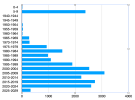
Nerd alert: I can't resist analyzing data.

I downloaded the registry and filtered it down to airplanes with turbine engines that have valid registrations. That left me with 60,896 aircraft of 6,295 separate types.

Next, I filtered out anything where there's only a single example of the type since those are mostly experimental, anything by the "big airplane" manufacturers (Airbus, Boeing, McD-D), and anything with less than 8 (as specified by @k9medic) or more than 24 seats - There's a shocking dividing line right there, I didn't see any business aircraft above 24 seats nor any airliners below 24.

Anyway, that left me with 22,968 aircraft of 389 different types. So, I went back and filtered the list down to those types and grouped them by year and in 5-year groups. About 10% of the records had no manufactured year or just "0", because all data is dirty but the FAA's data is way dirtier, so I left the 0s in place and put "5" in for the blanks.

Next, I added columns by 5-year groupings and decades... And here is the result:

Screenshot 2025-10-31 at 1.44.35 AM.png

The median manufactured year (where it's present) is 2006, so half the "large" turbine airplanes on the registry are 19 years old or younger. Sorry @k9medic, the facts don't agree with ya!

BTW, here's the top 10 aircraft types in the data above:

1. Bombardier BD-100-1A10 (Challenger 300 series) (826)
2. Pilatus PC-12/47E (820)
3. Cessna 208B Caravan (645)
4. Cessna 560XL Citation Excel/XLS (601)
5. Cessna 560 Citation V/Ultra/Encore (596)
6. Cessna 550 Citation II/S/II/Bravo (497)
7. Embraer EMB-505 Phenom 300 (469)
8. Lear 45 (451)
9. Cessna 525 Citation CJ1/M2 (444)
10. Bombardier CL-600-2B16 Challenger 601/604/605 (383)
 
Nerd alert: I can't resist analyzing data.

I downloaded the registry and filtered it down to airplanes with turbine engines that have valid registrations. That left me with 60,896 aircraft of 6,295 separate types.

Next, I filtered out anything where there's only a single example of the type since those are mostly experimental, anything by the "big airplane" manufacturers (Airbus, Boeing, McD-D), and anything with less than 8 (as specified by @k9medic) or more than 24 seats - There's a shocking dividing line right there, I didn't see any business aircraft above 24 seats nor any airliners below 24.

Anyway, that left me with 22,968 aircraft of 389 different types. So, I went back and filtered the list down to those types and grouped them by year and in 5-year groups. About 10% of the records had no manufactured year or just "0", because all data is dirty but the FAA's data is way dirtier, so I left the 0s in place and put "5" in for the blanks.

Next, I added columns by 5-year groupings and decades... And here is the result:

View attachment 146695

The median manufactured year (where it's present) is 2006, so half the "large" turbine airplanes on the registry are 19 years old or younger. Sorry @k9medic, the facts don't agree with ya!

BTW, here's the top 10 aircraft types in the data above:

1. Bombardier BD-100-1A10 (Challenger 300 series) (826)
2. Pilatus PC-12/47E (820)
3. Cessna 208B Caravan (645)
4. Cessna 560XL Citation Excel/XLS (601)
5. Cessna 560 Citation V/Ultra/Encore (596)
6. Cessna 550 Citation II/S/II/Bravo (497)
7. Embraer EMB-505 Phenom 300 (469)
8. Lear 45 (451)
9. Cessna 525 Citation CJ1/M2 (444)
10. Bombardier CL-600-2B16 Challenger 601/604/605 (383)

Thanks Ron! :)
 
As for the subject of the OP, his Enablers are already at work, and all this talk about which three-million-dollar single-pilot jet he should buy begs the question: should he even be a pilot at all?
I'm square in the middle on this one. I do believe there are people with the right temperament and skillset to pull this off to great success. I believe I could successfully pull this off, if I'd made an order of magnitude more during my career. I'm basically looking to retire so I can fly more, and I already fly a lot more than the average non-professional pilot. I stretch my skills and take instruction regularly. With more money I could see myself someday achieving this goal.

However, most are not as obsessed as I am. Medical issues can be a blocker. Skill issues can be a blocker. Family obligations can be a blocker. It's common to lose interest in a hobby. It's a lot of work. Probably far more work than someone with zero experience realizes. You don't know what you don't know. For all these reasons, it's far more likely the goal will change here before it is achieved.

I think the adage "Buy your last plane first" is completely wrong in every scenario. To be successful at this you need a wide range of experience. You get that best and fastest by doing many different types of flying. The candidate likely to be successful at this, is going to be a plane nut. Someone that wants to fly different kinds of planes. Someone that will learn from each plane in a progression safely and more quickly than jumping right into a jet. Someone that has flown a turboprop and a jet before deciding that "it's got to be a jet". Ok, time to stop, starting to get salty.
 
I propose that military training is superior to most, if not all, GA training programs. What’s more, those who lack aptitude, or who display a bad attitude or predilection toward recklessness, usually wash-out.

And I spent a career in 121 flying with many of these guys (ex-military type). Like you say about those who "usually wash out", well I have some news, the weak and inept do make it through military training. I've shared the cockpit and sim sessions with them.
 
…well I have some news, the weak and inept do make it through military training. I've shared the cockpit and sim sessions with them.
That’s not news to me, Doc. My experience is similar, which is why I chose the word usually.
 
I'm square in the middle on this one. I do believe there are people with the right temperament and skillset to pull this off to great success. I believe I could successfully pull this off, if I'd made an order of magnitude more during my career.
IMO, the problem is that many (not all) of the people who earn enough to jump straight in with a kerosene-burner aren't going to put enough focus on the training side prior to purchase.

Those of us with more modest means are likely to spend more time and effort climbing the aviation ladder before we can afford and/or justify a faster plane.

All that being said, the part of the OP that sticks out to me is the single-minded focus on "jets". If his/her decision-making isn't based on the mission profile when buying, why would we expect it to be any better when flying?

I read his “mission profile” was to fly between homes in CT and FL, along with hunting trips.

Further along I read a jet was desired to top out weather.

I also read they have a mentor pilot arranged who is highly experienced.

Again, all I’m seeing is a lot of envy towards a guy that has the means to get what he wants including disparaging remarks about what kind of pilot he will eventually be.
That's fair, but honestly if the Vision Jet is on the list, why wouldn't you also look at Epic, PC-12, TBM, etc.? The Epic is faster, has higher service ceiling, and lower operating costs - and doesn't require a type rating.

From my perspective as I daydream about future upgrades, the only reasons to go Cirrus over Epic are because the initial purchase price is cheaper or you would want to brag about flying a jet....and the price reasoning doesn't match the profile in the OP.
 
Sounds like a sailboat owner I met in the lower Florida Keys. I almost said "sailor" but realized that would be a lie.

We invited him to join us on our regular lawn chairs for a beer, he invited us to his trimaran, with padded bar stools, bolted to the deck.

We joined him, he served us our choices, and had an 'on the rocks of his choice.

I asked how much sailing of the voyage down from NYC he had done, the answer was "none, its is all in canals, you cannot sail. We motored all the way".

Then, "I plan to learn to sail down here, it is a better place to learn, open water and sheltered water everywhere".

The million dollar trimaran is stable, roomy, multi engine, large generator for primitive anchorages so it always has heat or air-conditioning. He had a great selection of fishing gear, all new.

The guest rooms are in the outer hulls, so all three bedrooms have privacy at night.

Regular stops in urban areas and yacht clubs allow bringing a whole taxi full of groceries aboard at one time to stock the freezer and refrigerator.

His sailing friends that he expected to flock down and cruise with him realize that he is a man in charge type, and going out with him will have the possibility of ignored weather knowledge, and danger regardless of the size of his yacht.

He had a power boat employee with him to assist in negotiating locks and bridges, who is also a non sailor.

He had a couple of sailing books on board, but they were more about cruising, not the fundamentals of making a boat go with power from the wind, or reading the sky and clouds for what is next to happen to you.

I did not offer to go out with him, even though I had sailed the ICW hundreds of miles, both on bays and canal portions. I have sailed sailing surfboards, and up to a 38 foot schooner, thousands of hours. Sailing with him was a risk that I was not willing to take.

If he had joined us for a beer sitting on a common lawn chair, my decision might have been different, but he was not that kind of guy.
 
That's fair, but honestly if the Vision Jet is on the list, why wouldn't you also look at Epic, PC-12, TBM, etc.? The Epic is faster, has higher service ceiling, and lower operating costs - and doesn't require a type rating.

From my perspective as I daydream about future upgrades, the only reasons to go Cirrus over Epic are because the initial purchase price is cheaper or you would want to brag about flying a jet....and the price reasoning doesn't match the profile in the OP.

I believe the Vision Jet was looked at by the OP with the desire of the chute for safety. But the reality is the Vision Jet is in the turbo prop class due to speed and altitude.

Jets have the capability to top the weather out whereas turbo props will put you in the worse of it.

I don’t think this thread is about someone wanting bragging rights.
 
I can offer up a title for the episode: "Last plane first" And the opening bit "The aircraft he purchased was intended to be his last, but similar to the wish from a genie, it didn't work out to be a favorable situation".

But... While I have met a couple of people who fall into the category of being able to write a check and buy a jet, they are not all in the category of know it all people who are dismissive of those around them. Some are humble, down to earth, and listen. They'd be the guy that wouldn't describe the pilot beside them as a useless bit of weight, but instead as the pilot, who actually knew what was going on. And I don't know, maybe those folks are the ones that are content just sitting in the back, and we don't hear about them at all.

No idea where the op's pilot fits in that range, but I do know that stereotypes are never 100%, maybe closer to 50% on average.
 
This is the way. Cirrus has been selling SR-22s to non-pilots since day 1 and they are far better at getting people from zero to hero than anyone else. I would even suggest a conversation with them about starting this guy in the jet right away, they might even have that figured out. If not, they've done enough to get commonality between the SR22 and the Vision Jet that it's a logical step up, and they're selling these things to lower-time owner pilots and they haven't been sued into oblivion yet, which shows that they're generally doing the right stuff!
Hangar neighbor has a SF-50. Previous ride was a DA-62. Couple thousand hours. Started in a 172, about a thousand in a 182 before he got the Diamond. He bought the jet, and Cirrus prescribed something like 50 hours in an SR-22T with a CSIP to learn the "Cirrus Way". So I think "zero time, learn in the jet" aint happening, although from what I've seen of it, it's easy enough to operate and slow enough that you probably could.

I'm sorry I had skipped out on this thread; it's been entertaining. I'd advise this guy to buy an SR-22 and get his private & instrument. See if he even likes flying. If so, the Vision Jet is a reasonable next step. When he wants to go faster, he has some turbine time.
 
Jets have the capability to top the weather out whereas turbo props will put you in the worse of it.
The Epic turboprop has a service ceiling of 34,000, while the Vision Jet has a service ceiling of 31,000 (as does the TBM). I'm not seeing how the Vision Jet has any advantage over the SETPs in this area of performance.
 
The Epic turboprop has a service ceiling of 34,000, while the Vision Jet has a service ceiling of 31,000 (as does the TBM). I'm not seeing how the Vision Jet has any advantage over the SETPs in this area of performance.

I didn't say it did, I said the Vision Jet is in the same category as turbo props due to it's service ceiling.
 
What? There's about three single-engine turboprops (M series, TBM, PC12) and a gazillion twin turboprops.

You left out the Epic. It's less expensive than the TBM or PC-12, and seems like a really good deal among the competition.

I'm not sure the TBM really would be attractive to this buyer anyway, though. While it's cheaper to operate than the Vision jet, and has similar (and slightly better) performance, it also costs more to purchase. I think staying in the Cirrus ecosystem and going SR22-Vision Jet just makes way more sense than any other solution if we're talking about a zero-to-hero owner pilot.

The ~$3.5M price tag on the Vision makes it by far the lowest capital cost option for someone entering this segment. Yes, it has higher operating costs than the SETPs, but it takes quite a few years to recoup the entry cost differential.

To play devil's advocate:

How much time and money does it take to progress through PPL, Instrument, complex, high performance, etc. when you're doing it by buying and selling a plane at every level? By the time to you go through the purchase process, get through the first annual, fix what needs to be fixed, deal with hangar space, finding an A&P that is qualified and available for the make.....etc...... It burns a LOT of time. money and energy.

Think about the people who have the free assets to spend on this sort of thing. Their time is measured in dollars/minute. How much time can they afford to spend on starting with a SR20, Cherokee or C172, then getting a SR22T or Bonanza to fly for a couple of years, then buying a Twin Comanche or equivalent to fly for a couple of years....

Speaking for myself, I'm about 21 months in from "cold start" and have just over 140 hours of complex/retract time (270 total) and instrument rating. Commercial (and possibly AMEL) will be next, at which point I'll start looking for my upgrade plane. I'm guessing that's another year of calendar time, along with all of the costs associated with it. Total is close to three years, and then I'd have to go through the transition/type training and whatever insurance requires before the plane is actually useful for the intended purpose. Every year is one year closer to the insurance company "age-out" notice - or the dreaded AME visit that doesn't end with a new Class 2 or 3 cert.

Looking backwards, the Cirrus program of training in their SR2x and going "direct" to the SF50 looks fast and inexpensive in comparison.
 
Last edited:
You left out the Epic. It's less expensive than the TBM or PC-12, and seems like a really good deal among the competition.


The ~$3.5M price tag on the Vision makes it by far the lowest capital cost option for someone entering this segment. Yes, it has higher operating costs than the SETPs, but it takes quite a few years to recoup the entry cost differential.

To play devil's advocate:

How much time and money does it take to progress through PPL, Instrument, complex, high performance, etc. when you're doing it by buying and selling a plane at every level? By the time to you go through the purchase process, get through the first annual, fix what needs to be fixed, deal with hangar space, finding an A&P that is qualified and available for the make.....etc...... It burns a LOT of time. money and energy.

Think about the people who have the free assets to spend on this sort of thing. Their time is measured in dollars/minute. How much time can they afford to spend on starting with a SR20, Cherokee or C172, then getting a SR22T or Bonanza to fly for a couple of years, then buying a Twin Comanche or equivalent to fly for a couple of years....

Speaking for myself, I'm about 21 months in from "cold start" and have just over 140 hours of complex/retract time (270 total) and instrument rating. Commercial (and possibly AMEL) will be next, at which point I'll start looking for my upgrade plane. I'm guessing that's another year of calendar time, along with all of the costs associated with it. Total is close to three years, and then I'd have to go through the transition/type training and whatever insurance requires before the plane is actually useful for the intended purpose. Every year is one year closer to the insurance company "age-out" notice - or the dreaded AME visit that doesn't end with a new Class 2 or 3 cert.

Looking backwards, the Cirrus program of training in their SR2x and going "direct" to the SF50 looks fast and inexpensive in comparison.
Keep in mind that a jet is neither high performance nor complex. :D
 
You left out the Epic. It's less expensive than the TBM or PC-12, and seems like a really good deal among the competition.
I do keep leaving it out, mainly because they haven't sold a ton of them yet and so they tend to not enter these conversations as much as the TBM, PC-12, and M class SETPs.

It is a really nice plane, though, especially the latest ones. I do find it odd that they're still using the G1000 when most everyone else has switched to the G3000, but at least Garmin has apparently added the autoland and autothrottle to the G1000.

The performance, though, is unbelievable. I just wish they had a pilot door!

I’m still trying to get my head around anyone looking at the Vision and thinking “Jet”.
Well, I don't see any props, and it's not a glider...
 
Why does the Vision Jet have so much higher operating costs than the TBM or M600, when acquisition costs are the same?

Sure, there is increased fuel burn, but I think most of it is “jet stream” costs? Are those mainly going into Cirrus’s pocket, or is the SF50 actually more expensive to run (aside from fuel)?
 
Why does the Vision Jet have so much higher operating costs than the TBM or M600, when acquisition costs are the same?
Longer TBO, and MUCH higher fuel burn - like 60% more (75-80 gph vs 45-50 gph). The acquisition costs aren't really comparable, though.

Vision $3.5M
TBM $5.75M
Epic $4.7M
 
Longer TBO, and MUCH higher fuel burn - like 60% more (75-80 gph vs 45-50 gph). The acquisition costs aren't really comparable, though.
Well, if you believe Google AI, the FJ33-5A in the Vision jet costs $800K to overhaul and has a TBO of 4,000 hours, so $200 per hour on the engine; while the TBM's PT6E-66XT costs $605,000 to overhaul and has a TBO of 5,000 hours, so $121/hr or a $79/hr savings on engine reserve.

Another 30 gph of fuel is going to cost somewhere between $120-$240/hr most of the time, so now we're at $200-$320/hr more for the Vision than the TBM just on those two items.

But...

Vision $3.5M
TBM $5.75M
Epic $4.7M
Dang, they're getting expensive. $2.25 million / $260/hr = 8,653 flight hours for the TBM acquisition cost to break even vs. the Vision. Wow.
 
Well, if you believe Google AI, the FJ33-5A in the Vision jet costs $800K to overhaul and has a TBO of 4,000 hours, so $200 per hour on the engine; while the TBM's PT6E-66XT costs $605,000 to overhaul and has a TBO of 5,000 hours, so $121/hr or a $79/hr savings on engine reserve.

Another 30 gph of fuel is going to cost somewhere between $120-$240/hr most of the time, so now we're at $200-$320/hr more for the Vision than the TBM just on those two items.

But...


Dang, they're getting expensive. $2.25 million / $260/hr = 8,653 flight hours for the TBM acquisition cost to break even vs. the Vision. Wow.

Don’t forget the prop overhaul on the TBM. Also you need to add in hot sections.
 
At those prices, I’m kind of amazed TBM can sell many vs the Epic. I suspect once the Epic becomes more common, proves itself and adds a G3000, TBM will have to sharpen their pencil.
 
At those prices, I’m kind of amazed TBM can sell many vs the Epic. I suspect once the Epic becomes more common, proves itself and adds a G3000, TBM will have to sharpen their pencil.
Agreed. Maybe a pilot door for the Epic too - That is a very nice thing to have on planes of this size, as the cabins are too short to maneuver around on foot and squeezing between the seats to get into the cockpit isn't fun. Daher discovered that people don't like that when they made the pilot door an option and nearly everyone took it - It's a standard feature now and has been for over a decade.

But yeah, based on what I can find about the Epic at this point it seems like except the door and G3000, it's hard to justify going with the TBM even at the same price, much less for an extra million.
 
Back
Top