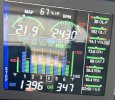
Leaning AT peak ... not ROP or LOP

I ran my angled 360 that way for decades. Doesn't matter to longevity, it still failed due to fasterner fatigue cracking, failure of the studs in my case. I ran my 320 before that full flogged, with documented history of cam spalling btw. I lived.

BL, peak EGT is fine. ROP is fine too (100ishROP is highest CHT for the power, which is to say peak EGT is actually less strain on the cylinder components). My point is that said preference has zero longevity enhancing features than running any other mixture, save LOP at power settings so high you actually do settle on CHTs in the high 400s and start running temperature weakened metallurgy.

Now, those who have an entire cult following based on overemphasizing the degree to which some red knob selection is the leading cause of death and divorce in this life, will tell you it matters. That's the avionics peddling brigrade, engine monitor zealots. I'm not swayed by their appeal in NA applications, nor by their poor-shaming smears for eschewing the engine monitor choice. The rent-seeking of organized religion has been known for millenia so I'm not saying anything new.

To summarize, lack of engine use, environmental corrosion as a consequence of the former, and high cyclic fatigue incidence [in the case of the angled Lycos, less of an incidence for your parallel lyco], is ime what ends up costing the farm on these overpriced anachronistic engines. Your new found mixture preference is fine, I've used it too. It's just a non sequitur if the motivation is fears of having to face another overpriced overhaul expense. You'll have one if you don't fly enough to justify that engines expense before calendar TBO (most recreational owners fall in that category)... but it won't be because of red knob preferences of little import.
 
Just went up and did some testing on my way to pick up a case of oil. Ran it 65% peak and 65% ROP. Speed difference was 7 mph. I forgot to record fuel flow but I think it was about 2 gph difference. I'm going to do a table later this week for 65 peak, 65 ROP, and 75 ROP.
 
Serious question - why is Mike Busch so romanticized? Is his opinion more credible than the other thousands of well seasoned IA’s?
I met him back in the days he was hawking Flightmaster or whatever that PDA thing was.
 
I am not meaning to be an *hole here. But, why . . . exactly . . . is it surprising that an engineer from the manufacturer knows more than SGOTI? And why is that "news"?

Didn't you read? The engineer from the manufacturer believes in old wives' tales. As opposed to the retired software developer and self taught mechanic, who has it all figured out, apparently.
 
Didn't you read? The engineer from the manufacturer believes in old wives' tales. As opposed to the retired software developer and self taught mechanic, who has it all figured out, apparently.
I think so,

"Lately I've been putting more attention into following actual Lycoming guidance for the operation of my IO-360 . . ."

Which guidance was presumably written by a Lycoming engineer.

"instead of:

A. What my CFI taught me 30 years ago
B. What the SGOTI consensus says
C. What some YouTube guru says"


Okay, so given "B", my comment was not directed at you.

"Listening to the Lycoming presentation at Oshkosh reminded me that I have not tried their recommended Best Economy method of leaning to peak EGT. I always do 100 degree ROP so I don't get in the dreaded fin zone and melt my engine.

I thought I would have trouble with high CHT, but it worked great. Got up high at 9.5K, dialed in 65% power, and leaned it to peak EGT with no drop. I got it down to 7.2gph at one point. Hottest CHT stayed just below 400, right where Lycoming says to keep it for max longevity. Added nearly an hour to my endurance
."

Okay, what am I not understanding here? You followed the manufacturer's engineer's guidance and in return you got better economy without producing excess heat.
 
Last edited:
I'm kidding. Playing slightly dumber than I actually am. Was fantastic info and I appreciate the enlightenment
 
Didn't swift blame the valve recession on UND operating at pk?
 
Just went up and did some testing on my way to pick up a case of oil. Ran it 65% peak and 65% ROP. Speed difference was 7 mph. I forgot to record fuel flow but I think it was about 2 gph difference. I'm going to do a table later this week for 65 peak, 65 ROP, and 75 ROP.

What about your cylinder head temps at peak? Are you seeing any noticeable reduction compared with ROP ops?

I ran my original IO-360's (without GAMI's) at peak for years, but only above 7 - 8k altitudes to remain below the dreaded red zone. With stock Lycoming injectors they wouldn't run smooth anywhere LOP. Random owners do find some smoothness on the lean side of peak with stock injectors, but it's not common.

Grew sick of pulling off a couple inches of manifold pressure every minute of two when descending (probably another OWT) and slowing down early to keep from shock cooling higher cruise temperature cylinders. With the GAMI's I just run at full throttle from take off and climb (ROP), transition into cruising LOP, then descend down into the airport environment LOP (or a mile or so from the IAP on an approach).

Power is reduced in large increments (like flying a turbine), with no worries since the engine is already running cool before starting down then slowing down for landing. Love it.

Great article by Paul Ferraris
 

Attachments

Last edited:
Hey, @azure , where ya been? Haven’t seen you on the forum for a while.
Hey, @Half Fast ! I do drop by once in a while, but most of the time I've been on a different forum. I've also not been flying as much as I'd like - the wx in VT these days alternates between Florida-like and PNW-like. On the rare VFR day, I usually go hiking and plan to fly the next day if it's still VFR. It rarely is.
 
As some have already mentioned, LOP is fine to save fuel at the expense of going slower. My purpose of flying is not to save money on fuel, it's to get places. I'm running ROP for those extra 10 kts or so. I pull back until it stumbles, richen it until the EGT comes down to 1325 which will make the cylinder temp 380. If it gets higher, I richen a bit to bring it down; if it falls below 380, I lean it a bit to bring it up. Seems to work.

I do need an EIS. Played with a few at Oshkosh, will probably go with another third GI 275 for the EIS function.

(Skylane running a Continental 0 470 R).
 
What about your cylinder head temps at peak? Are you seeing any noticeable reduction compared with ROP ops?

I ran my original IO-360's (without GAMI's) at peak for years, but only above 7 - 8k altitudes to remain below the dreaded red zone. With stock Lycoming injectors they wouldn't run smooth anywhere LOP. Random owners do find some smoothness on the lean side of peak with stock injectors, but it's not common.

Grew sick of pulling off a couple inches of manifold pressure every minute of two when descending (probably another OWT) and slowing down early to keep from shock cooling higher cruise temperature cylinders. With the GAMI's I just run at full throttle from take off and climb (ROP), transition into cruising LOP, then descend down into the airport environment LOP (or a mile or so from the IAP on an approach).

Power is reduced in large increments (like flying a turbine), with no worries since the engine is already running cool before starting down then slowing down for landing. Love it.

Great article by Paul Ferraris
In my case, yes CHTs LOP are definitely lower - MUCH lower - than at peak. But they aren't concerningly high at peak either, assuming <65% power. Either my EDM-700 is reading inaccurately or my engine's cooling airflow is more than adequate - I have never seen any CHT approaching 400ºF even at high power (ROP of course). My understanding is that as long as I'm in a regime where the "Red Box" doesn't exist, there's no mixture setting that can hurt my engine. So I just don't see an advantage to running LOP vs peak.

Besides, even with GAMIjectors, running the recommended LOP settings has the engine on the edge of roughness, because the leanest cylinder is so lean it's making very little power. That's because of the wide spread between the cylinders. Running "at peak", my leanest cylinder is already significantly LOP anyway.
 
… My purpose of flying is not to save money on fuel, it's to get places. I'm running ROP for those extra 10 kts or so. I pull back until it stumbles, richen it until the EGT comes down to 1325 which will make the cylinder temp 380. If it gets higher, I richen a bit to bring it down; if it falls below 380, I lean it a bit to bring it up. Seems to work.

You could also play with cowl flaps to keep temps lower.
 
One thing we can maybe somewhat agree on is, when operating at lower power settings, leaning is much more forgiving.

Years ago I’d listen at times to a handful of financial advisers/gurus when driving or at home. My favorite was Bob Brinker(RIP), there were a handful of others. Even with the very favorites, doesn’t mean one is in lockstep with every syllable uttered. Most pilots are known to develop their own opinions on matters.
 
:popcorn:

Ah, another LOP ROP debate. Just needs hoppy beverages, campfire and a bunch of cargo shorts wearing pilots.
 
As some have already mentioned, LOP is fine to save fuel at the expense of going slower. My purpose of flying is not to save money on fuel, it's to get places. I'm running ROP for those extra 10 kts or so. I pull back until it stumbles, richen it until the EGT comes down to 1325 which will make the cylinder temp 380. If it gets higher, I richen a bit to bring it down; if it falls below 380, I lean it a bit to bring it up. Seems to work.

I do need an EIS. Played with a few at Oshkosh, will probably go with another third GI 275 for the EIS function.

(Skylane running a Continental 0 470 R).

Are you running <380 cowl flaps closed in the Summer? Or do you keep them open

My process is the same but number 2 is always above 380 if flaps closed no matter the setting
 
After my climb, I close the flaps and adjust the mix to keep it at 380 even in the summer. Close the flaps during the climb and it gets too hot though.

Or rather, keep cylinder temp instrument I have - one number - at 380. Big question is of course is that accurate, and how close is that to the actual hottest cylinder? Thus, I do need to add an EIS.
 
Ran my M20J with Lycoming IO360A3B6D at least 2000 hours LOP with zero cylinder, valve or spark plug problems. Tried to cruise at 8 to 10k (so less than 65% no matter what ) at 5deg Lop. Very happy.
Now I have to feed and maintain two TCM TSIO520NBs. LOP is a must for CHTs and fuel flow. I only have 160 gallon fuel ROP that’s less than 4 hours to MT. LOP I’ve got almost an hour’s more range at ~15.3 gph/64% power. And my oil’s cleaner. And my spark plugs are cleaner.
So my experience lines up with Mike Busch and GAMI.
I’m not debating. Just throwing in a couple of data points.
 
After my climb, I close the flaps and adjust the mix to keep it at 380 even in the summer. Close the flaps during the climb and it gets too hot though.

Or rather, keep cylinder temp instrument I have - one number - at 380. Big question is of course is that accurate, and how close is that to the actual hottest cylinder? Thus, I do need to add an EIS.


Which cylinder is it on? The spreads on my front and back cylinders is like 40-50 degrees most days.. I have 470U
 
Which cylinder is it on? The spreads on my front and back cylinders is like 40-50 degrees most days.. I have 470U
I don’t know which cylinder; the CHT / EGT gauge came with with plane. Which is why I do no higher than 380.
 
Bit wait - what about Continental vs Lycoming? Do you LOP even in a low wing?
 
This is ROP, ugly as it is. 182 w/IO470. Cowl flaps closed. 100 deg ROP
IMG_8371.jpeg
 
Interesting. I’ve found EGT of 1325 gives me CHT 380.
 
I ran either 150 degrees ROP or 50 degrees lean of peak after reading the red box red fin Mike Bush article when I got my new io-360 3 years ago. I did that for 500 hours and started losing compression on the two front cylinders due to exhaust valve leaks, #1 in particular was 40/80. I lapped the #1 and 2 exhaust valves and seats, ran for 80 hours at peak EGT like lycoming says and got to 75/80+ on both cylinders.

I can’t say for sure if my operating practices in the first 500 hours caused my problems but it seems likely. It was probably the ROP mostly, if I had to guess though.

I still run ROP now, but only during climb, and only 100 or so ROP.
 
Interesting. I’ve found EGT of 1325 gives me CHT 380.

I would say baffling might be responsible for that difference, but it might be variability in where along the exhaust header from the cylinder, how deep into the header, and clock position of the EGT probes between everyone’s installations. Think about the 3D shape of the flame exiting the exhaust port. Guessing.
 
  • Like
Reactions: WDD
I have no cowl flaps on the O-540. Cylinder heads are never getting up there unless I decide to try and climb out at 80kts, and lean for peak CHT at the same time. Oil temp actually is what I have to watch on climb. Once in cruise, I lean to peak EGT - usually cylinder 5 or 6, which puts it in the 1425-1450 range, and the cylinders just chill out at 290 - 340. Yeah front two get A LOT of cooling. I take my 13-14gph at 155KTAS. I can push to 16-17GPH and get an extra 3 knots, but it's not worth it.
 
Lately I've been putting more attention into following actual Lycoming guidance for the operation of my IO-360 instead of:

A. What my CFI taught me 30 years ago
B. What the SGOTI consensus says
C. What some YouTube guru says

Listening to the Lycoming presentation at Oshkosh reminded me that I have not tried their recommended Best Economy method of leaning to peak EGT. I always do 100 degree ROP so I don't get in the dreaded fin zone and melt my engine.

I thought I would have trouble with high CHT, but it worked great. Got up high at 9.5K, dialed in 65% power, and leaned it to peak EGT with no drop. I got it down to 7.2gph at one point. Hottest CHT stayed just below 400, right where Lycoming says to keep it for max longevity. Added nearly an hour to my endurance.
I don’t know what the Lycoming rep said, buy here is what Lycoming says on their website.
Revision “D” to Service Instruction No. 1094 supersedes all previous recommendations and should be used for engine leaning during normal flight operations. All leaning recommendations are based on calibrated instrumentation.

Lycoming strongly recommends that all engine instrumentation be calibrated annually. All instrumentation for manifold pressure, engine RPM, oil temperature, cylinder head temperature, exhaust gas temperature and turbine inlet temperature in the aircraft should be included in this annual calibration.

Regardless of the fuel metering device, fuel management of normally aspirated engines is primarily dependant on the instrumentation available. The method is the same for both fixed- and controllablepitch propellers.

Leaning the Normally Aspirated Engines​

  • Use full-rich mixture during takeoff or climb. Careful observation of engine temperature instruments should be practiced to ensure the limits specified in Lycoming Operator’s Manual are never exceeded. Refer to the aircraft POH (Pilot’s Operating Handbook) or AFM (Aircraft Flight Manual) for more specific instructions.
  • For 5,000 feet density altitude and above, or high ambient temperatures, roughness or reduction of power may occur at full rich mixture. The mixture may be adjusted to obtain smooth engine operation. For fixed-pitch propellers, lean to maximum RPM at full throttle prior to takeoff where airports are at 5,000-feet density altitude or higher. Limit operation at full throttle on the ground to a minimum. For direct-drive and for normally aspirated engines with a prop governor, but without fuel flow or EGT, set throttle at full power and lean mixture at maximum RPM with smooth operation of the engine as a deciding factor.
  • For cruise powers where best power mixture is allowed, slowly lean the mixture from full rich to maximum power. Best power mixture operation provides the most miles per hour for a given power setting. For engines equipped with fixed-pitch propellers, gradually lean the mixture until either the tachometer or the airspeed indicator reading peaks. For engines equipped with controllable pitch propellers, lean until a slight increase of airspeed is noted.
  • For a given power setting, best economy mixture provides the most miles per gallon. Slowly lean the mixture until engine operation becomes rough or until engine power rapidly diminishes as noted by an undesirable decrease in airspeed. When either condition occurs, enrich the mixture sufficiently to obtain an evenly firing engine or to regain most of the lost airspeed or engine RPM. Some engine power and airspeed must be sacrificed to gain a best economy mixture setting. NOTE: When leaned, engine roughness is caused by misfiring due to a lean fuel/air mixture which will not support combustion. Roughness is eliminated by enriching slightly until the engine is smooth.
  • The exhaust gas temperature (EGT) offers little improvement in leaning the float-type carburetor over the procedures outlined above because of imperfect mixture distribution. However, if the EGT probe is installed, lean the mixture to 100˚ F on the rich side of peak EGT for best power operation. For best economy cruise, operate at peak EGT. If roughness is encountered, enrich the mixture slightly for smooth engine operation.
  • When installing an EGT probe, the probe must be installed in the leanest cylinder. Contact the airframe or kit manufacturer for the correct location. In experimental or custom applications, multiple probe instrumentation is required, and several power settings should be checked in order to determine the leanest cylinder for the specific application.
  • During normal operation, maintain the following recommended temperature limits:
    • Cylinder head temperature – limit listed in the Lycoming Operator’s Manual.
    • Oil temperature – limit listed in the Lycoming Operator’s Manual.
    • For maximum service life, maintain the following recommended limits for continuous cruise operation:
    • Engine power setting – 65% of rated or less.
    • Cylinder head temperatures – 400˚ F. or below.
    • Oil temperature – 165˚ F. – 220˚ F.
 
So summarizing all that Lycoming said, lean to a stumble, enrich to smooth.

Not everything they said, don't forget that...
"Lycoming strongly recommends that all engine instrumentation be calibrated annually. All instrumentation for manifold pressure, engine RPM, oil temperature, cylinder head temperature, exhaust gas temperature and turbine inlet temperature in the aircraft should be included in this annual calibration.
 
Back
Top