King Air Fatal, Coral Springs, Hurricane Relief Flight, 11/10/25

Garretts on a King Air, never knew.
I was told P&W workers were threating to strike and there might have been a shortage of PT6's so they used the Garretts.

I actually flew this plane some back in 86/87.
 
I was told P&W workers were threating to strike and there might have been a shortage of PT6's so they used the Garretts.
I had heard there was an extended strike with no PT6 output and dozens of new A100s outside the factory with lead weights hanging on the engine mounts to keep them on the front wheel.
 
I had heard there was an extended strike with no PT6 output and dozens of new A100s outside the factory with lead weights hanging on the engine mounts to keep them on the front wheel.

Similar situation when P&W went on strike earlier and the factory had 90 King Airs and no engines.

So they hung piston engines on them and called it a pressurized Queen Air.
 
Juan's videos would be 75% shorter if he didn't read crap that we all can see for ourselves literally word for word...
YouTube has a new feature where you can drag a slider at the bottom to fast forward ;)

Ribbing aside I think he’s trying to create content that is stand alone and complete.

Creators are penalized for unwatched, fast forwarded content so you can be pretty certain he’s not doing it to annoy you.
 
Juan's videos would be 75% shorter if he didn't read crap that we all can see for ourselves literally word for word...

Agreed. Always felt he just gathered all info that a lot of us are just too lazy to go get and on some occasions would drop a small amount of knowledge.
 
Speak for yourself brother, my wet behind the ears GA life means his videos are usually filled with stuff I’ve never heard befofe.

Unlike some of you greybeards who grew up hanging off the wings of biplanes with a spare rudder cable wrapped around your waists… the subtleties of heat transfer in turboprop vanes compared to Soviet era frangible ceramic flibberjams elude some of us ;)
 
Unlike some of you greybeards who grew up hanging off the wings of biplanes with a spare rudder cable wrapped around your waists… the subtleties of heat transfer in turboprop vanes compared to Soviet era frangible ceramic flibberjams elude some of us ;)
Apparently standards have slipped. My CFI would have keeled off the wing of his Curtis Jenny if he thought I didn't understand the subtleties of heat transfer in turboprop vanes compared to Soviet era frangible ceramic flibberjams. I guess they're handing out goggles and a silk scarf to just anyone these days.
 
Silk scarf? Dude we don't even get an expiration date these days lol
 
giphy.gif
Does it involve marzelvanes actuated by dinglearms attached to a prefabulated amulite baseplate?
 
As someone wrote earlier, who reads? JB is probably targeting the no-reading, video-watching-for-education crowd. Videos must be of a certain length, plus the longer the video and more views results in positive vibes for the algorithm magic.
 
"That video must have been made for people who like videos."

News at 11.
 
Certainly not one we can call a stall/spin. Hard nose-down trim?
Add in “improperly handled” and you’ve got the speculation elsewhere. And if it was a runaway trim, I’d say the odds are better than 50/50 that they didn’t do the trim check on preflight and took off with an existing malfunction.
 
Add in “improperly handled” and you’ve got the speculation elsewhere. And if it was a runaway trim, I’d say the odds are better than 50/50 that they didn’t do the trim check on preflight and took off with an existing malfunction.
It appears to be low time in this particular aircraft, as well. Toss in possible CG issues and it gets more interesting.
 
Add in “improperly handled” and you’ve got the speculation elsewhere. And if it was a runaway trim, I’d say the odds are better than 50/50 that they didn’t do the trim check on preflight and took off with an existing malfunction.

IIRC the B100 had the same nose trim system as the BE99 which was all electric (no manual trim wheel)
 
IIRC the B100 had the same nose trim system as the BE99 which was all electric (no manual trim wheel)
Correct. Unlike the overwhelming majority of King Airs.

Also unlike the overwhelming majority of King Airs, you need to press AND HOLD the interrupt button in the event of a runaway.
 
It’s been 30 years since I flew one, but I don’t think that’s right.
Actually, from what I can find, I think you are right. It’s funny, I don’t remember that. Too much time with that nice big wheel in the 200 I guess.
 
Also unlike the overwhelming majority of King Airs, you need to press AND HOLD the interrupt button in the event of a runaway.

Is there a way to retrim the opposite way while holding interrupt? Seems like a lot going on while you’re also being Popeye against the control force.
 
Is there a way to retrim the opposite way while holding interrupt? Seems like a lot going on while you’re also being Popeye against the control force.

Nope. On the BE99 we had a washer safety wired to the nose trim CB so we could locate it quickly and pull while holding the interrupt button. Once the system is disabled the trim is where it's at.
 
Nope. On the BE99 we had a washer safety wired to the nose trim CB so we could locate it quickly and pull while holding the interrupt button. Once the system is disabled the trim is where it's at.
Obviously a land as soon as practicable situation.
 
I never flew a 99 but did fly this one almost 40 years ago but only for a short while.

From the King Air Mag

"To accommodate the 15 passengers, the 99’s fuselage is quite long and the tail needed to be designed to provide enough control and trim authority to handle a much larger CG envelope. Instead of trim tabs on the elevators, Beech went with a movable horizontal stabilizer … like that used on a Piper Cub or Cessna 180, for example. However, unlike the Cub and Skywagon, the stabilizer on the 99- and 100-series was so big that moving the jackscrew manually proved to be too difficult. Instead, a system was designed and certified that included both an electric Main and electric Standby trim motor that operate the stabilizer through a clutch/gearbox arrangement such that if one motor fails the other can still function. When one first flies a 100, it is a bit disconcerting to reach for the elevator trim wheel and find it missing! Normal trimming is accomplished through the use of dual switches on the outboard grip of the pilot’s or co-pilot’s control wheel. Standby trimming is achieved by use of two switches on the pedestal, accessible to both pilots. A trim-in-motion aural tone beeps whenever the stabilizer moves. That, too, is unusual at first but soon becomes expected and almost unnoticed."

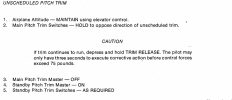
My B100 training manual is at the airport but I did find this online.

1763078336434.png
If I remember right on step #3,4, and 5 the switches are on the center pedestal.
 
I never flew a 99 but did fly this one almost 40 years ago but only for a short while.

From the King Air Mag

"To accommodate the 15 passengers, the 99’s fuselage is quite long and the tail needed to be designed to provide enough control and trim authority to handle a much larger CG envelope. Instead of trim tabs on the elevators, Beech went with a movable horizontal stabilizer … like that used on a Piper Cub or Cessna 180, for example. However, unlike the Cub and Skywagon, the stabilizer on the 99- and 100-series was so big that moving the jackscrew manually proved to be too difficult. Instead, a system was designed and certified that included both an electric Main and electric Standby trim motor that operate the stabilizer through a clutch/gearbox arrangement such that if one motor fails the other can still function. When one first flies a 100, it is a bit disconcerting to reach for the elevator trim wheel and find it missing! Normal trimming is accomplished through the use of dual switches on the outboard grip of the pilot’s or co-pilot’s control wheel. Standby trimming is achieved by use of two switches on the pedestal, accessible to both pilots. A trim-in-motion aural tone beeps whenever the stabilizer moves. That, too, is unusual at first but soon becomes expected and almost unnoticed."

My B100 training manual is at the airport but I did find this online.

View attachment 147156
If I remember right on step #3,4, and 5 the switches are on the center pedestal.

I flew the 99 back in 1983, 1984. A straight -99 with -20's and no spar strap. Back then it had 28,000 hours on the airframe.
 
In various aircraft I've flown over the years, it's really disconcerting to get a runaway trim, especially at a high workload time of flight (TO/App/Lndg). My last recurrent back in August I got one and it's still a momentary shock.
 
In various aircraft I've flown over the years, it's really disconcerting to get a runaway trim, especially at a high workload time of flight (TO/App/Lndg). My last recurrent back in August I got one and it's still a momentary shock.
I find it interesting how many people really hate the idea of a runaway trim, but aren’t willing to learn to do the test that helps prevent it.
 
Back
Top