I will literally Venmo you $10 if you can clearly and concisely explain CRMALOFT.

Princesspilot206

Pre-takeoff checklist
PoA Supporter
Joined
Oct 18, 2023
Messages
171
Display Name
Princesspilot
My instructor is about as useful as a sack of rocks. I understand the concepts, but I need some guidance on how to best articulate how each of these factors affects Vmc and Performance. If you could help me out I would appreciate it! My stage check is Monday.
 
is smacfum out of fashion? Or is "smac" violent language that needs suppressed? :D
 
Lots of good videos on youtube about Vmc

I may have a pdf file that my instructor made (customized for a Beech Duchess). PM me your email address of you want it.
 
My instructor is about as useful as a sack of rocks. I understand the concepts, but I need some guidance on how to best articulate how each of these factors affects Vmc and Performance. If you could help me out I would appreciate it! My stage check is Monday.
Your instructor may suck, but Vmc factors are pretty much page 2 of any textbook/training guide/handout/etc on multiengine flying. Certainly you got SOMETHING like that from your instructor or school, didn't you?

And there are probably 1000 videos on YouTube with this material.

I always recommended Bob Gardner's Complete Multiengine Pilot when I was doing ME training.

What exactly is it you're having trouble explaining?
 
I kept waiting for someone to define CRMALOFT, but since it went undefined I asked GROK.

Based on available knowledge and common aviation training mnemonics, "CRMALOFT" is likely a memory aid used to recall factors that affect Vmc (minimum control speed) in multi-engine aircraft, particularly during twin-engine flight training. Here’s the breakdown:
  • C - Critical Engine: Refers to the engine that, if it fails, has the most adverse effect on aircraft control due to factors like P-factor and torque. For most twin-engine planes with both propellers rotating clockwise, this is typically the left engine.
  • R - Rudder: The rudder’s effectiveness in counteracting yaw from an engine failure impacts Vmc. Less rudder authority (e.g., due to size or deflection limits) increases Vmc.
  • M - Mass (or Weight): Heavier aircraft have more inertia, which can reduce Vmc slightly, though the effect is often minor compared to other factors.
  • A - Altitude: At higher altitudes, air density decreases, reducing engine thrust and rudder effectiveness, which lowers Vmc (since less asymmetric thrust is produced).
  • L - Landing Gear: Gear down increases drag, especially on the side with the failed engine, potentially lowering Vmc by helping to counter yaw.
  • O - Out of Ground Effect: Operating out of ground effect (higher above the runway) can influence Vmc, though this is less direct; it’s often tied to performance impacts from reduced lift and drag changes.
  • F - Flaps: Flaps down can reduce Vmc by increasing lift and drag, which may stabilize the aircraft and lessen the yaw tendency from an engine failure.
  • T - Trim: Proper trim (especially rudder trim) reduces the control force needed to maintain directional control, affecting Vmc indirectly.
In twin-engine flight instruction, CRMALOFT helps pilots understand how these variables influence the speed below which the aircraft becomes uncontrollable with one engine inoperative. For example, a critical engine failure at low altitude with gear and flaps up would typically result in a higher Vmc, making control more challenging. Instructors use this acronym to teach students how to manage these factors during scenarios like engine-out procedures or Vmc demonstrations.

Airplane acronyms never cease to baffle me. They are harder to learn than flying an airplane.
 
Grok:

The acronym "SMACFUM" is commonly used in aviation, particularly in twin-engine flight instruction, as a mnemonic to recall the factors that determine Vmc (minimum control speed) for multi-engine aircraft under FAA certification standards (e.g., 14 CFR 23.149). Here’s the breakdown:
  • S - Standard Day at Sea Level: Vmc is calculated under standard atmospheric conditions (sea-level pressure and temperature), which maximizes engine thrust and rudder effectiveness.
  • M - Max Power: Maximum power on the operating engine increases asymmetric thrust, raising Vmc.
  • A - Aft CG (Center of Gravity): An aft CG shortens the rudder’s moment arm, increasing Vmc by making directional control harder.
  • C - Critical Engine Windmilling: The critical engine (typically the left in conventional twins) is windmilling, producing drag and yaw, which raises Vmc.
  • F - Flaps Up/Gear Up: Flaps and landing gear are retracted, reducing stabilizing drag and lift, thus increasing Vmc.
  • U - Up to 5° Bank: A bank of up to 5 degrees into the operating engine is allowed, which lowers Vmc by reducing sideslip and aiding rudder control.
  • M - Most Unfavorable Weight: Typically the lightest weight, as a lighter aircraft has less inertia to resist yaw, increasing Vmc.
SMACFUM represents the conditions under which Vmc is tested and published for an aircraft. These factors ensure the plane’s controllability is assessed in a worst-case scenario, helping pilots understand the limits during engine-out situations. Let me know if you need more detail!
 
Grok:

It seems like "SMACMUF" might be a slight variation or typo of the more commonly recognized aviation mnemonic "SMACFUM," which I explained earlier as relating to Vmc (minimum control speed) factors in multi-engine aircraft. However, I’ll treat "SMACMUF" as a distinct request and interpret it based on the provided letters, adjusting where logical in the context of twin-engine flight instruction.
Here’s a possible breakdown of "SMACMUF," assuming it’s intended to align closely with Vmc-related factors or a similar aviation concept:
  • S - Standard Day at Sea Level: Vmc is determined under standard atmospheric conditions (sea-level pressure and temperature) to ensure consistent thrust and control authority.
  • M - Max Power: Maximum power on the operating engine maximizes asymmetric thrust, increasing Vmc.
  • A - Aft CG (Center of Gravity): An aft CG reduces the rudder’s leverage, making control more difficult and raising Vmc.
  • C - Critical Engine Windmilling: The critical engine (e.g., the left in most twins) is windmilling, adding drag and yaw, which increases Vmc.
  • M - Most Unfavorable Weight: Typically the lightest weight, reducing inertia and increasing Vmc.
  • U - Up to 5° Bank: A bank of up to 5 degrees toward the good engine is permitted, lowering Vmc by reducing sideslip.
  • F - Flaps Up/Gear Up: Flaps and landing gear retracted, minimizing stabilizing effects and raising Vmc.
The repetition of "M" (Max Power and Most Unfavorable Weight) suggests "SMACMUF" could be a misremembered or reordered version of "SMACFUM." In "SMACFUM," the letters align perfectly with FAA certification standards for Vmc (14 CFR 23.149), while "SMACMUF" swaps the positions of "F" and "U" and repeats "M." This could reflect a simple error or an alternate teaching variation, though "SMACFUM" is the standard form in most flight training contexts.
If "SMACMUF" is meant to represent something entirely different in twin-engine flight instruction, please clarify further—e.g., by providing context or correcting the sequence—and I’ll adjust accordingly! For now, it’s most likely a close cousin of "SMACFUM," focused on Vmc factors.
 
Now to further illustrate my frustration with sequences of seemingly random letters without any definition of their respective meaning, my initial Grok query resulted in this:

Twin-engine flight instruction typically refers to training pilots to operate aircraft with two engines, such as a multi-engine rating or certification process. This involves learning aircraft systems, performance, handling characteristics, and emergency procedures like single-engine operations. Crew Resource Management (CRM) is a training methodology focused on enhancing teamwork, communication, decision-making, and situational awareness among flight crews to improve safety and efficiency. LOFT, or Line-Oriented Flight Training, is a scenario-based training approach that simulates real-world flight operations to practice CRM and technical skills in a realistic environment.

If you're asking about how these elements—twin-engine flight instruction, CRM, and LOFT—interconnect in airline operations training, here’s an explanation:
In twin-engine flight instruction, pilots first master the technical aspects of flying a multi-engine aircraft, often starting with light twins like a Piper Seminole or Beechcraft Duchess. This includes understanding asymmetric thrust, engine-out procedures, and performance calculations. CRM becomes critical when transitioning to crewed operations, especially in airline or commercial settings where twin-engine aircraft (e.g., Boeing 737, Airbus A320) are common. CRM training ensures that pilots work effectively as a team, using all available resources—human, equipment, and information—to manage the flight safely. LOFT complements this by providing a practical framework where pilots can apply CRM principles during simulated twin-engine flight scenarios, such as dealing with an engine failure during takeoff or navigating a complex approach in poor weather.

For example, a LOFT session for twin-engine flight might involve a simulated airline route where the crew encounters an engine issue mid-flight. The instructor would evaluate how the pilots communicate, delegate tasks, and use CRM to handle the situation while maintaining control of the aircraft. This bridges the technical skills of twin-engine flying with the interpersonal and decision-making focus of CRM.

You'll have to excuse me now. I noticed a cloud that need yelling at when I was chasing some kids off my (synthetic) lawn.
 
Who learned everything that it "knows" from a random collection of web pages...
Well, I could have done the same with about 25 google searches and then filtered out the nonsensical, the click bait and porn, but I'm lazy and Grok was easier. Especially considering I don't really care what the answer is. I was befuddled by a seemingly random undefined set of characters. YMMV. BWTHDIK. IYKYK. It helps to RTFM ICYDAK.

And, there are times that the random collection of web pages Grok uses for its "knowledge" is flat out wrong.

I was mainly trying to cite my source of information rather than assigning some god-like credibility to AI.
 
As far as contributing anything useful to the Vmc discussion, this video was posted online years ago. I think it was here, but not positive. Seems credible to me.

"Airplane Accidents after Engine Failure—Real Value of Vmc" by Harry Horlings, uploaded to YouTube around August 12, 2017.


I remembered it, but didn't remember who published it. I cheated. I relied on an internet search for that too.
 
Well, I could have done the same with about 25 google searches and then filtered out the nonsensical, the click bait and porn, but I'm lazy and Grok was easier. Especially considering I don't really care what the answer is. I was befuddled by a seemingly random undefined set of characters. YMMV. BWTHDIK. IYKYK. It helps to RTFM ICYDAK.

And, there are times that the random collection of web pages Grok uses for its "knowledge" is flat out wrong.

I was mainly trying to cite my source of information rather than assigning some god-like credibility to AI.
Did you click the link in the second post?
 
Did you click the link in the second post?
Clearly a rhetorical question. I did not. I generally do not click on links. I do like when links are provided with a short explanation. I did use it to infer the topic had something to do with twin engine training (as did the first post). I guess it's as obvious to most as TOMATO FLAMES.

I got marked off in English enough times in High School that I finally came to expect that any abbreviations or acronyms were spelled out at first use. The Federal Aviation Administration (FAA), for example. There after FAA was acceptable. I understand that is no longer generally adhered to. I get even more lost with emoji's.

It's just my preference, but it would have been helpful (to me at least) to see something like this:

FROM:


"Originally Posted by aviationbill (Post 933502)
Oh wow, I can't believe I'm going to type this but here goes, hope it helps

CRM LOFT ACE

C - Critical engine inop and windmilling (windmilling drag is significant compared to feathered)
R - Most rearward CG (rudder effective arm is reduced)
M - Most unfavorable weight (light weight. Remember your horizontal component of lift and how it opposes your operating engine)

L - Landing gear (as required by manufacturer certification)
O - Operating engine at max takeoff power (and remember this can only occur at sea level in standard conditions
F - Flaps (again as required by manufacturer certification
T- Trim for takeoff (an aircraft not trim for takeoff will require control loads outside of those necessary. Especially in the case of a rudder trim which is an anti-servo tab style.)

A - Airborne and out of ground effect (remember the effect that better performance can have when close to the ground)
C - Cowl Flaps (as required again by manufacturer setting. Especially for those flying a seminole this is required to be open)
E - Eliminate sideslip (max 5 degrees towards good engine)

"

I'll crawl back in my hole now. Sorry for the diversion.
 
I kept waiting for someone to define CRMALOFT, but since it went undefined I asked GROK.

Based on available knowledge and common aviation training mnemonics, "CRMALOFT" is likely a memory aid used to recall factors that affect Vmc (minimum control speed) in multi-engine aircraft, particularly during twin-engine flight training. Here’s the breakdown:
  • C - Critical Engine: Refers to the engine that, if it fails, has the most adverse effect on aircraft control due to factors like P-factor and torque. For most twin-engine planes with both propellers rotating clockwise, this is typically the left engine.
  • R - Rudder: The rudder’s effectiveness in counteracting yaw from an engine failure impacts Vmc. Less rudder authority (e.g., due to size or deflection limits) increases Vmc.
  • M - Mass (or Weight): Heavier aircraft have more inertia, which can reduce Vmc slightly, though the effect is often minor compared to other factors.
  • A - Altitude: At higher altitudes, air density decreases, reducing engine thrust and rudder effectiveness, which lowers Vmc (since less asymmetric thrust is produced).
  • L - Landing Gear: Gear down increases drag, especially on the side with the failed engine, potentially lowering Vmc by helping to counter yaw.
  • O - Out of Ground Effect: Operating out of ground effect (higher above the runway) can influence Vmc, though this is less direct; it’s often tied to performance impacts from reduced lift and drag changes.
  • F - Flaps: Flaps down can reduce Vmc by increasing lift and drag, which may stabilize the aircraft and lessen the yaw tendency from an engine failure.
  • T - Trim: Proper trim (especially rudder trim) reduces the control force needed to maintain directional control, affecting Vmc indirectly.
In twin-engine flight instruction, CRMALOFT helps pilots understand how these variables influence the speed below which the aircraft becomes uncontrollable with one engine inoperative. For example, a critical engine failure at low altitude with gear and flaps up would typically result in a higher Vmc, making control more challenging. Instructors use this acronym to teach students how to manage these factors during scenarios like engine-out procedures or Vmc demonstrations.
This is why AI sucks. There are several things wrong with this "explanation".

"AI" makes word salad based on probabilities. That's it. It's great for a starting point if you're writing about a subject you already know enough about to correct what it gets wrong. It's terrible for learning a new subject, as you'll internalize the wrong with the right and need to have the wrong parts trained out of you.
 
This is why AI sucks. There are several things wrong with this "explanation".
The same could be said for instructors, examiners, FAA pubs, random youtubers, and Old Man Stan at the FBO. If you understand the physics behind e.g. Vmc, Va, dihedral, whatever, you can (sometimes) see through the BS

Nauga,
who asks, "static, dynamic, or ground?"
 
This is why AI sucks. There are several things wrong with this "explanation".

"AI" makes word salad based on probabilities. That's it. It's great for a starting point if you're writing about a subject you already know enough about to correct what it gets wrong. It's terrible for learning a new subject, as you'll internalize the wrong with the right and need to have the wrong parts trained out of you.
It would be helpful to point out the differences where one or both are incorrect (I don't know the answer). The indented and bulleted was from Grok. The non-bulleted, non-indented are from post #2 (assuming I edited/transferred correctly). Note: Grok was CRMALOFT per the title. Post #2 was CRM LOFT ACE
  • C - Critical Engine: Refers to the engine that, if it fails, has the most adverse effect on aircraft control due to factors like P-factor and torque. For most twin-engine planes with both propellers rotating clockwise, this is typically the left engine.
C - Critical engine inop and windmilling (windmilling drag is significant compared to feathered)
  • R - Rudder: The rudder’s effectiveness in counteracting yaw from an engine failure impacts Vmc. Less rudder authority (e.g., due to size or deflection limits) increases Vmc.
R - Most rearward CG (rudder effective arm is reduced)
  • M - Mass (or Weight): Heavier aircraft have more inertia, which can reduce Vmc slightly, though the effect is often minor compared to other factors.
M - Most unfavorable weight (light weight. Remember your horizontal component of lift and how it opposes your operating engine)
  • A - Altitude: At higher altitudes, air density decreases, reducing engine thrust and rudder effectiveness, which lowers Vmc (since less asymmetric thrust is produced).
A - Airborne and out of ground effect (remember the effect that better performance can have when close to the ground)
  • L - Landing Gear: Gear down increases drag, especially on the side with the failed engine, potentially lowering Vmc by helping to counter yaw.
L - Landing gear (as required by manufacturer certification)
  • O - Out of Ground Effect: Operating out of ground effect (higher above the runway) can influence Vmc, though this is less direct; it’s often tied to performance impacts from reduced lift and drag changes.
O - Operating engine at max takeoff power (and remember this can only occur at sea level in standard conditions
  • F - Flaps: Flaps down can reduce Vmc by increasing lift and drag, which may stabilize the aircraft and lessen the yaw tendency from an engine failure.
F - Flaps (again as required by manufacturer certification
  • T - Trim: Proper trim (especially rudder trim) reduces the control force needed to maintain directional control, affecting Vmc indirectly.
T- Trim for takeoff (an aircraft not trim for takeoff will require control loads outside of those necessary. Especially in the case of a rudder trim which is an anti-servo tab style.)

These are from Post #2 and additional not addressed by Grok.
C - Cowl Flaps (as required again by manufacturer setting. Especially for those flying a seminole this is required to be open)
E - Eliminate sideslip (max 5 degrees towards good engine)

On the other hand, I have only a passing interest in the subject. Enough for the rating, but since I have a Centerline Thrust Rating (CLT) it is less applicable to me unless I decide to remove the limitation.
 
Fire them.


Do you actually understand the concepts?


Good luck, can you move it to the right?
Performance is based off of drag, and Vmc on rudder effectiveness or authority. I am at the point now I explain them, but I am having trouble verbalizing why Vmc is higher with one engine being at max power.
 
Is it because of accelerated slipstream on the operating engine creating a center of thrust further from the center of gravity. So there is more lift banking the airplane into the inop engine, making it so the rudder needs more deflection? Needing more airspeed. I know I am saying this so stupidly. :(
 
It's because the operating engine produces more thrust which creates a larger yawing moment that must be overcome by the rudder (and bank angle to some extent). The correcting yawing moment is a function of rudder deflection and dynamic pressure (i.e. speed), so if you don't have enough rudder deflection available to stop the yaw from the operating engine at full power and some fixed airspeed, going faster will give you additional yawing moment with the same rudder deflection.

Nauga,
off-axis
Thank you!
 
It would be helpful to point out the differences where one or both are incorrect (I don't know the answer). The indented and bulleted was from Grok. The non-bulleted, non-indented are from post #2 (assuming I edited/transferred correctly). Note: Grok was CRMALOFT per the title. Post #2 was CRM LOFT ACE
Thanks for putting these together in one spot, that makes it easier. In general, where they differ, the human is correct and the AI is not.
  • C - Critical Engine: Refers to the engine that, if it fails, has the most adverse effect on aircraft control due to factors like P-factor and torque. For most twin-engine planes with both propellers rotating clockwise, this is typically the left engine.
First of all, torque is the same for either engine so that doesn't contribute. Take away "and torque" however, and it's still missing the most important part of this item, the windmilling:
C - Critical engine inop and windmilling (windmilling drag is significant compared to feathered)
This. A windmilling prop gives you a MASSIVE amount of drag on the dead-engine side, and a way worse yawing moment.

  • R - Rudder: The rudder’s effectiveness in counteracting yaw from an engine failure impacts Vmc. Less rudder authority (e.g., due to size or deflection limits) increases Vmc.
R - Most rearward CG (rudder effective arm is reduced)
Again, the AI isn't wrong about rudder effectiveness, but it completely misses the effect that the CG has on the rudder's effectiveness.

On this one, think of a top view of the airplane. Draw a dot at the CG, that's your point of rotation. At a fixed airspeed, a fully deflected rudder gives a fixed amount of force, but the yawing moment can be increased by increasing the arm between the rudder and the CG. Aft CG gives you the shortest arm, forward CG gives you a longer arm and thus a higher moment.


  • M - Mass (or Weight): Heavier aircraft have more inertia, which can reduce Vmc slightly, though the effect is often minor compared to other factors.
That's... Useless.

M - Most unfavorable weight (light weight. Remember your horizontal component of lift and how it opposes your operating engine)
Much better. Lighter weight = less lift, so the 5 degrees of bank* gives you less horizontal lift.

* The 5 degrees of bank is merely the maximum that can be used to determine the published Vmc and prevent the manufacturers cheating.

  • A - Altitude: At higher altitudes, air density decreases, reducing engine thrust and rudder effectiveness, which lowers Vmc (since less asymmetric thrust is produced).
Again, it's not saying anything "wrong" before the last comma... But reduced rudder effectiveness would *increase* Vmc and it doesn't address the balance between reduced thrust and reduced rudder effectiveness at higher altitude.

  • L - Landing Gear: Gear down increases drag, especially on the side with the failed engine, potentially lowering Vmc by helping to counter yaw.
Gear down increases drag on the side with the *operating* engine, lowering Vmc by helping to counter yaw. This is mainly only true if the gear is in the propwash, though.

  • F - Flaps: Flaps down can reduce Vmc by increasing lift and drag, which may stabilize the aircraft and lessen the yaw tendency from an engine failure.
Not "wrong" but missing the key point again. This works just like the gear - Faster slipstream thanks to propwash means you'll get more drag from a flap that's behind an operating engine than behind a dead engine.

  • T - Trim: Proper trim (especially rudder trim) reduces the control force needed to maintain directional control, affecting Vmc indirectly.
T- Trim for takeoff (an aircraft not trim for takeoff will require control loads outside of those necessary. Especially in the case of a rudder trim which is an anti-servo tab style.)
I believe this one is just a certification requirement that you can't require more than 50 (?) pounds of force on the rudder. Trim does not increase the rudder's effectiveness, it increases your leg's effectiveness. ;)

These are from Post #2 and additional not addressed by Grok.
C - Cowl Flaps (as required again by manufacturer setting. Especially for those flying a seminole this is required to be open)
Cowl flaps will give a bit of drag in the slipstream and thus decrease Vmc just like the gear and flaps as described above.

 
re: "most adverse weight"
Much better. Lighter weight = less lift, so the 5 degrees of bank* gives you less horizontal lift.
There's a reason the cert criteria reads "Most adverse...weight" and/or "most unfavorable weight" instead of "light weight." All other things being equal, as weight increases an airplane must fly at a higher AOA for a given airspeed. Rudder control power ("effectiveness") *tends* to decrease as AOA increases, so what is controllable at a particular airspeed at low weight may not be controllable at that airspeed at higher weight.

re: flaps
Not "wrong" but missing the key point again. This works just like the gear - Faster slipstream thanks to propwash means you'll get more drag from a flap that's behind an operating engine than behind a dead engine.
That's a fairly esoteric argument. As long as flaps increase lift they will reduce the AOA you need to fly at for a given airspeed. As above, lower AOA, more rudder control power, so Vmc *tends* to be lower.

Nauga,
and the steel-toe bootstomp
 
Think in terms of factors that increase stability (airspeed over the vertical) and decrease stability (drag of the dead engine). Build two lists from the typical examples from the training guides with each type in its column.
 
My instructor is about as useful as a sack of rocks. I understand the concepts, but I need some guidance on how to best articulate how each of these factors affects Vmc and Performance. If you could help me out I would appreciate it! My stage check is Monday.
I know this is a foreign concept to aviation students these days, but maybe you should actually get out a book and read. https://www.faa.gov/sites/faa.gov/f...ls/aviation/airplane_handbook/14_afh_ch13.pdf
 
You sound like a guy who wakes up alone every morning. Who do you think you are talking to like that?
His point (and implied questions) is still valid though.

Did your instructor or school provide you with any instructional materials or books? Which ones? Recommended videos?

As I stated before, I'm surprised that the Vmc information wasn't on there. Is there a specific aspect you're having trouble understanding?
 
Last edited:
You sound like a guy who wakes up alone every morning. Who do you think you are talking to like that?
I am a CFI at a busy 141 / college flight school who deals with students like you everyday. Get out the books and study.
 
Last edited:
My instructor is about as useful as a sack of rocks. I understand the concepts, but I need some guidance on how to best articulate how each of these factors affects Vmc and Performance. If you could help me out I would appreciate it! My stage check is Monday.
Then fire them. If you paid your jabrony CFI all that money and still have to google your flight training you're just proving my point:

80% of CFIs are hot garbage.
 
POA is full of tools.
His point (and implied questions) is still valid though.

Did your instructor or school provide you with any instructional materials or books? Which ones? Recommended videos?

As I stated before, I'm surprised that the Vmc information wasn't on there. Is there a specific aspect you're having trouble understanding?
Lord have mercy! Nauga already answered the last question I had about it. Why are you guys still droning on about it? WTF. As far as I am concerned this conversation is over.
 
POA is full of tools.

Lord have mercy! Nauga already answered the last question I had about it. Why are you guys still droning on about it? WTF. As far as I am concerned this conversation is over.

That'd be a shame for two reasons -- first that you treated this forum like a personal answer vending machine and disposed of it when done, but second because the next 3+ pages of minutia and arguments may actually tease out some interesting subtleties about your question. Maybe.

"Ignore the tools" is probably good life advice.
 
Then fire them. If you paid your jabrony CFI all that money and still have to google your flight training you're just proving my point:

80% of CFIs are hot garbage.
You can thank the FAA for allowing hot garbage to get CFI certificates. The concept of a CFI applicant having instructional knowledge has gotten lost over time in a world where students no longer read and study.
 
Last edited:
re: "most adverse weight"

There's a reason the cert criteria reads "Most adverse...weight" and/or "most unfavorable weight" instead of "light weight." All other things being equal, as weight increases an airplane must fly at a higher AOA for a given airspeed. Rudder control power ("effectiveness") *tends* to decrease as AOA increases, so what is controllable at a particular airspeed at low weight may not be controllable at that airspeed at higher weight.
OK, I can buy that... Tail might be in a position relative to wings where the airflow is disturbed at a higher AoA, right? I mean, what do I know, I fly a plane with a backwards tail. :rofl: But maybe that's a clue too, since my backwards tail is theoretically there to improve rudder effectiveness at high AoA and a swept tail could lose effectiveness at higher AoA due to the vertical angle between the rudder and the relative wind?
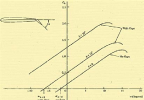
That's a fairly esoteric argument. As long as flaps increase lift they will reduce the AOA you need to fly at for a given airspeed. As above, lower AOA, more rudder control power, so Vmc *tends* to be lower.
Don't flaps technically give you the same total AoA at a lower pitch? #pedantic But the effect is the same, lower Vmc with flaps.
 
OK, I can buy that... Tail might be in a position relative to wings where the airflow is disturbed at a higher AoA, right? I mean, what do I know, I fly a plane with a backwards tail. :rofl: But maybe that's a clue too, since my backwards tail is theoretically there to improve rudder effectiveness at high AoA and a swept tail could lose effectiveness at higher AoA due to the vertical angle between the rudder and the relative wind?
In another thread we're talking about how understanding lift and drag can help spot BS. The "forward vertical sweep means more effective rudder" is largely BS. In fact, forward sweep tends to increase vertical tail blanking by the wing, fuse, and horizontal stab as AOA increases. Think about the blockage at very high AOA, like a spin, compared to an aft-swept tail. But it looks great on the marketing glossies.

Don't flaps technically give you the same total AoA at a lower pitch? #pedantic But the effect is the same, lower Vmc with flaps.
I'm guessing you're saying the chordline changes with flap extension. In an aerodynamic sense, the chordline stays with the fixed part of the wing and flap extension shifts the lift curve upward. Got a copy of Abbot and Von Doenhoff handy?
Not A&D bit similar:

lift curve with flaps.png

The astute observer might also note that in this example the AOA for CLmax (i.e. stall AOA) reduces as flaps extend, but CLmax is still higher than with flaps up.

Nauga,
who celebrates over-the-hump day
 
Back
Top