Higher Oil Temp than usual

Ed Haywood

Final Approach
Joined
Jul 12, 2020
Messages
7,624
Location
Tampa FL
Display Name
Ed
Home Airfield
FD77
OT has been consistently in 180's and 190's for first 200 hours of engine life. I just changed the oil. Since then, OT has been 205-210. Red line is 240.

Same oil type and weight. Aeroshell W100+.

I have two senders and gauges, so it is not an indication issue.

I rinsed out the oil pressure screen and housing with mineral spirits when I changed the oil. I verified the housing and gasket are in correct orientation.

I did not pull the suction screen this time, but did 25 hours ago.

Oil cooler was replaced at engine OH 2 years ago. I did not replace vernatherm.

I checked baffles, seals, and scat tubes. Nothing out of place, everything in good shape.

Ideas?
 
Last edited:
Vernatherm is a possibillity. Pull it, make sure the seat doesn't have damage, put it in hot water, check temp with a candy thermometer. The vernatherm should open at 180-185F.
 
OAT still in same general range?
So on both gauges, the temp increased equally?
Does the OT increase after start appear to be the same except it goes up to 205?
And no other work performed at the same time no matter how small?
 
OAT still in same general range?
So on both gauges, the temp increased equally?
Does the OT increase after start appear to be the same except it goes up to 205?
And no other work performed at the same time no matter how small?
Yes to 1-3. No to 4.

I'll have to check logs, but I think vernatherm probably was changed at OH two years and 200 hours ago.
 
Yes to 1-3. No to 4.

I'll have to check logs, but I think vernatherm probably was changed at OH two years and 200 hours ago.

Actually, I did fix a very light seeping leak to the AN fitting between the OP sensors and hose. Disassembled, cleaned, reassembled with Permatex high temp thread sealant. And I added an AN coupling to the drain valve on the gascolator.
 
So on both gauges, the temp increased equally?

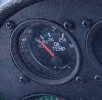
A little more detail. Primary is analog gauge connected to sender on pressure screen housing. It is hard to read precisely because it is off center and only has tick marks for 30 degrees. Picture below. I'd call that 180 ish.

PXL_20250926_194700555~2.jpg

The JPI sensor is mounted on the front right port. It reads about 10 degrees higher, as expected.

When the picture above was taken, I was cruising at 8500 feet at 65% power leaned to peak. CHT was 390. Primary OT gauge reads 180ish. JPI reads 191. All readings stable. This was just prior to my recent oil change.

Now the JPI reads 205-210 and the primary OT reads approx 200.

Lately I have been flying harder acro, regularly pulling 5G. This can be hard on unexpected parts of the aircraft. For instance, one of my scat tubes detached a few days ago. The flange on the airbox for heated alt air pulled off the rivets due to a previous shoddy repair.

PXL_20251018_172241315.jpg

So, I cannot rule out damage to other components, coincident to the oil change. Who knows what 5G does to a vernatherm, for instance.
 
Last edited:
Was all the oil from the same batch?
If not is there any chance the manufacturer changed something in the formulation?

You haven't mentioned oil pressure so I assume you're seeing the same pressure since the oil change.
 
Was all the oil from the same batch?
If not is there any chance the manufacturer changed something in the formulation?

You haven't mentioned oil pressure so I assume you're seeing the same pressure since the oil change.

OP is steady. I suppose there could be some oil weirdness, but I have previously used victory XC50 and saw same temps. Also had same temps with mineral oil during break in.

Vernatherm seems like an obvious and easy first step to troubleshoot.
 
Last edited:
Google says hard acro is hard on vernatherms. Particularly so for alternating negative and positive G, due to pressure drops and surges.
 
Did the acro dislodge some stuff that's now clogging the oil cooler?

Possible, but the engine is fairly new and the screens are clear. If the vernatherm passes muster, next step is probably back flushing the oil cooler.
 
When the picture above was taken, I was cruising at 8500 feet at 65% power leaned to peak. CHT was 390. Primary OT gauge reads 180ish. JPI reads 191. All readings stable. This was just prior to my recent oil change.

Now the JPI reads 205-210 and the primary OT reads approx 200.
So basically an approx increase of 20 degrees after the oil change?
Does both readings stay consistent at 200 and 210 like the 180/190 readings, or do the higher readings fluctuate?
And the red line is 240?
And the only other mx was fix a slight leak at one sensor?

Are all other indications the same as prior to oil change?
And you didn't change oil brand or grade with this last change?
And to performed the oil change identical to the last change?

What type of engine oil system is installed for your air work, ie, wet or dry sump?
 
Gave it another workout. Temps between 205 and 210, got as high as 214 when climbing. Never seen that before. All temps from engine monitor probe on front case. Primary probe stays 10-15 lower.

Immediately after shutting down, I pulled the top cowl off. The oil cooler and hoses to/from were quite hot. I measured them at 165-175 depending on location. Case was 190-195. That was 5 to 10 minutes after shutdown, as measured with a cheapo laser thermometer.

Right now my plan is let it cool, then pull the vernatherm and take it home to test in hot water.
 
The vernatherm should open at 180-185F.
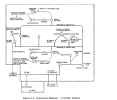
It should CLOSE at those temps. One has to know the oil circuitry in the engine to understand that:

1760915655994.png

The "oil cooler by-pass valve" at center bottom is the Vernatherm. When the Vernatherm expands, it pushes its valve cone into the bypass port in the engine's accessory case, closing it and forcing the oil through the cooler.

The arrangement for the six-cylinder engines is the same. http://www.aeroelectric.com/Referen...rect-Drive-Engine_Overhaul-Manual_jan2007.pdf
 
OT has been consistently in 180's and 190's for first 200 hours of engine life. I just changed the oil. Since then, OT has been 205-210. Red line is 240.

Same oil type and weight. Aeroshell W100+.

I have two senders and gauges, so it is not an indication issue.

I rinsed out the oil pressure screen and housing with mineral spirits when I changed the oil. I verified the housing and gasket are in correct orientation.

I did not pull the suction screen this time, but did 25 hours ago.

Oil cooler was replaced at engine OH 2 years ago. I did not replace vernatherm.

I checked baffles, seals, and scat tubes. Nothing out of place, everything in good shape.

Ideas?

I had almost the exact same problem. There was a bird's nest wedged up against the top of the cooler.
 
Vernatherm passed the function test.

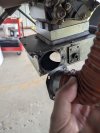
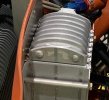
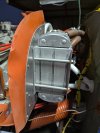
I think I may have found the problem. A mounting issue with the oil cooler. Will take a few days to collect the materials to fix.
 
Vernatherm passed the function test.

I think I may have found the problem. A mounting issue with the oil cooler. Will take a few days to collect the materials to fix.
Much better than an engine issue!
 
Radical, dude. How many Gs are you pulling?
 
Radical, dude. How many Gs are you pulling?

5G. But it was probably not G force doing the damage. G force would be in shear, straight down. More likely the damage was caused by a combination of vibration and high airspeed. I sometimes dive to 180mph; Vne is 200mph. That generates a lot of ram air pressure in the cowl. The crack probably started at the bottom of the flange from vibration and propagated upwards. Once it grew above the lower mounting screw hole, the air pressure would start bending the bottom of the oil cooler backwards and putting even more stress on the crack.

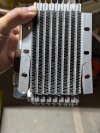
The fix is to bolt the new oil cooler through both flanges, with a spacer in between.

FB_IMG_1691952432034.jpg
 
JOOC, why not a doubler? Seems that the long bolt makes a big lever when you do pull Gs.

GeorgeC,
not a mech e
 
JOOC, why not a doubler? Seems that the long bolt makes a big lever when you do pull Gs.

GeorgeC,
not a mech e

There is a doubler on the baffle. If you mean on the cooler, the spacers and bolts create a rigid and strong box. That is the correct mounting method per the current TCDS drawings.
 
Back
Top