High time C-172

brien23

Pattern Altitude
Joined
May 31, 2005
Messages
1,624
Location
Oak Harbor
Display Name
Brien
Home Airfield
76S
What is a high time C-172, 50 years ago I thought 3,000 hr was high time now 10,000hr and up are still in use. As long as they are properly maintained they are safe, properly maintained seems to be the question. How many over 10,000hr planes have spots in them that no one has been in since it was new, or cables and pulleys runs that are still the same just a little old now. How many IA look that close and spend the time to look in area that do not get looked at with lower time aircraft, to get into some of those area require a lot of extra work and will the owners want the extra expense of that. Some people will want that extra care, will the person that buys a cheap ex flight school 172 with 10,000hr or more want to spend the the extra cost or just get a annual sign off. Might be I am just getting old, 50 years ago none of the shops I worked at would have let a 10,000 hr plane in the door or even work on them, now it's the norm.
 
This might help.
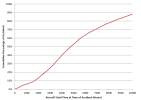
Here's a summary of aircraft total time for a set of about 3200 Cessna 172s. This data is from my Cessna 172 accident database, though I make no correlation between aircraft time and the fact that the aircraft had an accident. This just works nicely as a "snapshot" of ~3200 Cessna 172s.
1756492377272.png
So it looks like roughly ~5000 hours is typical for the Cessna 172 fleet.

Ron Wanttaja
 
I visited a flight school once, maybe 18 years ago, that had several 20,000+ hour 172s. I asked about several fairly important service bulletins that applied to those airplanes and whether they had been done. Nope, they said. I knew then that there would be some real show-stoppers in those airplanes. Cracks and so on.
 
Read the Cessna SID. It’ll point out the places that Cessna engineers think are worthy of inspection.
 
172 horizontal stab spars are always a place to inspect. I was taught long ago to give my stab a good up and down force to check it at preflight. No sissy effort, that stab carries a big load so give it a good pull and push. 172s are known for cracked stab spars. Nothing new there. Skywgons have jackscrews so need to be checked for play. Check the vertical fin attachment, too. The deeper dive universal point of interest in 100 series Cessnas is the wing strut attach points and spar attach points at the wing root. Look for corrosion and any wallowing that allows movement. Other than that, corrosion is Cessna’s focus. I recently had to remove my entry steps to deal with corrosion on the skins. See it, remove it, etch and alodine, and paint. Not a difficult task. The SID will advise to do a good corrosion inspection at hidden areas with intervals based on hours in flight and calendar time, adjusted for geographical area.
 
I'd rather have a high time plane that's regularly flown than a low time plane that sits.

It also depends on maintenance. Our club 172's have about 15,000 hours on them. Given how they are maintained, I have no concern about flying them. There are no issues with corrosion, cracks, leaking hoses, etc. etc. etc. etc.

Also, it's not as if all of the parts have 15,000 hours on them. Given how much preventive maintenance/maintenance has been done with replacing parts (cables, pulleys, seat frames, brakes, wheels, control cables, etc.) hard to say how much of the plane has what amount of hours on it.
 
There are no issues with corrosion, cracks, leaking hoses, etc. etc. etc. etc.
Given how much preventive maintenance/maintenance has been done with replacing parts (cables, pulleys, seat frames, brakes, wheels, control cables, etc.)
How do you know this to be fact?
 
How do you know this to be fact?
I've looked at the books, I've been the "project manager" of replacing the interiors where we did a complete check of the cables/pulleys/interior corrosion, etc. when everything was exposed. We replaced the air duct tubing for example. I've volunteered to assist with other maintenance, and I know how often the planes are inspected, oil is changed, etc. For example, I was "volunteered" to find a shop to rebuild the pilot seat frame (nice refurbishment shop in St Louis for that work). I've worked directly with our director of maintenance as well as with the shop that maintains the planes, and they are patient with all of my questions on past work, "what about this" questions, etc.

All in all, I'm confident in my assessment that our club planes are up to date and air worthy.
 
Back
Top