A recent thread on hobbies got me thinking… I’ve always been curious about hamm radio, I’ve researched a very small amount into it over the years, but it has been one of those recurring passing interests that I have yet to really dive into. There is a small shed about 15 miles away that has a large antenna that is obviously a ham, and about 30 miles away a farm that has a shed and an antenna setup that covers what has to be a 1/4 acre. I also think it is becoming a “lost art”… so anybody with experience in it talk me into or out of pursuing it. Also please anybody with good technical experience post what you know/advise. (None of us know how long we will be around, record the knowledge).

You are using an out of date browser. It may not display this or other websites correctly.
You should upgrade or use an alternative browser.
You should upgrade or use an alternative browser.
Ham!! (Radio that is)
- Thread starter Flatiowa
- Start date

Sierra1
Pre-takeoff checklist
Ham is a great hobby with endless places to go with it. Literally from local nets on handhelds to using computers to decipher signals across the globe to and from eachother, to Earth-moon-earth bounce or meteor bounce. Been a ham for around 6 years now, it’s a pretty fun group. Yes there are turds, yes there are jerks, yes there are stereotypes, but you will find a ton of helpful people in the hobby. There are a ton of YouTube channels like Ham Radio Crash Course (it’s all kinds of topics) to check out various aspects of the hobby. The HamStudy app is pretty helpful and free to get you in the door at the tech level. Post some questions and I’m sure many of us will answer. It’s a really broad topic.
My post, I admit, is very vague, but it is a very broad topic, and I am so far at the extreme left side of the dunning-Kruger curve of this topic that i do not even know what questions to ask to begin learning. I know it is a thing, I know that properly done can potentially communicate over extreme distances, I find the very concept of using an electromagnetic resonance wave to transmit and receive signals over long distances to be almost “magical” (yes I see the irony of using the internet to ask this, but it feels “different”).
Sierra1
Pre-takeoff checklist
It is, and it’s a ton of fun. I enjoy voice comms but as much crap as I gave my buddies about FT8 digital stuff it’s also really cool. Something neat about a computer pulling super weak power signals out of static from across the globe and making a connection.

While the arrival of cheap broadband internet has turned ham radio into even more of a niche than before, and there's a lot less homebrew these days, it's still a nice hobby.
And, if something bad happens to our communications infrastructure (either natural disaster or man-made), being a ham means you'll still be part of a functional communications network.
And, if something bad happens to our communications infrastructure (either natural disaster or man-made), being a ham means you'll still be part of a functional communications network.

Craig
Cleared for Takeoff
Making the assumption on your location, there are at least 40 amateur radio clubs in the state that are ARRL affiliated. 48 of them are listed on the ARRL website, along with any special interest the club promotes. Most have licensing classes from the basics on up. Cruise the list and check out the ones local to you. Just understand that not every club and every person will be a good fit, so don't give up if the first one doesn't feel right.

mark.staggs
Pre-takeoff checklist
I've had the same level of curiosity and interest, but I just haven't had the time to dive in.
Here in NC during Hurricane Helene, from what I understand, HAM operators provided critical communications in areas that had lost all cellular and landlines. That made me more interested in at least learning some basics. Yet, I still haven't.
Thanks for the tips above. I'm going to commit to learning more over the holidays.
Craig
Cleared for Takeoff
BTW...Got my ticket in 2010 and progressed to Extra within a year, just to have it done. Working on my GROL now.
JeffinNV
Pre-Flight
My dad was a Ham, I inherited his gear but it never caught on with me.
I did get my Tech license and have a mobile 2 meter I have taken with on road trips.
The big thing holding me back is getting an antenna up.
My dad had a couple of large trees with an inverted Y hanging in them.
I need to put up a tower, and am loath to spend the money on a hobby I may not stick with.
Here's a couple of links for more info, QRZ is a forum:
https://forums.qrz.com/index.php
The ARRL puts out study guides and test questions, the question bank changes every so often:

I’ve been a Ham for years. Ham radio covers lots of areas. Some like just talking on the radio. Some are into the tech side. Lots of makers are hams to gain access to RF spectrum
Learning isn’t hard. The rest is fairly straightforward too
Learning isn’t hard. The rest is fairly straightforward too

- Joined
- Mar 2, 2005
- Messages
- 16,628
- Location
- Southeast Tennessee
- Display Name
- This page intentionally left blank
Don’t know much about this, but does one need a large antenna if a repeater is nearby?

dans2992
En-Route
- Joined
- Jan 7, 2013
- Messages
- 4,308
- Display Name
- Dans2992
The large antennas are typically for HF, where you’re trying to talk across the world.Don’t know much about this, but does one need a large antenna if a repeater is nearby?
Repeaters are mainly used for higher frequencies like VHF.

Daleandee
Final Approach
- Joined
- Mar 4, 2020
- Messages
- 8,354
- Display Name
- Dale Andee
I'm a General class. I haven't done anything hammy in many, many, years. Last station I had was in a house in a neighborhood with covenants and that required stealth antennas (mostly an attic dipole).
I now have the land to put up a tower again, but not the will to do so. It was a lot of fun back in the day and someday I may get back to it. But for now the radios are collecting dust ...
I now have the land to put up a tower again, but not the will to do so. It was a lot of fun back in the day and someday I may get back to it. But for now the radios are collecting dust ...
I second this, I will as well. Thankfully I live were a large antenna will not be an issue (I already have a 12’x10’ directional tv one on a rotor mounted on a tripod tower on my house’s roof. It looks weird, but I get 30 channels for free and have no cable/satellite bill (plus some of the stations are really good).Thanks for the tips above. I'm going to commit to learning more over the holidays.
Go visit your neighborhood radio shacks, their house not shacks, and ask. Most will be thrilled that you are interested, and may even take you to the shack for some air time.
That was my experience, years ago.
I have a radio telephone license, but no idea where it might be. Useful when flying in Canada.
That was my experience, years ago.
I have a radio telephone license, but no idea where it might be. Useful when flying in Canada.
I was actually kinda thinking of doing that.Go visit your neighborhood radio shacks, their house not shacks, and ask. Most will be thrilled that you are interested, and may even take you to the shack for some air time.
That was my experience, years ago.
I have a radio telephone license, but no idea where it might be. Useful when flying in Canada.
For a study guide I strongly recommend Dans (below). Straight forward and will quickly get you ready for the tech exam.
Clubs have different DNA. So visit a few if that’s an option.
Clubs have different DNA. So visit a few if that’s an option.

Arrow76R
Pre-takeoff checklist
I earned my first ham license in 1961 as I finished high school. Since then the hardware has changed immensely from "home brewed" to digital processes. Personally I stick with voice communications to talk with and learn about people all over the world. There is a link between ham radio and flying in that if you listen to the audio of VOR stations you will hear Morse code as the identifier. Morse code is no longer required for ham licenses (a sad change, IMHO) but you will also see the code I.D. printed on sectional and IFR charts and approach plates. For "old" ham pilots we don't have to rely on the nav radio to "decode" the code!!! In natural disasters when power is out and cell service is either down or overloaded ham radio provides needed communications. In the days before cell phones ham operators provided communications for military personnel in far flung locations to talk with their families through the Military Auxiliary Radio Service (MARS). Today astronauts aboard the International Space Station, who happen to be hams, speak with school children through ham radio connections. So...join the "club"! In these days of Internet connectivity "search" for ham radio and you will find a lot of information that will help you get started with the basic license, Technician, up to the Extra class (which I earned decades ago). Have fun!!
I never liked Morse code. I like hearing the person on the other end of the radio wave. I was happy when they got rid of it.Morse code is no longer required for ham licenses
Daleandee
Final Approach
- Joined
- Mar 4, 2020
- Messages
- 8,354
- Display Name
- Dale Andee
I never liked Morse code. I like hearing the person on the other end of the radio wave. I was happy when they got rid of it.
It was actually fun stuff to learn as my son (he was a young teenager then) and I would use flashlights and headlights (if parked in different cars) to communicate and drive the rest of the family crazy as they didn't know what was being said ...

I really wish I could “hear” Morse code. I have tried a few times to learn it, but never really dedicated enough time (although in elementary school my buddies and me did get into trouble for learning the code for a, b, c, and d. we developed a code of the number of eraser taps was the tens digit, and lead taps was the ones digit for the test question number. Then the response was given in lead as dot, eraser as dash…).

DaleB
Final Approach
I’ve been licensed continuously since the early 90s, but inactive for well over 10 years now. I’m just easing back into it, getting the HF equipment set up and waiting for enough of a break in the weather to get a wire up in the trees.
I’ve used an attic dipole before with good results. I was working QRP (low power, under 5 W) and made contacts around the world. Of course it’s easier with a bit more power. Things seem to have shifted quite a bit since I was last on the air. You really don’t need a huge antenna. Big is good, but nearly anything can be made to work.
Aside from the “old school” CW on HF, there are nearly too many facets of ham radio to count. Really something for everyone, even if your thing is just arguing on forums.

Plano Pilot
Cleared for Takeoff
I had an SGC-2000 on an old boat and always planned on getting my ham but never did. The boat was damaged, in a storm, beyond what I wanted to repair. We had a ham operator on the boat one thanksgiving, and it was nice getting phone patches to call our relatives. We were around 90 miles to the closest land line, and it was around the year 2001.
Using the SSB side we regularly talked to boats in the 200-2000 mile range. Our best was around 7,000 miles.
Using the SSB side we regularly talked to boats in the 200-2000 mile range. Our best was around 7,000 miles.

jnmeade
Cleared for Takeoff
- Joined
- Sep 25, 2005
- Messages
- 1,280
- Location
- Eastern Iowa
- Display Name
- Jim Meade
- Home Airfield
- Iowa City, IA
I have six or so towers on my farm and mostly work HF looking for distance (DX) contacts). I have 300 DXCC mixed. Some like "rag chews" (just talking). Some like to participate in contests. There are a number of HF (high frequency - 6m to 30m) and VHF (mostly 2m and 70cm) regular nets. There is also the emergency service with probably a group in most counties or larger towns (ARES). I'm a member of a weather spottter group affiliated with the National Weather Service.
You can buy a 2m portable for the local VHF nets for about $30. DX Engineering is a good place to start, but there are many outlets. HF rigs will take a somewhat larger antenna of some kind, but there is quite a variety in size and cost, with many specializing in small and hidden antennas. You can spend about as little or much as you like. ARRL has many books and other media on all aspects of ham radio.
Like aviation, much of ham radio is social. It can be clubby and that can be fun or off-putting. Kind of like flying, it's mostly male. Some women are active on the air but many are more active on the social side. When you contact a club, keep in mind that just a like a when you were a new pilot, some of the old-timers had forgotten how that was, but most are very welcoming and helpful. As I retired, I found flying and radio a couple of good hobbies that compliment each other. Yes, I've made air mobile contacts back when I was flying small jets and had access to a Collins 40m USB upper side band radio (talked to MARS statsions, as amateur stations are LSB lower side band on that frequency). I rigged my little LSA with a radio, but never installed an HF antenna so haven't worked used it.
NO0B

tmyers
En-Route
An interesting topic in a flying Forum but not really as much as you think. I find a large percentage of Amateur Radio Operators that are also Pilots. I think it is the technical aspect that draws radio operators to flying and vice versa. Some that know me here also know that medical issues pretty much put the kibosh on my flying. The flying community has always been very gracious to me when attending fly-ins and other gatherings of currently flying pilots. My wife is how I got into Amateur Radio as her father and grand father are both silent keys. She wanted a vanity license plate for her car with her dads call sign and I said hey I can do that. Didn't think about the fact that I don't own her car and cant get a vanity plate for her. Since I had started the training, I finished my Technician license in Dec, 2023, then General in Jan of 2024, followed by Amateur Extra in Feb 2024. I have only been active for the last 22 months on HF which is my passion, and have almost 3500 contacts with 3500 different unique callsigns. I also have my VHF radio set up and work on our local repeater frequently. My HF Antenna is a simple 173' long piece of 14 ga wire 25' up in my trees. Probably less than $150 for everything. I also have an antenna on my Motor Home and get on the airwaves every time we take the motor home out.
If you have any questions feel free to message me, and I will try to answer them, and if you hear WA8MD on the air stop by and give me a call!!
If you have any questions feel free to message me, and I will try to answer them, and if you hear WA8MD on the air stop by and give me a call!!
Did some ham 30+ years ago. I’ve done some work lately using mesh radios for a commercial venture. Reach back is impressive and ITAK capabilities are impressive but considering it’s a derivative of TAK/ATAK, shouldn’t be surprising.
The biggest mindset shift is accepting text of digitized voice instead of modulated voice.
The biggest mindset shift is accepting text of digitized voice instead of modulated voice.

- Joined
- Jun 11, 2015
- Messages
- 5,612
- Display Name
- Piperonca
- Home Airfield
- M52
Memories flooding back! I was licensed just after I turned 14. Started with morse code only because I had minimal equipment. Quickly got the General Class with 13 wpm code test at FCC office in Nashville. Started trading around and got an AM rig and figured out how to make a phone dialer with a telegraph key mounted upside down and spliced into our home phone line. Soon I was doing phone patches for people. Crude but effective.In the days before cell phones ham operators provided communications for military personnel in far flung locations to talk with their families through the Military Auxiliary Radio Service (MARS).
Fast forward to 1969 I'm in Chu Lai Vietnam flying Army Hueys. My wife had a serious operation back home, and the family arranged for me to talk with her at the MARS station in Chu Lai. I remember it well. Got a jeep ride across the base and saw a building with a gigantic log periodic rotating beam antenna. Went in and got the instructions on how to conduct the call and I heard her weak voice on a phone patch from around the world.
https://cherrieswriter.com/2017/11/10/calling-home-during-the-vietnam-war/
Last edited:
Had a lot of fun with one of these:Got a jeep ride across the base and saw a building with a gigantic yagi rotating beam antenna.
100W would get you all around the globe.
Albany Tom
Final Approach
- Joined
- Jul 23, 2021
- Messages
- 5,703
- Display Name
- Albany Tom
There are a lot of flavors of ham. Some people are into it for the tech, but even with tech there are a lot of different areas and disciplines. It's kinda like shooting in that respect. Skeet shooters and sporting clays and long range rifle and bullseye pistol and the combat pistol shooters all get along great, but it's different stuff. In ham, there are VHF/UHF FM guys who use hand held and mobile radios and repeaters, and who never use code. There are probably still guys out there playing with long range VHF+ to GHz from mountain top to mountain top, and those doing moonbounce. There are people in it entirely for HF contesting, or just collecting QSL cards from around the world. There are people in it for just the digital modes, on either HF or VHF+. And there are people in it for just the public service aspects of it.
Clubs are kinda like that too. Some can be a little cliquey, even if they don't intend to be, because they're focused around a particular sort of stuff. Don't be discouraged if the first club or bunch of guys seems like they're doing things you don't like. It is a hobby that's fading away, but there are good groups for probably all of it.
My thing was playing around with the tech of it, and doing public service because it seemed like the thing to do. So VHF simplex or repeater, and HF digital and voice w/ NVIS. You can spend a little or a tiny fortune on it...but it's generally a lot cheaper than airplanes in my opinion.
DaleB
Final Approach
Indeed. You could build the world's biggest contest station for less than the cost of a lot of used airplanes, even if you limited that to piston singles.You can spend a little or a tiny fortune on it...but it's generally a lot cheaper than airplanes in my opinion.
jnmeade
Cleared for Takeoff
- Joined
- Sep 25, 2005
- Messages
- 1,280
- Location
- Eastern Iowa
- Display Name
- Jim Meade
- Home Airfield
- Iowa City, IA
My intro to ham radio was a MARS phone patch out of Vietnam to my wife in Hawaii. I got my license in Germany when my son went to the Gulf with the 3rd AD. Never talked to him but worked a lot of Marsgrams out of Heidelberg, where I was stationed, and used their log periodic to talk to the world. Cell phones killed that, of course. It's correct, there are many facets to amateur radio.

Half Fast
Touchdown! Greaser!
- Joined
- May 7, 2016
- Messages
- 21,187
- Location
- Central Florida
- Display Name
- Half Fast
- Home Airfield
- KGIF
I have my Extra class ticket (AJ4CM) but I've been off the air for a few years. One of these days I'll get back to it. In fact, there's an HF radio sitting on the shelf behind me, but I need to string an antenna. Once upon a time I served as a Volunteer Examiner and helped administer license tests, and I was part of our local ARES ("Amateur Radio Emergency Services") team. Life and other interests got in the way.
VHF/UHF, where you should start, is used for local comms and for repeater access and requires a Technician license. You'll be limited to those bands and you'll have power limits, but there's still a lot of capability there. The next step up is a General license, which will allow you access to the HF bands and more power, and with that you can talk around the planet. HF radio waves reflect off layers in the atmosphere and can travel around the world. I've talked from Central Florida to the south Pacific, Japan, Russia, the Falklands, etc., using nothing more than a wire in my trees and a 100W transmitter. The highest tier is an Extra license, which opens up more frequencies for use.
It's pretty easy to get started with a Technician's license and a handheld radio, assuming there are repeaters in your area. Some repeaters are connected via the internet using Echolink, so if you have access to such a repeater you can connect it to a similar repeater across the country or across the world and talk all over. One of the snowbirds in our group lived half the year in Britain, and while he was there he often used Echolink to join our local repeater nets and ragchews.
In fact, if you get your Tech license you don't even need a radio to access Echolink. Just install the SW on your computer and you can talk over repeaters with a headset plugged into your PC. https://www.echolink.org/
BEWARE - it's not hard to start with this,
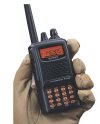
and before you know it, your bank account has been converted into this.
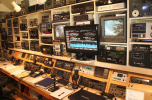
(NOT MINE, THANK GOODNESS!)
It's not uncommon for clubs to pool resources and build elaborate stations, often with a goal of competing well in contests. For a while I was part of a club at LockMart, and we had a good station installed on the roof of a tall building with some decent antennas.
VHF/UHF, where you should start, is used for local comms and for repeater access and requires a Technician license. You'll be limited to those bands and you'll have power limits, but there's still a lot of capability there. The next step up is a General license, which will allow you access to the HF bands and more power, and with that you can talk around the planet. HF radio waves reflect off layers in the atmosphere and can travel around the world. I've talked from Central Florida to the south Pacific, Japan, Russia, the Falklands, etc., using nothing more than a wire in my trees and a 100W transmitter. The highest tier is an Extra license, which opens up more frequencies for use.
It's pretty easy to get started with a Technician's license and a handheld radio, assuming there are repeaters in your area. Some repeaters are connected via the internet using Echolink, so if you have access to such a repeater you can connect it to a similar repeater across the country or across the world and talk all over. One of the snowbirds in our group lived half the year in Britain, and while he was there he often used Echolink to join our local repeater nets and ragchews.
In fact, if you get your Tech license you don't even need a radio to access Echolink. Just install the SW on your computer and you can talk over repeaters with a headset plugged into your PC. https://www.echolink.org/
BEWARE - it's not hard to start with this,
and before you know it, your bank account has been converted into this.
(NOT MINE, THANK GOODNESS!)
It's not uncommon for clubs to pool resources and build elaborate stations, often with a goal of competing well in contests. For a while I was part of a club at LockMart, and we had a good station installed on the roof of a tall building with some decent antennas.
- Joined
- Jun 11, 2015
- Messages
- 5,612
- Display Name
- Piperonca
- Home Airfield
- M52
Thanks - I realize now my station in Chu Lai (AB8AAD) had a log periodic beam. Didn't know the right nomenclature. I was never active after my service but still keep my license current. You never know, the bug may bite again (pun intended).... worked a lot of Marsgrams out of Heidelberg, where I was stationed, and used their log periodic to talk to the world.
Half Fast
Touchdown! Greaser!
- Joined
- May 7, 2016
- Messages
- 21,187
- Location
- Central Florida
- Display Name
- Half Fast
- Home Airfield
- KGIF
As they say, ham is a well-done rare medium.
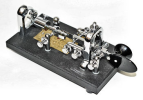
I wonder how many people still know how to use a mechanical bug.You never know, the bug may bite again (pun intended).
[][/]
- Joined
- Jun 11, 2015
- Messages
- 5,612
- Display Name
- Piperonca
- Home Airfield
- M52
You had to tune it like guitar or something. Several fiddly parts had to be just right. Only then could you use it with satisfaction.I wonder how many people still know how to use a mechanical bug.

Don't worry. Hams can be curedYou never know, the bug may bite again (pun intended).
I got my Amateur Extra back in 1988 or so back when you had to use 20WPM to get it. Before that I was a Technician class going back to the 70s. Also picked up the second class radiotelephone (now GROL) and the (formerly second class) Radiotelegraph tickets.
Ron N1RN
Formerly WN3SBS, N3AGV, KE2LG, and WO2L

RalphInCA
Cleared for Takeoff
- Joined
- Jun 1, 2014
- Messages
- 1,391
- Location
- McMinnville, OR
- Display Name
- RalphInCA
- Home Airfield
- KMMV
Did not read all the above responses, so this may be a repeat but… Ham is definitely not dead. Perhaps not as big as it once was but still pretty active.
Get into it if you enjoy technical challenges. It’s no longer a reliable way to communicate, and its value in a crap hits of fan situation is fairly limited as well since professional emergency service organizations no longer rely on us in most areas.
But from a “let’s figure out this difficult technical machine“ standpoint it’s a lot of fun.
Also, not sure if this was mentioned above, look into parks on the air. This is where you set up to operate from a park and talk to people around the world. That’s what I do lots and lots of fun.

 parksontheair.com
Get into it if you enjoy technical challenges. It’s no longer a reliable way to communicate, and its value in a crap hits of fan situation is fairly limited as well since professional emergency service organizations no longer rely on us in most areas.
But from a “let’s figure out this difficult technical machine“ standpoint it’s a lot of fun.
Also, not sure if this was mentioned above, look into parks on the air. This is where you set up to operate from a park and talk to people around the world. That’s what I do lots and lots of fun.
Parks on the Air | POTA | Parks program for amateur radio.
Parks program for amateur radio, also known as Parks on the Air (POTA), including a map and list of entities for the program.
parksontheair.com
- Joined
- Jun 11, 2015
- Messages
- 5,612
- Display Name
- Piperonca
- Home Airfield
- M52
Respect. Until now I never heard of anybody that did that.I got my Amateur Extra back in 1988 or so back when you had to use 20WPM to get it.
It took an effort. I was able to go from 5 to 13 WPM in about a month of dedicated practice. Took another three months to try to get to 20WPM, passable enough to get through the test.Respect. Until now I never heard of anybody that did that.