Good Source for AD's?

WDD

Final Approach
PoA Supporter
Joined
Oct 16, 2019
Messages
8,855
Location
Atlanta / Marietta
Display Name
Vintage Snazzy (so my adult children say)
Home Airfield
KPUJ
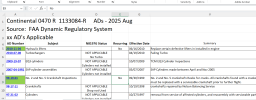
What are you all using for current AD's? I'm creating a list from the FAA Dynamic Regulatory System, searching on my model (C182 P), engine (0470 R), etc. Is there a better way I should be doing this?

Background: Since I now own a plane, I thought maybe I ought to be an involved owner and get smarter about what exactly I'm flying. Not that I don't trust the A&P I'm working with, but as the airplane owner I am after all the one ultimately responsible for it being air worthy. Was recently cleaning up the log books. Found a warranty card for a Tannis pre heater. From 1995, for an engine long ago replaced. Invoice for repairing a transponder replaced 10 years ago, a coupon for ChickFilA, etc. (OK, made up that last on). Also found lists of AD's from previous A&P's, but none of them matched 100%. So I'm creating my own list just to double check that all is current. I also want to cross reference the list to the log book entry that shows the AD was complied with.

Thanks!


1755352619003.png


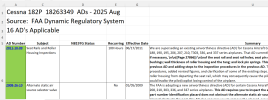
Here is the spreadsheet I'm building:
1755353531853.png


1755353370239.png
 
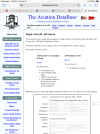
A fellow IA uses this system.. IIRC he said $28 for the list for 1 aircraft.

There are other “up-charges” you may want though.

I have the “ No New Patients” sign out so I use the Bi- Weekly portion

Of DRS. It goes back about 20 years.
 

Attachments

  • IMG_2522.png
    IMG_2522.png
    518.6 KB · Views: 38
DRS
Create a Compnenent Inventory of all items installed on the plane. Make, model, serial numbers, etc. Knowing the lineage of some companies will help you for older ADs. For example, Marvel carbs have been under multiple company names over the years, Volare, Precision Airmotive, Facet, Borg, Borg Warner.
Then go through each selection in the Make dropdown in DRS and look for applicable AD’s.
Once you have a list, pay attention to the bieeekly ADs as they come out to keep up with new ADs.

I keep an column in my AD spreadsheet for supersedures.
 
What are you all using for current AD's?
I have recommended the adlog system for years. It provides a managed AD system accessible to private aircraft owners. While the DRS is an option it requires you to have a working knowledge of Part 39 and its requirements and can lead to missed ADs to include Appliance ADs. Even as a mechanic I used a paid AD service vs the previous FAA RGL database or the current DRS. For one off or newly issued ADs the DRS works fine. And to add, the APIA is only responsible for AD currency at the time of inspection where you the owner are responsible for all ADs per 91.403 the remaining 364 days of the year.
 
Adlog sounds familiar, I believe it’s the one my current IA uses, and prior IAs have from previous owners based on the stack of paper in my logs.

If you want to go overboard, look up all the SBs even though those are only for commercial ops I believe? I have not done so, but would be interested.

Mine is also a 182p (1976), but also with different STCs and equipment.
 
Some folks are not aware that AD’s must be complied repeatedly and it may not coincide with Annual Inspections.Like Bell said; it is the responsibility of the owner to address these.

With these “Recurrent” ADs I have a separate sheet with the status of these ADs including when they are do and includes a signature. You must be able to provide CURRENT AD status ONLY. Providing a logbook where the
“ overfly” is apparent is not wise. With the “Recurrent Sheet” you can just toss it and just show Current compliance.. Entries can be on any format.

This was suggested by my FSDO as they really don’t want to make a big deal regarding 76 07 12 ( Bendix Switch) for example. Unless they need/want to!
 
You must be able to provide CURRENT AD status ONLY. Providing a logbook where the “overfly” is apparent is not wise. With the “Recurrent Sheet” you can just toss it and just show Current compliance.
By CURRENT I assume you mean any one time as well as recurring that applies to your airframe, engine, prop, etc. . Or are you saying - I don’t think you are - that the log book only needs to have a summary of the recurring ADs and when they were last recurred with?

Not sure what the phrase “overfly” means.
 
The Records ( not necessarily the Logbook) should be a compilation of all ADs for aircraft, prop, engine etc. They should be designated as n/a by s/n,
date mfg etc. For “ one-time” AD there should be an entry that states the who, what, how & when that is traceable to a signature. Most services provide a template for this.

Assume AD 76-07-12 ( Bendix Switch) is due every 100 hrs.

But your Annuals were 130 hrs apart and you did not do the Op Ck and
LOG-IT by the 100 hr limit. That means you “overflew” the AD by 30 hrs.
There could be grief if ramp checked or you had an incident.
You don’t want to volunteer this evidence. You do not want someone to make an entry at an earlier reading if they did not do the check. You can keep RECURRENTS on one sheet and toss it. When the AD is done you just begin a fresh sheet. You do not have to provide a history of superseded events; just show it had been complied with in the last 100 hrs. There are several ways you can do this. My preference is the separate RECURRENT sheet. Why would I want to keep records of this check for the last 50 years?
 
Last edited:
I use AD Toolbox. It’s like $450 and rock solid, I use it for multiple aircraft.
 
Magman
I think this is a great idea, however I can not find a A&P/IA that agrees with this!
The Records ( not necessarily the Logbook) should be a compilation of all ADs for aircraft, prop, engine etc. They should be designated as n/a by s/n,
date mfg etc. For “ one-time” AD there should be an entry that states the who, what, how & when that is traceable to a signature. Most services provide a template for this.

Assume AD 76-07-12 ( Bendix Switch) is due every 100 hrs.

But your Annuals were 130 hrs apart and you did not do the Op Ck and
LOG-IT by the 100 hr limit. That means you “overflew” the AD by 30 hrs.
There could be grief if ramp checked or you had an incident.
You don’t want to volunteer this evidence. You do not want someone to make an entry at an earlier reading if they did not do the check. You can keep RECURRENTS on one sheet and toss it. When the AD is done you just begin a fresh sheet. You do not have to provide a history of superseded events; just show it had been complied with in the last 100 hrs. There are several ways you can do this. My preference is the separate RECURRENT sheet. Why would I want to keep records of this check for the last 50 years?
 
I think this is a great idea, however I can not find a A&P/IA that agrees with this!
As you are the regulatory custodian of your aircraft records, you could request a specific format for your AD records. Now if your APIA uses an AD service that provides a pre-formated printed result sheet, perhaps offer to pay for his time to transcribe his result sheet to your AD format?

You can keep RECURRENTS on one sheet and toss it.
So how does that benefit if the ramp check or incident happens during the 30 hour overfight period? Plus once the annual is signed which includes a current AD sign off any previous issue becomes moot. I must be missing something?
 
You only have to provide records that show Current Compliance. If you volunteer records showing the 30 hour overflight it may not go well. This was suggested to me by my local FSDO.if you have a new List printed at every Annual it accomplishes the same. Just don’t give the Feds the old List too!

As most folks know there are ADs that may require several different compliance options. So “par 3 method B” may be much more involved than “par 2 method A”. Often Records only indicate P/C/W , C/W, or N/A with no other info. At best this can result in additional time by the current Inspector or at worst result in loss of airworthiness. My suggestion is to keep
records of this sort in a “Dead Envelope” that is not provided but is available if needed.

To illustrate the last paragraph I’ll refer to an AD on Ercoupe Aileron Cables.
These are only less than 1 foot long but control Ailerons, Rudder and Nosewheel steering. You can inspect the cables at 100 Hr intervals or modify the component as a One-time event. Interpreting records of a 100 hr event as a One-time can have dire consequences. The cables are “7 x19” which is
7 strands that each contain 19 wires or a total of 133 wires. I’ve encountered aircraft with 5 broken strands which means there is very little material left before loss of Flight Controls!

To perform the referenced AD the cables must be removed , inspected, reinstalled, re-rigged and the turnbuckles re-safetied. Access under the panel is limited. So often one persons entry with lack of detail so be misinterpreted at subsequent inspections until failure occurs.

btw- Generally having 3 broken wires ( not strands) may still allow flight.
This does vary in some cases but broken strands are never permitted.
 
You only have to provide records that show Current Compliance.
True. But part of those current records for ADs with recurring action is the time and date of the next required action. And if an ASI wants to see those records you need to provide them which will have that recurring AD due date and time listed in black and white. So still not seeing the benefit of a separate sheet?
 
I agree with what you say regarding “ next compliance due at” and Current Compliance. You do not have to provide “previous compliance done at” that would show 130 hrs. My impression is the ASI attitude was if you show me you overflew the AD I will have to take action that I really don’t want to bother with.
 
My impression is the ASI attitude was if you show me you overflew the AD I will have to take action that I really don’t want to bother with.
So your reason for a separate recurrent AD record is if an owner overflies a 100hr AD check by 30 hours prior to annual... and after the next annual is completed and signed... that some ASI may ramp check the owner and notices that the previous recurrent AD 100hr cycle was overflown due to the AD record shows a running count of all AD compliance... then does the math between the current valid AD cycle sign off and the previous non-valid AD cycle... and confirms the 30hr overflight... then that ASI would have to violate the owner for those 30 hours that are no longer applicable to the current AD cycle? Am I correct?
 
FAA takes a dim view on overflying ANY required inspection including ADs
Records of superseded events do not have to be kept; again including ADs.
Most of the time there will be no problem. But you never want to provide
the Feds with any evidence of any type of overflying. They will go to remarkable lengths if the attitude is “ Prove it”!

Example would be lengthy.
 
Has anyone ever been required to produce maintenance records at a ramp check? How would that work, when you aren't required to fly with them or even keep them with the plane?
 
But you never want to provide
the Feds with any evidence of any type of overflying. They will go to remarkable lengths if the attitude is “ Prove it”!
You do realize that the FAA has a 6 month window to find and deal with an issue for most regulatory violations. Then it becomes moot under the stale complaint rule. And given most AD services print out a new AD listing each time except for a few like ADlog, we are still talking about someone knowingly overflying an AD. And if it becomes a regular offense then perhaps that owner should request an AMOC to extend that AD to 130 hours. ;)

Has anyone ever been required to produce maintenance records at a ramp check? How would that work, when you aren't required to fly with them or even keep them with the plane?
I've heard about it and seen it happen but usually because something is noted during the ramp check. One even resulted in an Aircraft Condition Notice being issued. Usually the owner will be given a written request for aircraft records to be presented at the FSDO is "X" days or weeks.
 
I've heard about it and seen it happen but usually because something is noted during the ramp check.

Must have been quite notable. I've been ramp checked twice. Both at remote rural airfields. Both times they checked my airworthiness cert, registration, and pilots' license, and gave the cockpit a cursory glance. Less than 5 minutes total.
 
Must have been quite notable. I've been ramp checked twice. Both at remote rural airfields. Both times they checked my airworthiness cert, registration, and pilots' license, and gave the cockpit a cursory glance. Less than 5 minutes total.
What prompted them to target you twice?
 
What prompted them to target you twice?

Random dumb luck.

First was on a Saturday morning at KMEB in North Carolina. There were 3 human beings at the airport: me, the guy helping me jump start my airplane after an alternator failure, and the FAA guy. He was literally walking around the airfield looking for someone to inspect. His office was near the coast and he was driving back from a trip inland. I suspect he needed to log an inspection in order to justify claiming mileage.

The second was at a rural airport in central Georgia. I had landed to gas up. While I was there, a medevac helicopter arrived and met an ambulance to pick up an elderly lady. There was a group of people watching the patient transfer process. The helo blocked my ability to taxi from the ramp, so I pushed the plane off to the side and watched. One of the folks in the group came over, introduced himself, showed his ID, and asked to look at my plane. I think he just liked my plane.
 
I’ve been doing this longer than most so I’ve seen some odd things. Since this is public forum I have to be a little vague. One guy knowingly overflew an AD and Annual with an aircraft he did not own. Months later the aircraft had an unrelated issue and the Feds examined the records and discovered this. When confronted on the details of the flight he responded “Prove it!” It didn't take long to show him the motel receipts either.

Most of the Fed Folks are good people and deserve respect. His comment activated another bunch that specializes in investigation. I’m sure you’ve heard of them. The fallout continued with other folks getting tangled as well.Keep in mind there were no injuries involved.

Often I encounter folks that overflew Recurrent ADs between Annuals. I will not provide a false entry but I will toss their Record and provide one showing current compliance. I find that easier with the separate sheet.
 
One of the ADs cited in this thread is the 100 hour Cessna seat rail inspection. What do those who sign these off feel about just "no defects found" or similar? I have always felt that one should have more information than that - either actual dimensions or the results using one of the sets of go/no-go gages. There's parts on the rail and parts on the seat that require inspection and compliance. Higher utilization aircraft will need it between annuals. It's one you want right - you or a pax grabbing the yoke on rotation due to a slipping seat will have bad consequences.

As far as how to record the ADs, tend to start over with a new aircraft. This will require several hours of time reviewing the logbooks and what comes up on Adlog or FAA. Have found many ADs "PCW" which in fact still need a repeated sign-off - this is often when something was found to have cracked, some sort of SB/AD kit is applied, but the need to verify that it is still not cracked (again) down the road (each annual typically) has not been removed. A spreadsheet is generated in chronological order for the aircraft, engine, prop, and accessories on separate tabs. Recurrent ADs are highlighted in yellow; the comments column might specify how an AD was made to go away (NA by S/N, PCW, etc.) or the date/hours of the next inspection requirement for a recurrent AD.

Owners who resist having a thorough AD search either because of dollars or concern about lurking unknowns are not customers. After all, the same thing was theoretically done on their behalf when they purchased the airplane. Good news is the next year it's a breeze to document changes/needs.

Never quite sure what to do with abandoned STCs, meaning systems that might once have been installed, but which at the present time are removed but not documented or partially removed. Both seem to present conformity inspection challenges (aka annual).
 
What do those who sign these off feel about just "no defects found" or similar?
I see no problem with that terminology as any defect noted requires additional action. Regardless, if you as owner want additional info included in the sign off you are definitely within your right to request the mechanic to include it in the record.

Never quite sure what to do with abandoned STCs, meaning systems that might once have been installed, but which at the present time are removed but not documented or partially removed.
Technically, “abandoned” STCs have a regulatory definition which is different than this. However, any STC that was installed and then removed requires a specific process once they are removed. Or as you state the aircraft no longer meets its type design or properly altered version.

If the STC data package included restoration instructions, then only a simple logbook entry is needed to remove it. However, if there are no restore instructions, then a 2nd 337 is needed to remove it and recorded as needed. Usually any permanent STC provisions can remain as documented in the removal 337 so long as they don’t present an unairworthy issue.

Often I encounter folks that overflew Recurrent ADs between Annuals.
Often? While I think everyone deserves a mulligan when it comes to overflights, when they get to that level I think you may want to tell them to find a different mechanic or learn how to count.
 
Yes, was using abandoned differently - “no longer in use or functional yet still partly there.”

Restoration instructions are new to me - I I’ll see if can find any to learn.

Personally would want all of it gone as wouldn’t want to be saying that what’s left can’t affect airworthiness.
 
Personally would want all of it gone as wouldn’t want to be saying that what’s left can’t affect airworthiness.
STC restore are not common but worth a check in your documentation. Unfortunately, sometimes you can't feasibly or economically remove all the alterations from a STC. However, there are methods to deal with those type of issues. For example, we had a helicopter with a hole cut into its honeycomb floor panel per a One Time STC. We removed all STC part except the hole and merely fabricated "permanent" cover plates which were screwed in and sealed. But because the covers hid areas we added a 100hr/12mo inspection requirement to the removal 337 to remove the plates and inspect those hidden areas. But without specifics on your aircraft can't offer much more.
 
Steam: I use NOTES to track discrepancies and comments. Brake discs , Cherokee trim, etc may have a “recheck in 50 or 100,hrs” or similar.
Parts needed or other status items are included and sent to all involved.
Very easy to update and provides a good starting point for subsequent inspections. It is also a warning to avoid the shock of immediate compliance.

I have a large satchel that I used in pre iPad day that I used to carry ADs
Keep in mind the bi-weekly updates made it slightly heavier every 2 weeks!
I have kept it along with the Summary of STCs and other “stuff”. It comes in handy on rare occasions.
 
Steam: I use NOTES to track discrepancies and comments. Brake discs , Cherokee trim, etc may have a “recheck in 50 or 100,hrs” or similar.
Parts needed or other status items are included and sent to all involved.
Very easy to update and provides a good starting point for subsequent inspections. It is also a warning to avoid the shock of immediate compliance.
Think we are doing about the same thing with our notes and comments!
 
Back
Top