Engine Failure low Altitude

CherokeeDriver

Filing Flight Plan
Joined
Jan 5, 2026
Messages
6
Display Name
CherokeeDriver
I’m wondering what everyone else’s take is on this. We’re all taught aviate, navigate, communicate. Period. Fly the airplane.

Say we have an engine failure in a light single engine piston airplane, at low altitude.
 
I’m wondering what everyone else’s take is on this. We’re all taught aviate, navigate, communicate. Period. Fly the airplane.

Say we have an engine failure in a light single engine piston airplane, at low altitude.

Then you immediately aviate right into the most survivable spot you can reach.
 
I’m wondering what everyone else’s take is on this. We’re all taught aviate, navigate, communicate. Period. Fly the airplane.

Say we have an engine failure in a light single engine piston airplane, at low altitude.
How low is low. Everybody should know what their skills will get them without an engine at various altitudes (and positions). There's a transition altitude between when it is best to land straight ahead (or nearly so, my instructor would say, just what you see out the front window). There was an article back 40 years ago by David Rogers about how high you need to be before you can perform a well-executed return to the runway you departed from. That was lower than the "conventional" wisdom, but you need to execute it well.

The answer either way is likely GET THE NOSE DOWN so you maintain best glide speed. Then figure out where you're going. Then go there.

I had an engine failure right after takeoff (flying Young Eagles even). There was nothing really straight ahead that looked palatable, but off to my left I could see the airport access road. As I turned to line up with that I noticed I had a huge paved ramp area that was empty. Even better. And then finally, I saw I had enough altitude to make the runway. Fortunately, the guy taking off behind me heard my radio call and bugged out quickly. As I'm lined up about 150' AGL over the runway, I'm thinking "Now, what am I forgetting.... Oh yeah, gear." Luckily it comes down fast in the Navion. The biggest problem was that I was still drifting a little sideways on touchdown and rolled the tire off the rim.

Of course, if you're in a Cirrus, you're decision point is the minimum CAPS deployment altitude.
 
Some thoughts on this less than a year ago ...

 
I’m wondering what everyone else’s take is on this. We’re all taught aviate, navigate, communicate. Period. Fly the airplane.

Say we have an engine failure in a light single engine piston airplane, at low altitude.
Do not stall / spin would be my first advice.
 
I'll do anything and everything to make sure everyone inside the airplane remain in good health, and the airplane belongs to the insurance company. I will try to avoid people on the ground.
 
How low is low?

I was doing an intro lesson. Just before we took the runway, I did a verbal takeoff briefing, part of which included landing on the remaining runway with loss of power. We took off and quickly realized we were not developing enough power. I tweaked the mixture (we were in Colorado) and when that had no effect, I pulled power and landed on the runway.

Potential student loved it. Thought it was so cool.
 
Last edited:
You don't brief for that on every takeoff? Interesting. In gliders we practice for it (frequently).

With the Grob 103, Vref is 65 plus half wind and six if the air is choppy. Know the number before you give the signal. At rope break (I guess that would be full loss of power) assume the attitude for Vref. Under 200 AGL land straight ahead. A little before 600 depending on the weather you can turn back and land with the wind on the runway. Over 1000 you can fly an abbreviated pattern.

We also brief the practice area / anticipated route and have every potential out landing spot noted on our map.
 
"We have an engine failure in a light single engine piston airplane, at low altitude."

Welcome to PoA! "Do you like movies about gladiators?"
No, but sitting through GENG 135 was like a Turkish prison.
 
Always place the nose lower first, that needs to be instinctive. Down low (i.e., <200' AGL) your brain and eyes need to immediately determine the best (most survivable) a place to make contact, then calculate the flight path needed to get there, and touch down. Flying the plane into a quickly determined contact point is necessary. And doing it without panicking, pulling back, then stalling somewhere nearby above it may be tough to do, but it's necessary.

Regarding taking the time to preform the mental and physical process of establishing a best glide speed should depend on the altitude, terrain, engine (rough or stopped) and features viewed outside the windows... in other words, the time it takes to get to best glide is not a priority down low. That takes away from the time your brain needs to find a survivable location, fly towards it, then make contact at the lowest airspeed possible. It's purely visual, and all stick and rudder.

Best glide to attempt to reach a more distant location is likely not a good idea. Certainly not if a survivable location is real close. From less than 200' hopefully there will be one. Take it. Trying to stretch a glide to somewhere better, and coming up short is a popular killer.

Sticking the nose between two tree trunks could be your best spot. Get there, and leave room to float whatever distance you choose to lower airspeed before contact.

 
Do not stall / spin would be my first advice.

Advice? I thought that was in the FARs…

Tools, who ALWAYS follows the rules.

BTW, engine failure simplifies things, like being surrounded. It’s an undetermined power loss that is much more interesting.
 
You don't brief for that on every takeoff? Interesting. In gliders we practice for it (frequently).

With the Grob 103, Vref is 65 plus half wind and six if the air is choppy. Know the number before you give the signal. At rope break (I guess that would be full loss of power) assume the attitude for Vref. Under 200 AGL land straight ahead. A little before 600 depending on the weather you can turn back and land with the wind on the runway. Over 1000 you can fly an abbreviated pattern.

We also brief the practice area / anticipated route and have every potential out landing spot noted on our map.
My Favorite video on this...


My comment is it wasn't an emergency procedure it was just a procedure as rehearsed.

Brian
CFIIG/ASEL
 
“My place is easy to find…it’s got the only two trees for miles around.” :rofl:
reminds me of a guy I used to work with that was an observer in OH-58. They had a mission patrol something like 100miles section of the southwestern US. In the section they were patrolling there was exactly 1 tree near middle of it. They decided to set down next to the tree and have lunch, hovering near the tree, a gust of wind caught them and put them into the tree with expected results. While waiting for the recovery crew and eating their lunch they (mostly the pilot) were contemplating how to explain how the hit only tree within 100miles of them.
 
You don't brief for that on every takeoff? Interesting. In gliders we practice for it (frequently).
In twins yes because there are decisions to be made. In most singles, you pretty much just have to avoid stalling and prepare for landing.
 
I’m wondering what everyone else’s take is on this. We’re all taught aviate, navigate, communicate. Period. Fly the airplane.

Say we have an engine failure in a light single engine piston airplane, at low altitude.
I haven't practiced that since Monday! At the altitude we "lost" the engine, I wouldn't have even tried a restart, so I immediately picked a spot and did the required maneuvering.
 
If really low, you land straight ahead~ish. I don’t see the real question here.
The rest of my post didn’t go. I was asking if I should fly the thing or attempt to shut anything off. Obviously no time to troubleshoot.
 
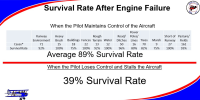
I'm amused that the runway is only 92 (of course, I'm not sure how that meshes with Short of the RUnway.

Put me in the 100% survival rate, sample size of two: one on the runway, one in a pasture (though I did go through the fence at the end).
 
I'm amused that the runway is only 92 (of course, I'm not sure how that meshes with Short of the Runway.
I define "Runway Environment," as being anything within the airport bounds (although buildings are counted in their own categories).

Some examples:

WPR18FA131: As the airplanes approached the airport, the accident pilot transmitted a "mayday" call and reported that he was going to land on the runway located directly ahead of his position. The airplane began to descend while performing an S-turn, and touched down beyond the midpoint of the 9,000-ft-long runway at a slightly higher speed than normal. A 4-knot tailwind prevailed on the landing runway about the time of the accident. A 1,200-ft-long series of propeller strikes on the runway were consistent with the pilot applying heavy braking after touchdown. The airplane veered right as it reached the end of the runway, entered a gravel area, nosed over, and came to rest inverted. Given the airplane's nominal landing distance in addition to the factors that increased that distance on the accident landing, namely, remaining runway at the time of the touchdown, the airplane's higher landing speed, and the tailwind, the pilot would have had very little margin for error before the airplane's landing distance required exceeded the available runway. The vertical stabilizer collapsed when the airplane nosed over, which resulted in the canopy structure contacting the ground and subsequently failing. As a result, the pilot's head was impinged at an angle against the ground, resulting in airway restriction. The pilot's extraction from the airplane by first responders took about 45 minutes, and during that time, the pilot died of asphyxiation.

WPR17LA054: After reaching 100-200 ft above ground level (agl), the engine experienced a loss of power. The airplane made a steep turn back toward the airport and collided with terrain, coming to rest on flat, soft vegetation on airport property. The accident site was located about 1,650 ft from the departure end of runway 07. The front-seat pilot survived the impact but died in the hospital later that day.

CEN13LA299: The private pilot was conducting a personal flight in the amateur-built airplane. A witness reported that he saw the pilot start up the airplane and take off. Just after becoming airborne, the airplane impacted a berm on the right side of the runway, spun 180 degrees, and then came to rest. A postcrash fire ensued, which consumed a majority of the airplane.

Ron Wanttaja
 
Cherokee Driver"

After "do not stall!":

Fuel selector OFF. you might prevent a fire (committment to land).
Master off.
Fly the thing all the way down 'till done.
Shoe in the door
You're probalby flaring by the time you get to "shoe in the door"....in between tree, into a fence, whatever. It happens VERY VERY fast.
 
Last edited:
Back
Top