EIS and Stormscope Interference

BigghHauss78

Pre-Flight
Joined
Aug 15, 2025
Messages
55
Display Name
BiggHauss
POA,
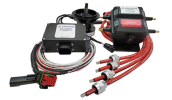
Last year I had installed and Electroair EIS in my 182R. Since then, my WX-950 Stormscope is picking up the spark plug lead noise and plotting it as ghosts in front of me. Apparently this is common. And to confirm, I've already done all the troubleshooting regarding isolating the noise to when ONLY the EIS is turned on. The axis of the various plots coincide with the left and right side plug leads. I'm using the provided leads that came with the EIS. They are brand new so in good shape. New plugs, etc. We have multiple grounds setup per Electroair recommendations from Coil Pack to frame. EIS controller to frame. Etc. The Coil pack is mounted pilot side, lower firewall. Leads run to bottom plugs well clear of any other electrical lines (left side upto the cylinders. Right side behind and below the engine and up to the cylinders. EIS controller is on top of glove box Co-pilot side behind the panel. It's a very 'clean' installation based on what I was told.

My WX-950 antenna is just right of centerline under the the area between the front and back seat Co-Pilots side. The display is on Co-Pilots side, upper right panel. It appears to be well grounded. Wire's in good shape. Not running parallel with any significant electrical loads. But whenever my EIS is on, I get hits at roungly 10degrees and 350 degree's in front. More RPM pushes more hits, and adds them further away.

Any ideas on what I could do to remediate this issue??? I like the WX-950 for my usage. It been reliable up to the point I installed the EIS. Now it just picks up all that noise. Would moving the antenna further back, work? My only concern there is i have an AP servo motor between battery and Tail. Will that affect the scope? Other ideas??? Local shop doesn't have ability to help me out, so my A&P said he would help me if we can find a good next step, hence the question.

Thanks!
 
Are the leads shielded? Even if they are, a second set of shields might improve things.
 
They are how they came from Electroair. I'm not even sure how would I add shields to these, so please explain! Is that legal? I do know that my leads must be separated from each other as required in the STC. So we did put spacers throughout the ignition lead runs.
 
They are how they came from Electroair.
Like this? They definitely do not look shielded to me.
1774992317837.png
I'm not even sure how would I add shields to these, so please explain! Is that legal?
That is a discussion between you and your A&P, but I would consider that a minor alteration.
You'd have to add braids over the leads and ground them at both end. Might be worth a conversation with Electroair. Reading online I see a few others have had issues.
 
Last edited:
I will add that my experience with Electroair support has been severely disappointing on many fronts. I've had continual issues with my EIS results and have tried to work closely with them to find a solution to my specific issue. Their response has been to deflect/defer/ignore and rpoint me to my installer. He, however, has been nothing but a champ trying to help make this system run right! He is really smart on it, and seems to want to try and do anything we can to fix the issue, including he worked on getting my controller adjusted to try and move forward. I feel the support from Electroair is more like 'its not our system because it's perfect. Must be your install, your engine, or something you did!'

So, to answer your question, I have not reached out to Electroair on this subject. I'll try but am expecting to get a less than stellar response.
 
So, to answer your question, I have not reached out to Electroair on this subject.
Thats a shame they dont support their product. I don't know the WX-950 but have worked issues with the WX-500 years ago in helicopters. I can go through the 500 T/S steps I used if you want, but there's no shortcut and it will require the removal and possible disassembly of the existing system. And more than likely in the end you'll need a replacement antenna cable, or the materials to remake a new antenna cable. But since you're confident on the noise source, it shouldn't take long to figure out the solution.
 
You bring up a good point - Could I have an antenna cable that is somehow more susceptible to the RF noise off the EIS? I guess I hadn't considered that direction purely because it was working fine PRIOR to EIS install. I guess I would consider that a possibility, but it seems there is quite a bit of evidence of EIS interference with Stormscopes in general, so I'm thinking its a low probability issue all other data points considered.

I feel like the antenna is doing its job and is seeing the noise generated off the EIS and plotting it accordingly. The fact that its soo closely tied to EIS On/Off that I hadn't really considered anything else. EIS On...hits on the WX-950. EIS off, no hits on the WX-950.
 
Could I have an antenna cable that is somehow more susceptible to the RF noise off the EIS?
No really. More likely you put a new electromagnetic field source in the middle of the sensor range. One of the important parts to installing a stormscope is that you need to map out its potential antenna locations as it will sense any type of electromagnetic fields, not just RF. Even the minute electro-fields found in some aircraft groundplanes will be picked up.

Does the 950 have any service screens in the menu? Look for the noise monitor screen and use it to verify without a doubt its only your EIS making that noise. Also look for a 950 installation manual as it will give you more instructions on those service screens if they are there. My guess, unless other issues are noted during troubleshooting, you'll need to relocate the antenna to a different location or remove the EIS. However, moving the antenna can also create new problems depending how your aircraft EMI signature maps out.
 
Bell, Fair question. To answer, there are no errors on the system. I've been through that, along with the manual, extensively. Dialing it into the EIS is the result of all that effort. The question for me is now, at this point, will moving the antenna back solve the problem? Or is the EIS that strong, that moving it is not an option. If so, then what can I do? Which is where I am now.
 
Quick search of the interwebs reveals a couple other conversations of radio interference, with one apparently solved when they got "better shielded" (different resistance, not shielded) ignition wires.
As I stated before, they do not look shielded to me. They seem to rely on an internal resistive core to dampen some of the radio noise, but that is clearly not enough for your application.
If you compare that to your magneto ignition harness, it's easy to see what shielded ignition looks like. My opinion (take it for whatever it's worth) is that you l'll need to look into shielding those eires to get any meaningful results.
 
To answer, there are no errors on the system.
And you wouldn't typically see any errors with this as the systems is working. So based on what you stated, you used the Noise Monitor screen to determine the EIS was the cause? Will moving the antenna fix this? Probably. But I would first make sure its wasn't being triggered by the 950 power or ground circuits. There is Stormscope test equipment still available called skin mappers but they're pricey and only check for radiated EMI. Now if you can build a second antenna harness long enough to put the antenna on different locations, then you can look for an optimum place to move it to. As I noted there are no shortcuts to fixing this problem if you want to keep both the stormscope and the offending equipment.
 
Reply from Electroair is to not shield their leads. They further explain that will lead to radio noise issues when shielding high energy ignition systems, thus I am to avoid leads that use an outer jacket for shielding. Their system uses an 8.5MM spirol core wire for this reason.

I received a tech response recommending the use of the Skinmapper. Ideally this would be perfect, but yeah, its expensive, and I don't know anybody who has one around here. You're idea of maybe building a longer harness to just try and find a quite space is notable and may be something my A&P would be willing to explore. Regarding the noise monitor screen, I have not delved into that screen as the obvious culprit seemed to be the EIS. Basically, EIS On...strikes appear on scope at the correct bearings to each side of the engine from the antenna itself. RPM increase, strikes increase and extend further out along those axis. EIS OFF, strikes no longer appearing on the scope. My only delve into the service menus is to check for any startup or faults, and none of them are being reported.
 
Regarding the noise monitor screen, I have not delved into that screen as the obvious culprit seemed to be the EIS.
The noise monitor screen does not have the filtering and processing done to its results as the strike and cell screens do. The noise screen is designed to troubleshoot these issues and I highly recommend that you delve into that part of the install manual and use that screen to verify what you have found using the other screens and that there is not a secondary issue involved as well like the power or ground circuits. But its your time and money. Best of luck.

You're idea of maybe building a longer harness to just try and find a quite space is notable and may be something my A&P would be willing to explore.
FYI: If you go that route, its important to maintain the integrity of the ground plane for the antenna when moving it to different locations.
 
Bell,
Thanks for the advice. I'll dive into that portion of the manual and see what it produces. I'm assuming it's all laid out in the manual. Maybe there is more to this issue, and it will uncover some information that I'm not aware of! I appreciate the assist.
 
Do you fly IMC much?
A strike finder is really great to have on planes that fly IMC but don’t have real onboard radar. I’d probably return the electric invitation system and go back to bendix if I flew much in weather or night.

Like this? They definitely do not look shielded to me.
View attachment 151176

That is a discussion between you and your A&P, but I would consider that a minor alteration.
You'd have to add braids over the leads and ground them at both end. Might be worth a conversation with Electroair. Reading online I see a few others have had issues.

Those look a lot like automotive leads

Personally I’d return it and get a better system, you shouldn’t be having these issues if it was designed properly
 
Last edited:
Reply from Electroair is to not shield their leads. They further explain that will lead to radio noise issues when shielding high energy ignition systems, thus I am to avoid leads that use an outer jacket for shielding.

I have dealt "a little bit" with electromagnetic compatibility. Never once a case of radiated interference was made worse by shielding, IF the shielding is done right. And by done right I mean proper shielding braids and wide braided conductors grounding the shields. A long piece of 22ga wire won't do anything for a shield ground at high frequencies.

Case in point: if you're ever around a small turboprop or helicopter when they start, you'll hear some loud pops coming out of the engine before it lights off. Those are the engine igniters, and they are proper high energy. They're also well shielded and don't create radio noise or other interference.

What I do suspect is that the insulation on the electroair harness is a bit marginal (hence the spacers) and they are concerned a grounded metal shield so close to the leads will at a minimum cause arcing (which could create radio noise, along with other issues).

A little experiment you could do with your mechanic, if you see this issue on the ground as well: close off the bottom of the cowl with wire mesh and metal tape (take protective measures so you don't damage the paint). Perform an engine run and see if the problem goes away.
 
After nearly 40 years following the installation of a faithful WX-950 (purchased slightly used), the unit finally needed repair.
Up until that point I considered the unit amazing, and totally bulletproof.

Also, the last round of new paint covered its antenna, which is clearly marked "Do Not Paint", but it seemed to work normally afterwards. FWIW, kept it turned off throughout each winter, and only turn it on when it was anticipated to be needed.

It was less expensive purchasing a working used unit w/antenna, cable and guarantee from Valentine Aviation. Don is truly the Stormscope expert. You may consider giving him a call about your situation (hope he's still in business):

Don Valentine
The Stormscope Specialist
Valentine Aviation
2024 W 15th St
Ste F #367
Plano, TX 75075
972-495-3284 phone
972-638-5846 fax
[email protected]
www.valentineaviation.com
Aircraft Electronics Association Member
www.linkedin.com/in/stormscopes

One other tidbit which in your situation could be useful. When we installed the antenna, there was some corrosion around the mounting plate that needed to be cleaned up, likely preventing a good ground to the airframe.

The used WX-950, cable and antenna purchased from Don is working great about 5 years later. A lot of pilots consider Stormscopes (all models in general) useless, but I strongly disagree about batching this model in with the older models that don't cluster the various intensity lightning discharges into cells, when desired.
 
"Do Not Paint"
A lot of paint has metal (or metal oxide) flakes in it. That would definitely have an impact. Your paint most likely didn't, but the vendor has no idea what paint will be used, hence the generic "Don't!".
 
Just an update: I went out this weekend, and got into the service menus further as suggested above. It turns out the unit is returning Error 17 which correlates to a noisy location. Further, I did run the Noise monitor extensively and the EIS is the absolute culprit with my noise issues. I have a very periodic Alternator hit....like 1x, usually when turning it on or off. However, as soon as the EIS is energized, the whole things starts to populate, and continue to populate with hits. I have been in contact with Don and he's helped me with a few suggestions as to what to do. I also have a Skinmaper coming my way, so most likely this will come down to a location issue with the antenna. The EIS just gives off soo much noise. I'm fully expecting to move it aft back where the tail starts to curve upwards. This seems to be the preferred location anyways, so I'm hoping just a move somewhere else will put this issue to bed.

Regarding the advice to just return the EIS is nothing that i would consider or frankly helpufl. The cost are already spent and sunk, and at this point, the performance improvement outweighs the stormscope issue, so that piece of advice really doesn't really provide me much. Plus, I'm not one to quickly make the determination that everything is junk and should just be tossed.

Regarding the question about flying IFR - I'm wrapping up my IFR ticket now. My desire to keep the system is simply because I have it, and the stormscope can provide additional info and guidance regarding size and direction of convective activity to help avoid. My instructor feels it's definitely something I should keep and I agree.

Antenna painting: Not sure. Mine looks to be in really good shape. I've never painted it, so I don't know the absolute status, other than it was working prior to EIS install with no issues (except the occasional random strike).
 
Antenna painting: Not sure. Mine looks to be in really good shape. I've never painted it, so I don't know the absolute status, other than it was working prior to EIS install with no issues (except the occasional random strike).
Glad to hear Don is still around and was able to offer suggestions.

Regarding paint on the antenna - I believe most of the WX-950's are constructed out of a white shiny plastic. It should be obvious if painted (even white) by scraping off a little and noticing what if anything is underneath.

I agree with the advice to keep it. Although not as tactically useful as it once was prior to in the cockpit NEXRAD or XM, it does offer instantaneous display of lightning strikes at the earliest phase of thunderstorm development. Many minutes before it can possibly be shown on NEXRAD or XM.
 
“Regarding the question about flying IFR - I'm wrapping up my IFR ticket now. My desire to keep the system is simply because I have it, and the stormscope can provide additional info and guidance regarding size and direction of convective activity to help avoid. My instructor feels it's definitely something I should keep and I agree.”

That’s a old system do you really need it.
Having a lot of WX10A experience with Florida thunderstorms and the learning curve is long.

I’d caution trusting that technology until well understood through many hours.
To me your spinning your wheels since real time radar returns are available in the cockpit nowadays.

My used airplane came with a WX10A and I flew it for a year or two. Following an experience (in Florida) where the radial spread was hiding additional storms located behind a closer storm which was clearly displaying lots of lightning in that direction. At that point the realization hit... the radial spread presentation was a significant weakness of that model's design, and not nearly as useful as I expected to use for tactical changes in routing.

Jumped at the opportunity to dump the WX10A and purchase a slightly used WX-950 with an algorithm that included a reliable method of displaying cell clusters downstream behind an active cell(s). There's a world of difference between those two models.

FWIW, I wouldn't consider any ground based weather radar returns to be "real time". Many GA pilots consider yellow and red colored displays to be definitely convective in nature and must be avoided at all costs and a wide margin, often resulting (IMO) in a lot of unnecessary zig-zagging and/or large deviations in direction.

Flying within a stable airmass with varying intensities of rain (as shown on radar) can be done safely, and in smooth conditions, if you don't mind the potential for a loss of paint on the leading edges. Definitely keep away from the red, especially in areas where there is a green to yellow to red gradient in a short distance, as that likely is an indication of heavy rain, turbulence and a potential for dangerous convection.

A Stormscope instantly shows the direction towards the dark side of an atmosphere that is not (or no longer) safe to approach, by showing the first early lightning strikes out there in real time, before it begins working its way through the ground based computer system and finds the way into the cockpit.
 
Back
Top