Zeldman
Touchdown! Greaser!
Interesting that they upgraded the tach to the same one I'm using, and I don't see a speedo.
I didn't even have a tach on my race cars. Just a RPM limiter.
But a big giant tach and shift light impresses the teenagers...


Interesting that they upgraded the tach to the same one I'm using, and I don't see a speedo.

I didn't even have a tach on my race cars. Just a RPM limiter.
But a big giant tach and shift light impresses the teenagers...
Wasn't your racing more drag racing, though? To me the tach is the most important driving instrument.
I went drag racing one summer on a whim when a race gas customer had a front engine dragster for sale. The fun kind of left me when it took longer to get into the cockpit than it took to make one run through the 1/4 mile....

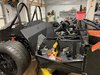

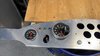

The part where drilling a hole is a full commitment is always the hardest. Stuff in the bowels seems to matter less than the dashboard. Looks great!


I like the progress and write up. Thanks for taking the time.

I like the progress and write up. Thanks for taking the time.
My thought has always been that the battery disconnect switch should isolate the battery from everything else. It is to isolate the battery from potentially damaged wiring, so the battery doesn’t cook off and explode on top of everything else.

Yesterday evening I managed to get another few holes drilled and wires made. At this point I've got the master kill switch sitting in place and made the wires going from it to the main fuse box (with its 100A protection fuse), the fuse for the AC compressor, and the battery. I made the alternator to starter wire, and drilled the holes for the battery mount. So all of that is coming along.
One thing I'm trying to figure out is how I want to wire the starter/alternator wire with respect to the kill/battery disconnect switch. My thought is that it needs to be on the same side as the battery. Otherwise, if I hit the disconnect with the engine running, the alternator will continue to power the ECU/ignition and it won't kill the engine. Of course I also have the key which will shut off power, so it depends on what I want the function of the kill switch to be.
One concern of mine is running a consistent 50-150 amps through the switch, which is what it will see in normal operation. I think that with the water pump, ECU, ignition, and fuel pump, 40-50A is probably a reasonable normal operation, and then add in AC, electric fan, and you're easily over 100A. But maybe that just means I need a better kill switch than the one I bought (which admittedly I'm not convinced is the best - it's also a part that's not too hard to replace).
Sometime today or later this week I intend on getting the AC hoses made up, at which point I can really start making things come together.
That's exactly the sort of point I was looking for. Isolating the battery it is. The key is the way to kill the engine. Thanks.
This afternoon I ran up to the hose shop and got my AC hoses made. This afternoon I might take a social isolation motorcycle ride to my friend's house to get my AC vacuum pump back and borrow his gauges so that I can get the system sucked down, filled, and (ideally) running. I figure what I will probably do is get the system together, pull a vacuum on it, let it sit overnight or longer - I'm not in a hurry like I was when I did AC work at the shop. Meanwhile, fill the cooling system with water, make sure that it seems to not be leaking, including when pressurized and the water pump is running (benefit of an electric water pump). Once that's all confirmed, add the freon. Even if I don't run the compressor yet at least then the system is properly set up and has freon in it.
This is the kill switch we used: https://www.pegasusautoracing.com/productdetails.asp?RecID=1464 . It's rated at 100 amps continuous and 500 peak. Back when I was racing the other choice was the Lucas kill switch, which occasionally worked a little too well, as was expected considering who made it. The main point of failure was that water leaked down the shaft and corroded the copper disk that connected the two poles. The switch linked to here, which is made by Merit, never let us down, and it's configured for an alternator.
A social isolation motorcycle ride sounds good about now. I don't have access to a motorcycle, but it's going to be in the 80s on Sunday, and I do have a Waverunner, and I think it just might get launched for the season Saturday.

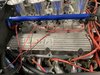

Well, remember that the engine thermostat won't be open, so running the electric water pump won't push water everywhere. May just want to run the pump after the engine warmed up so that you could cycle water pump after shut down if desired, or remove thermostat (kind of decreases the purpose of bleeding system though).

I know this is really late to this party... but I just read this today and I thought about your project:
https://www.roadandtrack.com/car-culture/a33010324/ford-73-liter-godzilla-v-8-crate-engine/
Maybe for the next one!
Oh believe me, that engines been all over the Factory Five builder Facebook group. Not what I’d put in, but someone will.
A 7 liter cast iron block engine isn't going to do anything good for the car's weight distribution.
Header wrapping is a little difficult to master and time consuming, but well worth the trouble.
My cousin just took delivery on the F350 with one of these. This is the motor that converted him from diesel.Oh believe me, that engines been all over the Factory Five builder Facebook group. Not what I’d put in, but someone will.