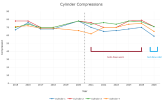
Cylinder compressions: readings on hot v cold engine

ArrowFlyer86

En-Route
PoA Supporter
Joined
Jul 17, 2019
Messages
3,285
Location
Around
Display Name
Flight
Normally during annual we take compressions on a warm engine. This year the new shop I went to did it cold. Didn't notice til I flew home, reviewed the annual write-up and saw the numbers, and on the cold engine they're a bit lower. The IA wasn't concerned about their levels, but as the owner I kind of want to do another compression test on a warm engine with a local shop and just log it in there (and also just for my own peace of mind I'd like to know the levels are fairly consistent). Helps to have a comparable series over time. Is there any reason not to do that and log it?
 
I don’t think I want to pull a plane parked all night off a 0°C ramp and do a compression check, but pulling it off a ramp with temps >25°C the last 24 hours and running the check is not a problem.
 
I don’t think I want to pull a plane parked all night off a 0°C ramp and do a compression check, but pulling it off a ramp with temps >25°C the last 24 hours and running the check is not a problem.
Yeah, I am a little focused on consistency (maybe needlessly so). In the Lycoming spec it appears specific in how to perform it. But to be blunt, I don't have the experience to know what the marginal return between doing it when ambient temps are warm-ish to when the engine is run to the spec below. But cylinders dropped by like 6-10psi each with this shop doing it cold, which concerned me -- though it did not concern the A&P or IA.
1787326280541.png

If you already have a compressor, buy a differential gauge and do it yourself. Less than an hour of shop time.
I thought about that because it's cheaper to get the differential tester than it is to have the shop the whole procedure, and then I can do it whenever I'd like (already have the air compressor). Ironically it was your recent case (I believe it was you who wrote about it?) where you had an incident while doing a compression test with the prop? That made me a little apprehensive about doing it myself without having someone walk me through the procedure first.
 
The outside air temp is -5F. How do you get the engine oil and cylinder temps to normal?
 
The outside air temp is -5F. How do you get the engine oil and cylinder temps to normal?
Go fly the airplane hard AF for 30 mins and try to get it as warm as possible? Or... You wait for a warmer day :)
In this case I'm not really bounded by OAT to get a reading that complies with the instructions. Not saying those cases don't exist, but it shouldn't be a factor here unless I wait 4 more months for a Chicago winter to do the check. But I concede some cases you probably just have to live w/it and take the reading at ambient hangar temps?
 
The compression check is good to detect immediate problems (like a valve issue) and allows one to track long-term trends. However, I don't think having *one* test on a cold engine (vs. previous ones done warm) is a reason to re-do the check, as long as the cold values are in the desired range.

The compression tests on my C-85 have been done cold since before I owned it (same A&P doing the condition inspection for the previous owner). First year I owned it, a valve wasn't seating right, which definitely showed up on the compression test (not to mention hearing the hissing inside the cylinder). Since that was fixed, all the compression tests have come out 80/75 or higher, cold, with four different A&Ps.

Warm tests are useful if the readings are coming out low; you may be able to get the reading above the threshold. If it tests OK cold, don't spend the money to re-do it. Just remember to do it warm next year.

Ron Wanttaja
 
However, I don't think having *one* test on a cold engine (vs. previous ones done warm) is a reason to re-do the check, as long as the cold values are in the desired range.

Warm tests are useful if the readings are coming out low; you may be able to get the reading above the threshold. If it tests OK cold, don't spend the money to re-do it. Just remember to do it warm next year.
Yeah, that's why I'm looking to get another one done. The values declined to a range that I'm not happy with, even if the IA is content. Here's the Lycoming's guidance for reference. If it doesn't test great when done w/specified procedure, then I'll get more concerned.

FWIW, here's the compression chart (bought it in 2020 and did a bunch of engine work). I've flown it ~150hrs a year since buying, except 2026 where I did about half that.
1787333178386.png


Thanks. That was one thing I'd read a while back and why I didn't put too much stock into this test as a perfect diagnostic. Everything else on the engine is fine: makes full power, no metal, no other weirdness during operation. As much as I don't want to read TOO much into the test, that can be hard to do when it's the latest data point available. Easier to look in retrospect and an anomalous reading and write it off as an aberration. Harder to ignore (for me at least) when it's the latest read on the engine.
 
Yeah, I am a little focused on consistency (maybe needlessly so).
And that is your right as the owner. However, guidance for performing this test can vary, to include the variance of what are acceptable results. For example, some state to run the engine to ensure the cylinder walls are properly lubricated vs temp related; with others stating lower than 65/80 is not good with no daily equipment calibration, and others using a daily calibration, can be 50/80 and still acceptable. I look for readings 70/80 and above whether hot or cold. Less than 70 and we will need to look further regardless the engine type.
 
And that is your right as the owner. However, guidance for performing this test can vary, to include the variance of what are acceptable results. For example, some state to run the engine to ensure the cylinder walls are properly lubricated vs temp related; with others stating lower than 65/80 is not good with no daily equipment calibration, and others using a daily calibration, can be 50/80 and still acceptable. I look for readings 70/80 and above whether hot or cold. Less than 70 and we will need to look further regardless the engine type.
I'm curious, where does that guidance vary? Is that engine manufacturer publications where they put out multiple methodologies or interpretations, or do different sources suggest different procedures+interpretations? I would think Lycoming publication would reign supreme as the authoritative read on the engine health, but maybe I'm thinking about it wrong.

And also wondering when you draw a line at 70, if something measures in at say 62, what do you need to see in order to be comfortable with it? Or is no scenario acceptable below 70 and some remedy needs to occur to bring it up? Or does it just depend?
 
I'm curious, where does that guidance vary?
AC 43.13-1B: <60/80 pull cylinder to investigate; >60/80 okay
Lycoming: 70 and above good; <65/80 recheck every 100hrs; <60/80 remove cylinder to investigate; or if 10 psi difference between a cylinder(s) investigate further
TCM: requires minimum leakage value calculation via tester set up prior to test which depending on ambient conditions can range as low as 48/80 and possibly lower?

I would think Lycoming publication would reign supreme as the authoritative read on the engine health, but maybe I'm thinking about it wrong.
Per Part 43.13(a): the guidance points to OEM manuals and ICAs, or methods acceptable to the Administrator. So yes the Lycoming reference would be the preferred one, however, that rule also allows the use of other references as well. For example, if I'm troubleshooting a stubborn Lycoming low pressure cylinder I will use the TCM calculation to validate other readings, which would still be legal under that rule as it is an acceptable method same with the AC method.

And also wondering when you draw a line at 70, if something measures in at say 62, what do you need to see in order to be comfortable with it?
Either correct it back to 70 or figure out why its at 62, which would include knowing if the 62 was a sudden drop or was it 66 last time. If it was a sudden drop or I couldn't get it to increase back to at least 66 without removal, I would usually pull it for a detailed leak check and inspection after discussion with owner.

 
For what you are talking about you would be well served to buy your own and do the tests yourself. That way you can check it the same way each time with the same tester each time. The more variables you can control the more meaningful your results.

It is really not a hard test and it is impossible to get wrong in the sense that something in the motor will be damaged. Watch a couple videos and play around with it. If you are not reasonable strong or very flexible I would want a second person to help handle the prop.
 
AC 43.13-1B: <60/80 pull cylinder to investigate; >60/80 okay
Lycoming: 70 and above good; <65/80 recheck every 100hrs; <60/80 remove cylinder to investigate; or if 10 psi difference between a cylinder(s) investigate further
TCM: requires minimum leakage value calculation via tester set up prior to test which depending on ambient conditions can range as low as 48/80 and possibly lower?


Per Part 43.13(a): the guidance points to OEM manuals and ICAs, or methods acceptable to the Administrator. So yes the Lycoming reference would be the preferred one, however, that rule also allows the use of other references as well. For example, if I'm troubleshooting a stubborn Lycoming low pressure cylinder I will use the TCM calculation to validate other readings, which would still be legal under that rule as it is an acceptable method same with the AC method.


Either correct it back to 70 or figure out why its at 62, which would include knowing if the 62 was a sudden drop or was it 66 last time. If it was a sudden drop or I couldn't get it to increase back to at least 66 without removal, I would usually pull it for a detailed leak check and inspection after discussion with owner.
Thanks, that was super helpful. Looking at the AC 43.13-1B...
"If a cylinder has less than a 60/80 reading on the differential test gauges on a hot engine, and procedures in paragraphs 8-15b(5)(i) and (j) fail to raise the compression reading, the cylinder must be removed and inspected."

This guide also specifies a hot engine. But I'm seeing how you can get different guidance from different places...

Good to know on your philosophy for addressing it -- thanks. I've had a cylinder in the 60s each year I've had the plane, except for last year. For better or worse, I always went with the A&P's recommendation, which for the first year was pretty intrusive and we pulled all 4 cylinders, sent to G&N and replace some components. In 2024 we did a solvent ring flush (Savvy recommendation) which helped improve it as well when Cyl#1 was reading lower than expected and that brought it back up to previous year's value. But aside from that the engine has been trouble free so far (famous last words lol).
 
Easy to perform the test yourself but can a non a&p do it without supervision on a certified aircraft?
 
Easy to perform the test yourself but can a non a&p do it without supervision on a certified aircraft?
They can perform the test for reference, but can't sign off that work, just the remove/install of the plugs.

This guide also specifies a hot engine.
FYI: Most of the differential tests I've done were on cold cylinders mainly due to how things worked out.

That made me a little apprehensive about doing it myself without having someone walk me through the procedure first.
Definitely. But have seen quite a few "job-aids" built to assist with the task solo to mitigate any potential issues.
 
Go fly the airplane hard AF for 30 mins and try to get it as warm as possible? Or... You wait for a warmer day :)
In this case I'm not really bounded by OAT to get a reading that complies with the instructions. Not saying those cases don't exist, but it shouldn't be a factor here unless I wait 4 more months for a Chicago winter to do the check. But I concede some cases you probably just have to live w/it and take the reading at ambient hangar temps?
Run as hard as you like, but cylinder head temps will crash on approach, landing and taxi. Waiting for a warmer day in the north might be spring.
 
Easy to perform the test yourself but can a non a&p do it without supervision on a certified aircraft?
It’s an easy test for sure, but it is also an easy way to wind up in the emergency room if you are not paying attention to the Prop.
 
I thought about that because it's cheaper to get the differential tester than it is to have the shop the whole procedure, and then I can do it whenever I'd like (already have the air compressor). Ironically it was your recent case (I believe it was you who wrote about it?) where you had an incident while doing a compression test with the prop? That made me a little apprehensive about doing it myself without having someone walk me through the procedure first.
:)
I did heal, and I got another great foible story out of it. To go with my "how I almost lost a finger baking corn muffins" story. And the "O'Hare airport polar vortex" story. And the "Superman motorcycle" accident story. And the ...

I believe I also described my process changes to avoid future such incidents.
--Take the readings--all 4 or 6--from the high blade side. From the cockpit my prop indexes at 10 and 4 o'clock, so I take all the readings from the 10 o'clock side. This means you can rock the high blade with your left hand and not have to reach down, potentially getting your head in the prop arc.
--Rather than fully pressurize the cylinder, then gently rock the prop to find the highest reading, pressurize to 35-45 psi, then rock to the highest reading.
Finally, hands off the prop, increase the input pressure to 80 psi, and record the cylinder pressure.

If you are going to do it yourself, buy ~50 copper spark plug gaskets and some anti-seize thread paste. Use the gaskets once, then anneal them yourself to re-soften them. Opposite from iron, copper anneals by hot quenching. Heat to glowing red and drop into water. I hang three or four on a copper wire and hit them with a propane torch. I've been using the same 50 gaskets for 20 years. In the interest of full disclosure, I've had some A&Ps poo-poo my annealing effort as unnecessary but harmless.
 
It’s an easy test for sure, but it is also an easy way to wind up in the emergency room if you are not paying attention to the Prop.
a certified prop, if we're going to go by the line of logic implied in the original post..... :devil:
 
Since you are going to change the oil and examine the filter, generally aircraft is run for a bit, then oil drained and filter removed and set aside for examination. Then the compression test is performed, so often it's "warm" as opposed to hot.

Continental and Lycoming MMs have specific guidance on what pressure is acceptable and where leaks may or may not be permitted independent of pressure read. That's what you follow. Typical master orifice values are 43-46 but can vary a little.

Doing it yourself is fine if you know what you are doing. Otherwise you can in fact hurt yourself badly pumping 80 psi into a cylinder in what is now a low friction, easy to turn engine.

All that said, a good mechanic, while interested in the compression trends, is going to be far more interested in where the air is going - intake (less common but happens), exhaust (watch out, check value burn pattern, look at seats, carbon build up, etc.), or rings (may be messy with high oil "burn" but not necessarily disastrous).
 
Back
Top