
You are using an out of date browser. It may not display this or other websites correctly.
You should upgrade or use an alternative browser.
You should upgrade or use an alternative browser.
Crash near Greenwood, Indiana 07/30/25
- Thread starter Hypie
- Start date


ahmad
Line Up and Wait
I was literally landing 10 miles from this very airport at the very time this crash happened. I had a bunch of ppl calling to make sure I wasn't in a crash.
So tragic as she was on her 2nd leg of flying around the world.
So tragic as she was on her 2nd leg of flying around the world.

bbchien
Touchdown! Greaser!
Ta_rnation. Sigh. ?SR 22?
B
B
- Joined
- May 15, 2020
- Messages
- 7,770
- Display Name
- Ernie
- Home Airfield
- C81
- Joined
- Jul 29, 2011
- Messages
- 1,466
- Display Name
- MountainDude
- Home Airfield
- KPDX
From what I understand, more than 25% of all IV Ps have been involved in fatal accidents. If true, flying one is equivalent to smoking.

Kenny Phillips
Final Approach
- Joined
- Jul 29, 2018
- Messages
- 6,572
- Display Name
- Kenny Phillips
Or somewhat worse, given the little time one spends flying.From what I understand, more than 25% of all IV Ps have been involved in fatal accidents. If true, flying one is equivalent to smoking.
Albany Tom
Final Approach
- Joined
- Jul 23, 2021
- Messages
- 5,703
- Display Name
- Albany Tom
I'd never heard of it before. From the specs, it's faster than the first production P-40's. Why so dangerous? I'd guess because it is neutral in roll and easy to spin, but that's mostly just guessing based on the looks and speed of the thing.

Grum.Man
En-Route
They had a nasty stall break. Winglets were added to help tame it but it's still pretty unforgiving. Being an around the world flight it could have been flying over gross with a lot of extra fuel which would make the stall even worse.

wanttaja
Final Approach
- Joined
- Jun 7, 2008
- Messages
- 5,667
- Location
- "War-Torn" Portland
- Display Name
- Ron Wanttaja
- Home Airfield
- Twin Oaks Airpark
I occasionally compute the Fleet Accident Rate for a variety of homebuilts. This is an estimate of what percentage of a given model has an accident in an average year.From what I understand, more than 25% of all IV Ps have been involved in fatal accidents. If true, flying one is equivalent to smoking.
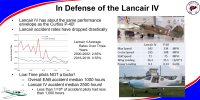
For the 1998-2021 time period, the Lancair IV had a 1.21% fleet accident rate...that is, 1.21% of the Lancair IVs were involved in accidents each year. This is high (the average for homebuilts is about 0.72%) but not the worst. It's about equal to a number of common homebuilt types, such as the Zenair CH-601 and the Searey.
Where the Lancair IV does stand out is in the pilot experience level. The median pilot total time for all homebuilt accidents is 1,000 hour, while the Lancair IV pilots involved in accidents have a 2,500 hour median. The Old Wives Tale says that many Lancair IV accidents are due to inexperienced pilots trying to fly a "hot" aircraft, the statistics don't show it. The rate of Pilot Miscontrol accidents is about quarter less than that of the overall homebuilt fleet.
The Lancair IV *does* take the record for the fatality rate, that is, the percentage of accidents that result in at least one death. About 51%, vs. a 24% average for the overall homebuilt fleet. But that's just MV^2 in action; a very high performance aircraft is going to tend to hit the ground at a faster speed, and thus impart higher forces on the occupants. As Albany Tom mentions, the Lancair IV has about the same performance envelope as the Curtiss P-40.
Ron Wanttaja

- Joined
- Sep 25, 2019
- Messages
- 828
- Location
- Lancaster, Pennsylvania
- Display Name
- Rick A
- Home Airfield
- KLNS
I'm curious if fire is a factor in the high fatality rate, too.he Lancair IV *does* take the record for the fatality rate, that is, the percentage of accidents that result in at least one death. About 51%, vs. a 24% average for the overall homebuilt fleet. But that's just MV^2 in action; a very high performance aircraft is going to tend to hit the ground at a faster speed, and thus impart higher forces on the occupants.

Thanks Ron.I occasionally compute the Fleet Accident Rate for a variety of homebuilts. This is an estimate of what percentage of a given model has an accident in an average year.
For the 1998-2021 time period, the Lancair IV had a 1.21% fleet accident rate...that is, 1.21% of the Lancair IVs were involved in accidents each year. This is high (the average for homebuilts is about 0.72%) but not the worst. It's about equal to a number of common homebuilt types, such as the Zenair CH-601 and the Searey.
Where the Lancair IV does stand out is in the pilot experience level. The median pilot total time for all homebuilt accidents is 1,000 hour, while the Lancair IV pilots involved in accidents have a 2,500 hour median. The Old Wives Tale says that many Lancair IV accidents are due to inexperienced pilots trying to fly a "hot" aircraft, the statistics don't show it. The rate of Pilot Miscontrol accidents is about quarter less than that of the overall homebuilt fleet.
The Lancair IV *does* take the record for the fatality rate, that is, the percentage of accidents that result in at least one death. About 51%, vs. a 24% average for the overall homebuilt fleet. But that's just MV^2 in action; a very high performance aircraft is going to tend to hit the ground at a faster speed, and thus impart higher forces on the occupants. As Albany Tom mentions, the Lancair IV has about the same performance envelope as the Curtiss P-40.
View attachment 143441
Ron Wanttaja
So if I understood that correctly it sounds like Lancair IVs suffer from both a frequency and severity problem with their accidents.
1.21 vs 0.72 avg -- fleet accident rate... Not the worst, but not great.
51% fatal vs 24% avg fatal -- accident severity. Pretty bad.
And those stats occur with pilots that have a median 2.5x the experience compared to average homebuilt pilots involved in accidents?
Those are pretty uncomfortable numbers... Be a more experienced pilot and still crash more, and more crashes are fatal.
In this case the pilot sounded quite accomplished if I was reading her bio correctly: Valedictorian, degree in math and aero from purdue, professional 767 pilot, distinguished AOPA flight instructor, already had flown around the world? I doubt it was a lack of intelligence or flying knowledge that led the crash.


Ed Haywood
Final Approach
Complacency moves up the list of suspects. Which of course comes in all forms, and there but by the grace of God go I.
She posted a long social media video from the cockpit just before taking off, thanking all her sponsors. That does suggest some degree of distraction.
OTOH it appeared to be a clear day, no passengers, and an easy leg from IN to PA.
No fire. Wonder what that says about fuel status? I imagine such a plane would be a handful during an off airport landing, especially in a built up exurban area.
Ed Haywood
Final Approach
They had a nasty stall break. Winglets were added to help tame it but it's still pretty unforgiving. Being an around the world flight it could have been flying over gross with a lot of extra fuel which would make the stall even worse.
Useful load of 1350 pounds, and carries 125 or 145 gallons of gas. Almost impossible to over gross with one person on board, especially her. Maybe could have overloaded the rear with baggage and created an aft CG situation?
Kenny Phillips
Final Approach
- Joined
- Jul 29, 2018
- Messages
- 6,572
- Display Name
- Kenny Phillips
Luck. Low fuel. Or, the worst, wrong fuel (JET-A?)She posted a long social media video from the cockpit just before taking off, thanking all her sponsors. That does suggest some degree of distraction.
OTOH it appeared to be a clear day, no passengers, and an easy leg from IN to PA.
No fire. Wonder what that says about fuel status? I imagine such a plane would be a handful during an off airport landing, especially in a built up exurban area.
wanttaja
Final Approach
- Joined
- Jun 7, 2008
- Messages
- 5,667
- Location
- "War-Torn" Portland
- Display Name
- Ron Wanttaja
- Home Airfield
- Twin Oaks Airpark
I did do a study on homebuilt fires about five years ago. Digging up the spreadsheet from that...covers 1998 through 2018:I'm curious if fire is a factor in the high fatality rate, too.
Overall, about ten percent of homebuilt accidents result in a post-crash fire (I track in-flight fires separately), vs. 29% of Lancair IV crashes. It's not the worst case, but the one that beats it has a relatively small number of accidents and the results may be skewed by the sample size (I usually require at least 50 accidents to make an assessment, the other aircraft has only 19 in the 21-year time period).
Remember, though, that just because the plane caught fire in the accident doesn't mean the fire contributed to the deaths of the occupants. Autopsy reports usually indicate whether the persons were still breathing when the fire broke out, but the NTSB reports don't reliably report this and I've never attempted to track it.
Again, recall that the Lancair IV is an extremely high-performance aircraft...It's likely going to hit the ground harder than other types.
This is a chart from an older study, covering only ten years. It plots the fatality rate vs. the aircraft's published cruise speed. The red dashed line is a visual approximation showing the trend in the rise of fatality rates as the performance increases. The low-wing homebuilt on the far right is the Lancair IV...and you can see that it's significantly below the trend. Now, as I mentioned in an earlier posting, the fatality rate in the longer time period is a bit of 50%, not 40% as shown here. But even so, it'll still be in family.
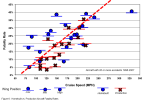
It may seem strange that a Fly Baby driver is defending the Lancair IV, but I honestly believe it's getting an undeserved bad rap. Yes, the numbers are higher...but the performance is much greater than most of the homebuilt fleet.
Ron Wanttaja
Grum.Man
En-Route
It was the first leg of a planned around the world flight. You aren't accomplishing that with only 145 gallons. They typically have specialty built fuel bladders in the cockpit and routinely takeoff over gross for these types of trips. For several years I was parked beside another guy who held several round the world flight records in a Lancair IV-P so all that info is straight from the goose.
Edit: Again not knowing her flight plan she may not have had the aux tanks full but it was a theory.
https://www.flyingmag.com/lancair-westbound-circumnavigation/ 361 gallons for Bill's plane
Edit: Again not knowing her flight plan she may not have had the aux tanks full but it was a theory.
https://www.flyingmag.com/lancair-westbound-circumnavigation/ 361 gallons for Bill's plane
- Joined
- Jul 29, 2011
- Messages
- 1,466
- Display Name
- MountainDude
- Home Airfield
- KPDX
She was trying to inspire Asian women to get involved in aviation. What does her crash and death mean for that mission? I worry it will have the opposite of the desired effect.

CFI and ATP typed in 757 and 767
This was not a low hour pilot.
We always discuss quantity vs quality of hours.
Who gets 757/767 type rated without flying them at an airline, and why? If she did fly them at the airlines, I missed that.
I looked at some of the FB/Insta posts after the mishap. Some of the things I saw tripped my sense of danger. Yes, that could be just the social media persona and not the real thing, but from past encounters, the delta isn't usually that large.
I understand you have to do the dog and pony show for the sponsors, but that can apply some serious external pressures thst will make one make some substandard decisions.
Remember the guy who tried to reach the North Pole in a balloon in 1897? Most agree that he knew the expedition was doomed to fail, but the sponsor pressure made him go despite some extremely serious weather and equipment issues (he knew the balloon leaked more gas than allowed, but instead of aborting, he would order secred top-offs to make things look better).

Andrée's Arctic balloon expedition - Wikipedia
Maybe I'm wrong, and the investigation will reveal a mechanical failure that dealt her a losing hand. But I can't shake the feeling that something wasn't right with her approach to aviation.
Albany Tom
Final Approach
- Joined
- Jul 23, 2021
- Messages
- 5,703
- Display Name
- Albany Tom
Normally there's that swiss cheese thing. But sometimes mistakes happen. The very experienced F-14 guy that took off with the gust lock on comes to mind. Maybe she just made a mistake and stalled it at low level, not enough time to recover. I wouldn't jump to a character flaw or experience problem on this. She'd already flown around the world one time solo.
- Joined
- May 15, 2020
- Messages
- 7,770
- Display Name
- Ernie
- Home Airfield
- C81
From the linked article in the first post.We always discuss quantity vs quality of hours.
Who gets 757/767 type rated without flying them at an airline, and why? If she did fly them at the airlines, I missed that.
I looked at some of the FB/Insta posts after the mishap. Some of the things I saw tripped my sense of danger. Yes, that could be just the social media persona and not the real thing, but from past encounters, the delta isn't usually that large.
I understand you have to do the dog and pony show for the sponsors, but that can apply some serious external pressures thst will make one make some substandard decisions.
Remember the guy who tried to reach the North Pole in a balloon in 1897? Most agree that he knew the expedition was doomed to fail, but the sponsor pressure made him go despite some extremely serious weather and equipment issues (he knew the balloon leaked more gas than allowed, but instead of aborting, he would order secred top-offs to make things look better).
Andrée's Arctic balloon expedition - Wikipedia
en.m.wikipedia.org
Maybe I'm wrong, and the investigation will reveal a mechanical failure that dealt her a losing hand. But I can't shake the feeling that something wasn't right with her approach to aviation.
"become a pilot & later AOPA Distinguished Flight Instructor, and a B767 pilot for a major carrier.”
Yes, but...From the linked article in the first post.
"become a pilot & later AOPA Distinguished Flight Instructor, and a B767 pilot for a major carrier.”
Which airline? There's no information anywhere that I could find. Some facebook page with news from Bahrain states she was a 767 ferry pilot.
Not a lot of information out there, and it all seems to be re-hashes of the same source.
Last edited:
Ed Haywood
Final Approach
Read elsewhere that witnesses said it was a stall/spin shortly after takeoff.
If that effect stops people from joining because of the wrong reasons, that is a good thing. I think we saw in Toronto this year what happens when the wrong people are inspired.She was trying to inspire Asian women to get involved in aviation. What does her crash and death mean for that mission? I worry it will have the opposite of the desired effect.
A good starting point for selection are the people who made their way to the airport on their own over and over to watch aircraft rather than specific people targeted by groups with an agenda. The former will be obsessed and spend a higher percentage of time thinking about their obsession(such as being on this board).
A similar accident last year had someone involved in all kinds of non-aviation stuff with the flying thing being a newer addition to the many interests.
This business/hobby has many risks that can be deadly.
- Joined
- May 15, 2020
- Messages
- 7,770
- Display Name
- Ernie
- Home Airfield
- C81
LinkedIn says Amazon since December 2022,, but I thought they just contracted everything out.Yes, but...
Which airline? There's no information anywhere that I could find. Some facebook page with news from Bahrain states she was a 767 ferry pilot.
Not a lot of information out there, and it all seems to be re-hashes of the same source.
I will say the social media presence is a bit too influency for my taste.

dans2992
En-Route
- Joined
- Jan 7, 2013
- Messages
- 4,309
- Display Name
- Dans2992
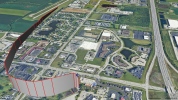
Speed drops way off at the end. Might have been an engine failure and nose was not lowered quickly enough.Found this ads-b plot:
View attachment 143508

FPK1
Line Up and Wait


Katamarino
Pattern Altitude
- Joined
- Dec 14, 2011
- Messages
- 2,232
- Location
- YPJT
- Display Name
- Katamarino
- Home Airfield
- Jandakot YPJT
Anh added me on social media a few years ago now during my own flight around the world. She had been planning this for a very long time.
You don't take off with ferry tanks full to fly from Indiana to Pennsylvania.Being an around the world flight it could have been flying over gross with a lot of extra fuel which would make the stall even worse.
I don't believe this is correct. If so, this current flight would not have been the one to make her "the first Vietnamese woman to fly solo around the world" (these "firsts" are having to get pretty specific now).She'd already flown around the world one time solo.

Found this ads-b plot:
View attachment 143508
Where do you get this kind of 3d ADS plot?. There was an almost identical track accident 8/27 out of KMAN with a Mooney N5764H. The Mooney had a bit tighter turn making it look like perhaps he was trying to get back to the airport, but no loss of altitude indicating he hadn't fully lost power.
For the track above I find it interesting that she wasn't tracking outbound of on the runway center line at all.

Flying Keys
Cleared for Takeoff
- Joined
- Jul 2, 2021
- Messages
- 1,027
- Display Name
- Flying Keys
Most of the flight tracking sites offer a KML export of the ADS-B track, which can be interpreted in Google Earth.Where do you get this kind of 3d ADS plot?. There was an almost identical track accident 8/27 out of KMAN with a Mooney N5764H. The Mooney had a bit tighter turn making it look like perhaps he was trying to get back to the airport, but no loss of altitude indicating he hadn't fully lost power.
For the track above I find it interesting that she wasn't tracking outbound of on the runway center line at all.
Lindberg
Final Approach
Don't assume the registration of the satellite photo or the track is perfectly accurate. Unless she took off from the grass, there's likely some offset error.Where do you get this kind of 3d ADS plot?. There was an almost identical track accident 8/27 out of KMAN with a Mooney N5764H. The Mooney had a bit tighter turn making it look like perhaps he was trying to get back to the airport, but no loss of altitude indicating he hadn't fully lost power.
For the track above I find it interesting that she wasn't tracking outbound of on the runway center line at all.
dans2992
En-Route
- Joined
- Jan 7, 2013
- Messages
- 4,309
- Display Name
- Dans2992
She drifted left pretty quickly after takeoff.Don't assume the registration of the satellite photo or the track is perfectly accurate. Unless she took off from the grass, there's likely some offset error.
Flying Keys
Cleared for Takeoff
- Joined
- Jul 2, 2021
- Messages
- 1,027
- Display Name
- Flying Keys
Or just started drifting left immediately after takeoff. With so many points along that particular (diverging) azimuth, it is a pretty good indication that it’s not an error.Don't assume the registration of the satellite photo or the track is perfectly accurate. Unless she took off from the grass, there's likely some offset error.
Lindberg
Final Approach
Why?With so many points along that particular (diverging) azimuth, it is a pretty good indication that it’s not an error.
Flying Keys
Cleared for Takeoff
- Joined
- Jul 2, 2021
- Messages
- 1,027
- Display Name
- Flying Keys
Short answer: statistical analysis.Why?
Long answer: More datapoints equals stronger data correlation. Easy to write off an erroneous outlier here and there, especially if it’s multilateration (no ADS-B) but this was a pretty tight grouping of ADS-B data.
Additionally, an ADS-B offset error would show each point moved laterally (or vertically) by the roughly same amount, so the points would be to either side of the flown course. So if the flown course was indeed parallel to the runway, the average track that would produce would be roughly parallel to the runway (MLAT or singular hits notwithstanding). Instead, what we’re looking at here is an angular divergence from a known heading (the runway), resulting in a steady increase to over 1000’ of “offset.” For that to have been produced by an ADS-B offset error over several fairly uniform datapoints, the error itself would have to be a steadily increasing vector in the same azimuth with each hit. Statistically that is extremely unlikely.
Lastly, ADS-B reports its own accuracy. The positional error (NACp) at the time was being reported as <10m with 95% certainty. Coupled with the multiple hits, all on the same diverging course, all with the same (minimal) position uncertainty, I’m confident what you see there is accurate to within 10m.
However, that’s not to say there wasn’t a navigational error that caused the erroneous heading. Or something completely else. Or heck, that path could have been flown intentionally for all we know.
Hot edited for clarity
Last edited:
Ed Haywood
Final Approach
Wasn’t the winds pushing her left:
KIND 301554Z 00000KT 10SM FEW033 SCT250 31/22 A3009 RMK AO2 SLP180 T03060222
KIND 301454Z 00000KT 10SM FEW030 SCT250 30/23 A3010 RMK AO2 SLP182 T03000228 53006
KIND 301554Z 00000KT 10SM FEW033 SCT250 31/22 A3009 RMK AO2 SLP180 T03060222
KIND 301454Z 00000KT 10SM FEW030 SCT250 30/23 A3010 RMK AO2 SLP182 T03000228 53006
Lindberg
Final Approach
You seem to be assuming independent sources of error due each data point. And that the satellite image is perfectly aligned with reality.Short answer: statistical analysis.
Long answer: More datapoints equals stronger data correlation. Easy to write off an erroneous outlier here and there, especially if it’s multilateration (no ADS-B) but this was a pretty tight grouping of ADS-B data.
Additionally, an ADS-B offset error would show each point moved laterally (or vertically) by the roughly same amount, so the points would be to either side of the flown course. So if the flown course was indeed parallel to the runway, the average track that would produce would be roughly parallel to the runway (MLAT or singular hits notwithstanding). Instead, what we’re looking at here is an angular divergence from a known heading (the runway), resulting in a steady increase to over 1000’ of “offset.” For that to have been produced by an ADS-B offset error over several fairly uniform datapoints, the error itself would have to be a steadily increasing vector in the same azimuth with each hit. Statistically that is extremely unlikely.
Lastly, ADS-B reports its own accuracy. The positional error (NACp) at the time was being reported as <10m with 95% certainty. Coupled with the multiple hits, all on the same diverging course, all with the same (minimal) position uncertainty, I’m confident what you see there is accurate to within 10m.
However, that’s not to say there wasn’t a navigational error that caused the erroneous heading. Or something completely else. Or heck, that path could have been flown intentionally for all we know.
Hot edited for clarity
Flying Keys
Cleared for Takeoff
- Joined
- Jul 2, 2021
- Messages
- 1,027
- Display Name
- Flying Keys
Your first sentence is illogical. I explained to you why a continuous divergence over multiple datapoints is extremely unlikely. Put another way, to get the results we see over multiple points as a result of a divergence error (despite the self-monitoring and reporting) would take a set of coincidences the chances of which are astronomically small.You seem to be assuming independent sources of error due each data point. And that the satellite image is perfectly aligned with reality.
The satellite image is Google Earth, but since the path is geocoded, you can see it on any number of map overlays, all showing the same thing. Despite that, a choice to continue with skepticism not borne of evidence to the contrary is certainly a choice.