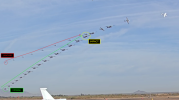
Crash in Arizona (Marana, Feb 19, 2025)

The article didn't make it clear which pilot allegedly accused the other of cutting. And it's possible the witness can't be certain.
True. However, there was another report early on that said the Lancair reported “going around again.”
 
The Lancair was arguing that someone cut him off? That’s a pretty strong position to take considering that the bigger picture, according to ADS-B, showing that wasn’t the case - that it appeared he was the one outside of the flow of the existing traffic. I suppose any rush to judge it as moot (or not) depends upon one’s preconceptions.
As earlier post stated that there were two 172s in the pattern. The one not involved landed and departed the runway. The closure rate caused the Lancair to go around. Then, on the Lancair's next attempt, a different 172 did a touch and go in front of him. This was the cause of the second go around.

See, my problem with all of the tech gurus is right here. The Lancair broke off his landing and initiated a go-around because a 172 landed (on a touch and go) in front of him, and did not clear the runway quickly enough for him to safely land.

So . . .

If the Lancair didn't land because he saw the 172 still on the runway . . .

Why didn't he sidestep? (I know it isn't required. But it is a smart thing to do. Especially with trainers . . . who around here . . . tend to do more touch and goes than full stops.)

I'm not "victim blaming". My assumption is that the Lancair with its faster closure rate momentarily lost sight of the slower trainer . . . to a disastrous outcome. I'm nobody, but that is my takeaway here. Losing visual on the aircraft in front of you in the pattern is fatal.
That was probably my post earlier, which was derived from looking at the ads-b (which admittedly might not show additional, non-ads-b aircraft, if present). The other (displayed) traffic was established in the pattern ahead of the Lancair and nobody appeared to cut anybody off. The Lancair did a 360 to give way to a Cessna on crosswind, which he later overtook and went around, after which he overtook yet another Cessna, which ultimately took off into him. Perhaps that first Cessna is the one who “cut him off” instead of extending the departure leg? That’s the only idiosyncracy I can possibly discern from the data alone. Still, he overtook that one and proceeded to do it again to another in the next lap, where things ultimately broke down (agree about the need for a sidestep as well).

The gadgetry does not absolve anybody from using their eyes, but it can absolutely be effective at instantaneously painting the bigger picture at busy airports. I’ve had numerous cases where it allowed me to better time my pattern entry so as not to be disruptive, as well as letting me know when someone else was going to be disruptive.
 
As earlier post stated that there were two 172s in the pattern. The one not involved landed and departed the runway. The closure rate caused the Lancair to go around. Then, on the Lancair's next attempt, a different 172 did a touch and go in front of him. This was the cause of the second go around.

See, my problem with all of the tech gurus is right here. The Lancair broke off his landing and initiated a go-around because a 172 landed (on a touch and go) in front of him, and did not clear the runway quickly enough for him to safely land.
…

If you have so many issues with taking advantage of available tech solutions …. here is a scary thought for you … every time you get up there you are already totally committing your personal safety to a bunch of mostly nameless tech gurus responsible for designing and implementing this amazing , 100% technology based , contraption with wings and engines and other assorted technological marvels …. unless you get up there by some other means in which case I will take it all back.
 
If you have so many issues with taking advantage of available tech solutions …. here is a scary thought for you … every time you get up there you are already totally committing your personal safety to a bunch of mostly nameless tech gurus responsible for designing and implementing this amazing , 100% technology based , contraption with wings and engines and other assorted technological marvels …. unless you get up there by some other means in which case I will take it all back.
More than 80 years ago, a bunch of talented "tech gurus" of their day and age put together a bunch of . . . perhaps not cutting edge . . . but not 100 year old parts to create the A-65 down in Western Michigan. So, I really appreciate them as well as Mr. Taylor and Mr. Piper. But tech is useless without common sense, good situational awareness, and good task management.

If I am not doing my job as a pilot, the answer is not to trade my 1940's tech in for newer tech . . . perhaps a carbon-fiber and glass airplane with a "modern" 912. Because if you aren't paying attention to the plane that you know is in the pattern and collide with said plane, having another piece of tech that can warn you about what you already know is a distraction, not an advantage.

Actually the correct answer often is to trade out your 1940s tech… as long as you do it smartly, that is.

No matter how vigorously you end up advocating for “paying attention” and being “always in command” , we are all human and there are pretty hard limits as to how much improvement you can achieve with this approach alone.
I would even argue that we have hit these limits a while ago and virtually all of modern safety improvements are result of augmenting humans and their inherent limitations with increasingly smarter and better technological solutions that are not meant to allow us to become more reckless while relying on machines to maintain the same level of safety ( as you seem to be suggesting ) but rather further improve upon it.
 
I'm kinda wondering if this one wasn't just two pilots being jerks (assuming based on report of argument), but if the CFI actually didn't know how to let someone else in the pattern, and the other pilot didn't know how to enter a pattern. Going out on a limb and guessing, if the CFI only knew how to fly a tight pattern and never extend, and the other pilot only remembered how to do a straight in approach, so they'd have to circle out X miles from the airport and just use luck to fit in, I could see how they could be annoyed with each other. Guessing.

Or to put it another way, that warning light for your blind spot is great, but it isn't all that helpful if you're trying to merge in Boston. Or Schenectady at the right time of day for that matter.
 
Here, this might give whoever is interested an idea of the big picture:


Starts at 1513Z, the Lancair is N3602M, the accident 172 is ASI85, first go-around is at 15:22:10, crash is at 15:28:45
 
I'm kinda wondering if this one wasn't just two pilots being jerks (assuming based on report of argument), but if the CFI actually didn't know how to let someone else in the pattern, and the other pilot didn't know how to enter a pattern. Going out on a limb and guessing, if the CFI only knew how to fly a tight pattern and never extend, and the other pilot only remembered how to do a straight in approach, so they'd have to circle out X miles from the airport and just use luck to fit in, I could see how they could be annoyed with each other.
I don't think that kind of guessing is really necessary, or helpful. The CFI and her student survived, and there has been a noticeable lack of criticism, especially given the current political environment. Seems people respect her enough not to trash her online.
 
I don't think that kind of guessing is really necessary, or helpful. The CFI and her student survived, and there has been a noticeable lack of criticism, especially given the current political environment. Seems people respect her enough not to trash her online.
Fair in the sense that just about any speculation is kind of guessing. But my guess isn't based on any political environment or belief, and kind of not my place to temper a guess based on anything along those lines, or I'd be just as bad, perhaps worse, as those that are looking for some sort of angle.
 
Not sure I want to go back through all this thread, but why would an instructor do a "stop and go" with traffic fairly close behind? And why take off when traffic behind has announced going around?
 
Not sure I want to go back through all this thread, but why would an instructor do a "stop and go" with traffic fairly close behind? And why take off when traffic behind has announced going around?
I don’t know if it’s the case here, but some flight schools forbid touch and goes. Had they chosen to do a full stop, it still would have led to a go-around, but not the collision.

Regardless, I’ve been in a busy pattern plenty of times and had time to do a (quick) stop and go. It all depends on how much space there is to plane behind you, how fast it’s closing, and whether everybody is on the same page.
 
Includes a composite photo from a security camera and a diagram of the aircraft paths with annotations from the CTAF recording.
Interesting collision path. Picture below for reference.
1742184342526.png

"A small debris field was found on runway 12 and stretched over a 300ft by 100 ft area towards the airport segmented circle and contained fragmented pieces fromthe left wing tip, left aileron, aileron trim tab, and outboard wing skin of the Lancair."
So all it took for the Lancair to be uncontrollable was losing part of the left wing tip and aileron. From the composite picture it doesn't even look like too much damage. I wonder if a good amount of rudder could've kept them level and under control.
 
I saw that composite. It honestly doesn't look like there was much, if any, effort from the Lancair to climb back to pattern altitude.

That's concerning.

It’s easy to see that the 172 was climbing.
 
Last edited:
Not sure I want to go back through all this thread, but why would an instructor do a "stop and go" with traffic fairly close behind? And why take off when traffic behind has announced going around?
In hindsight, that does seem like something to keep in the back of your mind as an instructor, but typically, if someone calls a go-around, it's because they have eyes on you. If you already declared your intentions, landed, and "owned" the runway, you have the right-of-way until you get off either by taxiing off or taking off, and the aircraft going around would primarily be responsible to avoid you.
 
In hindsight, that does seem like something to keep in the back of your mind as an instructor, but typically, if someone calls a go-around, it's because they have eyes on you. If you already declared your intentions, landed, and "owned" the runway, you have the right-of-way until you get off either by taxiing off or taking off, and the aircraft going around would primarily be responsible to avoid you.
If I hear someone doing a go-around when I'm landing, still in the air, I'm doing a full stop landing, to pull off and see/hear what's going on. If, however, I'm already in the process of taking off again from a touch and go, I don't think I'd consider a go-around by someone else enough of a problem to discontinue my takeoff. Goes without saying I'd be looking around, but that might not be enough, of course. That's just me, and I don't know if thinking about this accident will change my mind.
 
If I hear someone doing a go-around when I'm landing, still in the air, I'm doing a full stop landing, to pull off and see/hear what's going on. If, however, I'm already in the process of taking off again from a touch and go, I don't think I'd consider a go-around by someone else enough of a problem to discontinue my takeoff. Goes without saying I'd be looking around, but that might not be enough, of course. That's just me, and I don't know if thinking about this accident will change my mind.
Yeah, and then you've got to throw in the fact that there's stuff going on in a training cockpit with the instructor and the student and sometimes students do things that complicate the situation, too.
 
So all it took for the Lancair to be uncontrollable was losing part of the left wing tip and aileron. From the composite picture it doesn't even look like too much damage. I wonder if a good amount of rudder could've kept them level and under control.
What does the top of the right wing look like? The prelim says "...and outboard wing skin of the Lancair" and does not give any indication of the state of the bits that remained attached. *My* speculation is that no one here has any idea of the full extent of the damage, the flying qualities of a Lancair with the damage as described, or the state of the occupants after the collision.

So far.

Nauga,
and his singing raccoon
 
As has been stated by many far more experienced people than I, ASD-B did not / could not / would not have prevented this tragic accident. ASD-B was / would have been more "noise" in the pattern. A place where eyeballs need to be gazing o-u-t-s-i-d-e the w-i-n-d-o-w-s. There is no magic. Just people who must use fundamental a-i-r-m-a-n-s-h-i-p to safely m-a-n-e-u-v-e-r around other k-n-o-w-n traffic in the pattern.
Because that has never been known to fail, except all the time. It just usually doesn't result in aluminum hail. You probably resented backup cameras, as many did. Until they found out it was better than looking out the rear w-i-n-d-o-w or using the m-i-r-r-o-r-s.
Simple tools (at least in today's world) can save lives. Changing human nature?
A-i-n-t g-o-n-n-a h-a-p-p-e-n.
 
If I hear someone doing a go-around when I'm landing, still in the air, I'm doing a full stop landing, to pull off and see/hear what's going on. If, however, I'm already in the process of taking off again from a touch and go, I don't think I'd consider a go-around by someone else enough of a problem to discontinue my takeoff. Goes without saying I'd be looking around, but that might not be enough, of course. That's just me, and I don't know if thinking about this accident will change my mind.
Well, you are like the person who taught me to drive. To look at the other roadway at intersections and not trust that others will obey stop signs and lights. Because, you can have the right of way and still get hit if the other person isn't following the rules, has a medical issue, or a mechanical failure.

Fancy collision alert software notwithstanding.
 
I saw that composite. It honestly doesn't look like there was much, if any, effort from the Lancair to climb back to pattern altitude.

That's concerning.
Could be the damage isn’t what caused the crash. It’s possible the impact caused an upset and the pilot didn’t recover.

Then again, the Lancair does have a pretty small wing with high wing loading. So the same damage that would allow a 172 to continue and land could have made a Lancair uncontrollable.
 
You probably resented backup cameras, as many did. Until they found out it was better than looking out the rear w-i-n-d-o-w or using the m-i-r-r-o-r-s.

as an aside, do the math on the cost of installing backup cameras vs the numbers regarding lives saved or property damage avoided. Hint: don't forget that it's not the cost of a single camera on one car, but the total number of cameras on ALL the cars and trucks.
 
Because that has never been known to fail, except all the time. It just usually doesn't result in aluminum hail. You probably resented backup cameras, as many did. Until they found out it was better than looking out the rear w-i-n-d-o-w or using the m-i-r-r-o-r-s.
Simple tools (at least in today's world) can save lives. Changing human nature?
A-i-n-t g-o-n-n-a h-a-p-p-e-n.
1742214471029.png
The only car that I've owned so far rolled off the assembly line a few months before my mom was rolled out of the hospital with me as a newborn in her arms. (It ran, but had to be towed home where I basically rebuilt it.) Needless to say it does not have collision avoidance software, a steering wheel shaker, or backup cameras.

But, it isn't a giant SUV, it has good glass and three good mirrors that I actually use.

Now, lots of idiots who drive igloos around here (we got another couple inches over the weekend so the skis get to stay on the Vag a bit longer) have backup cameras and sensors that I don't have. But I have the strange item pictured above. An item they are completely unaware of the existence or use of.

Because the bottom line is that people who are too stupid, lazy or arrogant to remove the snow from their windshield let alone their back and side windows are also too lazy, arrogant, or stupid to clean off the camera and the sensor heads. No amount of high-tech can substitute for good judgement.
 
as an aside, do the math on the cost of installing backup cameras vs the numbers regarding lives saved or property damage avoided. Hint: don't forget that it's not the cost of a single camera on one car, but the total number of cameras on ALL the cars and trucks.
Which idiots will ignore.
 
Could be the damage isn’t what caused the crash. It’s possible the impact caused an upset and the pilot didn’t recover.

Then again, the Lancair does have a pretty small wing with high wing loading. So the same damage that would allow a 172 to continue and land could have made a Lancair uncontrollable.
That’s not what I was pointing out.

Usually, if I’m going around, I’m regaining altitude ASAP. In the picture, it definitely looks like the Lancair was just level at the 150’ or so and was making no effort to climb.

Just a guess, but it looks like he thought he could go full throttle and end up ahead of the Cessna in the pattern if he kept it flat and didn’t climb over the runway - or - as mentioned earlier, was trying to “buzz” the 172. But if he was in the left seat, he might have not seen the 172 in the last 2-3 seconds.
 
Last edited:
"0825:14, the student pilot announced their intentions to perform a stop and go landing.

"0825:41, the Lancair transmitted 'traffic on base are you a touch and go?' to which the flight instructor replied, “we are a stop and go”.

"0826:05, the pilot of the Lancair advised that they were turning left base and . . .

"shortly after the student pilot advised that they were on final for a stop and go on runway 12."

"The flight instructor stated that they landed uneventfully and while in the process of taking off, they heard the Lancair pilot announce on the CTAF that he was going around again. The flight instructor stated that she looked at ADS-B information displayed on her iPad and saw the Lancair converging towards their airplane from behind. As the instructor was “keying up the radio” to ask the Lancair pilot if they saw them, both airplanes collided."

from Preliminary report: https://data.ntsb.gov/carol-repgen/api/Aviation/ReportMain/GenerateNewestReport/199723/pdf posted in #175 by @tlglenn
 
The flight instructor stated that she looked at ADS-B information displayed on her iPad and saw the Lancair converging towards their airplane from behind.
Hmmm....
How do *you* maintain visual contact with an airplane approaching from behind?
or maybe asked a different way, How do *you* maintain situational awareness of an airplane approaching from behind?

Nauga,
leading, following, or getting out of the way
 
Hmmm....
How do *you* maintain visual contact with an airplane approaching from behind?
or maybe asked a different way, How do *you* maintain situational awareness of an airplane approaching from behind?

Nauga,
leading, following, or getting out of the way
Why by looking at the pixels - as they converged - of course. :rolleyes:
 
Just a thought…

Careful observation of what can be factually determined is more useful than interpretation and projection when we have discussions like this.

Ironically, with regards to the previous post immediately above, most Cessna 172s including the accident aircraft DO have rear windows, but for an aircraft behind and above they are of minimal utility.
 
I have been following this thread since its inception and even posted a few times (and had some posts rightfully removed as being off topic).

I am going to try to keep this on topic in relation to the incident. I honestly don't get the pushback on modern technology from some folks in this thread. ADS-B may not have prevented this incident. But was it a contributing factor? Was it a possible cause? I can't see how unless the pilots involved were so eyes-on-screens that they lost visual contact with each other. Which seems very very unlikely especially in the phases of flight the two airplanes were in (one actively departing and one in the midst of a GA, however improperly executed it was). I have ADS-B. I use it prior to entering the pattern for situational awareness while I am listening to the radio. I am also looking all over the place to spot airplanes in the hornet's nest that is the traffic pattern around the local airports. I never use it on final or in the midst of a departure. I can't see a scenario where the pilots in this incident used it in those phases of flight either.

Long story short - why the pushback on ADS-B as something to augment overall situational awareness?

Personal opinion incoming - For me, it is an amazing tool that helps me paint the mental picture of the airspace around me. It actually HELPS me spot aircraft that I may not otherwise have seen. I guess milage may vary here. Not meant to be controversial, just trying to understand the thinking here.
 
Most aircraft do not have a rear window. So yes, by looking at pixels and listening to the radio.

Mine doesn't. Recently while flying Young Eagles I was departing and called a left crosswind as I heard a returning YE flight reporting overflying midfield for left downwind entry. He saw me and asked if I had him in sight. I did not as my back was to him. I had no time for ADS-B so I reported that I would extend my crosswind out away from the pattern. ADS-B can be extremely beneficial at times but in the pattern, especially during approach and departure, there isn't much on the panel to see (eyes outside) ...
 
Why by looking at the pixels - as they converged - of course.
I think you're kidding, but just in case (or for other reading that may not get it).... You can never look at ADS-B and say you have "visual contact" of an aircraft. If you don't see it out the window with your eyes, you don't have a visual.

ADS-B is great at helping you look in the right direction, or if you don't see it, then to make a positive change in your course to avoid them. But they are never "visual" if they're on a screen. And, of course, NEVER tell a controller you have traffic "in sight" if you're using ADS-B and not your eyes.
 
. . . . why the pushback on ADS-B as something to augment overall situational awareness?
Two reasons, there are those who like to post that ADS-B is essentially Jesus bringing you a bottomless plate of zero-calorie bacon. It is a tool. I like tools, but I don't use a hammer, screwdriver, or an adjustable wrench to remove a Grade 8 nut. Some people love the "latest and greatest" even if it isn't an appropriate tool. As stated from the beginning, in this situation, both aircraft were in communication with one another, both were aware of the other. Which brings me to . . .

Having ASD-B in some situations, possibly but not conclusively this one, is just "more noise". The CFI who was in communication with the Lancair pilot and heard him say he was behind her checked her iPad immediately before the collision. Now, to this noob, it sure seems like the 172 "owned" the runway. While not a requirement, I think the Lancair should have made a sidestep. That, combined with remaining low instead of climbing to pattern altitude, was fatal.

I am with @RyanShort1 in thinking "Just a guess, but it looks like (the Lancair pilot) thought he could go full throttle and end up ahead of the Cessna in the pattern if he kept it flat and didn’t climb over the runway - or - as mentioned earlier, was trying to “buzz” the 172."

So, in the situation here, in no way could ADS-B have been a benefit. It may (or may not) have been a distraction. And it bothers me when people project their biases by making suggesting that all aircraft should have ForeFlight, ADS-B, electric starters, or stall horns, and that those who do not have those (and other "wonders" of modern technology) are a hazard. From my left seat, it seems that those who expect technology to replace competence are the hazard.

(I am in NO way saying that everyone who loves ForeFlight, ADS-B, electric starters, stall horns, or including engine oil in their empty weight is part of the problem.)

 
Back
Top