cloud illusion

SixPapaCharlie

May the force be with you
Joined
Aug 8, 2013
Messages
17,546
Display Name
First Officer 6PC
I am sure there is a technical term for this but I don't know it.
Yesterday, closing in on my destination I got on top of a layer. Well actually in between a few layers. Clear skies behind me but sheet of white in front.

Interesting thing I learned. Off in the distance about 8-10 miles in front of me, I could see a clear cutoff in the clouds and ground. Like a line where the clouds just stop.

So I flew to it. When I got there, it was gone.
I saw another one so I did this a 2nd time. Clearly there it's where the cloud cover ends and I see ground... Nope.

I would get to the "ridge" and both times it was a small valley in the clouds perpendicular to my heading. That along with a higher layer was creating a very dark shadow. The contrast was enough that it appeared like obvious end of the clouds.

I had almost 3 hours of fuel remaining but let's say I had 1 hour or less. Flying to that ridge a couple times would have put me into a "time to confess" situation.

I ended up flying about 20 min past my destination flying for those spots before turning back and finding a hole large enough to circle down through.

Before going down, I got the weather where I was at and it had gone from VFR to MVFR. I got below them about 1300. Ground elevation was ~200 so no biggie.

Pretty non eventful and of course 5 minutes after I touched down, it broke apart and blue skies.

Lesson learned I guess: I am not one to take less fuel than max weight will allow but if I had, it would be way smarter to go ahead and either turn back to where I know it was clear or Let ATC know rather then try for those ridges. No reason to not carry more than enough fuel if you are VFR.

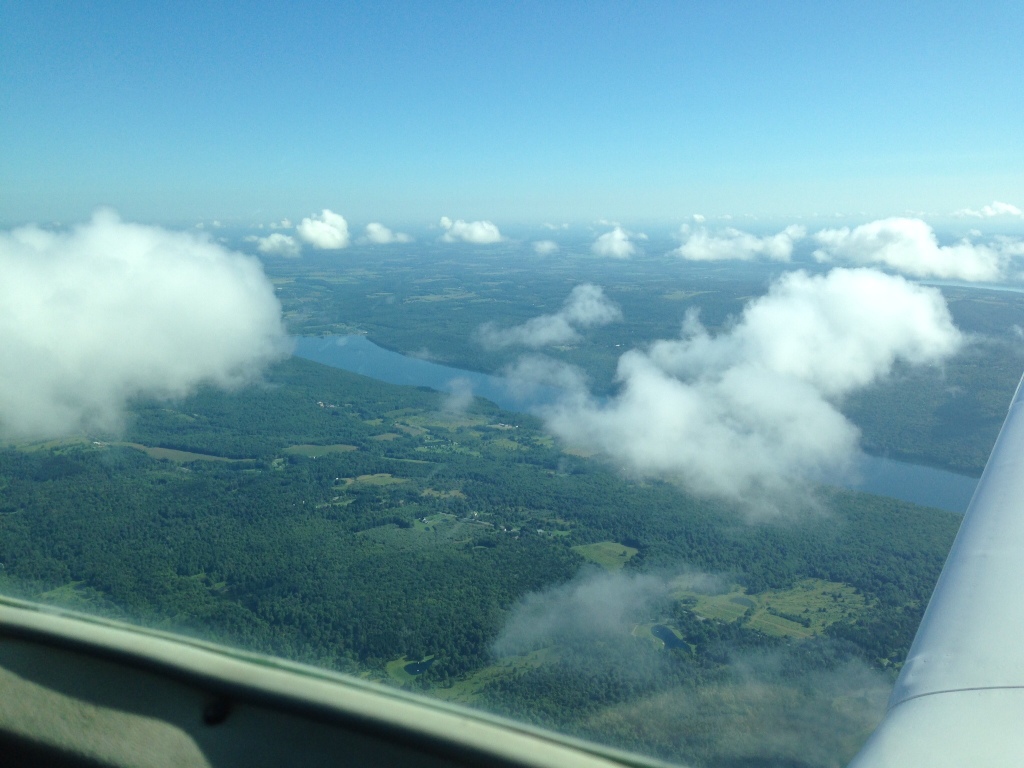
I don't have a good picture to describe what I was seeing. This is kinda sort of similar. Top of the photo looks like the clouds stop.
What I was seeing looked a lot more like ground beyond the ridge.

999943563528.jpg
 
I'm sure there were some anxious moments! I did exactly one long XC when I first got my PPL and had a similar experience and when I got back home decided to go for my instrument rating.
 
If you have the skills to let down through an overcast, no big deal. If you don't, you are betting your life on a weather forecast.

If it seems safer to go over the top than to scud run underneath, then you need to think about scrubbing the trip. (Unless you have the IFR skills and equipment.)
 
That's the risk of getting stuck on top. Problem is that often times when you turn back your departure point is closed in. Best answer is to use all available resources to find a VFR field. ATC can always help as can having local ATIS or AWOS freqs of course this is also where having a 396 or higher can really shine.

The phenomenon you described might be overcome if you climb but seeing as you were between layers not sure that would be a realistic option.
 
It's called chasing the ghost. Clouds are optical illusions. You only THINK you see one but what you are looking a is water/dust reflecting sunlight. You angle of view will change what you see. And all of it is a moving target. Hey are not giant cotton balls, they are more like smoke in a room.
 
With an IFR rating, all the pain and anxiety will be gone.
 
The technical term is called: Prelude to VFR into IMC.

I've never flown on top except when with a CFII and we punched through a layer at both ends. I sat left seat and manipulated the controls on that flight. Great experince but boring in retospect.

I've had VFR-IMC at night. Its not cool. I've been told that the more you fly the statistical likelihood goes up of joining the club.
 
Just for reference, this was the "hole" I came down through.
I never breached any of the clouds. It wasn't a death defying adventure by any means but I definitely thought a lot about "what if I didn't have enough fuel and there was no hole?"


999935222693.jpg
 
Just for reference, this was the "hole" I came down through.
I never breached any of the clouds. It wasn't a death defying adventure by any means but I definitely thought a lot about "what if I didn't have enough fuel and there was no hole?"


999935222693.jpg


Holes can close quickly and a bigger risk is going through a hole only to find a lower ceiling that expected and obstructions. Below are a series of photos from a recent IFR flight I made. The transition from "few" to "overcast" happened over a 20 mile stretch.

Even in the "few" picture, I could see that some of the windmills were sitting in the clouds that were there.

4ezy9uqy.jpg


y5esujeg.jpg


natu9uqa.jpg
 
I was flying under a scattered layer last week. At various points along the way, it looked like there was an end to the clouds just up ahead, except that I never seemed to reach it. I also noticed that the holes looked a lot bigger from the ground than they did from the air, although that is easy enough to explain geometrically. I ended up staying under the layer, though I probably could have gone on top on the way back home.
 
Just for reference, this was the "hole" I came down through.
I never breached any of the clouds. It wasn't a death defying adventure by any means but I definitely thought a lot about "what if I didn't have enough fuel and there was no hole?"


999935222693.jpg

How did you determine that the hole was big enough?
 
How did you determine that the hole was big enough?

I flew the circumference of it and looked at the distance flown then divided by pi to get the diameter. :goofy:

kidding. Had to eyeball it. The photo is a little misleading. It was pretty obvious it wasn't going to be an issue.

Same hole from below a few min later.

999964025573.jpg
 
Yeah, I had a frustrating day as well. I flew to KHAF expecting "scattered at 1,300'. Well, when I got there, they were more like broken at 1,300 feet and after scouting out the area, I decided I couldn't get in there legally, at least not VFR. Bottoms were I'm sure below the VOR approach minimums, and I cannot file as a /G and do a WAAS approach in my plane. So I headed home.
 
And here I thought you were going to go Joni Mitchell on us... :goofy:

But to join the chorus, YES you need an instrument rating if you're going to do that kind of flying. That layer was pretty thin (and the bases apparently well above any obstructions) so you would have been in little danger if you could not have found a hole even if your instrument skills are only PPL level -- unless you backed yourself into a low fuel situation before taking the plunge. The thing is you couldn't have known that for sure. Before I was instrument rated it was very rare that I would go on top of a solid layer -- basically only if I KNEW for 100% certain that it was clear below at my destination. The one time I made an exception was when I was in the left seat with an instrument rated and current pilot in the right seat, and she DID have to ask for a clearance as there were no holes anywhere to be found, and the one I climbed through was many miles back and probably long since filled in.

To answer your question though, I've never experienced what you did but suspect that you were not far enough above the layer to get a good view of what was beyond the buildup you were passing over. What looked like ground was probably just more clouds. It's also possible that they were building in the heat of the day and all the holes were rapidly closing.
 
So, this totally happened to me on Tuesday.

So there I was... VFR over the top on a CAVU day. I'm at 7500, clear air behind me, streets of scattered fair weather cumulus ahead at maybe 6500. It looks like the clouds ended another 5 or 10 miles down the road. I've got about 10nm to go before I get to the 3500' bravo shelf.

I call up Potomac to let them know that it looks like the clouds are ending, but it's hard to tell exactly how soon, so I ask for a bravo just in case. They clear me into the bravo and I keep trucking along, expecting the clouds to be ending any minute now... but it's just street after street. Still scattered, but the clouds certainly did not just "end" they way they looked like they would.

Eventually, enough is enough, so I descended through the next hole. The end.
 
I call up Potomac to let them know that it looks like the clouds are ending, but it's hard to tell exactly how soon...

Sometimes it's possible to gauge cloud's shadows on the ground to obtain a preview of the coverage, distance, and amount of clouds ahead.

Regarding the distance away from the plane where a hole or group of clouds end, it's a similar exercise to what you do to visually search for an airport that's many miles ahead when you know the distance from the plane beforehand.
 
Here's an interesting view of cloud tops off the right wingtip at sunset while VMC (in haze) flying parallel along it around sunset. It appeared to be mountains, where there weren't any. Zoomed in on the iPhone camera it was clearly cloud tops.

IMG_2594.jpeg
 
From what I have been told, the recurrent instrument rating isn't as tough as the initial because they already know you are capable of flying instruments and let's be honest, you already have the rating. Its not like they can take it away from you.

I'm not going into it unprepared. I got my foggles and I know what most of the buttons do. I'm ready
Is it like an IPC?

Oh wait. You probably already did a video about it, didn't you?
 
Is it like an IPC?

Oh wait. You probably already did a video about it, didn't you?

Annual recurrent training.
2 days of ground concluding with an exam on fatigue and a Knowledge Validation test (Sort of like a written but Envoy / Embraer 175 spcific)
I completed this last week.

Tomorrow starts 3 days of sims.
Day 1: Upset recovery training
Day 2: Maneuver Validation (single engine stuff like V1 cuts, single engine approaches, emergencies, etc)
Day 3: Line Oriented Flight. This is just 1 leg where a captain will be Pilot Flying and I will be pilot Monitoring. Fly from A to B, deal with a minor emergency.

It's AQP so train to proficiency which means lower stress than old school check rides.

After all that is done, they kick me back out on the line to resume flying.
 
I suspect that the illusion referenced at the beginning of the thread might be related to the curvature of the Earth. If the top of an undercast has a constant MSL altitude, then the top of the undercast will follow the curvature of the Earth. Consequently, the farthest point you can see on the undercast will be moving away at the same speed as the ground speed of the airplane.
 
Back
Top