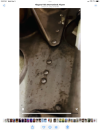
Cessna Nose Strut Rebuild

Ventucky Red

En-Route
PoA Supporter
Joined
Jan 9, 2013
Messages
2,595
Display Name
Jon
Home Airfield
KCMA
Anyone know if there is company that specializes in this? That is, take it off, box and ship, and get it back good as new?

I ask as I am going away on a business trip whirl wind for most of March and don't have the time for it.

Thanks
 
It’s a fairly easy task.

The usual reason is a flat strut.

If fluid leaks out it’s the bottom seals.

If not it’s the upper seals including Schrader Valve gasket.

If removed do all.

Seems more involved to have shipped than to have a Local A&P do.

Perhaps a remote location?
 
What's the deal here? Is the owner normally doing "owner-maintenance" that is not legally permissible, and just wants someone else to do this job?

Or is this indicative of his mechanic reluctant to tackle it? This seems to be an increasing problem. Mechanics that aren't willing to do much more than change oil and tires, clean sparkplugs, and inspect the airplane. We see a lot of posts here about alternators and magnetos being sent off for the most basic inspections. The manufacturers of all this stuff publish manuals on how to work on it. Cessna has the nosegear strut right there in their service manuals. All a mechanic has to do is get out that manual and read the section on strut overhaul. Chapter 5.

Have all the old generation get-'er-done mechanics retired?
 
Their was a time when mechanics read the service manuals to fix things and you could tell by the condition of the manuals that they were well used. Now either mechanics wash their hands before reading the manuals as they are nice and clean books, without the old grease and oil marks, even the computer keyboards are clean, or just know it all and blunder through it.
 
Anyone know if there is company that specializes in this? That is, take it off, box and ship, and get it back good as new?

I ask as I am going away on a business trip whirl wind for most of March and don't have the time for it.

Thanks
I think there is at least one . . .
1741027319708.png
 
Anyone know if there is company that specializes in this? That is, take it off, box and ship, and get it back good as new?
Haven't really seen that type of service for small aircraft. But for business or cabin class aircraft like King Airs which have cycle limits on their landing gear assemblies, yes. But even if there were, I doubt their turn-around lead time would fit into your schedule. Perhaps ask around to see if you can find a mechanic who is willing to perform the service if your shop doesn't have the time?

Have all the old generation get-'er-done mechanics retired?
While it tends to be more location specific, yes the older mechanics have been retiring at a steady clip with a bigger group fixing to hit in about 2-3 years. But what I've found to be more the case, the older guys can now be more selective in what work they need to perform to make the year. And I don't blame them. Have also heard that some insurance underwriters have re-defined some mx tasks by separating out certain ones that could be considered component "overhauls" vs simply a repair, etc. But haven't seen that personally.
 
Have also heard that some insurance underwriters have re-defined some mx tasks by separating out certain ones that could be considered component "overhauls" vs simply a repair, etc. But haven't seen that personally.
If that's happening, it's likely because accidents or incidents are being blamed on such work, and more than likely the work was not done in accordance with the applicable manuals.

In the Canadian Aviation Regulations we have the "Interpretation" section that defines for us what Overhaul and Repair mean:

overhaul means a restoration process that includes the disassembly, inspection, repair or replacement of parts, reassembly, adjustment, refinishing and testing of an aeronautical product, and ensures that the aeronautical product is in complete conformity with the service tolerances specified in the applicable instructions for continued airworthiness; 

repair means the rectification of deficiencies in an aeronautical product or the restoration of an aeronautical product to an airworthy condition;


And then we have the definitions of Specialized Maintenance listed. I give a couple of examples:

SCHEDULE II​

The following tasks constitute the specialized maintenance referred to in section 571.04 of these Regulations.
<snip>

Component​

  • 6 Any of the following types of maintenance of an appliance or component, where the work is beyond the limits recommended in the manufacturer’s maintenance manual or service instructions for service in the field, is component specialized maintenance:
  • <big snip>
  • (g) the rewinding of the field coil or armature of an electrical accessory;
  • (h) the overhaul of an aircraft magneto;
And further, the manuals for such components will specify what their definitions of repair and overhaul are, and those manuals, being FAA-approved, carry authority.

I don't think the FARs have any Specialized Maintenance restrictions, do they?

Note that Slick calls the 500-hour inspection an Inspection, not an overhaul. Their definition of an overhaul means the replacement of just about everything in that magneto except the case and magnet rotor. Anything less is a repair, and at inspection time one normally doesn't replace anything beyond the points, maybe the condenser, and very rarely the distributor. A mag overhaul coincides with the engine's TBO.

The alternator is not mentioned there other than any rewinding being specialized maintenance. Well, I should say so. That takes specialized equipment and the training to operate it.

The nosegear strut? Certainly not specialized.

Mechanics have a lot more freedom than they realize. They could use it to improve their skills and save their customers money. I keep hearing about 500-hour magneto "overhauls," something totally unnecessary and expensive. And with mag overhauls being expensive I suppose we sill soon hear of people replacing their mag with brand-new mags every 500 hours. Stuff like that contributes to the demise of GA.

 
If that's happening, it's likely because accidents or incidents are being blamed on such work, and more than likely the work was not done in accordance with the applicable manuals.
No idea. But this happened to me back in the 90s on engine work. If I wanted to OH engines I needed a rider to cover OHs. My standard insurance would only cover repairs which included cylinder replacements. From what I’ve heard it sounds like that same thing where additional coverage is needed if a mechanic wants to perform certain work.

As to restrictions, they’re listed in Part 65.81: “excluding major repairs to, and major alterations of, propellers, and any repair to, or alteration of, instruments.” Basically, everything else is open for an APIA to perform provided they meet the additional requirements of 65.81 and don’t need additional ratings like for 91.411/413 checks.

In the Canadian Aviation Regulations we have the "Interpretation" section that defines for us what Overhaul and Repair mean:
There’s similar FAA guidance: Part 43.2, Order 8900.1, Vol 3, Ch 15, etc.

Mechanics have a lot more freedom than they realize. They could use it to improve their skills and save their customers money.
Actually, I’ve found most mechanics know what they can legally perform, except they simply decide not to offer those services given how a number of owners approach aircraft mx. I know/knew a number of mechanics who provide different levels of mx services based solely on how an owner adress this. And I was one of them. Regardless, if an owner merely wants the minimum mx performed on their aircraft, where’s a mechanics incentive to go beyond those minimums?
 
Any tips on how to get the strut out of the top forging? Mine is stuck in there pretty good.
Is it worth taking it all the way out? TIA
 
Real Old Guy here answering Dan’s #4 question:

“Used-to-do List”

Jet stuff, radials, welding, fabric, extensive sheet metal, painting, avionics

install, engine overhauls, mags and carb work and maybe a couple more.

More and more it’s doing primarily “ IA Work”. To me this is inspecting and

making work for other people. So my tool list is significantly reduced

to iPad, flashlight, mirror, timing light and compression tester. My

“ no new patients “ sign has been up for some time so the owners and

Techs are aware of this.

Glad to mentor younger folks and I’m on the phone almost every night

doing so. It’s not a one-way as they reciprocate with things like

$(#@* IACRA!
 
Pretty sure bare metal under the cap and on the strut.
Good. Sometimes people will paint those areas and reinstall the strut before the paint fully cures. My guess you might have some corrosion or dirt on the strut/mount faying surfaces. Have seen some use a heat gun on the mount band to break the “bond” but I’ve had equal luck with a strap wrench on the strut housing to give more leverage during removal. Just make sure your aircraft is supported good before trying to convince the strut to come out. But not to sound facetious, you do have the upper bolt or pin out?
 
Whomever rebuilds the strut should use McFarlane's "square" seal kit. Far superior to the OEM style kit, IMHO.

 
Good. Sometimes people will paint those areas and reinstall the strut before the paint fully cures. My guess you might have some corrosion or dirt on the strut/mount faying surfaces. Have seen some use a heat gun on the mount band to break the “bond” but I’ve had equal luck with a strap wrench on the strut housing to give more leverage during removal. Just make sure your aircraft is supported good before trying to convince the strut to come out. But not to sound facetious, you do have the upper bolt or pin out?
I have loosened corroded parts using a rivet gun and flush rivet snap. Set the gun to a low setting and use it to tap around the housing to crumble the layer of rust that might be in there.

It might also be stuck due to overflowed 5606 fluid. That stuff can seep into interfaces and dry there. It gets really sticky and could glue that strut into the bracket.
 
Whomever rebuilds the strut should use McFarlane's "square" seal kit. Far superior to the OEM style kit, IMHO.

That would help, but there are other factors in O-ring rolling and spiral fracture. One of them is cold weather; the seal shrinks and hardens and grabs that strut and even a quad ring is going to suffer sooner or later. It cracks as the strut grabs it and rolls it. The other is the habit of some owners to wipe the exposed strut with 5606 "to lubricate it and stop corrosion," they think. That 5606 dries to a really sticky film that grabs that ring and destroys it. Don't believe it? Wet that strut with it and leave the airplane to sit for a month, then feel it to see what it's like. It will be sticky, and there will be sand and dust stuck to it. Now that strut has become a big round file. There goes the scraper ring and strut seals.

$71.80 for that kit. Huh. I used to buy that whole kit (with round seals) from Cessna for under $20, up until about 14 years ago.
 
I REGULARLY USE mineral spirits to keep my strut clean.
I don't have any leaks 5606 or nitrogen.
It's getting a new tire and tube.
My old tire is almost 5 years old, 903 hours. I haven't added up the landings yet but it is a lot. Tire was wore out and the reason for the shimmy when I got on the brakes hard and other hi speed situations.
I wanted to inspect it on the bench, the whole strut.
Yes I have the bolt out of the upper forging.
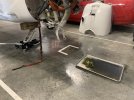
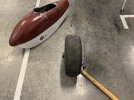
I cleaned it on the plane last night. I will give it one more try to get it out tonight.IMG_5215.jpeg
The old tire was a Goodyear flight special II, It never failed. I used the same tire for the replacement.
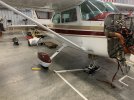
IMG_5198.jpeg
 
Last edited:
How are you attempting to get it out?

Strut fully extended provides good leverage.

Perhaps penetrating oil at the top and follow later

with twisting ?

Never had the issue.
 
How are you attempting to get it out?

Strut fully extended provides good leverage.

Perhaps penetrating oil at the top and follow later

with twisting ?

Never had the issue.
It's been soaking for a couple days now. It is somewhat loose, just won't come out yet. Did experiment with different lengths strut without loosing 5606 which allowed me to move it around a little more.
Strap wrench sounds like worth trying.

BTW the service manual makes everything sound easy and many know that is not always the case.
 
Last edited:
What are you getting leverage from?

Also important to note if span ring is not positioned correctly the strut

Will work just fine. However; next disassembly will to tough.

It’s possible a hard landing or flat strut in the past could have

damaged the upper cylinder to make removal difficult.

You may want to assure rivets are still intact and check aft side of firewall.

Not the best pic but all rivets on both sides were popped.

Note heads are still there. The vid was to large to post.
 

Attachments

  • IMG_2190.png
    IMG_2190.png
    1.7 MB · Views: 9
Last edited:
BTW the service manual makes everything sound easy and many know that is not always the case.
Its not an interference fit so it does tend to come out with limited issues. Sounds more like your's has been installed for a while and just needs a little persuasion to come out. You're not going to break it if you decide to show it who is boss.;)
 
Its not an interference fit so it does tend to come out with limited issues. Sounds more like your's has been installed for a while and just needs a little persuasion to come out. You're not going to break it if you decide to show it who is boss.;)
I am pretty sure it's hasn't been out since built June 1979.
 
I have loosened corroded parts using a rivet gun and flush rivet snap. Set the gun to a low setting and use it to tap around the housing to crumble the layer of rust that might be in there.

It might also be stuck due to overflowed 5606 fluid. That stuff can seep into interfaces and dry there. It gets really sticky and could glue that strut into the bracket.
Probably the case here? because I remember over filling it with 5606 in 2018.
 
Last edited:
Rebuilding a strut is not involved like rebuilding an engine. I'd say it's comparable to a brake job in difficulty. If your mechanic won't do it, he's not much of a mechanic.
 
Back
Top