Cessna 182 Shotgun Panel History

Jon Wilder

Line Up and Wait
Joined
Oct 19, 2015
Messages
613
Display Name
Jwylde
I've noticed that Cessna 182s from even the same model year differed in panel design (let's go with 67-68 (K-L) models). Some had a "shotgun" panel, while others had a layout resembling the more traditional six pack. Does anyone happen to know what dictated which plane on the assembly line got which panel configuration?
 
While Cessna did occasionally make mid-year model changes, from what I've read they went to a six-pack layout in 1968 with the L model which officially started with serial 18258506. There will be some confusion since they usually started production of the 'new' model year a few months prior to the start of the year. Also, of course, many people have upgraded their panels to a standard layout.

C.
 
As an owner of a 182L, what's a "shotgun" panel?
 
As I recall, the sixpack grouping did not become standardized until the mid 1960s. The first Mooney I flew, an older C model, had a shotgun panel.
 
As I recall, the sixpack grouping did not become standardized until the mid 1960s.
I believe it was at the time Part 23 was codified under the FARs from the CARs and various updates were applied to the new FARs. As I recall, the reason behind was so a pilot could monitor certain instruments during specific flight modes with minimal effort.
 
As I recall, the sixpack grouping did not become standardized until the mid 1960s. The first Mooney I flew, an older C model, had a shotgun panel.
That's about right. Owned a 1967 F model Mooney equipped with a factory shotgun panel, then converted it to a six pack.


I've noticed that Cessna 182s from even the same model year differed in panel design (let's go with 67-68 (K-L) models). Some had a "shotgun" panel, while others had a layout resembling the more traditional six pack. Does anyone happen to know what dictated which plane on the assembly line got which panel configuration?

I wouldn't shy away from buying or keeping a shotgun panel, if the price is right, if that's what you have in mind.

It was an easy transition from flying the standard six pack (in a former Mooney) over to the newly purchased older Mooney with the shotgun panel, then ultimately modifying the F model's panel over to a six pack a couple of years later. No big deal flying instruments after quickly changing the scan. If it wasn't for improving the F's resale value, IMO it would have been a mistake to spend the time and money modernizing it to a six pack.

The more recent conversion from steam gauges (regardless of their positions) over to glass (for me) was/is a really big deal.
 
I believe it was at the time Part 23 was codified under the FARs from the CARs and various updates were applied to the new FARs. As I recall, the reason behind was so a pilot could monitor certain instruments during specific flight modes with minimal effort.
I might well be wrong but AFAIK, the six pack configuration is not regulatory requirement but an industry-accepted standard. There have been a number of these. The POH format is one; HSI green needles (VLOC) vs pink needles (GPS) is another (although so far not accepted by Aspen).
 
I might well be wrong but AFAIK, the six pack configuration is not regulatory requirement but an industry-accepted standard.
I believe the "Six Pack" came from a military standard in the 1940s, but the "T" configuration within that Six Pack is/was regulatory under Part 23.
 
I believe the "Six Pack" came from a military standard in the 1940s, but the "T" configuration within that Six Pack is/was regulatory under Part 23.
And of all the “standard six pack” airplanes I’ve flown, I think exactly one had the standard six pack. The TC/T&B was relocated for an RMI, second nav head, or something like that.
 
Many years of IFR in both "standard" six-pack and shotgun panels - doesn't really matter once you are proficient. Suspect learning is easier in a standard config though. Much more anal about having a second AI in any panel of a plane that is going to be flown IFR. Can always ditch T/C if needed. And not on the other side of the panel.
 
Much more anal about having a second AI in any panel of a plane that is going to be flown IFR. Can always ditch T/C if needed. And not on the other side of the panel.
Somewhere above Baron speeds I’d agree, although I’ve flown King Airs needle, ball, and airspeed just fine. But in slower airplanes I’d prefer the T&B to a second AI.
 
Somewhere above Baron speeds I’d agree, although I’ve flown King Airs needle, ball, and airspeed just fine. But in slower airplanes I’d prefer the T&B to a second AI.
If you fly King Airs, and I have also, you are not in the average 50-70 hour per year pilot group. You’ll be proficient enough to fly needle ball and airspeed.

The average IFR pilot, can assure you, should absolutely have a second AI over a TB or TC. They won’t survive needle ball airspeed after their training period.
It had little to do with how much or what I flew, but more about the 25+ hours of needle, ball, and airspeed training I got towards my instrument rating.

I’m not sure the average IFR pilot would survive on a second AI. There are plenty of crashes either way.
 
Last edited:
Cessna definitely had some overlap during those years, especially as they transitioned to the standard T-arrangement. The switch to the six-pack layout officially happened during the 1968 L model production. If you see a K model with a six-pack, it was likely an early factory test or a later modification.
The K model that my grandfather bought brand new had a shotgun panel.

My buddy's L model had the six-pack.

Looking at airplane for sale ads, I happened to see an ad for a K model with the same factory six-pack I saw in the L model.

I wasn't aware that '67-'68 was a transition period but that makes sense.
 
It had little to do with how much or what I flew, but more about the 25+ hours of needle, ball, and airspeed training I got towards my instrument rating.

I’m not sure the average IFR pilot would survive on a second AI. There are plenty of crashes either way.
Had similar training - holds with compass, T/C, and airspeed only, in the clouds at night. Long time ago.

Sadly agree the average IFR pilot might not survive with a second AI and might not even know which one is telling the truth. Have had to revert to backup three times so far, and ignore the one that was lying. Glad to have the second one of course.
 
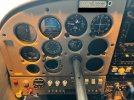
This is a panel from a 182G...1964. Not a shotgun panel.
 

Attachments

  • 637043431_26072428245707313_1423180179805492148_n.jpg
    637043431_26072428245707313_1423180179805492148_n.jpg
    134.5 KB · Views: 6
Back
Top