Cessna 150 left side dead

Gone Flyin

Pre-takeoff checklist
Joined
Nov 30, 2020
Messages
147
Display Name
Gone Flyin
This is a bit of stumper for both me and my IA. Hoping someone can see what we're missing, here.

Cessna 150M was running just fine. IA suggested I replace the Slick mag wires as mine were the original from 1976 and getting a bit frayed.
Ordered from supplier to the tune of $1200+ for the pair. Fine.
Installed the other day, no issues as all the spark plug leads are marked on the caps.. T1, B2, etc. so cannot mess up.
Spark plugs were blast cleaned, gapped and spark tested. All passed no problem.
Everything put back. Engine started right up, but running very, very rough.
Shut down. Pilot side of the engine ice cold top and bottom. Right side hot top and bottom.

On restart, I did the key switch mag-test and, yes, there is the drop on each position

It appears, to us at least, the entire left side is not firing either top or bottom... but, how can that be since the dual mags split the duties between left and right cylinders?

Everything I can think of has been rechecked but still the same.

Clues, suggestions, tests to try?
 
Some harnesses are better than others.

Also means some are not as good.

Suggest a Lead Tester be used prior to changing again.

I’ve met numerous bad leads that were new.

I think overcrimping is the culprit.

My guess is you have leads for Slick mags rather than a Slick Harness?

Other possibility is you have anti seize on plug firing end.
 
Wires are bad. Put the old ones back on.

If the same problem recurs with the old wires, it's not the wires.
:yeahthat:
If you do something and the engine runs rough, undo what you just did. That's advice generally given while in the air but works on the ground as well.
 
Some harnesses are better than others.

Also means some are not as good.

Suggest a Lead Tester be used prior to changing again.
Will a standard ohm meter work? Can I assume I should see close to 0 ohms or are there resistors in the leads to reduce radio interference I need to deal with?
I’ve met numerous bad leads that were new.

I think overcrimping is the culprit.

My guess is you have leads for Slick mags rather than a Slick Harness?\
Well, purchased what was shown on Aircraft Spruce for Slick Harness (4103 I believe, log book at the hangar) magnetos. Cap with 4 clearly marked leads.

M1755 for left, M1745 for right.


Other possibility is you have anti seize on plug firing end.
 
Make sure you put the leads on for firing order and not location order. Seen that happen a number of times over the years.
The caps have a marking 1 on the inside that I matched up. I also scratched on the old cap and base to get them on the same way.
Magnetos were not removed.

Leads were marked with spark plug on the end caps. 1T for cylinder 1 on top.

This is how I have them installed, correct?
 
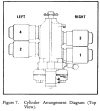
This may be a "duh" reply, but make sure the cylinders are identified properly... Continental and Lycoming identify them differently (on Lycomings #1 is the front right cylinder).

1778503669148.png

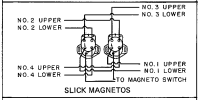
Then, double check that everything's connected properly... a bad installation is more likely than four bad wires on brand new harnesses:

1778503883053.png
Both of these images are from the Continental overhaul manual.
 
Folks have misinterpreted the cylinder markings on the case.

Use previous post for identification.

Slick Leads do not have wires or threads

There is a coil spring instead.

Continuity is generally not the issue so an Ohmmeter will not help.

Leakage from the center conductor to the shielding is often the culprit.

Silicone insulation is good for higher temps but still has limits.

Heat or other damage in service or overcrimping during manufacture

can provide an easier path to ground that diminishes the spark.

Many A& P’s have a Harness Tester that will put approximately

20,000 volts to the lead and check a window in the device to indicate condition.

Before taking everything apart I suggest:

1. Remove ALL 8 leads for safety.

2. Identify #1 cylinder and lead.

3. With switch on BOTH hold lead about 1/4 inch from cylinder ( not plug)

4. Rotate prop until you see a park.

5. Move to #3 cylinder- you should get a spark 1/2 turn later.

6. Repeat the process for #2 and #4 jugs.

7. Start over with #1 but this time use the other lead.

If all fire it’s likely the leads are ok although they may not fire under pressure.
 
:yeahthat:
If you do something and the engine runs rough, undo what you just did. That's advice generally given while in the air but works on the ground as well.
I should probably put this in a different thread, but this mantra may have prevented my off airport landing. Apparently, with the sunken float, the engine would idle better with the boost pump off, where turning it on was making it too rich and killing it dead. So, in theory, my turning the boost pump on for landing may have been what killed the engine, and turning it back off may have resolved the problem. That's a lot of "may have's" and I'm not sure I could ever over-ride my burned in "turn on the boost pump if the engine fails" training in order to turn the boost pump off to try to restart my engine.

It's an interesting conundrum.
 
Issue resolved.

Think this gets back to what a couple suggested...

Turns out the markings on the spark plug caps were not correct. I had actually put tape on my old wires indicating where each one went not knowing they were marked on the caps. When I installed the new Champion harnesses I followed the markings on the new caps.

Big mistake...as it turns out.

Comparing the old harnesses with the new ones I found the B2 and B4 leads were reversed as were the T2 and T4 leads. Hence, the reason the left (pilot) side was stone cold. Nothing on that side was firing.

Anyway, all is well with the world once more and I do appreciate all the suggestions.
 
Good deal....Mag markings and firing orders bite more times than one would think.
 
Turns out the markings on the spark plug caps were not correct

is this the raised numbering where the lead exits the’cap’?

how could it turn out that these are incorrectly marked?
:confused2:

what about the markings often seen at the cable termination?
 
Make sure you put the leads on for firing order and not location order. Seen that happen a number of times over the years.
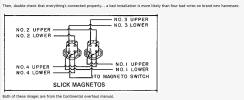
This. And from Dana:

1778640657430.png

That last sentence explains it all. A failure to consult the manuals is behind SO many problems.
 
Back
Top