
Bonanza crash: a slip starved the engine of fuel

MountainDude

Cleared for Takeoff
PoA Supporter
Joined
Jul 29, 2011
Messages
1,466
Display Name
MountainDude
Home Airfield
KPDX
This one is new to me: slipping can prevent fuel from going to the engine.

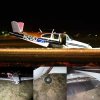
N1206Z Beech N35 Plainview Texas 16 JAN 2025
The pilot reported that while approaching to land he placed the airplane into a slip using right rudder and left aileron in order to lose excess altitude. When the airplane was about 100 ft. above the ground the engine stopped producing power. The pilot suspected that fuel flow to the engine was interrupted because the fuel migrated away from the fuel pickup during the slip resulting in a loss of engine power. He reported that there were no mechanical malfunctions or failures of the airplane.
Probable Cause and Findings:
Fuel starvation due to fuel migration during the pilot induced slipping maneuver.
 

Attachments

  • 493225092_1121446530023419_1717318603496399538_n.jpg
    493225092_1121446530023419_1717318603496399538_n.jpg
    159.6 KB · Views: 46
Possibly a little relation to the ‘WAG’ comments in the Sparta, TN Mooney accident. That is, the amount of fuel in the tank during an ‘unporting’ type event.

Just as an example, any ‘unporting’ would be more possible at a rather low fuel state. This lower fuel state may be workable in coordinated, mostly level flight, not so if forces move the fuel inside the tank.
 
  • Like
Reactions: Tai
This is the reason I prefer having a header tank. I can run the wing tanks completely dry and still have a full header tank to land with.
 
Unporting a partly filled tank in a slip is quite possible. The bigger question is how the pilot managed to mess up so badly. An engine failure at 100' when you're high enough that you need to slip should be a non event, unless you're so high that a go-around is necessary.
 
How do we know that the pilot simply ran out of fuel? Pilots word?
Aren't some older Bonanza known for unporting fuel in a turning takeoff?
 
Unporting a partly filled tank in a slip is quite possible. The bigger question is how the pilot managed to mess up so badly. An engine failure at 100' when you're high enough that you need to slip should be a non event, unless you're so high that a go-around is necessary.
Possibly knew he was low on fuel, kept it high in case it quit too soon, then slipped hard and being a tad too conservative in altitude bit back?
 
This one is new to me: slipping can prevent fuel from going to the engine.

N1206Z Beech N35 Plainview Texas 16 JAN 2025
The pilot reported that while approaching to land he placed the airplane into a slip using right rudder and left aileron in order to lose excess altitude. When the airplane was about 100 ft. above the ground the engine stopped producing power. The pilot suspected that fuel flow to the engine was interrupted because the fuel migrated away from the fuel pickup during the slip resulting in a loss of engine power. He reported that there were no mechanical malfunctions or failures of the airplane.
Probable Cause and Findings:
Fuel starvation due to fuel migration during the pilot induced slipping maneuver.
Bonanzas from that era are known to have unporting issues when running on anything other than the left main, and with low fuel levels. Obviously, less fuel in the tank means more chance of unporting. The aux (and tips if equipped) are gravity-fed and only for use in straight and level flight.

The order of tank consumption should be:

1) Left main for T/O and climb, then burn enough fuel to make room for overflow return.
2) Aux tanks (this will refill the left main partially)
3) Left main again to burn off some fuel.
4) Right main (this will put some fuel back into the left main)
5) Left main - time to land, as by this time you'll have just about reserve level.

Mine is a J and it requires T/O on left main and landing on the "fuller" main tank; assume the N is similar. If you've planned well, you'll have all of your reserve in the left main at this point in the flight, which should always be safe for T/O and landing.

The problem comes in if you're flying a long-ish distance and for some reason you don't use the aux tanks or right main completely, and you don't have more than a half-full left main. You absolutely don't want to try to land on auxes or tips, nor do you want to land with a near-empty main tank.
 
Or it could have been failure to follow the landing checklist which includes fuel selector the fuller tank.
 
I love slips in my no-flaps Decathlon, but why do it when you have 30 degree flaps?
 
Happens.

Better to slip "away" from a low tank in many (most?) aircraft.
I remember this when I had a Cessna 140. There was no "both" option like most later Cessnas. One day I was slipping to land and the engine sputtered. Luckily I had the runway made and it was no issue... well, maybe a missed heartbeat or two, but nothing too bad!
 
I love slips in my no-flaps Decathlon, but why do it when you have 30 degree flaps?
I did a short slip Saturday in my Bo.

The way ABS teaches landings, you rarely use flaps. Part of the reason is that there are no intermediate settings, so practically speaking you end up using no flaps or holding the switch down for an estimated time to get a partial setting. Easier to have no-flaps as your default procedure, then only use flaps for a true short-field situation.
 
This is the reason I prefer having a header tank. I can run the wing tanks completely dry and still have a full header tank to land with.
The Navion has both mains feed to a small header tank. That's where your unusable fuel is. The stock Navion fuel selector is strictly on-off. It also has single point fueling.
 
This is the reason I prefer having a header tank. I can run the wing tanks completely dry and still have a full header tank to land with.

I like my header tank, though I don't necessarily like it hanging above my crotch.
 
So, the N model has the 40 gallon tanks (37 usable). There are no Aux tanks on this model and the tank selection should be to use the fullest tank as both left and right tank selection sends the excess fuel back to the tank that fuel is being drawn from. The tanks were originally unbaffled, and there is a maximum slip duration limitation of 20 seconds in the POH. With the baffled tanks, the limitation is 30 seconds. I have no use what so ever for slipping a Bonanza to lose altitude. With the gear down, the power off descent rate will peg the VSI at maximum gear speed. You are simply never too high in a Bonanza. My Bonanza has a higher gear speed than the N model, but I see 6000 ft/min in the emergency descent maneuver.
 
I did a short slip Saturday in my Bo.

The way ABS teaches landings, you rarely use flaps. Part of the reason is that there are no intermediate settings, so practically speaking you end up using no flaps or holding the switch down for an estimated time to get a partial setting. Easier to have no-flaps as your default procedure, then only use flaps for a true short-field situation.
ABS recommendations notwithstanding, you might want to research the stall speed chart.
 
I did a short slip Saturday in my Bo.

The way ABS teaches landings, you rarely use flaps. Part of the reason is that there are no intermediate settings, so practically speaking you end up using no flaps or holding the switch down for an estimated time to get a partial setting. Easier to have no-flaps as your default procedure, then only use flaps for a true short-field situation.

That is not the way ABS instructors teach landings. I have owned my Bonanza for 46+ years and have been a BPPP instructor and now an ABS Recognized Flight Instructor. For all regular landings, I teach full flaps when the runway is made. I also will teach landings without flaps, but that is only done under special circumstances such as electrical failure, some very gusty wind conditions, or at the end of an instrument approach. I don't teach landings using partial flaps on Bonanzas that don't have an approach flap setting. I don't use flaps for instrument approaches because it just adds more work in the event of a missed approach. The Bonanza flies a relatively steep approach with full flaps, power off which is close to 8 degrees, so it takes some power to keep the descent angle lower. With the gear down and full flaps, power off is very steep and if you haven't practiced it, most pilots don't have an appreciation of how far one can glide in the dirty condition. I demonstrate this by having the pilot remain at pattern altitude until the pilot believes they can make the runway without power. In almost every case, they realize shortly after cutting power that they are in too much of a "down elevator" and have no chance of making the runway and have to add power back. The Bonanza also specifies a higher emergency approach speed when landing without power so that they will have sufficient energy to round out in the flare. The POH only specifies approach speeds with full flaps. Approach speeds without flaps should be determined based on 1.3 times the stall speed without flaps.
 
Last edited:
  • Like
Reactions: Tai
Bonanzas from that era are known to have unporting issues when running on anything other than the left main, and with low fuel levels. Obviously, less fuel in the tank means more chance of unporting. The aux (and tips if equipped) are gravity-fed and only for use in straight and level flight.

The order of tank consumption should be:

1) Left main for T/O and climb, then burn enough fuel to make room for overflow return.
2) Aux tanks (this will refill the left main partially)
3) Left main again to burn off some fuel.
4) Right main (this will put some fuel back into the left main)
5) Left main - time to land, as by this time you'll have just about reserve level.

Mine is a J and it requires T/O on left main and landing on the "fuller" main tank; assume the N is similar. If you've planned well, you'll have all of your reserve in the left main at this point in the flight, which should always be safe for T/O and landing.

The problem comes in if you're flying a long-ish distance and for some reason you don't use the aux tanks or right main completely, and you don't have more than a half-full left main. You absolutely don't want to try to land on auxes or tips, nor do you want to land with a near-empty main tank.
Sounds like a P.I.T.A
 
I have seen “avoid prolonged slips” cautions for fuel flow reasons in the POH for a few different types.

I won’t get into the Bonanza/flaps argument about what’s “right” but have flown V-tails, 33 series and 36s and havenever even heard of no-flap landings as SOP in one.
 
Sounds like a P.I.T.A
Somewhat, but any plane with multiple tanks is going to require some planning. Have you ever looked at the C310 fuel system? [https://www.pilotsofamerica.com/community/threads/all-about-cessna-310s.117510/]

I have seen “avoid prolonged slips” cautions for fuel flow reasons in the POH for a few different types.

I won’t get into the Bonanza/flaps argument about what’s “right” but have flown V-tails, 33 series and 36s and havenever even heard of no-flap landings as SOP in one.
Really? Interesting - and not in sync with the documentation I have. The ABS instructor I used for transition training only had me do one or two landing with any flaps at all. In fact, the ABS "By The Numbers" chart for my plane (J35) shows no flaps or a max of 10 degrees for all conditions:

 
Somewhat, but any plane with multiple tanks is going to require some planning. Have you ever looked at the C310 fuel system?
The Twin Cessna fuel systems are really a matter of understanding your systems, which should be true for the PIC of any aircraft. The understanding of systems drives planning and prevents problems. And, like anything else in life, once you understand it the complexities melt away.
 
Doesn’t an ‘unporting’ fuel scenario sound a little better than ‘running out of fuel’? I think it’s almost the same thing, but maybe coming in on fumes, it’s slight more excusable to get caught in an un-porting event.

Isn’t there a saying, ‘it costs fuel to carry fuel’. Load ‘just enough’ fuel.
 
Doesn’t an ‘unporting’ fuel scenario sound a little better than ‘running out of fuel’? I think it’s almost the same thing, but maybe coming in on fumes, it’s slight more excusable to get caught in an un-porting event.
No, it's not the same thing.

You can unport with a half-full tank, particularly if you aren't well coordinated and using the wrong tank. This is why the tip and aux tanks on a Bonanza are only approved for use in straight/level flight.
 
Doesn’t an ‘unporting’ fuel scenario sound a little better than ‘running out of fuel’? I think it’s almost the same thing,
It’s the difference between fuel exhaustion (ran out) and fuel starvation (fuel still in the airplane, but the pilot can’t manage to get it to the engine.) The latter usually falls under fuel mismanagement just like the former.
 
I actually had this happen to me while training a commercial student. At 3,000 AGL above the airport i pulled the power & asked him to make a no power landing & touchdown within 200ft of the 1,000' bars. He didn't cut short his base turn when we appeared low. As we turned final it was apparent we weren't going to make the runway so i instructed him to add power. When he pushed in the throttle we realized we had no power. I must have yelled 3 or 4 times to pitch down & maintain approach speed. In my mind I knew we were going to land short in the sagebrush. I had a flash thought of how I was going to explain to the Bonanza owner how we crashed his airplane. We did make the runway but barely. As soon as we touched down I knew we had starved the engine of fuel. The engine came to life as we rolled out & we went to the fuel pump. We had just over 30 gallons left. Just low enough to starve the engine as we made our decending left spiral. We were lucky.

Now when I do that maneuver in that airplane we make sure we have at least half tanks.
 
If you’re on the left main, push the right wing down in the slip and you’ll be fine. I don’t have a Bo, but my checklist says fullest tank. If I only have 4-5 gallons left in the tank and I open the gas cap, I won’t see any fuel. The tank angles down towards the suction hole or whatever it’s called.
 
But turbulence should never have the ball out far enough one direction to import a tank.
Unless the fuel level is significantly lower than it should be., i.e., forgetting to switch tanks to the fullest one. Don't ask how I know that...
 
There is a yellow caution range on the Bonanza fuel quantity indicators. In my V35A there is also a placard to not take off if fuel quantity gages indicate in the yellow band or less than 13 gallons in each main tank. This was imposed by an AD. Pilots were also warned not to make rapid turning takeoffs due to the possibility of un-porting the fuel pickup. If the fuel was below the 13 gallons, it would be possible for the fuel pickup to be un-ported.
 
Back
Top