Best Glide, Glide Ratio and minimum sink

Hang 4

En-Route
Joined
Aug 18, 2017
Messages
3,425
Display Name
Hang 4
There's been a bunch of threads recently on best glide speeds and implications. Was doing a post maintenance test fight today and had a couple minutes to play around. Plane is a PA-28 180, Piper Challenger (Archer 1) with a Hershey bar wing.

I got out over the ocean to eliminate convective lift. Slowed to best glide speed @ idle. That's 80 MPH or 70KTS indicated. Got stable at that speed and noted descent/sink rate. That was 800 fpm. True airspeed was 75kts. That works out to roughly a 9:1 Glide ratio. That's not too bad. Not a sailplane by any stretch, but not horrible.

Next, I slowed to try and find minimum sink. As I suspected, that doesn't mean much in this plane. I got the sink rate to 700 fpm, which isn't much of a practical difference. It was also not a speed I'd want to be messing around trying to fix anything. The plane trimmed out fine at best glide and I could see running a checklist if you had a lot of altitude and/or good landing options. The instability at min sink was definitely not worth the 100 fpm difference in sink rate. Think the difference in airspeed was around 5 knots. That's getting close to a stall, which I think is why it would not fly hands off very well.

What I didn't try was to establish a polar curve by flying at speeds above best glide and noting the sink rate. Might do that another time as knowing how steep that curve is would help in knowing what to do in a headwind.

The glide ratio was likely helped by the idling engine vs an actual engine out.

Not a flight instructor, nor did I sleep in a Holiday Inn Express last night, but my takeaway is there's no useful difference between best glide and min sink in a GA trainer. Second takeaway, folks should have a practical idea of their glide ratio and try gliding from a decent altitude to a place a fair distance away and seek how the actual performance aligns with the theoretical glide ratio. I've done this a few times and have a decent idea from looking out the window where I can glide to if the engine quits. I do have windspeed and direction on my panel so I can adjust for head/tail wind differences.
 
Most... I say again... MOST... Airplane Single Engine Best Glide will be somewhere between Vx and Vy with the engine at idle. Remember that an engine at idle may be contributing to drag from the prop disc. A stopped prop has the drag of a 8ft 2x4 as opposed to a 90" round table. That's why those with CS Props would select as close to full feather as the system allows. That's why multi engine planes do have full feather capability.

MOST... I say again... MOST... ASEL can achieve Vg, Best Glide, at full nose up trim with the engine at idle.

Remember, Best Glide gets you the best distance over the ground for the altitude lost. Min Sink speed may increase your time aloft, but at a risk of not traveling as far, putting an airport or landing area that might have been reachable at Best Glide, out of reach.

Also remember, that Min Sink puts you very close to the "back side of the power curve", or in glider parlance, close to stall. Very observant that reducing to "min sink" created what was considered an unstable platform that would take more brain cells to maintain control that could not be used to trouble shoot a problem.
 
which isn't much of a practical difference.
Nice. I think that once we get into trying to drill down we wind up with a lot of that. Just a few observations.

Best glide is about maximizing range; best sink is about maximizing altitude. And whichever one you choose is going to lessen the other. The engine out in a piston single is primarily about about getting to a place where we can touch down - that's about range. Sure, if we're in the clouds with a forest below us and we can't see a landing spot, we might want to descend as slowly as possible and give up range, but that probably a very small number of engine outs.

It was also not a speed I'd want to be messing around trying to fix anything.

The other is that many discussions of best engine out technique involve a lot of "messing around." We can add the zoom climb to the range vs sink discussion. That's pitching up aggressively to gain altitude while getting to best glide. Maybe it will buy something, but it seems to me to disregard the most important part of an engine out (whether partial or complete) - locating and getting to the best place to put down. That's not limited to the zoom climb. When I do an engine out exercise as part of a flight review, I often see pilots spending a whole bunch of time with their heads inside the cockpit staring at the ASI until points to that 70 or 80 or 90 book value (while heading away from the best place). That time is better spent (to repeat) locating and getting to the best place to put down. And that's aside from the fact that the book best glide is for max gross weight, so the chances are excellent the target airspeed you are spending so much time tweaking isn't best glide speed at your weight anyway!

I've mentioned my technique of just pitching to a level cruise attitude. It ends of closely approximating best glide and has the advantage of being the single most familiar look out the window we know. Here's how a came across that technique.

I was a relatively new CFI. I was doing a rental checkout in a Cessna 172 for a 20,000 hour retired airline pilot. When I pulled the power for the
simulated engine failure, he was at best glide and heading toward a landing spot within 6 seconds. What he did was look out the window and pitch for level cruise while turning to a potential landing area. The result was a speed close enough to best glide that the difference was inconsequential. So inconsequential that trying to be "perfect" would have a negative impact. As I recall it was a bit slower than book best glide so it might even have accounted for the fact we were well below max gross weight.

I've been using and teaching the "look out the window" technique ever since. Done it in multiple types of singles, always with the same result. The nice part is, it applies to the engine failure immediately after departure where there is not time to do anything other than push to best glide and land. Tweak if you need to with a touch of trim. If your autopilot has an IAS or emergency mode, use it. But only once underway to your landing area.
 
Last edited:
Not sure what I'd ever use Minimum Sink Rate for, other than maybe to try and stop the prop and not loose much altitude while I was doing that.

If you're over where you're going to land, there's no reason to maintain more altitude for any additional time. If I'm not over where I'm going to land, you're loosing a lot of distance by trying to stay up higher longer.

OH... One possible reason. If there was a ridge in front of me that Best Glide would have me run right into the the side of the hill/mountain, where Min Sink may ultimately loose my total glide distance, but gets me over the ridge to better landing sites. But I'd want to do a LOT of experimenting before I ever tried that.
 
Part of my point was min sink doesn't really affect sink all that much. So it's not a useful speed. Compare that with a sailplane that has a 200fpm min sink and a 500 fpm best glide sink rate and min sink is actually useful. 100 fpm difference, not so much.
 
OH... One possible reason. If there was a ridge in front of me that Best Glide would have me run right into the the side of the hill/mountain, where Min Sink may ultimately loose my total glide distance, but gets me over the ridge to better landing sites. But I'd want to do a LOT of experimenting before I ever tried that.
Best glide by definition would be what would get you to a fixed position the highest. If you aren't getting over a ridge at best glide, you aren't getting over it.
 
Sure, if we're in the clouds with a forest below us and we can't see a landing spot, we might want to descend as slowly as possible and give up range, but that probably a very small number of engine outs.
Agree with all your points, except maybe this one. If I'm in the clouds, job 1 is staying upright. I would want to be at a speed that is the most stable, which would likely be best glide, or a touch faster. Particularly convective clouds with the associated turbulence.
 
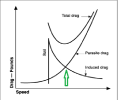
I always think of this chart to understand how to use V Best Glide. It is where you have the least drag, where parasitic and induced drag cross. As stated above, Vy will usually be a little faster, and Vx will be a little slower. Below Max Glide you're "behind the power curve", where as much power is needed to go slower as is needed to go faster if you were above Max Glide. With simulated engine out training, its still "against my initial instincts" to pitch up and slow down to V Max Glide - which of course get's you further down the road on a dead engine.

I should do the comparisons some day - I bet V Max Glide is pretty much your V Ref speed.


1752179954377.png
 
Last edited:
Nice work, thanks for posting it. One discussion point:
What I didn't try was to establish a polar curve by flying at speeds above best glide and noting the sink rate. Might do that another time as knowing how steep that curve is would help in knowing what to do in a headwind.
It's good to know how much the glide ratio changes at off-nominal speeds because the best glide speed changes with weight. My book best glide (at max gross) is about 90 KIAS, but more often than not I'm flying at or below max aerobatic weight, where best glide is closer to 82 KIAS. I couldn't tell you off the top of my head what the difference in glide ratio is by flying 90kt at aerobatic weight but I *can* tell you I'm not going to do it if I'm at all concerned about getting where I need to be with no motor. One of the benefits of AOA indicators is that you don't have to know the variation with weight, you just have to know and fly the AOA for max L/D, which doesn't change with weight.

Nauga,
a different kind of alpha male
 
@nauga Come to FL and we'll fly and get the two pilot weight Vg speed. Speed changes, but in theory, glide ratio does not. From a practical standpoint, not sure that holds as true in GA planes. Sailplanes ballast up to fly faster in the strong lift part of the day and they are a very low drag airframe. For XC competitions they want to get to the next thermal as fast as possible. For GA planes, I suspect the effect of their lousy drag profile means there's not a large delta between light and heavy best glide speed.
 
@nauga Come to FL and we'll fly and get the two pilot weight Vg speed. Speed changes, but in theory, glide ratio does not. From a practical standpoint, not sure that holds as true in GA planes. Sailplanes ballast up to fly faster in the strong lift part of the day and they are a very low drag airframe. For XC competitions they want to get to the next thermal as fast as possible. For GA planes, I suspect the effect of their lousy drag profile means there's not a large delta between light and heavy best glide speed.
I appreciate the offer...but suggest that we might learn something a little different and more useful:
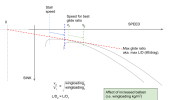
The *calibrated* airspeed for max L/D (which is best glide speed) changes as weight changes with the square root of the ratio of weights. This can be known in advance. The glide ratio at that speed will not change. The decrease in range flying above or below best glide speed for your current weight depends on the airplane's drag polar. This degradation in performance is useful because it tells you how critical maintaining best glide speed is (or isn't).

Nauga,
and the smell of old sweaty test cards
 
Correct, guess what I really meant is the difference in speeds will be a lot less in a draggy airframe. Or in other words the polar curve will be very steep.
 
Correct, guess what I really meant is the difference in speeds will be a lot less in a draggy airframe. Or in other words the polar curve will be very steep.
The penalty (reduction in glide ratio and resulting glide range) for flying off best glide speed will be greater in an airplane with a steep *drag* polar. The % change in best glide speed for a given % change in weight will be the same for a clean airplane and a draggy airplane.

Nauga,
like a turd off a tall moose
 
Here's a graph that explains it - and now I better understand what you are saying. The glide ratio of a turd is bad no matter how heavy it is :).Screenshot 2025-07-10 at 5.33.47 PM.png
 
Part of my point was min sink doesn't really affect sink all that much. So it's not a useful speed. Compare that with a sailplane that has a 200fpm min sink and a 500 fpm best glide sink rate and min sink is actually useful. 100 fpm difference, not so much.
Having learned to fly in a geographic area that boasts consistent but weak thermals, I love light gliders with low min sink speeds . . . think feel the pre-stall buffet and just ease the stick forward 'till it goes away . . . 128 fpm. Time slows, your turns tighten while your bank eases . . . it's easier to stay centered as you go up.

Now, even with just one height to weight appropriate pilot on board and the b/c filled with helium birthday balloons, a PA-28 will never be mistaken for a glider. But, say you have a suitable emergency landing area in sight. Circling it at min sink would give you more time aloft to try and restart or communicate.
 
Here's a graph that explains it - and now I better understand what you are saying. The glide ratio of a turd is bad no matter how heavy it is :).
I was confident we'd get there eventually :)
By the way, the speed ratio resolves to sqrt(weight1/weight2) if you assume constant wing area. If you assume wing area somehow changes then the ratio is invalid because the aero characteristics (drag polar, etc) almost certainly change as well.

Nauga,
and his invariable geometry
 
Agree with all your points, except maybe this one. If I'm in the clouds, job 1 is staying upright. I would want to be at a speed that is the most stable, which would likely be best glide, or a touch faster. Particularly convective clouds with the associated turbulence.
That's why I said "might."
 
Best glide by definition would be what would get you to a fixed position the highest. If you aren't getting over a ridge at best glide, you aren't getting over it.
You might either hit the books or ask for a refund from your Ground School. :D
 
OH... One possible reason. If there was a ridge in front of me that Best Glide would have me run right into the the side of the hill/mountain, where Min Sink may ultimately loose my total glide distance, but gets me over the ridge to better landing sites. But I'd want to do a LOT of experimenting before I ever tried that.
Best glide by definition would be what would get you to a fixed position the highest. If you aren't getting over a ridge at best glide, you aren't getting over it.
You might either hit the books or ask for a refund from your Ground School. :D
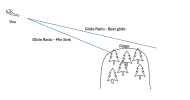
Think you might be the one needing a refund or we're talking past each other. If you have a fixed object in front of you - I'm assuming by a few miles - best glide is what will get you over it, not min sink. The only potential exception would be if you could zoom climb by turning airspeed into altitude. Not doing that by slowing from 70kts to 65kts in a GA aircraft.Screenshot 2025-07-10 at 7.58.50 PM.png
 
Last edited:
OH... One possible reason. If there was a ridge in front of me that Best Glide would have me run right into the the side of the hill/mountain, where Min Sink may ultimately loose my total glide distance, but gets me over the ridge to better landing sites. But I'd want to do a LOT of experimenting before I ever tried that.
Nope - Vg gives you the best glide ratio and thus the best chance of making it over a physical object in your way.

Unless you meant you'd have a strong tailwind and fly up next to the ridge at min sink to try and use ridge lift to go back up and clear it.

The reason for using minimum sink is that you have more than enough altitude to get to your landing spot, and you want more time for troubleshooting, communicating, briefing your pax about what you're doing, and any number of other things. You definitely DON'T want it if there's any doubt about making your chosen landing spot.
 
I have doing many no flap landings lately.
Pull the power to idle and trim to 65 kts abeam the numbers. Then try to manage your energy to the runway without using any power.
I think it might be the type of training that you are talking about?
Anyway I think it is fun and I have done as many as 11 in row. I have done them in both directions and with and without wind. Getting pretty good at it now.
 
Not sure what I'd ever use Minimum Sink Rate for, other than maybe to try and stop the prop and not loose much altitude while I was doing that.

If you're over where you're going to land, there's no reason to maintain more altitude for any additional time. If I'm not over where I'm going to land, you're loosing a lot of distance by trying to stay up higher longer.

OH... One possible reason. If there was a ridge in front of me that Best Glide would have me run right into the the side of the hill/mountain, where Min Sink may ultimately loose my total glide distance, but gets me over the ridge to better landing sites. But I'd want to do a LOT of experimenting before I ever tried that.
Maybe during ocean crossings, where you have to ditch regardless, you want as much time to prep as you can? Just brainstorming.
 
Back
Top