B58 Baron N2063G fatal crash 4/13/2026 Knoxville, TN (KDKX)

So let’s circle back to this VMC thing. When done properly it’s occurring well above actual VMC. There is always sufficient margin to recover the aircraft prior to an actual VMC event. I think VMC should stay in the ACS.
My point is that, as fundamental as it is, it doesn’t get near the practice that it should.
 
I always blocked the rudder. It’s the only way to ensure there is margin. I always thought those that didn’t were nuts. Literally every document I’ve read during my spool up as a multi engine pilot recommended blocking the rudder.

Your DPE was a psychopath. Lol
The DPE also didn’t follow ACS guidance…
“Therefore, recovery should be made at the first indication of loss of directional control, stall warning, or buffet,” doesn’t mean he gets to choose. It’s whichever comes first. It’s that kind of ****ing around that causes the problems.
 
All this talk of twins and VMC rolls makes me want to just stick with single-engine planes. When the engine goes out on my single all I have to do is go for a restart and decide where I’m going to land. I think the twins will kill you quicker if you lose an engine. Sure seems to be that way lately!
 
Yes but it can mitigate it.
That's not what you stated above. "Never" is an absolute. That aside, no maintenance program or procedure can prevent or mitigate certain failures of the rotating assembly, fuel, or ignition systems. In essence, everything is vulnerable to failure.
 
Last edited:
VMC demo in a Duchess was a big nothing burger for me during commercial multi training. Of course my MEI was a highly experienced individual and taught me well.

Don’t be scared of aircraft or maneuvers. Get good training and expand your abilities.
 
Indeed. It's one of the reasons that I have been very, very hesitant to get my multi. The Vmc demo just seems insane to me, as an intentional degradation of safety margin which approaches the edge of an unrecoverable state. Back in the day, maybe it was necessary. Today, we have high-fidelity simulators that can not only demonstrate Vmc flight, but can let the student take it all the way to catastrophe and then still get a beer afterwards.
A properly done Vmc demo in most light twins is not "insane" and is very easy to recover from. See page 60 of the Commercial Pilot ACS for the maneuver - It's basically configuring the airplane as it would be right after gear retraction on takeoff, reducing to Vsse+10, and then slowing down at 1 knot per second until the first indication of stall, loss of directional control, or buffet, at which point you recover by reducing power on the good engine and lowering the nose enough that you can add power back in and reestablish the climb at Vyse±5. With that low of a rate of airspeed change, it's not a scary maneuver and unlike a stall, you kinda know when it's coming because at the beginning of the maneuver you aren't using full rudder. When the rudder hits the stop, you *know* you're about to lose directional control and if you calmly begin the recovery there will be an "indication" as the nose starts to go towards the dead engine. If you're in a plane with Vmc closer to stall, you'll get the imminent stall warning (buffet and/or horn) first and recover right away without any loss of directional control.

I did my multi in the mighty Apache, with Vmc of 85 and clean stall of 72. Rudder would run out first, and nose would start yawing to the left. Recovery seemed easy, and none of it was scary.

Tbh, I’m a bit afraid to do my spin training and my goal is to get my CFI this year. After the incident last year, I don’t even want to do stalls. I will go to a higher altitude for sure.
First time I did a spin I was like "Holy crap, that was scary!!!... Let's do it again." That's also when I realized that I'd once gotten into the start of a spin on an early Private training flight during a power on stall. CFI had taken over and recovered on that one and I didn't even really know it what had happened. The 172 spins a bit more benignly than an Extra. :rofl:

Finding a simulator for a piston twin is going to be challenging
Simcom has a bunch of them for Barons, 300 and 400 series Cessnas, and Navajos. Various Redbird sims can be configured as twins as well. Shouldn't be that much of a challenge to find something.

A good example of the diminishments in skill and learning can be found in K-12 schools. Students are given instruction that intentionally avoid the rigors of study about subjects like Algebra and Algebra II. Certain groups of "activists" assert that these subjects are inherently biased to make students fail, and lobby for their removal from curriculum.
You sound like certain "news" organizations. In reality, students are learning more advanced math earlier thanks to newer teaching techniques.

Similarly, producing pilots that cannot perform maneuvers which might save their lives puts them at mortal risk. It apparently surprises a set of people that flying can present dangers, and that instruction and recurrent training in certain areas will save lives. Certainly it's tragic that accidents in training occasionally take lives.
There's a balance to be struck between practicing dangerous maneuvers and practicing bleeding. Old-school Vmc demos that had to be done at low altitude was over the line and killed too many DPEs, CFIs, and students. I'd venture to guess the same was true when spin training was required. We still do training in those, but it's nerfed a little to make it safe enough to train. The balance that has to be found is between the amount of danger in doing the maneuver in the airplane vs the value of the training. Make it too hard and you kill too many people. Make it too easy and what's the point?

I say maintenance and never lose an engine.
You can't say that... And in a twin, you're twice as likely to have an engine failure.

All this talk of twins and VMC rolls makes me want to just stick with single-engine planes. When the engine goes out on my single all I have to do is go for a restart and decide where I’m going to land. I think the twins will kill you quicker if you lose an engine.
They absolutely can. I did a study of single vs multi safety in the 135 and 91 corporate worlds and found that they're almost identical, with the singles being *just* slightly safer in both cases. Pretty much for every single-engine failure that results in fatalities, there's an engine failure resulting in loss of control on a twin.

Yes but it can mitigate it.
... And make you complacent in the process. You still need to *expect* an engine failure on every takeoff.
 
I did a study of single vs multi safety in the 135 and 91 corporate worlds and found that they're almost identical, with the singles being *just* slightly safer in both cases. Pretty much for every single-engine failure that results in fatalities, there's an engine failure resulting in loss of control on a twin.

Plus, a single has the advantage of an engine front and center to help cushion, deflect and break stuff during an emergency off-field landing or bird strike.
 
Simcom has a bunch of them for Barons, 300 and 400 series Cessnas, and Navajos.
So, guy wants a ME checkride and lives in Montana. The DPE there does the entire ride, except in your example the VMC demo. Now he has to fly or drive to Florida, book some sim time (or does he jump in cold just to do the VMC demo?) provide a hotel, rental car and meals then the return trip home.

Yea, should work out very well................ :rolleyes:

Various Redbird sims can be configured as twins as well. Shouldn't be that much of a challenge to find something.

Redbird sims will not produce the required outputs to be considered as viable for demonstrating a VMC maneuver for testing purposes.
 
I did my multi in the mighty Apache, with Vmc of 85 and clean stall of 72. Rudder would run out first, and nose would start yawing to the left. Recovery seemed easy, and none of it was scary.
The mighty Apache: three potatoes flying in close formation. I received my ME and MEI in an Apache, and taught a bit in that same airplane. Keep in mind that the Apache is relatively docile near Vmc, compared to some other GA airplanes (I'm lookin' at you, Baron). Just prior to my MEI checkride, a local ace-of-the-base perished in a training accident involving a Beech 95 Travel Air. The findings suggested that the airplane entered a flat-spin that likely developed during a Vmc demonstration, from which the pilots were unable to recover. Needless to say, that tragic event cast a pall over my own training, and made a lasting impression (no dark pun intended).

As for simulators, I agree that the use of a capable simulator is FAR more effective, and almost infinitely safer, than training in an airplane--especially when training engine-out procedures. But it has to be a level D device to effectively replicate the actual maneuver--a Redbird box won't cut it.
 
Pilots and instructors continue to die trying to train or test on maneuvers and recoveries to avoid the probability of dying in the real world.
My thoughts just like spin training.
If spin training was mandatory for PPL would we see more or less spin accidents?
 
The mighty Apache: three potatoes flying in close formation. I received my ME and MEI in an Apache, and taught a bit in that same airplane. Keep in mind that the Apache is relatively docile near Vmc, compared to some other GA airplanes (I'm lookin' at you, Baron). Just prior to my MEI checkride, a local ace-of-the-base perished in a training accident involving a Beech 95 Travel Air. The findings suggested that the airplane entered a flat-spin that likely developed during a Vmc demonstration, from which the pilots were unable to recover. Needless to say, that tragic event cast a pall over my own training, and made a lasting impression (no dark pun intended).

As for simulators, I agree that the use of a capable simulator is FAR more effective, and almost infinitely safer, than training in an airplane--especially when training engine-out procedures. But it has to be a level D device to effectively replicate the actual maneuver--a Redbird box won't cut it.
What’s the Apaches single-engine climb rate at 5,000’ altitude?
 
My thoughts just like spin training.
If spin training was mandatory for PPL would we see more or less spin accidents?
That very much depends on the parameters you put on it. If you require that the instructor have certain hours and qualifications, probably fewer accidents. If just anyone can do it, more accidents.
 
What’s the Apaches single-engine climb rate at 5,000’ altitude?
Laughter aside: at typical training weights at about 5k’, that particular Apache would manage a ROC that I would characterize as “discernable” in cool weather, and a solid -100 in hot weather.
 
Last edited:
So, guy wants a ME checkride and lives in Montana. The DPE there does the entire ride, except in your example the VMC demo. Now he has to fly or drive to Florida, book some sim time (or does he jump in cold just to do the VMC demo?) provide a hotel, rental car and meals then the return trip home.

Yea, should work out very well................ :rolleyes:


Redbird sims will not produce the required outputs to be considered as viable for demonstrating a VMC maneuver for testing purposes.
What won't a Redbird do that's needed? It's got motion, presumably it can simulate a buffet, and it can absolutely simulate a loss of directional control.

My point in bringing up Simcom is that there are piston twin sims. I don't know where they all are... And there are Redbirds all over the place.

Finally, how is this different from the spin training required for the CFI rating? Plenty of people have to travel to accomplish that as well.

The mighty Apache: three potatoes flying in close formation.
:rofl: Truth!

I received my ME and MEI in an Apache, and taught a bit in that same airplane. Keep in mind that the Apache is relatively docile near Vmc, compared to some other GA airplanes (I'm lookin' at you, Baron). Just prior to my MEI checkride, a local ace-of-the-base perished in a training accident involving a Beech 95 Travel Air. The findings suggested that the airplane entered a flat-spin that likely developed during a Vmc demonstration, from which the pilots were unable to recover. Needless to say, that tragic event cast a pall over my own training, and made a lasting impression (no dark pun intended).
As I recall, you are, um, a "pilot of significant experience." When did the above occur?

As for simulators, I agree that the use of a capable simulator is FAR more effective, and almost infinitely safer, than training in an airplane--especially when training engine-out procedures. But it has to be a level D device to effectively replicate the actual maneuver--a Redbird box won't cut it.
Why? Redbirds do have motion, if you think that is required... Frankly, I don't even think motion is really required to be able to demonstrate the maneuver. Simulate an Apache or whatever other relatively docile piston twin you want, and all you need to see is the view outside start turning and actions to perform the recovery taken.

What’s the Apaches single-engine climb rate at 5,000’ altitude?
Per the book, about 60 fpm. Keep in mind that's a density altitude, though.
 
What’s the Apaches single-engine climb rate at 5,000’ altitude?
Laughter aside: at typical training weights at about 5k’, that particular Apache would manage a ROC that I would characterize as “diacernable” in cool weather, and a solid -100 in hot weather.
Per the book, about 60 fpm. Keep in mind that's a density altitude, though.
Note also that any single-engine climb rate information that may exist in the AFM/POH would be at Blue Line with a prop feathered, and will be significantly degraded at slower speeds with the windmilling prop that’s normally used for Vmc demos.
 
What won't a Redbird do that's needed? It's got motion, presumably it can simulate a buffet, and it can absolutely simulate a loss of directional control.

How does the Redbirds simulate the yaw axis? Answer: It doesn’t.

And many of the Simuflight sims don’t have a yaw axis as well.

Simulators need to be approved for all functions they are trying to replicate. If one is missing then it can get that approval.
 
I live @ 4200’. Numbers published are for a new Apache (new engines and a properly rigged air frame, etc). In reality, at 4000 feet you would be descending in that old dog, I believe.
 
And there are Redbirds all over the place.
Even if it was approvable, they couldn’t just go use it for a checkride…they would have to go through the full approved training course, and at this point I don’t know of a 141 or 142 school that even has an approved syllabus for multiengine rating training in a simulator.

§ 61.64 Use of a flight simulator and flight training device.​

(a) Use of a flight simulator or flight training device. If an applicant for a certificate or rating uses a flight simulator or flight training device for training or any portion of the practical test, the flight simulator and flight training device—

(1) Must represent the category, class, and type (if a class or type rating is applicable) for the rating sought; and
(2) Must be qualified and approved by the Administrator and used in accordance with an approved course of training under part 141 or part 142 of this chapter; or under part 121 or part 135 of this chapter, provided the applicant is a pilot employee of that air carrier operator.
 
Last edited:
I always blocked the rudder. It’s the only way to ensure there is margin.
I’d add that wings level can increase Vmc by around 15 knots, so doing the demo wings level would bring the loss of control well above stall, even with altitude considerations, in most light twins that I’m aware of.

And if I’m recalling the numbers correctly, that would put the loss of control in a Baron not far below Blue Line, which would emphasize the need for both proper speed control and the value of the bank in OEI ops.

Edit: I’m not remembering the numbers correctly…Vmc would probably still be close to 20 knots below blue line, but probably still 10+ knots above stall.
 
Last edited:
As I recall, you are, um, a "pilot of significant experience." When did the above occur?
If by "significant experience" you mean a lot of experience screwing-up, then you recall correctly. That accident happened in or about 1979.
Why? Redbirds do have motion, if you think that is required... Frankly, I don't even think motion is really required to be able to demonstrate the maneuver. Simulate an Apache or whatever other relatively docile piston twin you want, and all you need to see is the view outside start turning and actions to perform the recovery taken.
Redbird... they sell an AATD that they claim is a "full motion" device. I believe that they are being intentionally misleading as the term "full motion" is not specifically defined, so they can get away with that claim. Most critically, it lacks the ability to "heave," which is the vertical motion that simulates g-force. A level C or D FFS has a 6 degree-of-freedom motion base with enough actuator travel such that it can generate motion which, when perceived by the vestibular system and correlated with appropriate visual cues, replicates rather authentically the actual experience of being in an aircraft in flight. Compared to a FFS, the motion base that Redbird utilizes is primitive, sluggish, limited in travel, and not at all realistic based on my experience with it. It's more like an amusement park ride, and it's biggest accomplishment is making students queasy.

While it is possible to teach procedures in an AATD, such a device does not provide the student with a realistic approximation of the sensations and feedback that are experienced in the aircraft. Such sensations and feedback are an important component of developing piloting skills, especially when flying close to the limits of the flight envelope.
 
How does the Redbirds simulate the yaw axis? Answer: It doesn’t.
Looking at their web site, all of the ones I looked at, including the cheapest motion one, do have yaw. :dunno:

And many of the Simuflight sims don’t have a yaw axis as well.
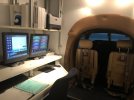
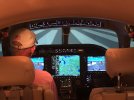
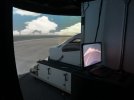
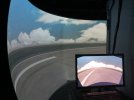
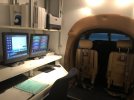
Most of them (Simcom) don't move at all. When I went there for TBM training it was pretty much the cockpit of an airplane hooked to some computers and a really fancy wraparound outside visual setup:

IMG_4638.jpeg
IMG_4643.jpeg
IMG_4642.jpeg

IMG_2071.jpeg

Simulators need to be approved for all functions they are trying to replicate. If one is missing then it can get that approval.
So, this all begs the question: Is yaw *motion* required for Vmc demo in a sim? Why?

Sure, you could recognize it from your butt... But IMO if you feel it there it's too late and you should have recognized it from the outside visual references and/or the inclinometer first, both of which can be simulated without motion in any axis. :dunno:

Also, it's not like the axes on a simulator are even doing what you feel like they're doing. For example, if you watch a takeoff from the outside of a Level D sim, there's a massive pitch up right at the beginning of the roll, which is how you feel the acceleration without moving. The simulator is using a gravity vector to simulate the overall acceleration vector one would experience in the plane.

Even if it was approvable, they couldn’t just go use it for a checkride…they would have to go through the full approved training course, and at this point I don’t know of a 141 or 142 school that even has an approved syllabus for multiengine rating training in a simulator.

§ 61.64 Use of a flight simulator and flight training device.​

(a) Use of a flight simulator or flight training device. If an applicant for a certificate or rating uses a flight simulator or flight training device for training or any portion of the practical test, the flight simulator and flight training device—

(1) Must represent the category, class, and type (if a class or type rating is applicable) for the rating sought; and
(2) Must be qualified and approved by the Administrator and used in accordance with an approved course of training under part 141 or part 142 of this chapter; or under part 121 or part 135 of this chapter, provided the applicant is a pilot employee of that air carrier operator.
I'm not saying that you would do an entire checkride in the sim, or even that this would have to be part of your checkride at all. It would be something akin to the spin training for CFI, where you go somewhere, do the training, and get it signed off at any time before your checkride. It would be removed from the ACS and added to the pre-checkride requirements of 61.103 (private) or 61.123 (commercial) just like how the spin requirement is listed in 61.183.

 

Attachments

  • IMG_4638.jpeg
    IMG_4638.jpeg
    1.7 MB · Views: 2
If by "significant experience" you mean a lot of experience screwing-up, then you recall correctly. That accident happened in or about 1979.

Redbird... they sell an AATD that they claim is a "full motion" device. I believe that they are being intentionally misleading as the term "full motion" is not specifically defined, so they can get away with that claim. Most critically, it lacks the ability to "heave," which is the vertical motion that simulates g-force. A level C or D FFS has a 6 degree-of-freedom motion base with enough actuator travel such that it can generate motion which, when perceived by the vestibular system and correlated with appropriate visual cues, replicates rather authentically the actual experience of being in an aircraft in flight. Compared to a FFS, the motion base that Redbird utilizes is primitive, sluggish, limited in travel, and not at all realistic based on my experience with it. It's more like an amusement park ride, and it's biggest accomplishment is making students queasy.
My experience also except none of my students got queasy. The electric motion system is a gimmick, and might even detract from the realism at times.
 
I’d add that wings level can increase Vmc by around 15 knots, so doing the demo wings level would bring the loss of control well above stall, even with altitude considerations, in most light twins that I’m aware of.

And if I’m recalling the numbers correctly, that would put the loss of control in a Baron not far below Blue Line, which would emphasize the need for both proper speed control and the value of the bank in OEI ops.

Edit: I’m not remembering the numbers correctly…Vmc would probably still be close to 20 knots below blue line, but probably still 10+ knots above stall.
I posted this simulator a couple years ago. Keeping the wings more near level during a Vmc demo is more favorable to me as a way to increase safety than playing footsie on the rudder with another pilot: https://www.pilotsofamerica.com/com...in-leyden-ma-triple-fatal.145804/post-3479438
 
Looking at their web site, all of the ones I looked at, including the cheapest motion one, do have yaw. :dunno:


Most of them (Simcom) don't move at all. When I went there for TBM training it was pretty much the cockpit of an airplane hooked to some computers and a really fancy wraparound outside visual setup:

View attachment 151601
View attachment 151602
View attachment 151603

View attachment 151604


So, this all begs the question: Is yaw *motion* required for Vmc demo in a sim? Why?

Sure, you could recognize it from your butt... But IMO if you feel it there it's too late and you should have recognized it from the outside visual references and/or the inclinometer first, both of which can be simulated without motion in any axis. :dunno:

Also, it's not like the axes on a simulator are even doing what you feel like they're doing. For example, if you watch a takeoff from the outside of a Level D sim, there's a massive pitch up right at the beginning of the roll, which is how you feel the acceleration without moving. The simulator is using a gravity vector to simulate the overall acceleration vector one would experience in the plane.


I'm not saying that you would do an entire checkride in the sim, or even that this would have to be part of your checkride at all. It would be something akin to the spin training for CFI, where you go somewhere, do the training, and get it signed off at any time before your checkride. It would be removed from the ACS and added to the pre-checkride requirements of 61.103 (private) or 61.123 (commercial) just like how the spin requirement is listed in 61.183.

 
You sound like certain "news" organizations. In reality, students are learning more advanced math earlier thanks to newer teaching techniques.
Unlike certain "news" organizations, I don't have an agenda. I think what I stated is generally factual, and it is supported by the horrible statistics regarding student attainment of grade level proficiency.

I parsed my comment in language that was as neutral as I could present it, because I did not wish to be seen as someone that has hair on fire and pointing fingers at a certain philosophy, group, or political party.

As philosopher Forrest Gump stated, "That's all I have to say about that."
 
My experience also except none of my students got queasy. The electric motion system is a gimmick, and might even detract from the realism at times.
Your students are better pilots than I am.

Butt I’m really a seat-o’-the-pants kinda pilot and when the box don’t buck and sway like it oughtta, it annoys the crap out of me. So to speak.
 
Unlike certain "news" organizations, I don't have an agenda. I think what I stated is generally factual, and it is supported by the horrible statistics regarding student attainment of grade level proficiency.

I parsed my comment in language that was as neutral as I could present it, because I did not wish to be seen as someone that has hair on fire and pointing fingers at a certain philosophy, group, or political party.

As philosopher Forrest Gump stated, "That's all I have to say about that."
Fair enough... I guess I just don't buy the premise that they're achieving less because "activists" are affecting the curriculum. If anything, it's the increasing lack of respect for the teaching profession and the ever lower pay for teachers is affecting the quality of people who are willing to do the job any more. It's really bad, and it's going to affect the country long into the future.

I can't think of a single issue that could possibly be more important than education, but it has done nothing but get worse and worse over the last 25+ years.
 
Back
Top