
Aviator's Oxygen

Therookguy

Pre-Flight
Joined
Mar 6, 2022
Messages
92
Display Name
Therookguy
Hi guys,

Been a while since I posted. I've finished my commercial and now I'm just about to finish up CFI. A bunch of ACS' now talk about differences and identification of "Aviators Breathing Oxygen" and other types of oxygen as a knowledge objective.

I have searched for almost an hour and a half during my commercial and now my CFI for an FAA document that states "Aviator's Breathing Oxygen" must be 99.5% oxygen and have less than .0005mg/L of water. Yet there are several commercial sources that state this, Sporty's, AOPA, etc. A few commercial sources state it should be even higher. I understand from these sources the important thing is the low water content, which is usually higher in medical or welding oxygen.

Here's my ask. Where is the FAA definition of "Aviator's Breathing Oxygen"? Heard of a kid failing a checkride because he couldn't find the Time of Useful Consciousness chart in the PHAK so I would like to have the official definition somewhere. Is the technical definition actually 14 CFR § 25.1443 and magical chemistry math makes 99.5% oxygen work? Is there some old retracted document that says it somewhere?
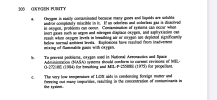
 
Update, there is also a mention in the Skills Section in most ACS' for "Determine the quantity of supplemental oxygen required in a scenario given by the evaluator". Here's the solution for that: Should be based on information from the tank manufacturer.

Here's an example: https://www.mhoxygen.com/chart/
 
ABO appears to be an SAE standard:

Your friend failing for not finding the Time of Useful Consciousness table, which is easily found in the PHAK, does not mean you would fail for not knowing the definition of ABO. You're applying for flight instructor certification not certification to sell oxygen.
 
FAA usually refers to a O2 MILSPEC, I have never seen a FAA spec other other than 99.5% purity.... there is reference to FAA requirements for flow (such as positive flow or quick dawning mask). Aviators/MILSPEC O2 is usually 1/10 water compared to medical. If you get a scenario question regarding using medical O2 to fill your portable aviation or aircraft bottle, simple answer is, you can't because both valves are different and incompatible.

However, for your knowledge and not to condone it in your oral if asked.... GA piston pilots use medical O2 all the time. Water content is not a factor for pistons as they are neither high enough or there long enough in cold FL's for it to be an issue. The fill valves are different preventing fill medical from aviator tanks, but adapters are available. Medical O2 is cheaper and easier to get for many.
 
Few times I used oxygen at altitude I used medical oxygen. I survived and none of the equipment froze up.
 
I was a paramedic for years. We got 5 bottles of welding O2 in our cascade and filled all the bottles on the ambulance there. There's no water or anything else in it. The local gas supplier will sell it all from the same source.
 
Okay this all makes sense and is along the lines of what I was thinking for what is actually practical with oxygen use. I've used it in gliders a few times but that's it. It's just in the ACS so I figured I should have documentation somewhere to backup my answers. Probably why I didn't get hardly any questions on it for my commercial.
 
 
Probably why I didn't get hardly any questions on it for my commercial.
At most you will be asked when is it needed and where you can get it refilled (most larger FBO's have it). If DPE really wants to dig into it, look over when a cannula can be used as opposed to positive pressure and quick donning mask is required, although I have only heard that asked on ATP and you can look it up.

Although correct answer is only use aviators O2, but in my experience in GA is they all use same medical and industrial O2 to fill the FBO bottles. However, my experience flying airline is the large crew bottles specifically are tagged as aviators oxygen, but I don’t know if that is true as never paid attention when it’s being filled. These bottles are often in below deck areas not entirely heated and it’s reasonable to believe after 12 hours with ambient temps -50, it could be an issue. But again, you won’t be asked anything that deep. I prep members in our flying club for orals and only heard the standard, when is o2 required? Is it just for pilot? Where can you refill it? What are signs of hypoxia? And rarely something about time of useful consciencesnes basics like how is it effected by altitude? If you get questions like this, than you are ace’ing the exam and making the rest of us look bad.
Good luck
 
Again, the O2 was already in liquid form at the gas facility. Nothing in aviation is going to get it that cold again.
 
please supply your N# and pilot cert # for violation notice forth coming
You neglected to indicate this was Scarcasm

Either way, in the states all o2 is all produced the same way, any many (most?) suppliers connect to the exact same source to fill a cylinder.
 
So, asking for a friend......

It's all the same today. It's cheaper for the gas manufacturer to just make one batch, have one set of standards. Medical grade, welding grade, aviation grade, etc. Hypothetically you can get your O2 from a welding supply store bottle exchange and it would be the same purity as a medical supply or aviation supply.
 
These days at the wholesale level the source is one and the same. What differs is the retail level price (e.g. welding supply vs FBO), the bottle valve type (CGA 540, CGA 870, etc), and who can fill it (back to cylinder valve type vs transfill setup, medical prescription, etc). My MountainHigh portable cylinder uses the CGA-540 valve which to the best of my knowledge is standard for portable aviation applications. I also carry an AN-800 transfill adapter to ensure no matter where I go and can get the bottled filled.
 
Hypothetically you can get your O2 from a welding supply store bottle exchange and it would be the same purity as a medical supply or aviation supply.
No hypothetical; I’ve inhaled O2 sourced from a welding shop for years as have many others.
I anesthetize 10-30 animal patients a day using the same, for 34 years now.
 
All oxygen sold by commercial gas places is cryogenically separated and pure enough for any purpose. The only difference is the paperwork that comes with it.
Correct. It's all done via liquifaction. But back in yesteryear we used to have a few different methods with varying degrees of purity/dryness. So it's a term and a hassle from a bygone era.
 
I agree, all flavors of compressed O2 are coming from the same source of cryo O2. But, I thought the protocols for filling the big t-bottles of medical or aviation O2 was to drain, then briefly apply vacuum to the bottles before refilling, so make sure every aviation or medical fill starts with a 'clean' bottle, while welding O2 T-bottles were simply topped off from whatever residual pressure they came in with. That might be old information, and even if the big t-bottles are treated that way, I know SCUBA tanks getting O2 fills for deco diving aren't typically drained and put under negative pressure first, and I doubt that aviation bottles are either, so even if aviation or medical O2 starts out being handled differently, that difference is gone by the time it gets to the end user.
 
If the only gas going into a tank is dry O2, how might water vapor be introduced ?

Even when a welding tank drains to atmospheric pressure, the tank is never open to the air so the it could mix in with its humidity.
 
As stated earlier by FlyingRon. O2 is O2 is O2. The difference in ABO is the paperwork chain of custody that it has not been tampered with from the source to the user. We used to be able to order our flying club ABO and pick up at any of the distributors outlets. We kept 2 K size bottles at the club to refill our glider portable bottles.

In the mid-20teens, govt got involved and said if the O2 is going into your body, it must be controlled. The supplier would not certify all of his outlets to carry ABO. From that point on, we could still get the O2 we needed, but we had to go to the "home office" and pick it up there. Paperwork and chain of custody.

All O2 has the same "liquid content", i.e. very dry. That's why you see the O2 bubbler at the hospital bedside, to introduce moisture so that patient on O2 for days on end does not dry out his lungs. Plus they can add medication to the O2 if they are treating a lung ailment.

Strict Lab Work requiring the purist of O2 may process the O2 again to try to get closer to 99.99% pure, this is not Ivory Soap. They cannot get to 100% pure O2. The best they may get in the Lab is 99.8%.
 
I've never seen them pump down bottles prior to filling. Most FBOs don't even have the equipment to do that. Most of the time they don't even have a cascade, just a single G tank.
 
I use an Inogen One G5 oxygen concentrator and don't worry about these details anymore. My Aerox system has been gathering dust for more than 5 years, hope I never have to go through the hassle of refilling again ;)
 
I use an Inogen One G5 oxygen concentrator and don't worry about these details anymore. My Aerox system has been gathering dust for more than 5 years, hope I never have to go through the hassle of refilling again ;)

I am curious, do these concentrators work well at high altitudes? I've seen aviation units with a compressor to pressurize the intake air, but it doesn't seem like Inogen has a compressor.
 
I agree, all flavors of compressed O2 are coming from the same source of cryo O2. But, I thought the protocols for filling the big t-bottles of medical or aviation O2 was to drain, then briefly apply vacuum to the bottles before refilling, so make sure every aviation or medical fill starts with a 'clean' bottle, while welding O2 T-bottles were simply topped off from whatever residual pressure they came in with. That might be old information, and even if the big t-bottles are treated that way, I know SCUBA tanks getting O2 fills for deco diving aren't typically drained and put under negative pressure first, and I doubt that aviation bottles are either, so even if aviation or medical O2 starts out being handled differently, that difference is gone by the time it gets to the end user.
My welding gas tanks are put on a manifold filled as a batch. They're not doing it one at a time. I do a believe a vacuum is pulled prior to fill. My guys have a nasty habit of leaving valves open. If they weren't dry there would be rust inside and tanks would eventually detiorate when they get hydro tested. I've seen tanks from the 1930's still in service.
 
... I know SCUBA tanks getting O2 fills for deco diving aren't typically drained and put under negative pressure first

When I was diving, we always used an analyzer to check percent O2 in tanks with anything other than air. My regular cave diving buddy had a couple of large oxygen tanks he filled at a welding supply house, and we’d use them to set up tanks with nitrox or pure O2.

You’re right, we never pulled a vacuum on O2 deco bottles, but blowing 3000 psi of oxygen on top of an ambient 14.7 psi of air was close enough.
 
A bunch of ACS' now talk about differences and identification of "Aviators Breathing Oxygen" and other types of oxygen as a knowledge objective.
There no longer is a difference. Back in the day, the O2 was tested for moisture content so that it would not freeze up. But it has been decades since there has been a difference in O2.

When you see those big tankers of 02 driving down the highway, they're delivering to airports and welders out of the same tank.
 
To add to all the above, not only is it the same, but the cleanliness required for working with multi-thousand PSI oxygen is high. Dirt or other contaminants, especially oil, in a system where you're turning on a valve and releasing 3k psi oxygen is potentially explosive. So the guys working on this stuff are keeping it pristine clean, not because of some standard, but to keep from getting hurt.
 
To add to all the above, not only is it the same, but the cleanliness required for working with multi-thousand PSI oxygen is high. Dirt or other contaminants, especially oil, in a system where you're turning on a valve and releasing 3k psi oxygen is potentially explosive. So the guys working on this stuff are keeping it pristine clean, not because of some standard, but to keep from getting hurt.
I’ve never seen a pristine welding shop.
They do teach in welding class to keep oil away from oxygen tanks and fittings.
 
I’ve never seen a pristine welding shop.
They do teach in welding class to keep oil away from oxygen tanks and fittings.
From the bottle to the end user in the shop, 100% agree, except if they're smart they're going to keep the high pressure side of the O2 regulator clean. I was speaking to the folks that fill and transfill bottles at the gas store. Those guys keep things clean, and I think the accidents weed out the ones that don't. Welding shops or outfits that run their own high pressure o2 lines is out of my scope of experience, so can't speak to that.
 
Compressed high-pressure oxygen tanks can become contaminated with carbon monoxide, primarily from the air supply used to fill them if the compressor is not properly maintained. This can be an issue in developing countries and why the FAA has a standard of using oxygen certified as Aviator.

Since carbon monoxide is a poison that absorbs more readily than oxygen, it’s bad juju.
 
Last edited:
This can be an issue in developing countries and why the FAA has a standard of using oxygen certified as Aviator.
Good point if you're flying into developing countries.
 
Compressed high-pressure oxygen tanks can become contaminated with carbon monoxide, primarily from the air supply used to fill them if the compressor is not properly maintained. This can be an issue in developing countries and why the FAA has a standard of using oxygen certified as Aviator.

Since carbon monoxide is a poison that absorbs more readily than oxygen, it’s bad juju.
That absolutely true for high pressure air, for scuba. I'm not saying it's impossible, but the only way to use an air compressor to fill an oxygen tank would be if the input to the compressor was from another, lower pressure, oxygen tank. A boosted trans-fill, as it were. And even if someone were to do that, you still couldn't get CO into it, because the input line would still be under some pressure from the source tank.

I believe the reason that the FAA has the standard is that the cryo process is relatively new in terms of federal standards - I think the process was patented in 1895, but not introduced until the 20's. I'd give them another 50 to 100 years to sort it out. Only half kidding.
The CO can be produced from highly over heated and burning components (lubricant and metal) in the compressor. Ideally there would be an inline filter to take care of this issue, but in developing countries filters are rather expensive.

In scuba diving, most CO is introduced by internal combustion engines near the compressor and poorly maintained filters, but can also come directly from the compressor. It’s actually more dangerous in Scuba than aviation because of breathing gas a depth vs breathing gas at altitude.
 
Last edited:
Actually you can. The CO comes from highly heated and burning components (lubricant and metal) in the compressor. Thats why I stated improperly maintained compressors.
I was considering the CO from a gas engine compressor, not something internal to the compressor.

But if CO is formed by incomplete combustion, how could that exist inside a compressor cylinder filled with 100% oxygen? I would expect running pure oxygen through a dirty compressor and taking that to 3k psi would result in an explosion. Even at low pressures, pretty much anything halfway capable of combustion burns very well at 100% oxygen.

Trying to come up with a scenario where that would work... If they weren't actually giving you 100% oxygen, but instead were going to use a compressor to take your tank up to 1k psi of air, or mostly air, and then top that off with oxygen, then yeah, I can see that working. Or maybe the reverse is more likely. They're not compressing the pure O2. They're a ratty shop, they're transfilling you with a low tank and you're getting an initial fill of pure oxygen to 1.5k, 2k, some random number. Then they take out the air compressor and top that tank off to 3k psi giving you maybe 70% oxygen, 30% air and random crap including compressor oil, and you're none the wiser. Possible. But I'd argue that this isn't because they're not giving you "aircraft oxygen", it's because they're knowingly not giving you all oxygen, and if they're going to do that they're just as likely to put a medial or whatever stamp on the tank.

Maybe I'm missing something. I don't see how you can create CO in a 100% O2 atmosphere, but I'm not a chemist. I've never even watched an entire episode of "breaking bad".
 
But what do FAA standards have to do with developing countries?
If you're flying an N Registered plane, a lot. :D

Would anyone know, probably not. But if you're flying back and forth and you have an issue related to O2, well, you do the math.
 
Back
Top