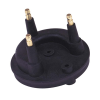
Anyone heard of an "ignition coil joiner" that NAPA used to sell?

AV8R_87

En-Route
Joined
Feb 1, 2024
Messages
3,628
Location
NE USA
Display Name
OC
One of my main issues with automotive engine conversions is the lack of redundancy on the ignition system. And there isn't an easy way to modify the cylinder heads to add a second set of plugs.
But plug failures aren't that common, at least not compared to actual ignition coil failures and their associated components.

Apparently at some point there used to be a coil joiner that was available to the racing community. A high voltage diode block that would combine the output of two ignition coils to one distributor. Has anyone seen one, and can you even find one anymore, new or used? Considering using something similar for an automotive conversion, but with a modern distributor-less system, so each plug would have to have one.

Any other way that you've seen or heard of to combine or switch two ignition coils on one plug?
 
The reason we have dual ignitions in aircraft is primarily because magnetos suck at everything but needing (external) electrical to run. The spark is feeble compared to the old auto cap/coil/points. The new electronic ignitions generate an incredible spark. I have had them blast through bad electrodes (both in the distributor back when they still had those and the plugs) where you wouldn't believe it should fire. The solution you need is to find a way to provide electrical redundancy so you're not reliant on the main alt/bat bus to fly.
 
Yeah, I had both magnetos needing to be overhauled last year and decided to instead overhaul one and replace the other with an electronic system. It's so much better. Highly recommended.
 
I've had coils fail on automotive engines, hence why I'm looking at a way to combine a couple coils on the same plug for redundancy.
 
I've had coils fail on automotive engines, hence why I'm looking at a way to combine a couple coils on the same plug for redundancy.
I've not seen a automotive coil in many a year.
 
I'm pretty sure they're still made, there was some discussion on the homebuilt airplanes forum a few years ago, but I don't recall what they were called. Basically they're high voltage diodes.
 
Might be worth taking a look at the guts of a top fuel magneto. Output is 44 amps and I think they directly drive the spark plugs without coils.
 
Basically they're high voltage diodes.
Yep. I just need to get an idea of the specs for them, I'd guess around 25 thousand volts, but the current rating is where I don't really know what it would be. Sparks are pretty short in duration, and for the energy delivered it looks like the peak current can be in the 100-200A range. Not sure if a diode would have to be sized for that current or if it could be a 10A diode, since it's all pulsed operation.
 
Reading the description, sounds like a switch, not a diode... the pilot has to select which system to connect to.

Paul

They operate with diodes. The coil (secondary) is wired to each side of the coil selector and the center output is sent to the middle of the distributor cap. Each coil will have it's own power source (primary) and switch (some use a SPDT). Different models allow both coils to be on at the same time and others don't recommend using them that way. Diodes protect each side from the high voltage of the other side crossing over.

In my particular conversion the distributor has a primary ignition trigger (electronic) and secondary trigger (points) inside the converted distributor. Some systems that use electric fuel pumps also use a DPDT switch so that when going to the backup ignition it switches to a backup fuel pump as well.
 
I've not seen a automotive coil in many a year.
Nowadays, I think automotive has all gone to 'coil on plug'. The advantage is no need for a distributor, and sort-of a fail-safe mode - if one coil fails, the others will still fire. [I've had that happen on my 2003 toyota several times - it still ran, just roughly (3 out of 4 cylinders firing).] That'd be the way to go on a conversion, I would guess - if you can figure out how to have the ECU fire both coils for each cylinder (dunno if the ECU driver transistors can handle 2 coils?)

As to a diode switch setup - the coil output is AC - is a half-wave spark good enough? Doesn't sound ideal. Would be better with some sort of high-voltage FET, maybe? I've never heard of a device that can handle switching that high a voltage.
 
That'd be the way to go on a conversion, I would guess - if you can figure out how to have the ECU fire both coils for each cylinder (dunno if the ECU driver transistors can handle 2 coils?)
If the goal is redundancy, you'd have two independent ECUs driving two coils.
As to a diode switch setup - the coil output is AC - is a half-wave spark good enough? Doesn't sound ideal.
It's not AC; it's a single pulse.
 
Back
Top