Aircraft down near KSUT

It is indeed 13LV.

He went in between two houses and hit the trees. Came back resting against one of the houses. Plane engulfed. Amazing he went in between both homes.

Plane has not flown in a while.

RIP to the pilot.
 
Final report on this crash was released. Nothing really new.

Probable Cause and Findings
The National Transportation Safety Board determines the probable cause(s) of this accident to be:
The pilot’s improper decision to fly a known unairworthy airplane, which resulted in a total loss of engine power due to oil starvation.

The docket is sad to read. Why would he do this? All this while your wife is sitting in the FBO making sure you get airborne before she start driving home.


https://data.ntsb.gov/carol-repgen/api/ ... 192440/pdf
Docket-
https://data.ntsb.gov/Docket?ProjectID=192440
 
Such a waste from making a poor decision.RIP
 
The NTSB report is a bit of a cop out. Yes, flying an unairworthy aircraft was a terrible decision. However, the battery issue identified by the A&P had nothing to do with the crash.

The crash was caused by oil starvation due to a loose oil drain sump accessory port, which the mechanic had apparently loosened and not restored to its previous condition. I don't know the applicable regs in the case of maintenance, but I do know that in the case of a failed inspection, the mechanic is required to provide a list of unairworthy issues to the owner.

Just declaring the aircraft UNAIRWORTHY is not enough. The mechanic has a duty to provide information on all known unairworthy issues. If he failed to inform the pilot that he had loosened and not retightened the oil drain fitting and refilled the engine with oil, he bears some responsibility for this death.
 
I don’t think there’s enough information in the report to say whether the loose plug was loosened by the mechanic or not, or even whether it was the drain plug used for changing the oil or a separate plug meant to stay in place. (My own knowledge is somewhat limited, but for example my air-oil separator on my IO-390 is plumbed to return oil to the sump by way of one of the there-in-case-you-need-it plugs.) I don’t know how else it could have been loosened, but what mechanic pours the oil into the engine without tightening the drain plug?
 
I don’t think there’s enough information in the report to say whether the loose plug was loosened by the mechanic or not, or even whether it was the drain plug used for changing the oil or a separate plug meant to stay in place. (My own knowledge is somewhat limited, but for example my air-oil separator on my IO-390 is plumbed to return oil to the sump by way of one of the there-in-case-you-need-it plugs.) I don’t know how else it could have been loosened, but what mechanic pours the oil into the engine without tightening the drain plug?

Fair point. I am reading into the situation a bit, but it sounds like one of those ****ing match situations that occasionally get posted on PoA, where neither side wants to give in.

I would be surprised if the engine was refilled with oil. A leak sufficient to drain the engine completely in such a short time would be very noticeable to anyone. It would leave a pool under the aircraft and probably have a visible stream draining from the cowl.

Odd that the report does not address whether anyone witnessed the owner doing a preflight or whether there is any evidence the engine had been refilled with oil by either party. That's why I say the report is a cop out. It seems to take the position that once the aircraft was declared unairworthy and a decision was made to fly it, anything else is irrelevant. But the specific condition that made the aircraft unairworthy was unrelated to the crash.
Witnesses saw oil leaking and white smoke coming from the plane during the taxi out for takeoff. But the pilot could have filled the oil. Or the mechanic could have never drained it. Or any number of other things. And I also don’t know if the mechanic was badgered into giving the plane back to the owner immediately, before he even had time to write up the unairworthy discrepancies. I didn’t read the whole docket so maybe some of these questions do have known answers. I’m willing to bet the answers are all parallel to the battery situation, but I agree that the battery situation shouldn’t be the focus of the report.
 
I would be surprised if the engine was refilled with oil. A leak sufficient to drain the engine completely in such a short time would be very noticeable to anyone. It would leave a pool under the aircraft and probably have a visible stream draining from the cowl.
Did you see the picture with oil all over the bottom tail of the aircraft? Lots of oil is visible.

Additionally, in addition to smoke, there was oil on the ground in more than one place when run ups were performed.

The bottom line here is you can disagree with your mechanic, but when he says it's unairworthy, don't fly it. Work through the issue(s).

No question there was tension between the mechanic and the pilot, but this doesn't mean you say "da hell with it give me the keys and I'm going home". This was 100% preventable and should have never happened.
 
The bottom line here is you can disagree with your mechanic, but when he says it's unairworthy, don't fly it. Work through the issue(s).
Did you see the picture with oil all over the bottom tail of the aircraft? Lots of oil is visible.

Additionally, in addition to smoke, there was oil on the ground in more than one place when run ups were performed.

The bottom line here is you can disagree with your mechanic, but when he says it's unairworthy, don't fly it. Work through the issue(s).

Except that is not the entire bottom line. The mechanic has an obligation to provide a list of issues that make the aircraft unairworthy. If he knew the oil fitting was loose and failed to inform the pilot, he is partially responsible for the crash. I could see a negligence suit here.

No question there was tension between the mechanic and the pilot, but this doesn't mean you say "da hell with it give me the keys and I'm going home".

That works both ways. It also doesn't mean the A&P gets to say "screw you, I say when it is airworthy, and I'm going to keep your plane until you do as I say."

I see this happen at my buddy's shop all the time. Aircraft show up for inspection, he gets under the hood and says these things gotta be fixed, owner says no and flies away. But they don't crash and burn to death, because he is a responsible person who returns the aircraft to flyable status less the issues he identifies and lists in the log.
 
Nor you, or I, know if the detailed list of squawks was shared. It wasn't in the docket but that doesn't mean it wasn't shared with the owner when he made the decision to drive down and get his plane. The plane had been in NC for 8 months for maintenance work, and an annual was not what it was there for. The tech could not start the plane due to dead batteries and was unable to finish his work.

The plane was unairworthy; conveyed verbally and in writing. Don't fly the plane. Period. I don't agree with you the tech has liability - he was unable to finish his work to certify it.
 
Nor you, or I, know if the detailed list of squawks was shared.

Do you mean to assert the pilot was told that the oil had been drained and an oil fitting had been loosened but not retightened, but decided to fly anyways?
 
I am going to be a bit harsh here, as I think Ed Haywood understated the issues.

The mechanic had possession of the plane for 8 or 9 months, and did not maintain the charge on the batteries. The issue of dead batteries did not come up until the owner became impatient with the no progress of the repairs, and the mechanic used the excuse that the batteries were now dead, so he could not proceed with the repairs, THEN found the alleged non airworthy battery installation.

The lack of other non airworthy items IS an issue, whether verbal or not, the mechanic had an obligation to provide it to the owner, and the mechanic should have a copy that did not get burned in the crash.

The airplane had not been dribbling oil all over the airport on arrival, and there was no big puddle under it when the owner came to fly it home.

Sometime after arrival, that oil plug became so loose it drained virtually all the oil during taxi, runup, and a very short flight.

It would seem most likely that plug was at a point that had oil present and under pressure only when the engine was running, so the dip stick may have shown full when a preflight was done.

Ed is right, the investigation did not address the possibility of a mechanic that had a motive to earn big dollars returning the battery system to factory original by decreeing the plane un airworthy.

Since the related logs apparently burned, we do not know if the battery alteration had been legally done, and logged.

Except for the apparently new massive oil leak, the plane may have been airworthy.

Except for the battery issue, the repairs that the mechanic had agreed to do were relatively trivial, and should have been done while the batteries were still charged 8 months ago.

Our club had similar problems several times, one solution was to have a mechanic from a much more reliable shop come, decree the issue was not "unairworthy" and flew to his airport for inexpensive repair. The second shop was qualified to build the whole assembly from in stock parts, but found that a simple repair was satisfactory.

Much better put than I did. Thanks.

I would further note that 4x14v batteries substituted for 2x28v batteries is not inherently unsafe. Batteries only matter when starting or in case of alternator failure. It's not impossible that someone got a field approval for a major alteration, it was poorly documented, and the owner did not know how to articulate it.

Even if unairworthy by virtue of lack of conformance to the TC, the pilot might have been able to get a ferry permit to another maintenance facility.

Both sides were idiots here, based solely on the facts presented. How much would it have cost the owner to just buy two 28v batteries and have them installed?

Bottom line, in my opinion the mechanic took an aircraft that was unairworthy on paper and made it unsafe in real life.
 
Both sides were idiots here, based solely on the facts presented.

Yes, but only one side is dead.

Bottom line, in my opinion the mechanic took an aircraft that was unairworthy on paper and made it unsafe in real life.

From what we have to go on, it seems like you're correct. The plane was not in the shop for an inspection, and really the only time an A&P-IA can decide whether a plane is airworthy is during an annual. A&Ps are not airworthiness police. Other than during annual inspection, it is the owner/pilot who decides whether or not a plane is airworthy. To me, the mechanic's statement about the batteries doesn't carry any real weight, and it certainly was not the reason for the crash.

Regarding the batteries, the report says
When the mechanic contacted the pilot about the discrepancy, the pilot instructed​
him to reinstall the four 12-volt batteries.​
Reinstall?! Who authorized the mechanic to remove them in the first place? And apparently someone (the shop??) did charge the batteries and reinstall them, but the report doesn't tell us who did that.

Overall it's a pretty shoddy report, leaving too many open questions. Perhaps the NTSB investigated further than what's in the report, but I rather doubt it. Was there a list of discrepancies, provided to the owner, that burned up in the fire? Doubtful, or the mechanic would have produced his copy during the investigation.

From the report,
The airplane had been in for maintenance for 8 months. The private pilot/owner had requested​
that the mechanic troubleshoot interior lighting, service the brakes, attach a standby vacuum​
hose, and repair an exhaust leak.​
There's nothing in that list of repair tasks that requires loosening the plug, and one would think that if the plug were loose in the shop somebody would have noticed 6 quarts of oil under the plane.

So who loosened the plug, and why?

Based on an assumption that the plug wasn't loose and leaking when the plane came into the shop, I just don't see anything that exonerates the mechanic, and I'm sure there's going to be a lawsuit. The NTSB investigation is too crappy to be of much use in defending the shop.
 
I am reading into the situation a bit, but it sounds like one of those ****ing match situations that occasionally get posted on PoA, where neither side wants to give in.
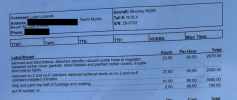
Its also similar to discussions on PoA where the participants only know one side of the story and only assume things. And I think if someone would have bothered to review the mx invoice below, it would have been evident there was a more substantial amount of work performed than what is highlighted in the thread. Regardless, the fact the owner flew his unairworthy aircraft without so much as a ground run, leak check for the cylinder remove/install shows his unfortunate mind set and places the responsibility 100% on his shoulders from both a legal point and regulatory point.

1749480386870.png
 
The accident report should have included information that major engine dis assembly and repairs were done. The removal and replacement of 2 cylinders immediately prior to an engine failure should open a careful investigation to determine if that was a contributing factor, and whether the leaking plug was possibly caused by those actions.

Not too much related, I would expect that the plane was not released without payment in full.

That was a common denominator when our club had issues with unairworthy determinations.

On one of our annuals, the A&P declared that our cam was worn beyond safe use, and declared the engine not airworthy. He proposed rebuilding in his shop, with a new cam and cylinders/pistons, as they were near TBO.

We had him reassemble the engine, crate in the crate sent by Mattituck on Long Island.

Mattituck rebuilt the engine, and provided a letter stating that the cam met all measurement specifications for a new from factory engine. For legal reasons, we had them replace it with new. With such a log book entry, you never know what an enterprising attorney might make in the event of an engine failure, regardless of the apparent real cause.

I was at Mattituck when the measurements were made.

Due to the efficiencies of a fully equipped shop and skilled personnel, the rebuild cost about the same as the local A&Ps estimate, with a much more valuable warrantee.

That engine gave excellent service. A year later, that mechanic no longer worked at the airport where he did that annual.
 
Its also similar to discussions on PoA where the participants only know one side of the story and only assume things. And I think if someone would have bothered to review the mx invoice below, it would have been evident there was a more substantial amount of work performed than what is highlighted in the thread. Regardless, the fact the owner flew his unairworthy aircraft without so much as a ground run, leak check for the cylinder remove/install shows his unfortunate mind set and places the responsibility 100% on his shoulders from both a legal point and regulatory point.

It strikes me as poor MX work. Every mechanic I know would’ve charged those batteries and tested the engine work prior to letting the airplane out of his/her sight. Then you can address the concerns about the legality of the battery installation, which is outside of the scope anyways.

Hopefully the owner understood this engine was entirely untested following major work by a mechanic that he did not trust.

It’s too bad we do not have the logbook sign off.
 
When I was still a student, our Cessna 150 went to the shop with a sticking valve. The cylinder was removed, valve replaced, and engine re assembled.

I went to the airport to fly the plane back to our airport, and in my preflight, found that the tach hours were the same (Measured in hundredths of an hour) as when we delivered it.

I refused to take the plane until the engine was run, and preferably flown. 10 minutes of running, including full throttle, and no oil leaks of malfunctions, I flew home.

The mechanic here should have been required to test run this plane for 10 minutes before the bill was paid and the plane accepted. There would be no story here if that had been done.

There would have been a very embarrassed mechanic, and a righteously furious owner.

Never let being mad get ahead of your intelligence. Not an uncommon problem, but here had fatal results.
 
Hopefully the owner understood this engine was entirely untested following major work by a mechanic that he did not trust.
Except we don’t have the mechanics side nor the context of his answers in the report. Regardless, what I find interesting is people are defending an owner who did knowingly replace two aircraft batteries with four vehicle batteries in the first place, then flew a known unairworthy aircraft. And people wonder why no one wants to enter or wants to leave the Part 91 recreational maintenance business with discussions like these.
 
Except we don’t have the mechanics side nor the context of his answers in the report. Regardless, what I find interesting is people are defending an owner who did knowingly replace two aircraft batteries with four vehicle batteries in the first place, then flew a known unairworthy aircraft. And people wonder why no one wants to enter or wants to leave the Part 91 recreational maintenance business with discussions like these.

Saying there is blame on both sides is not the same as defending the owner.
 
Except we don’t have the mechanics side nor the context of his answers in the report. Regardless, what I find interesting is people are defending an owner who did knowingly replace two aircraft batteries with four vehicle batteries in the first place, then flew a known unairworthy aircraft. And people wonder why no one wants to enter or wants to leave the Part 91 recreational maintenance business with discussions like these.

I’m not defending the battery install, I am saying he should not let this concern keep him from finishing the project that had been started. Raise all the concern you want, but verify your work.
 
The bottom line for me is that the airplane was not returned to service after maintenance but the pilot took it anyway. The lack of preflight or even the most cursory post maintenance check by the pilot is just another hole in the Swiss cheese.

Yes, I’ve heard the “horror stories” of mechanics who do terrible things, but maybe I’m a little biased here. I once represented a mechanic who installed ferry tanks for a trip to Europe. While the approvals were pending, the customer got tired of waiting, used his extra keys, grabbed the airplane, and left. No accident, but the mechanic was facing certificate action because the airplane flew. Some of the folks here sound a little like the ASI he dealt with.
 
When I was still a student, our Cessna 150 went to the shop with a sticking valve. The cylinder was removed, valve replaced, and engine re assembled.

I went to the airport to fly the plane back to our airport, and in my preflight, found that the tach hours were the same (Measured in hundredths of an hour) as when we delivered it.

I refused to take the plane until the engine was run, and preferably flown. 10 minutes of running, including full throttle, and no oil leaks of malfunctions, I flew home.

The mechanic here should have been required to test run this plane for 10 minutes before the bill was paid and the plane accepted. There would be no story here if that had been done.

There would have been a very embarrassed mechanic, and a righteously furious owner.

Never let being mad get ahead of your intelligence. Not an uncommon problem, but here had fatal results.
I disagree; the owner picked it up before it was completed. When I was in the car biz we had that happen from time to time. The owner signed a waiver and paid in full to leave the lot. Some wanted to refuse and call the law; we told them to do so. They signed.
The work wasn't completed, the job wasn't inspected, so anything could be wrong.
Asking for the shop to run it up is out of line.
 
I’m not defending the battery install, I am saying he should not let this concern keep him from finishing the project that had been started. Raise all the concern you want, but verify your work.
Except based on the report, once the mechanic informed the owner of the improper batteries, the owner stated he wanted his aircraft back which would effectively shutdown any further work. And given the mechanic's invoice was dated 10/13/2022 it points more to the aircraft stayed parked for 8 months before the owner picked it up in June 2023. Regardless, I believe the first sentence in the Final Report sums up this entire unfortunate event with zero culpability of the mechanic.
 
What Bell 206 says is what the club CFI taught in the club's paid monthly ground school bits. When the mechanic takes an engine apart, HE runs it before he is done, and payment is not made until that step is complete.

The test run back in 2022 would have been no problem, as the batteries would not have been dead then. Why was no test done?

The content of all phone calls and other messages would no doubt be interesting and informative, but not available.
 
The test run back in 2022 would have been no problem, as the batteries would not have been dead then. Why was no test done?
You're making an assumption the car batteries the owner installed were good. I think the ground run was planned right after the work in Oct 2022 when the illegal dead batteries were found. Owner then wanted plane back so no ground run.
 
Back
Top
