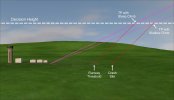
Sort of a meaningless post here. If you haven't been around, its much verbage over something that in reality is easy. If your rate of climb is greater than your rate of power off descending turn minus startle effect and time to set up a landing, then possibilities open. If not, straight ahead.
The OP forgets wind, startle effect, departure obstacles, confidence in making it work, slow flight experience, the actual chances of an engine starting or fixing itself . . . and reduces is down to a complex decision tree of engine start procedures or mental rules. The sort of overthinking that is done from an easy chair.
No.
Give me a grizzled old CFI who knows stick and rudder every time.
Run away from factory flight school CFIs who want clever procedures and checklist fundamentalism in an low and slow emergency. . . too many stall into the ground short of the runway. And ignore the mental lock up that happens due to startle effect.
Just memorize this and make it your religion:
Just fly the plane first and foremost.
Don't panic, don't stall. First move is to lower the nose. Keep it coordinated and gentle. Remind yourself the insurance company now owns the plane. Make a plan, scan the possibilities on the ground (you should never takeoff without a plan in mind).
Undo what you last did if you have time, grab carb heat, check full fuel tank and call it good. Then set up for a landing.
A lot of smoking holes in the ground are done by pilots who forget to keep the wind over the wings and think that a complex procedure under 1000' AGL in a hurry up low and slow turn is able to be done and still have time for a feather like landing back on a runway.
The video is an engine sag that didn't respond to full throttle, fuel vent issue. Crop duster turn, had to remind myself halfway through not to hurry with rudder. The moment my foot moved, I remembered the sentence from the book "Stick and Rudder" - I literally did. Don't hurry a turn with rudder, ever. Pulled the foot back, not a great landing, but considering, good enough. The intitial sag was hard to hear as I was going from tail down to running on the mains. On climbout, the engine simply refused to make full power.
The 2600 foot runway I fly out of now has a 45 seconds after throttle opens emergency window - if you lose an engine or have an issue going north, you aren't going to have very many choices so you have to know that. Rather than altitude, I use time and distance.