Oh, I get it. The average backyard bbq’r isn’t going to breakdown the big cuts. Seems like KCBS is trying to make an event more attractive to teams, which is entirely different than trying to find the team that makes the best turn in box that’s representative of barbecue as a whole. I’m a beef guy, so if teams aren’t required to turn in brisket along with pork, pork ribs, and chicken then they’re just cooking out.

. I get why teams don’t want to mess with brisket.
But specialization for contests has always been a thing, I guess. Look at cooking to a taste profile, for example. I guess what’s important is in the judging criteria. If taste/texture/color/presentation isn’t defined, then who cares what they turn in. But if bark is important and part of the judging criteria, I guess teams that don’t incorporate that won’t be winning.
KCBS contests are 4-meat contests. Chicken turn in at noon, ribs at 12:30, pork butt at 1:00 and brisket at 1:30.
Judging criteria is appearance (how much does it make you want to eat it), taste (flavor profile), and tenderness (how well is it cooked). Appearance is the most subjective and is weighted at about 1/2 point. Taste is weighted roughly 2.5 points and tenderness about 1. Scoring is similar to a school grading system, 9 = A, 8 = B, 7 = C, 6 = D, 5 = F. Then 2 = inedible, and a 1 is reserved for a DQ. 6 judges score each entry, lowest score is dropped, the other 5 are added together. Taste score is the first tiebreaker. No partial scores, so if you are wavering between an 8 and 9, you give the team the benefit of the doubt and round up.
I judged last week, and I think I awarded 2 or three 9/9/9 scores. I’m pretty sure one was chicken and another was a rib.
Some contests will have ancillary categories like sausage, turkey, miscellaneous, desserts, or whatever. In those cases, judges use their best judgement.
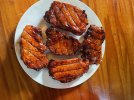
You mentioned bark in post, here’s an example from last weekend in a pork turn-in. A team turned in chunks that included almost all bark. That’s rare, and here’s why: I pulled out a nice looking sample, lots of bark, but a good sized chunk of pork attached to it. We score on appearance before anyone takes a sample. The taste score was very high, I liked the bark since that’s where the majority of the seasoning is, and it was well balanced by the milder piece of meat attached to it. Tenderness also scored very well. The bark had a really nice chew, the meat was tender, and overall it had a great moisture level. I scored it very high. The judge next to me said, “That’s the worst piece of pork I’ve ever judged.” Turns out the piece he grabbed was all bark, no meat, and it was dry, tough, and a little crunchy. Turning in something like that runs the risk that not every judge will get a consistent sample. Ribs can be like that, too. A rib on the end of a slab will usually be overcooked compared to a rib cut from the middle of a slab. So we normally cook 4-6 slabs and take the best 6 ribs from those.