61.129 Airplane-Single Engine XC Distance Question

vfrfreak23

Filing Flight Plan
Joined
Mar 18, 2015
Messages
5
Display Name
Jon S
Hello all,

I had a question with regards to cross-country when it comes to Part 61 Commercial ASE cross country requirement under 61.129(a)(4)(i). I see 3 parts of this requirement as:
1) One cross-country flight of not less than 300 nautical miles total distance,
2) with landings at a minimum of three points,
3) one of which is a straight-line distance of at least 250 nautical miles from the original departure point.

I probably did a bad job at searching FAA interpretation letters and this forum but was curious if 300 NM total distance is measured from landing point to landing point or does routing play a factor as well?

For context I took off and landed S37-KMPO-KORH-KBED which is roughly 275 or 276 NM. S37 to KBED is 265 NM

The routing I took with track log to prove was S37 PTW ETX KMPO HUO PWL CTR BAF WITNY KORH KBED which is 306 NM.

Ultimately does this flight count or not as fulfilling this requirement? Thanks for helping me become more informed.
 
I don't know the answer to this, but I share your cocern about the routing question. "not less than 300 nautical miles total distance" does not specify whether that is straight line (a term used regularly) or routing (which is used in describing the dual cross country for the instrument rating). I took a quick look and didn't see anything. I suspect the question doesn't come up often because these qualification flights are usually round trips - land 250 NM away from the original point of departure and return, and there's no problem. Even one-way cross countries tend to cover the whole 300.

Cross countries not qualifying is actually a big issue for commercial checkrides, so that's something I would check into. There might even be local variation if there is no official; guidance. Perhaps one of our DPEs can answer that. (FWIW, since the requirement includes intermediate landings, the total combined leg distances should qualify, but that's just some SGOTI viewpoint)

OTOH, if either S37 or BED is your home base and you flew both inbound and outbound within a reasonable amount of time between them (even overnight), treat the whole thing as one flight and you are fine.
 
Last edited:
My take on the commercial xc is there is an intent to get you a long way from home. If you include routing, you have the potential for getting a lot of miles, but not getting far away. That’s where the >250 nm distance comes into play. I honestly never thought about a route measurement before, just the airport to airport distance.
 
I don't know the answer to this, but I share your cocern about the routing question. "not less than 300 nautical miles total distance" does not specify whether that is straight line (a term used regularly) or routing (which is used in describing the dual cross country for the instrument rating). I took a quick look and didn't see anything.
If the perceived ambiguity keeps you up at night, pick the more conservative interpretation to CYA and move on with life ;)

Otherwise, it's middle school geometry; one leg of a triangle is >=250, and you pick the other two so the sum of all three sides >=300.

I suspect the question doesn't come up often because these qualification flights are usually round trips
For reasons I have forgotten, I thought some of the larger puppy mills did them one way.
 
If the perceived ambiguity keeps you up at night, pick the more conservative interpretation to CYA and move on with life ;)

Otherwise, it's middle school geometry; one leg of a triangle is >=250, and you pick the other two so the sum of all three sides >=300.
Since I already have the certificate and don't train anyone for the certificate, it doesn't keep me up at night. I can also do simple geometry, but I wasn't sure the FAA does. So the last thing I would want as an applicant is to arrive at a commercial checkride and be rejected by a DPE who doesn't agree with you. That might well produce a sleepless night or two.

But FWIW, I did check and yes,
For reasons I have forgotten, I thought some of the larger puppy mills did them one way.
I checked with a DPE I know and it's fine. They do and it's typically for maintenance.
 
Hello all,

I had a question with regards to cross-country when it comes to Part 61 Commercial ASE cross country requirement under 61.129(a)(4)(i). I see 3 parts of this requirement as:
1) One cross-country flight of not less than 300 nautical miles total distance,
2) with landings at a minimum of three points,
3) one of which is a straight-line distance of at least 250 nautical miles from the original departure point.

I probably did a bad job at searching FAA interpretation letters and this forum but was curious if 300 NM total distance is measured from landing point to landing point or does routing play a factor as well?

For context I took off and landed S37-KMPO-KORH-KBED which is roughly 275 or 276 NM. S37 to KBED is 265 NM

The routing I took with track log to prove was S37 PTW ETX KMPO HUO PWL CTR BAF WITNY KORH KBED which is 306 NM.

Ultimately does this flight count or not as fulfilling this requirement? Thanks for helping me become more informed.
Unless there's an interpretation that says this is OK, then I'd bet good money the DPEs I know would say no way. I'd ask them, but all that matters is what your DPE thinks.
 
Unless there's an interpretation that says this is OK, then I'd bet good money the DPEs I know would say no way. I'd ask them, but all that matters is what your DPE thinks.
The problem of DPEs making up their own interpretations still exists. That's why I raised the concern even though I think it should (and at least one DPE agrees) based on the regulatory context.
 
How did the plane get "home" after leaving it in KBED? Or did you sell it?
 
How did the plane get "home" after leaving it in KBED? Or did you sell it?
KBED is home for the plane. Took it back solo one-way from S37 after maintenance work so the XC was only S37 to KBED.
 
Maybe I am navigationally challenged, but how does one solo fly a straight line 250 nm leg, land, reverse course and land at 2 other airports and not have a 300 nm XC?
I guess you could fly a 250 nm leg, and then the 2 other airports are right next to each other? Like S37 to KBED is 265 nm then to 6B6 and KORH is only 296 nm total.

But you don't need a 250 nm leg. My understanding from other threads in this forum and other sites is that 61.129(a)(4)(i) only needs 250 nm straight-line distance from origin to one of your landing points
61.129(a)(4)(i):
"...with landings at a minimum of three points, one of which is a straight-line distance of at least 250 nautical miles from the original departure point."
So you can fly 10 nm legs between 25 different landing sites and as long as you can draw a 250 nm line from your departure and any of your landing sites then you're good.

This differs from 61.109(a)(5)(ii) for private pilot which specifically calls out a straight-line leg
61.109(a)(5)(ii):
"...one segment of the flight consisting of a straight-line distance of more than 50 nautical miles between the takeoff and landing locations..."

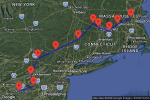
Anyways, visually this was my trip with routing.
1773428405915.png
 
My xc was out and back, I just needed to make sure one airport was >250 nm. The one I wanted, so I could meet my daughter for lunch, is 248 nm, so I bounced over to an airport a few miles past, then came back. I filed both directions and did get some routing, but my plans were direct-to. I was over 500nm total, but if I had taken routing into consideration that extra hop at my turnaround probably wouldn’t have been necessary.

I dunno, I’ve been around long enough to see other people have to refly XCs because they were 0.1 hrs or 1nm short. I don’t see the point of cutting it that close. I know some flight schools and CFIs can have favorite routes that meet the requirements and save the student additional Hobbs time.
Totally understandable. I didn't fly this flight with this requirement in mind as it was a completely different mission. But if I were to plan a flight in order to meet this requirement, then I'd definitely plan with no second guessing.

Seems like there hasn't been any FAA interpretation and the answer seems to be "depends on the DPE" and was just hoping to see if anyone had anything more concrete.

I'm not actively working towards my CPL anyways so when it comes to it, I'll fly a XC that surely meets it.
That’s how got my day commercial XC. Was just bumming around in a 150 with a CFI buddy, going nowhere in particular. We ended up doing enough time and distance to count it.
 
That’s how got my day commercial XC. Was just bumming around in a 150 with a CFI buddy, going nowhere in particular. We ended up doing enough time and distance to count it.
For me it was a business trip planned with no thought of the commercial requirement.
 
Hello all,

I had a question with regards to cross-country when it comes to Part 61 Commercial ASE cross country requirement under 61.129(a)(4)(i). I see 3 parts of this requirement as:
1) One cross-country flight of not less than 300 nautical miles total distance,
2) with landings at a minimum of three points,
3) one of which is a straight-line distance of at least 250 nautical miles from the original departure point.

I probably did a bad job at searching FAA interpretation letters and this forum but was curious if 300 NM total distance is measured from landing point to landing point or does routing play a factor as well?

For context I took off and landed S37-KMPO-KORH-KBED which is roughly 275 or 276 NM. S37 to KBED is 265 NM

The routing I took with track log to prove was S37 PTW ETX KMPO HUO PWL CTR BAF WITNY KORH KBED which is 306 NM.

Ultimately does this flight count or not as fulfilling this requirement? Thanks for helping me become more informed.

It boils down to "straight line distance" vs "total distance". My own interpretation of "total distance" is the sum of the straight lines between all the intermediate airports where you landed. It can't be the actual circuitous GPS track because then you should be able to count flying in circles and CAP grids, none of which meets the intent of cross country navigation.

Here is an interesting edge case that comes up. We have an airport that is 50.6 miles away. But the actual takeoff to touchdown distance can be less than 50 miles depending on which runway you take off from. Does this count as cross country (for Private pilot experience)?
 
Here is an interesting edge case that comes up. We have an airport that is 50.6 miles away. But the actual takeoff to touchdown distance can be less than 50 miles depending on which runway you take off from. Does this count as cross country (for Private pilot experience)?
I like the practical answer to that one - choose another airport a little further to land at or a different route. Unless you really don't like flying, why cut it that close? Unless the alternative is really far away, it's even the practical answer economically. II think it's cheaper to fly that extra distance than to pay a DPE twice.
 
The FAA is clear. It's ARP to ARP on the two airports. Routing doesn't matter. You can fly holding patterns at the destination forevery and it doesn't change the minimum distance requirements, but it does count for the flight time requirements.
 
Welcome, local-ish person!

This is a frequently-beaten dead horse. Read the reg, but don't overthink it.


1. 306 > 300
2. S37 + KMPO + KORH + KBED = you landed at 4 points, 4 > 3
3. S37 to KBED = 265, 265 > 250
I don't see item 1 above. My FF flight planning shows a total distance airport to airport of 276nm, not 306.
I would say the 300nm requirement was not met.

And he only landed at 3 points not 4. KMPO, KORH, KBED, but that is 3 and meets that requirement.

S37-KMPO = 76nm
KMPO-KORH = 171nm
KORH-KBED = 29nm
76+171+29=276
 
You're right. After I wrote that, I considered the clearly bogus case of flying to a destination >= 250 away and then orbiting in the pattern for 50 more. I agree with @saragan's interpretation above. The airport-to-airport distance was the "more conservative interpretation" that I later alluded to but failed to actually articulate.
Thanks for correcting me.
 
It boils down to "straight line distance" vs "total distance". My own interpretation of "total distance" is the sum of the straight lines between all the intermediate airports where you landed. It can't be the actual circuitous GPS track because then you should be able to count flying in circles and CAP grids, none of which meets the intent of cross country navigation.
I agree.
 
Back
Top