
You are using an out of date browser. It may not display this or other websites correctly.
You should upgrade or use an alternative browser.
You should upgrade or use an alternative browser.
2025 IAC Nationals
- Thread starter Ed Haywood
- Start date


Ed Haywood
Final Approach
Is there video of your flights? I think the POA peanut gallery would be inspired, humbled, or both by your performances.
Thanks for that. My flights are very tame compared to the upper levels and higher performance planes. You can watch me yesterday by fast forwarding to 4:22:00. The commentary is very good, BTW.
Last edited:
Ed Haywood
Final Approach
Nice flying, Ed. Better than I could do on my best day.
Thanks, I'm sure that's not true but I appreciate it.
- Joined
- May 15, 2020
- Messages
- 7,765
- Display Name
- Ernie
- Home Airfield
- C81
Ok I give. What was so poor about the flight in the vid?No, did poorly again.
Ok I give. What was so poor about the flight in the vid?
If I had to guess, that’s a relative description. I’m not an aerobatic guy and we could not see the box relative to the ground or judges, but the commentary appeared generally positive. There may have been a missed part of a maneuver about midway thru, but that’s based solely on what’s in the video compared to the description provided.
I’ll note there seems to be some commentary about relative positioning in the box that is complimentary and it appears there’s some weighting applied to each maneuver that can amplify small deviations from the objective performance.
All that is conjecture. As I said earlier, Ed flew the sequence better than I could ever hope to however watching his performance reminded me I could be capable of doing the same with motivation and dedication.
There was a time in my life where I tried to compete at a national level in triathlon and was humbled in the most competitive region. It’s kept me from trying to compete at an elite level in a couple of shooting disciplines and exploring aerobatics simply because I know the work it takes just to compete. That anyone even dips their tow in that space is awesome and respectable in its own right. Performing at the top levels is even more so.
All around, props to Ed.
Ed Haywood
Final Approach
Ok I give. What was so poor about the flight in the vid?
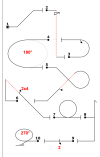
Well, poor is a relative term. Compared to the other pilots, the judges felt the accuracy of my lines and curves was not as good. I scored a 70% on that flight. A good score is 80%, with the winner usually getting an 85% or so. I scored 81% on the first day, flying the same sequence. I scored 65% on the second day, last in the field, but that was with a hard zero for the sharks tooth because I did a half roll instead of 2 quarter rolls.
Judging is inherently subjective. For example, two of the figures require an inverted 45 degree dive. Half the judges said my 45 degree lines were shallow. The other half said they were steep. Both sides took points.
Several very experienced pilots, including the guy who won the advanced category, complimented me on my flight. But the judges saw something different.
I think what it comes down to is I have not learned how to game the scoring system. I flew the "known" sequence 3 times, instead of designing my own free sequence for flights 2 and 3. When I looked at others free sequences, I realized they would be much easier to score well. For example, none of them had any 45 degree inverted lines. Hmmm.
The guys who won the category flew 8 or 9 local and regional contests this year. I flew one contest. They were also flying Extras and Pitts. My big lumbering Decathlon shows every mistake.
Next year I will know what it takes to be successful.
Attachments
Last edited:
Ed Haywood
Final Approach
I flew the "known" sequence 3 times, instead of designing my own free sequence for flights 2 and 3.
Just looked at the scoring. Everyone who did this got crushed. Most interestingly, we all received worse scores on flights 2 and 3 than on flight 1. That makes no sense. Each time you fly, you get a little more used to the box and you fly better.
IMO there is some sort of deliberate or subconscious downgrade for pilots who refly the known.
Welp, I know what I gotta do.

455 Bravo Uniform
Final Approach
Charles? 
Man, I can’t even do a Lazy 8 consistently well.
And let’s not forget, you dismantled and rebuilt that plane yourself.
You rock sir!! Thanks for sharing.
Man, I can’t even do a Lazy 8 consistently well.
And let’s not forget, you dismantled and rebuilt that plane yourself.
You rock sir!! Thanks for sharing.
Ed Haywood
Final Approach
Our dog died suddenly last night. Long flight home today.

- Joined
- Mar 2, 2005
- Messages
- 16,628
- Location
- Southeast Tennessee
- Display Name
- This page intentionally left blank
Looks like you’re having fun, enjoy the ride and come back next year!
Our dog died suddenly last night. Long flight home today.
 . I’m sorry, Ed.

Half Fast
Touchdown! Greaser!
- Joined
- May 7, 2016
- Messages
- 21,190
- Location
- Central Florida
- Display Name
- Half Fast
- Home Airfield
- KGIF
Our dog died suddenly last night. Long flight home today.
Oh, man. I’m so sorry. It’s bad enough to put a pet down, but so much worse when it’s unexpected.

Spinka
Pre-takeoff checklist
- Joined
- Jul 10, 2020
- Messages
- 202
- Display Name
- Spinka
It also shows when you don't do one. The Super S presents quite well because of it's size. With the Pitts the judges complain it's like judging a football regarding lines. Some of the same issues with lines and rolls in the Decathlon. Watching your flight I think you flew the figures well, however sometimes rushing slightly, like a very short stop on the 2 point roll. Maybe slightly shallow bank on the 270⁰ turn at the end.They were also flying Extras and Pitts. My big lumbering Decathlon shows every mistake.
My impression was also that you're trying to stay well within limitations, flying quite slow with shorter lines. Shorter lines shouldn't detract a score, but the judges are human as we know
The best way do improve is definitely with a coach on the ground. There is only so much you can do playing around on your own.
Also, putting together your own sequences is a big help, especially when moving up a category.
455 Bravo Uniform
Final Approach
Don’t push, be safe, momma needs you, even if it’s a day late.

- Joined
- Jun 11, 2015
- Messages
- 5,612
- Display Name
- Piperonca
- Home Airfield
- M52
Don’t push, be safe, momma needs you, even if it’s a day late.

This is awful. Be very careful flying.Our dog died suddenly last night. Long flight home today.
Half Fast
Touchdown! Greaser!
- Joined
- May 7, 2016
- Messages
- 21,190
- Location
- Central Florida
- Display Name
- Half Fast
- Home Airfield
- KGIF
I just watched your routine, Ed. You won the POA category hands down.

Daleandee
Final Approach
- Joined
- Mar 4, 2020
- Messages
- 8,354
- Display Name
- Dale Andee
I just watched your routine, Ed. You won the POA category hands down.
Agreed! He should get a POA shirt with a pocket on it ... oh wait!

Half Fast
Touchdown! Greaser!
- Joined
- May 7, 2016
- Messages
- 21,190
- Location
- Central Florida
- Display Name
- Half Fast
- Home Airfield
- KGIF
Agreed! He should get a POA shirt with a pocket on it ... oh wait!
Maybe next year we can at least get him a POA patch for his flight suit.
Ed Haywood
Final Approach
So close yet so far. CAVU all day but honking headwinds the whole way. Flew 10 hours and made it to within 20 minutes from home, but ran into skanky weather at night. I landed at KZPH. Will watch the weather for an hour and then decide whether to ask my wife to come get me.
Half Fast
Touchdown! Greaser!
- Joined
- May 7, 2016
- Messages
- 21,190
- Location
- Central Florida
- Display Name
- Half Fast
- Home Airfield
- KGIF
So close yet so far. CAVU all day but honking headwinds the whole way. Flew 10 hours and made it to within 20 minutes from home, but ran into skanky weather at night. I landed at KZPH. Will watch the weather for an hour and then decide whether to ask my wife to come get me.
Sounds like the better part of valor.
Daleandee
Final Approach
- Joined
- Mar 4, 2020
- Messages
- 8,354
- Display Name
- Dale Andee
So close yet so far. CAVU all day but honking headwinds the whole way. Flew 10 hours and made it to within 20 minutes from home, but ran into skanky weather at night. I landed at KZPH. Will watch the weather for an hour and then decide whether to ask my wife to come get me.
Smart ...

- Joined
- Jun 13, 2008
- Messages
- 9,173
- Location
- Marietta, GA
- Display Name
- Drake the Outlaw
- Home Airfield
- Cartersville, GA
Skanky weather at night is a no-go for me. Just nope. We’re in Stillwater OK today for my friend Steve’s son’s Okie State fly-in. Gonna be fighting those same winds on the way home tomorrow.So close yet so far. CAVU all day but honking headwinds the whole way. Flew 10 hours and made it to within 20 minutes from home, but ran into skanky weather at night. I landed at KZPH. Will watch the weather for an hour and then decide whether to ask my wife to come get me.
- Joined
- Mar 2, 2005
- Messages
- 16,628
- Location
- Southeast Tennessee
- Display Name
- This page intentionally left blank
Or grab an Uber and a hotel, you’ve earned it. Have a safe night!So close yet so far. CAVU all day but honking headwinds the whole way. Flew 10 hours and made it to within 20 minutes from home, but ran into skanky weather at night. I landed at KZPH. Will watch the weather for an hour and then decide whether to ask my wife to come get me.
- Joined
- Jun 13, 2008
- Messages
- 9,173
- Location
- Marietta, GA
- Display Name
- Drake the Outlaw
- Home Airfield
- Cartersville, GA
To follow up on this... we flew home today from Stillwater. Stillwater to Memphis, we faced a lower than expected headwind. The wind was more Southerly than Easterly and probably netted a 5-8 knot headwind. It got much worse on the east side of Memphis. We stopped at Muscle Shoals Alabama (the wind was right down the runway, which made that choice easy), then flew the last 150 (?) miles at low altitude ~3,000' below an overcast. That portion of the flight faced 30 knots or so on the nose and mechanical turbulence from the hills in East Alabama. I wasn't expecting weather in the Atlanta area, but by the time we got near VPC, we couldn't see Kennesaw Mountain, which is a good landmark maybe 15 miles SE of VPC - it was obscured by mist/rain. We landed in a direct 10-15knot crosswind at VPC and by the time we began unloading the plane it was drizzling and extremely marginal VFR. Our bailout option if the crosswind at VPC was too strong had gone IFR - McCollum near Kennesaw mtn. We got home just in time....We’re in Stillwater OK today for my friend Steve’s son’s Okie State fly-in. Gonna be fighting those same winds on the way home tomorrow.
Ed Haywood
Final Approach
My impression was also that you're trying to stay well within limitations, flying quite slow with shorter lines. Shorter lines shouldn't detract a score, but the judges are human as we know
After the 2nd flight, I decided to lengthen my lines by adding a count to each side of the 45. Eg 3 potato instead of 2 potato before the roll. Then I subconsciously counted faster!
Now I know what I need to practice. TBH I did not decide to go to nationals until 2 weeks ago, so I need to have realistic expectations.
Sitting here right now monkeying with OpenAero trying to come up with a good free sequence. Sebring is in 4 weeks, so that is a good opportunity to try it out.
Ed Haywood
Final Approach
I did have my wife come and pick me up. It was 10pm, I had been flying since 8am, and my fun meter was pegged.
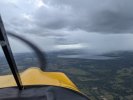
Weather was sketchy today, but much easier to weave through the cells in daylight. Typical Florida afternoon weather. A fun end to a 10 day aviation adventure.
Weather was sketchy today, but much easier to weave through the cells in daylight. Typical Florida afternoon weather. A fun end to a 10 day aviation adventure.
Last edited:
- Joined
- May 15, 2020
- Messages
- 7,765
- Display Name
- Ernie
- Home Airfield
- C81
Is there an stc to install a metronome?After the 2nd flight, I decided to lengthen my lines by adding a count to each side of the 45. Eg 3 potato instead of 2 potato before the roll. Then I subconsciously counted faster!
Now I know what I need to practice. TBH I did not decide to go to nationals until 2 weeks ago, so I need to have realistic expectations.
Sitting here right now monkeying with OpenAero trying to come up with a good free sequence. Sebring is in 4 weeks, so that is a good opportunity to try it out.
Good to hear you made it back
Ed Haywood
Final Approach
Is there an stc to install a metronome?
I probably could plug an electronic beeper into my aux audio. Or play music.
It's quite a challenge to slow yourself down and find a rhythm. You've got the normal adrenaline of diving straight at the ground at Vne, plus the added jolt of being in a big contest and wanting to do everything perfectly. You are constantly adjusting position and fighting the wind. It looks slow on video but it feels very fast in the cockpit.
I think it just comes down to practice and experience. The guys who placed in Sportsman category each flew 9 or 10 contests this year. If you are flying that often, you get used to it and everything slows down.
Until then, "one-po-ta-to two-po-ta-to" on the ground becomes ONEPOTATOTWOPOTATO!! in the air.
I watched this guy’s primary sequence and was surprised how busy it is in the cockpit through the entire run.…It's quite a challenge to slow yourself down and find a rhythm...
Lotta stuff going on in a brief period.
- Joined
- Jun 11, 2015
- Messages
- 5,612
- Display Name
- Piperonca
- Home Airfield
- M52
You beat me to it. On my smart phone, there is an app called MetroTimer. Dirt simple app, all it does is a tone or a beep and an interval, your choice of each. And volume control. Somewhere on POA there’s instructions to hook a smart phone up to the headset cord to answer phone calls. Shouldn’t be too hard to get other audio from the phone.Is there an stc to install a metronome?
Ed Haywood
Final Approach
I watched this guy’s primary sequence and was surprised how busy it is in the cockpit through the entire run.
Lotta stuff going on in a brief period.
Yep, that's what it feels like. And of course it gets faster and busier at each level up.
I'm by no means anything even approaching an expert, but my lay-guess is that it might help to get your heart rate under control.I think it just comes down to practice and experience. The guys who placed in Sportsman category each flew 9 or 10 contests this year. If you are flying that often, you get used to it and everything slows down.
Ed Haywood
Final Approach
I'm by no means anything even approaching an expert, but my lay-guess is that it might help to get your heart rate under control.
Very much so. Even over 3 flights in Nationals, I settled down quite a bit.
Familiarity with a box is a huge factor. The more you fly, the easier it is to spot landmarks and box markings. The first few flights can be pretty hectic until you get comfortable with visual cues for position and alignment.
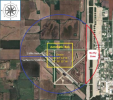
The Nationals box is pretty clean. Direction of flight is aligned with runway 17/35, which is enormous. All structures and ramps are aligned with the main runway, and the sectional road grid is NS/EW to infinity. You are not gonna get lost or misoriented in that box.
Most of the boundary markers are easy to spot, but a few are tricky. Landmarks work better than markers, since the markers are often directly under you in blind spots. When you are in a hurry, it's really easy to misinterpret a marker. I look for the landmark first, then find a marker to confirm and fine tune.
Diagonal runways are a sucker trap. Best to ignore those. Way too easy to pick up the wrong one and pull out 90 degrees off heading. BTDT.
What I just described takes up a lot of mental bandwidth. All while you are flying the aircraft at maximum performance and experiencing a good deal of physical exertion and stress. An aircraft traverses the entire box in about 10 seconds. As TCABM noticed in the video, it happens fast and there is a lot going on. Stress and adrenaline management is a big part of success.

- Joined
- Apr 18, 2013
- Messages
- 5,322
- Location
- The independent worm saloon
- Display Name
- Mantis Toboggan, MD
I would love to see a writeup of what your training and practice look like and how you prepare for an event.
Nauga,
a causal observer?
Nauga,
a causal observer?
Ed Haywood
Final Approach
I would love to see a writeup of what your training and practice look like and how you prepare for an event.
Nauga,
a causal observer?
Glad to, but with a caveat. My training and preparation are not yet the same as what the more successful pilots do. That is why I am not (yet) successful.
First, a quick overview of contest format. A standard contest has 3 flights. The first flight is the known sequence for each category. The known sequence is published in advance. The second flight is a free sequence. Each pilot designs their own free sequence; repeating the known sequence is an option, but a dumb one. The third flight is an unknown sequence. This is presented to pilots 12 hours prior to flight. Practice is forbidden. Primary and Sportsman categories repeat the free instead of doing an unknown.
The season starts in late fall with IAC publication of next year's known sequence. Here is the 2025 sequence for Sportsman. This sequence will be the first flight at every contest during the year, so mastering it is essential. The sequence is drawn to appear as it would to a judge watching from the side of the box. The small curved arrows are rolls. Red dashed lines are inverted flight. The triangle with vertical red dashed line is a spin. The vertical tick is a hammerhead. The circles with degrees inside are steep turns.
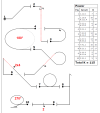
One of the goals of IAC is to push pilots to move up in categories. In order to do so, certain skills must be developed. Pilots will avoid some skills in free sequences that tend to score poorly. The known will usually have several figures which are difficult to perform to competition standards, to develop those skills. Figure 6 above, known as a sharks tooth or wedge, is a good example of that. There are a lot of ways to lose points on a sharks tooth with a 2x4 roll.
Note that each figure has a K factor. This is the difficulty rating, which becomes the weighting for each figure. The judges rate each figure. The total score for the flight is computed by multiplying each figure score by the K factor for that score. There is also a presentation score with a weight of 10, which is scored mostly by how well you keep yourself positioned in the box.
Preparation starts with learning the known sequence. If there are any maneuvers you don't know, you go out and practice them individually, getting help if necessary. For experienced pilots that is usually not a factor except when moving up to a new category. Then you put the sequence together and start flying it to get a feel for altitude, energy, and positioning. You might fly higher than normal at first, then gradually move the sequence down to optimal observation level as you become comfortable with it. Finally, you begin working on finer points of judging, scoring, and positioning. What altitude puts you at the best viewing angle? What is the optimal entry airspeed for each maneuver? How long do you count so that each straight line is the correct length? Where are the critical checkpoints for positioning? What are the figure elements most likely to lead to large point losses? Where do you have opportunities to adjust for wind?
The next step is designing a free sequence. The free sequence cannot be higher K than the known sequence, and should be as close as possible. Once designed and validated, you go through the same practice and refinement process as with the known.
It is a maxim of serious competition pilots that you cannot judge yourself. Successful pilots are coached from the ground. This is more critical as you rise in category. To facilitate this, most IAC chapters hold practice days. The good chapters do it all the time, say monthly. The less active chapters will do it once or twice before local contests. Higher level pilots with the time and money will also attend camps where they fly for a weekend, or a full week.
Casual pilots at primary and sportsman level do less of that. Most of us practice when we can, and get critiquing by flying in local contests and reading the judging comments. I usually start prepping 2 or 3 weeks prior to a contest. I will try to fly every other day, weather permitting. The weekend prior, I will try to fly 2 or 3 times a day. Each flight will consist of one or two full sequences. After the sequences, I will pick one or two figures I am not satisfied with and fly those 10 times in a row. Finally, I will spend a few minutes doing nothing but rolls. A typical practice flight takes 30 minutes, of which about 20 are near-continuous acro. I call it quits when my body and stomach tap out.
Sportsman and Primary have a box floor of 1500 AGL, which complies with 14 CFR 91.303, so we do not need a box or waiver to practice. We can legally fly aerobatics anywhere that complies with the separation requirements from congested areas and airways. The higher categories have a lower box floor, and thus need permission from the FAA to practice at contest altitude. There are approved boxes with altitude waivers in various locations. It usually takes at least a few people to run a waivered box, because you usually need spotters, plus judges to critique. Hence the prevalence of camps and practice events for the higher categories.
My main learning point from the Nationals was the need to have a free sequence rather than reflying the known. Here is one I just designed. I will try it this weekend, weather permitting. If it does not prove too difficult to learn, I will fly it at the fall Sebring contest on 31 October. There are a few tricky spots for my aircraft, mainly figure 10, which requires me to fly inverted after a vertical up line. I will have to practice good energy management to have enough airspeed to not stall at the top. Nerves will be a factor; I have to push forward to hold the nose up and prevent the aircraft from settling as it levels off. If my airspeed is too slow and my push too aggressive, I will drop a wing. Inadvertent inverted spins are high on my list of things to avoid.
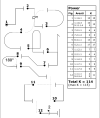
IMO that is a big benefit of aerobatics. Everyone watching focuses on high speed high G maneuvers. But the really challenging flying comes when you have just barely enough energy to make it happen. You have to nurse your airplane over the top with just enough control input, while compensating for forces like gyroscopic precession and torque that are rarely felt strongly in normal flight. I believe those skills transfer well to regular GA flying.
Last edited:
- Joined
- May 15, 2020
- Messages
- 7,765
- Display Name
- Ernie
- Home Airfield
- C81
Reminds me of an interview Dave Grohl did about recording drums for Nirvana. He kept racing through the songs. Producer finally made him play to a click track. Only needed one take to record "Lithium" after the click.I probably could plug an electronic beeper into my aux audio. Or play music.
It's quite a challenge to slow yourself down and find a rhythm. You've got the normal adrenaline of diving straight at the ground at Vne, plus the added jolt of being in a big contest and wanting to do everything perfectly. You are constantly adjusting position and fighting the wind. It looks slow on video but it feels very fast in the cockpit.
I think it just comes down to practice and experience. The guys who placed in Sportsman category each flew 9 or 10 contests this year. If you are flying that often, you get used to it and everything slows down.
Until then, "one-po-ta-to two-po-ta-to" on the ground becomes ONEPOTATOTWOPOTATO!! in the air.
Half Fast
Touchdown! Greaser!
- Joined
- May 7, 2016
- Messages
- 21,190
- Location
- Central Florida
- Display Name
- Half Fast
- Home Airfield
- KGIF
Reminds me of an interview Dave Grohl did about recording drums for Nirvana. He kept racing through the songs. Producer finally made him play to a click track. Only needed one take to record "Lithium" after the click.
The church band I play with also uses a click track. We rotate some of the musicians and vocalists every week, so considering that we don't play the same music all the time, a musician might go several months without playing a particular song. The click helps with that and keeps us a bit more consistent.
Our click track also has queues, like "verse 1" or "chorus" or "bridge" and that keeps us from having memory farts and getting lost.
I wonder if something like that, with queues for the maneuvers or other reminders, might be useful for an aerobatic routine.
- Joined
- Mar 2, 2005
- Messages
- 16,628
- Location
- Southeast Tennessee
- Display Name
- This page intentionally left blank
The church band I play with also uses a click track. We rotate some of the musicians and vocalists every week, so considering that we don't play the same music all the time, a musician might go several months without playing a particular song. The click helps with that and keeps us a bit more consistent
Ditto, I sing praise team once every two to three weeks, love click track!
Daleandee
Final Approach
- Joined
- Mar 4, 2020
- Messages
- 8,354
- Display Name
- Dale Andee
The church band I play with also uses a click track. We rotate some of the musicians and vocalists every week, so considering that we don't play the same music all the time, a musician might go several months without playing a particular song. The click helps with that and keeps us a bit more consistent.
Our click track also has queues, like "verse 1" or "chorus" or "bridge" and that keeps us from having memory farts and getting lost.
I wonder if something like that, with queues for the maneuvers or other reminders, might be useful for an aerobatic routine.
With what little I've done with music the one thing I learned early when going into a studio ... "if you can't play to click you can leave now."