2025 IAC Nationals

The church band I play with also uses a click track. We rotate some of the musicians and vocalists every week, so considering that we don't play the same music all the time, a musician might go several months without playing a particular song. The click helps with that and keeps us a bit more consistent.

Our click track also has queues, like "verse 1" or "chorus" or "bridge" and that keeps us from having memory farts and getting lost.

I wonder if something like that, with queues for the maneuvers or other reminders, might be useful for an aerobatic routine.
The click didn't work for live concerts so they wired up a strobe to flash in his face when they wanted it to sound perfect.

But yeah, it was just a thought to help keep rhythm. Having never flown acro I have no idea if it'd work. But in my head it sounds similar?

If @Ed Haywood starts using a click track and becomes the next Rob Holland, I expect a hat tip in the victory interview.
 
The click didn't work for live concerts so they wired up a strobe to flash in his face when they wanted it to sound perfect

On-stage sound volume at some rock shows is dangerously insane. I did on-stage monitor mixes for groups a few times and had to wear earplugs, the performers wanted it so freakin' loud. It's better now with most folks using in-ear monitors, but I can still understand that he might not have been able to hear a click.

The problem with using a recorded click live (as we do) is that it locks you in. No room for throwing in an extra chorus or changing the tempo. Sometimes we just kill the click mid-song if a singer is starting to improvise.

When I mixed sound at Disney World, many of our stage shows used recorded clicks with separate tracks that put in character voices (i.e., the seven dwarfs singing) or various sound effects. We also had some of the instruments recorded, so that if a trumpet player or a guitarist or whatever called in sick we could just turn up that track.
 
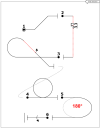
I would be remiss if I did not mention Primary category. That level is intended to encourage first time competitors. Only the known sequence is flown. Safety pilots are allowed and encouraged. If you show up as a Primary pilot, the contest organizers will go out of their way to help you through the process.

Here is the sequence. It should be flyable by grassroots aircraft such as the Citabria, RV series, EAA biplane, Cessna 150 Aerobat, etc. I think you could very easily do a 5 hour aerobatic intro course, practice this a few times, and fly in a contest.

Primary.PNG
 
IMO that is a big benefit of aerobatics. Everyone watching focuses on high speed high G maneuvers. But the really challenging flying comes when you have just barely enough energy to make it happen. You have to nurse your airplane over the top with just enough control input, while compensating for forces like gyroscopic precession and torque that are rarely felt strongly in normal flight. I believe those skills transfer well to regular GA flying.

An example of this. Over the last week I have been refining my spin entry technique. My old method was to climb until I was 10 mph faster than stall, then push over to level flight, hold it a few seconds, cut power, hold level flight until it stalls, then kick in pro-spin rudder. That often resulted in 5 or 10 seconds of gliding and settling until the break. That is a very imprecise and inconsistent entry that tells the judges I am not ready to compete.

Reading some of my reference materials, I was reminded of good competition technique. Pull 45 up, climb until at or below stall speed, then ease over to 20 degrees nose high. Catch the nose and keep it up. Your IAS will be below stall speed, but you will not stall because of full power and relative wind. Hold for no more than 2 seconds, then cut power. The nose will drop abruptly and cleanly. Kick in rudder to spin.

Doing such maneuvers refines your feel for controls on the hairy edge of a stall. Many GA pilots are deathly afraid of stalls and spins, and never do them except when forced to by a CFI. They only understand stalls in very gross, big movement terms. Stick back, horn blares, nose falls, aircraft has stalled. Shove stick forward, aircraft recovers. They don't develop a feel for that "bite" that happens when changing relative wind reduces AoA below critical and elevator becomes effective again. Nor do they learn the stall warning sign when small stick movements aft do not result in pitch change.
 
Last edited:
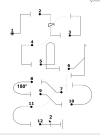
Tried my new free sequence out at the Sebring contest. Significantly better results. I scored 88% and 87% on it, and won 2nd place in Sportsman.
What did you settle on for a free sequence?
 
Lots of sharp corners. Do those score higher than rounder versions of the maneuvers? What is your reasoning for 7 and 9? Sorry for the dumb questions. I’ve never flown a sequence, just maneuvers with an instructor.
 
Watch the Gamebird starting at 6:28. Last flight on the stream. Damn thing was levitating.
Our university team flys a Gamebird, painted school colors. Supposedly anonymous donor gave it to the school but I have a suspicion who the donor is. One of these days I might get a ride in it.
 
Lots of sharp corners. Do those score higher than rounder versions of the maneuvers?

Those aren't really corners. They are actually quarter loops connecting the vertical and horizontal lines. The sharpness depends on airspeed.

You want to fly maneuvers that your plane presents well and you fly well. You also want to avoid figures with subjective judging criteria, like 45 degree lines.

My plane is very large, so it presents vertical lines well, but it rolls very poorly. I fly vertical lines well, so I tried to do a lot of those, while avoiding 45 degree lines and rolling components.

Unfortunately the rules prevent repetition of figures, so after a while I run out of ways to fly straight up and down, and have to mix in some other stuff.

What is your reasoning for 7 and 9?

A classic example of energy management. I wanted a wind correction maneuver, which moves you closer to or farther from the judges. A 180 degree turn is a simple way to do that. However, it bleeds a ton of energy if done at high speed. So, a 45 degree climb before the turn converts airspeed into altitude. A 45 degree dive after the turn gets the airspeed back.
 
Those aren't really corners. They are actually quarter loops connecting the vertical and horizontal lines. The sharpness depends on airspeed.

You want to fly maneuvers that your plane presents well and you fly well. You also want to avoid figures with subjective judging criteria, like 45 degree lines.

My plane is very large, so it presents vertical lines well, but it rolls very poorly. I fly vertical lines well, so I tried to do a lot of those, while avoiding 45 degree lines and rolling components.

Unfortunately the rules prevent repetition of figures, so after a while I run out of ways to fly straight up and down, and have to mix in some other stuff.


A classic example of energy management. I wanted a wind correction maneuver, which moves you closer to or farther from the judges. A 180 degree turn is a simple way to do that. However, it bleeds a ton of energy if done at high speed. So, a 45 degree climb before the turn converts airspeed into altitude. A 45 degree dive after the turn gets the airspeed back.
Thanks for the explanation, especially about converting kinetic energy to potential energy before the 180 wastes it. And I see now that the sharp corners on the sequence drawing are to define the line you stop pulling on (such as vertical) rather than how hard you pull.
 
Back
Top