MauleSkinner
Touchdown! Greaser!
We all know this is where that sentence really ends.I visualize Marisa Tomei


We all know this is where that sentence really ends.I visualize Marisa Tomei

There is a whole lot more to Aerodynamics that just how does a wing create lift. That in itself may not be all that important. But other aspects about Aerodynamics that affect how the wing performs are very important in keeping you alive.Sometimes, the most difficult student question to answer is "why do I need to learn this"? One of the topics where I struggle to answer this question is aerodynamics. Why do pilots need to understand how a wing creates lift according to Bernoulli or Newton? Many of us learned an explanation of lift based on the equal transit time theory, which is demonstrably false. Yet, we have been able to control our airplanes fine. I was also taught an incorrect explanation of why airplanes with dihedral have lateral stability. Even though I believed this incorrect explanation for years, I had no trouble keeping the wings level. If one can function well as a pilot despite an incorrect understanding of a topic, that calls into question whether understanding the topic is actually important. So, what do instructors on this forum say when asked by students why they need to learn about aerodynamics.
I am not suggesting that we take this material out of the curriculum (except the parts that are false). I would just like to be able to give a better answer to the "why do I have to learn this?" question than "it is on the test".
…he said authoritatively."Why learn aerodynamics?" ... you'll be able to participate in these discussions with a little more authority.
Curious. Do you think A&P mechanics should not have to learn basic theories like aerodynamics, as part of their training and education as well?Sometimes, the most difficult student question to answer is "why do I need to learn this"?

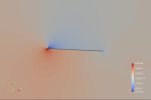
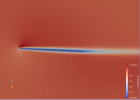
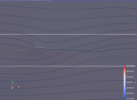


Just for the fun of it.
Hot off the press... Really- I'm still figuring out how to make this work.
CFD simulation of a balsa glider airfoil (50mm chord) traveling at 1m/sec at a 2.6 degree angle of attack.
Pressure field around the foil - more bluish: lower pressure. More redish - higher pressure.
View attachment 139480
Haven't yet figured out how to extract forces from this stuff.

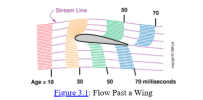
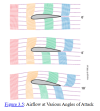
My favorite wind tunnel video:The misconception here is thinking that two air molecules separated at the leading edge are somehow still “linked” so that the upper one “knows” it must speed up to rejoin the lower one. They’re not.
My working visualization is that there is a venturi formed by the wing and the undisturbed air that exists somewhere above it. That’s why it speeds up and the pressure drops, thanks to Bernoulli.



FIFYYou guys have this all wrong. Airplanes fly because of money. The more money you had, the faster and higher they go!
Let me ask you a question, explain the difference between a shallow bank, medium bank and steep banked turn and why knowing these definitions has any importance to me as a brand new student?Sometimes, the most difficult student question to answer is "why do I need to learn this"? One of the topics where I struggle to answer this question is aerodynamics. Why do pilots need to understand how a wing creates lift according to Bernoulli or Newton? Many of us learned an explanation of lift based on the equal transit time theory, which is demonstrably false. Yet, we have been able to control our airplanes fine. I was also taught an incorrect explanation of why airplanes with dihedral have lateral stability. Even though I believed this incorrect explanation for years, I had no trouble keeping the wings level. If one can function well as a pilot despite an incorrect understanding of a topic, that calls into question whether understanding the topic is actually important. So, what do instructors on this forum say when asked by students why they need to learn about aerodynamics.
I am not suggesting that we take this material out of the curriculum (except the parts that are false). I would just like to be able to give a better answer to the "why do I have to learn this?" question than "it is on the test".


Ah, the good ol' "equal transit theory", which many of us learned in school and is complete and utter BS.Always thought of it as the air flowing over the top has to travel farther in the same amount of time.
FWIW, Wittman Regional Airport was so named long before Steve Wittman's fatal crash, but very shortly after he retired after having been its manager for nearly its entire existence.Does anyone other than an aeronautical engineer or test pilot really need to understand lift at the molecular or fluid dynamics level? Probably not. But if you are building an EAB with fabric wings, you better understand there is a pressure differential, lest you skip the rib stitching and wind up with an airport in Oshkosh named after you.

That sounds like the old "descending turn" fallacy where the pilot thinks that the load factor is less in a descent. It's not, unless it's a VERY steep descent. Climbing or descending at a steady rate of climb (or descent) is at 1G, just like level flight. Cranking in a steep bank at pattern speeds, even coordinated, is a death wish.When I was a young student pilot training at KLGB when the tower asked me to “make short approach “ on the downwind leg, I would lower the nose and crank her down in a steep bank without any regard to aerodynamic issues that might arise. My instructor would sit there within his arms folded and never said a word. I understood about keeping the turn coordinated and lowering the nose to maintain airspeed without fully understanding the effects of the aerodynamics at play. If your technique is proper it’s hard to get into trouble, even with limited understanding of aerodynamics.

Yet another scenario where some indicator of AOA would be valuable, even if for nothing more than a training exercise.That sounds like the old "descending turn" fallacy where the pilot thinks that the load factor is less in a descent. It's not, unless it's a VERY steep descent. Climbing or descending at a steady rate of climb (or descent) is at 1G, just like level flight. Cranking in a steep bank at pattern speeds, even coordinated, is a death wish.

I've always felt the stick makes a pretty good AoA indicator.Yet another scenario where some indicator of AOA would be valuable, even if for nothing more than a training exercise.
Nauga,
who can see what some people only think they can feel
Sometimes, the most difficult student question to answer is "why do I need to learn this"? One of the topics where I struggle to answer this question is aerodynamics. Why do pilots need to understand how a wing creates lift according to Bernoulli or Newton? Many of us learned an explanation of lift based on the equal transit time theory, which is demonstrably false. Yet, we have been able to control our airplanes fine. I was also taught an incorrect explanation of why airplanes with dihedral have lateral stability. Even though I believed this incorrect explanation for years, I had no trouble keeping the wings level. If one can function well as a pilot despite an incorrect understanding of a topic, that calls into question whether understanding the topic is actually important. So, what do instructors on this forum say when asked by students why they need to learn about aerodynamics.
I am not suggesting that we take this material out of the curriculum (except the parts that are false) I would just like to be able to give a better answer to the "why do I have to learn this?" question than "it is on the test".

Or the horizon.I've always felt the stick makes a pretty good AoA indicator.
This.A student that loves flight will want to know more answers, and will rarely, if ever, ask "why" to learning aerodynamics. The students that ask "why" are only interested in passing the test to keep climbing the ladder. So saying "its on the test" is exactly what they need to hear, and pretty much the only thing you can do.
Seriously?!Or the horizon.
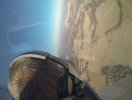

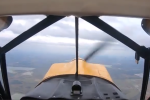
IDK what type, but it looks like a 2G turn more or less. Which in a 1-26 increases your stall speed from about 25 kn to about 35 kn.

What about mine?
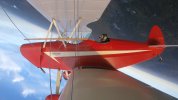
Oh, that looks like fun. Hatz off to you, sir.

Or the horizon.
demonstration of the OP’s premise.I hope that was sarcasm.

My Glasair doesn’t even have a stall warning device let alone AoA. The stick gives ample warning to impending stall. Now, if someone is task saturated or panicking, nothing can help that. Not even an AoA indicator.I've always felt the stick makes a pretty good AoA indicator.
Right around 4g, so about 100% more, more or less. The nose is also trending downward as I'm trying to maintain airspeed as g increases (AKA a 'windup turn'). There's no way to discern AOA from the horizon unless there are other constraints, like wings-level unaccelerated flight, which is far from the case in my pic or @Dana 'sIDK what type, but it looks like a 2G turn more or less.
I agree, to some extent. What's your stick position for on-speed approach? What about best range?I've always felt the stick makes a pretty good AoA indicator.
I agree, to some extent. What's your stick position for on-speed approach? What about best range?
It would definitely be useful, to me if no one else...one of these days I'm going to pay attention to the one in my plane and see how it actually correlates to my stick. It will probably be a useful training experience.

Only in level flight (maintaining altitude and wings level) and a whole bunch of other variables fixed to make it work.Or the horizon.