Where does the "Flooded Fuel" comes from?

leejy1025

Filing Flight Plan
Joined
Nov 3, 2025
Messages
12
Display Name
Phoenix345
I'm flying Cessna with Lycoming IO-360-L2A, has Aux fuel pump.

I overprimed a bit before starting, made a 100LL puddle under my engine.

where exactly thoes fuel came from? definitely starting from the cylinder,
but I cannot really picture the process of how the fuel is being discharged from the cylinder, endup on the ground.

any name of the engine parts, or pictures will be very helpful! thanks in advance
 
The IO-360 injection system is not like today's cars, which are direct injection (squirts fuel into the cylinder). It's more like old cars, which are port injection (squirts fuel into the intake manifold near the intake valves). It's not even like old cars (1980-2000), which were electronic sequential injection. It's more like really really old cars (1970's and earlier), which were mechanical continuous injection. And remember that the -L2A is an updraft system, so when you overprime it just flows back out the other end of the manifold.
 
The IO-360 injection system is not like today's cars, which are direct injection (squirts fuel into the cylinder). It's more like old cars, which are port injection (squirts fuel into the intake manifold near the intake valves). It's not even like old cars (1980-2000), which were electronic sequential injection. It's more like really really old cars (1970's and earlier), which were mechanical continuous injection. And remember that the -L2A is an updraft system, so when you overprime it just flows back out the other end of the manifold.
I do not know the car engine specifically, but now i know that L2A doesn't make a puddle thanks! it was question from examiner, i think he was asking about general reciprocating engines. do you have any knowledge about how the fuel drips down when it's overprimed other than L2A?
 
From the 172R service manual:

1768270757086.png

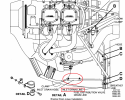
The fuel is injected into the intake manifold immediately next to the intake valves. When you flood the engine, that fuel runs down through the induction tubes and into the elbow below the injection/throttle servo, and out of the inlet drain line as shown above. Big puddle on the ground.

Don't confuse automobile fuel injection with aircraft fuel injection. Cars use electrically-fired solenoid valves (injectors) that put tiny amounts of fuel at a time either into the intake near the intake valves, or directly into the cylinder (direct injection). Because they're controlled by the Engine Control Unit, a computer that will not pump more fuel that needed for starting, flooding doesn't happen.

But the system in an airplane is totally mechanical, no computers, no electrics, because electrical systems are what fail most commonly. No big deal in a car, much bigger deal in an airplane. So the priming is controlled by the pilot, and it's easy to get it wrong. When the engine is running, the flow through the injector nozzle is constant, not timed pulses of fuel as in the car. Simple and reliable but harder to start. When you prime you're setting the throttle and mixture manually, and if that throttle is open a lot, a lot of fuel is pumped into the intakes. The throttle controls fuel flow directly, along with the air.
 
I do not know the car engine specifically, but now i know that L2A doesn't make a puddle thanks! it was question from examiner, i think he was asking about general reciprocating engines. do you have any knowledge about how the fuel drips down when it's overprimed other than L2A?
That engine picture I posted above is an L2A engine. Your examiner is not a mechanic. Examiners are experienced instructors, and some instructors are woefully uninformed. It doesn't help that the AFM for that airplane does not mention fuel draining out onto the ramp if overprimed.

Carbureted engines can easily be overprimed, too, and that fuel runs down through the induction system and out of the carb airbox. It often ends up in the cowling and on the ground as well as in the airbox. If the engine backfires on start, it can set that fuel afire in the airbox and cowl and cause plenty of damage. The POHs for earlier 172s have a section on engine fires on the ground in their Emergency Procedures section.
 
Back
Top