When the wimpiness started

Way ahead of you. 8GCBC Scout. Preferably late 70's so I can restore it.

An excellent backcountry choice. Maybe add floats or skis? Just don’t forget it’s not your Decathlon and start yanking it around. :)

Not much useful load, though, and only two seats. Do you want the option to bring spouse and son along? Maybe carry camping and hunting gear plus a moose carcass?
 
There are many Cessna 180s and 185s. They do not have low wing loadings. They have really decent cruise speeds, lacking the drag of a nosewheel.

185 numbers:

View attachment 149020
The 180/185, is in a different class, given higher cruise speed and load hauling capability. Lightly loaded it will almost fit in places that a Cub will, heavier it can haul more out of a slightly longer runway than just about anything else. Great aircraft, been flying several different ones for years.
 
The taildragger thing is a myth. Just watch youtube and you'll find a whole legion of unremarkable idiots that appear able to fly them just fine. When I learned to fly it was normal to send a 16 year old kid up by himself in a J3 after about 5 hours of instruction.
 
I'm pretty confident I'll be able to land a taildragger at least as badly as I can land a tricycle.
 
The taildragger thing is a myth. Just watch youtube and you'll find a whole legion of unremarkable idiots that appear able to fly them just fine. When I learned to fly it was normal to send a 16 year old kid up by himself in a J3 after about 5 hours of instruction.
100%!! I wasn't joking or being modest when I said if I can do it, anybody can do it. Even crosswind is just a feel thing, same with taxi. If you can ride a bicycle you can fly tailwheel.

I think, though, that by knowing how to fly tailwheel that you then know how to land, so the concept of just flying down to the runway and letting the thing land itself doesn't make sense. Similarly, if you can land a tailwheel in a crosswind, you automatically know how to use a rudder, so landing a tricycle in a crosswind is equally simple.

Or in other words, it's not difficult. But you can't fly any tailwheel I know of with your feet on the floor from takeoff to landing. So I do think it's worthwhile for any pilot to learn it, and discover that it's not only a pretty simple set of skills, but that it's also kinda fun.
 
Of course. But you also get to rely on them doing exactly the opposite of what is needed in a crosswind landing.
There is no such thing as a crosswind landing in an Ercoupe. Just point it wherever that keeps the flight path down the runway. And for a slip, cut the power and it drops like a brick.

(Got my tailwheel endorsement in a Champ)
 
Probably the same reason so many people wreck cars that are easy to drive - inattention.
 
If they are so easy to land why do so many people ground loop them
Just because something is easy doesn't mean it's not also easy to do it wrong. Like kids with ice cream. Easy. Also easy to drop it on the floor. Not to make light of it, but if you touch down with the center of gravity between the track of the wheels, and you don't do anything weird with the brakes, you'll be fine. If you land crooked - that is with the CG outside of the wheel track, expect it to turn around on you. If you're coming in and you're not lined up, go around and try again. Easy!

Now a little more difficult is crosswind you have to use aileron to keep it from drifting and rudder to keep alignment with the runway, but that really is also easy to learn.
 
why does that remind me of invulnerability and macho attitudes
 
why does that remind me of invulnerability and macho attitudes
seriously, which part? I'm not saying I'll never land a cub wrong, or that I'll never make mistakes. I am stating that I think it's pretty easy to land a cub right.

I'll agree there are some folks that will wear the "I can fly a taildragger" t-shirt and perhaps brag that their skills will save the day like mighty mouse. I'm not saying that at all. I'm saying that it really is a simple set of skills that anyone who can do a slip can do. No brag, no boast, and outside of a crosswind not compensated for, if you touch down with the CG between those wheels, no brakes, no weird runway, it's going to track true. It's NOT a magical mythical skill passed down like being a Ninja.

If I had a t-shirt like that, I'd put "...and so could you" in the same size letters. Actually, I think taking off tailwheel is quite a bit easier than tricycle. And more fun.
 
There's a reason taildraggers are referred to as "conventional gear", or at least used to be. My dad learned to fly in a Stearman. He taught me to fly in his Cessna 140. Tricycle gear was a later adaptation.
Flying with a tailwheel does not require unique or extraordinary skill. It is simply less tolerant of inattention on the ground. Nothing magic about it.
 
I really need to get my plane out West. Seems like I am missing adventure.
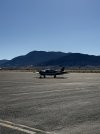
Give me 6 months notice,, a bit of currency training in FL (I have about 30 hrs in a champ, from 2009) and I’ll fly it out with you. We can overfly the Grand Canyon. The crew cars in Ely,NV are super cool, too (notice the white pine county, official use only decal)
 

Attachments

  • IMG_5763.jpeg
    IMG_5763.jpeg
    1.7 MB · Views: 13
  • IMG_5759.jpeg
    IMG_5759.jpeg
    1.5 MB · Views: 13
No brag, no boast, and outside of a crosswind not compensated for, if you touch down with the CG between those wheels, no brakes, no weird runway, it's going to track true.
No. The CG is fixed at a point just behind the mains and roughly in the center. Touching down in a crab does not take the CG outside the wheel track, but you'll be in a lot of trouble anyway.

The airplane needs to touch down with the main wheels pointing in exactly the same direction as the CG is travelling. That's the critical thing.
 
Give me 6 months notice,, a bit of currency training in FL (I have about 30 hrs in a champ, from 2009) and I’ll fly it out with you. We can overfly the Grand Canyon. The crew cars in Ely,NV are super cool, too (notice the white pine county, official use only decal)

Deal!
 
I had about 600 hours in my Bonanza and now over 700 in the Skywagon. I could land the Bo in winds I won't taxi the 185 in. I think there's some bar talk on this thread.

Truth. I agree that just about anyone can land a taildragger in benign conditions. But try it at max crosswind component and you better be on your game.
 
seriously, which part? I'm not saying I'll never land a cub wrong, or that I'll never make mistakes. I am stating that I think it's pretty easy to land a cub right.

I'll agree there are some folks that will wear the "I can fly a taildragger" t-shirt and perhaps brag that their skills will save the day like mighty mouse. I'm not saying that at all. I'm saying that it really is a simple set of skills that anyone who can do a slip can do. No brag, no boast, and outside of a crosswind not compensated for, if you touch down with the CG between those wheels, no brakes, no weird runway, it's going to track true. It's NOT a magical mythical skill passed down like being a Ninja.

If I had a t-shirt like that, I'd put "...and so could you" in the same size letters. Actually, I think taking off tailwheel is quite a bit easier than tricycle. And more fun.
Taildraggers are harder to land in crosswinds and harder period to land. It’s relatively easy to get behind the plane on landing. Especially on an asphalt runway. Way to many people get tw sign off, don’t practice or fly regularly and ground loop. Cub is one of the easiest. but even a decath can be a challenge and a Pitts. whew.
 
No. The CG is fixed at a point just behind the mains and roughly in the center. Touching down in a crab does not take the CG outside the wheel track, but you'll be in a lot of trouble anyway.

The airplane needs to touch down with the main wheels pointing in exactly the same direction as the CG is travelling. That's the critical thing.
I read this about four times, and found a description of where the CG is on a J3. And you're right. First, what I had been thinking of as "CG" is some point behind the rear seat, which is behind the trailing edge of the wing, and obviously can't be the CG. And second, I described something as a static condition where it's really dynamic. It's the vector of that point that has to stay within the wheel track to be able to keep the aircraft pointed forward.

Taildraggers are harder to land in crosswinds and harder period to land. It’s relatively easy to get behind the plane on landing. Especially on an asphalt runway. Way to many people get tw sign off, don’t practice or fly regularly and ground loop. Cub is one of the easiest. but even a decath can be a challenge and a Pitts. whew.T
There are a lot of people on here with way more tailwheel experience than me. I'm not claiming to be an expert, just stating that I don't think it's a difficult skill in general. I learned in a cub, have a hundred hours and more than 400 landings in them, took my first checkride in one, and am far from an expert. My point through all of this is that I don't believe tailwheel is a magical skill. I'm not suggesting anyone go out and get a paper endorsement and fly without adequate training, or that every aircraft flies the same.

Whenever tailwheel comes up there always seems to be a contingent that believes you have to be Bob Hoover to fly one, and that's just not the case. I think that mindset scares some people away, and that they're missing out on a lot of fun and a great learning experience by picking it up.

 
I read this about four times, and found a description of where the CG is on a J3. And you're right. First, what I had been thinking of as "CG" is some point behind the rear seat, which is behind the trailing edge of the wing, and obviously can't be the CG. And second, I described something as a static condition where it's really dynamic. It's the vector of that point that has to stay within the wheel track to be able to keep the aircraft pointed forward.


There are a lot of people on here with way more tailwheel experience than me. I'm not claiming to be an expert, just stating that I don't think it's a difficult skill in general. I learned in a cub, have a hundred hours and more than 400 landings in them, took my first checkride in one, and am far from an expert. My point through all of this is that I don't believe tailwheel is a magical skill. I'm not suggesting anyone go out and get a paper endorsement and fly without adequate training, or that every aircraft flies the same.

Whenever tailwheel comes up there always seems to be a contingent that believes you have to be Bob Hoover to fly one, and that's just not the case. I think that mindset scares some people away, and that they're missing out on a lot of fun and a great learning experience by picking it up.
i agree with that. they are great fun. u just need adequate training
 
Little taildraggers are not that hard in reasonable winds, and the J3 is one of the easiest of them all due to it's amazingly low stall speed if being three pointed. This generalization is true for most of the two seaters, whether Cub, or Cessna, or Citabria. And these may be the most fun of the lot, making tailwheel accessible to many after a little training, which will carry over into ordinary aircraft in terms of coordination and cancelling drift.

Where it gets interesting is in the four seat and bigger tailwheel aircraft. Particularly with a few folks in the back, now the c.g. Is further back, the airplane is heavier, probably going to want to do a wheel landing. Since it's a bigger airplane, probably used it to go from point A to B, now the crosswind has increased, and now the rubber hits the road. Doable when proficient - absolutely, but assume the pilot has substantial experience in that aircraft over time with different loads and in different winds.

It's not as perishable skill as IMC flying, but it is more particular to the airframe and wind conditions at that moment and within one's experience level. It's fun, rewarding, boosts overall airman competency, but you have to fly the airplane all the way to a stop. You never know when it will bite you, anyone who flies one regularly and in varying conditions has had a moment when they had to wrestle the beast for whatever reason.
 
It's the vector of that point that has to stay within the wheel track to be able to keep the aircraft pointed forward.
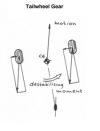
Still not right. Look at this:

1768672957546.png

To get that CG movement vector outside the wheel track, The airplane's centerline would have to be at around 160° or more to the vector, and it would be a lost cause long before it got to that point. Even heavy braking on the outside couldn't stop it.

No, the vector has to be lined up with the rolling direction of the wheels. Even five degrees off can be seriously wrong.
 
I am not saying to try this, only as an analogy. Tricycle gear is like driving a car forward, conventional gear is like driving a car in reverse. A small deviation going forward at 60mph is not a big deal. Driving 60 mph in reverse is also not hard IF you keep corrections small and keep it mostly in line, but a screw up/deviation can and will make it almost if not fully uncontrollably. The skills are the same, but the precision required is higher in conventional gear.
 
I think the FBD posted is showing the effect of tire friction which is why it's easier to land a tailwheel on grass, which allows some sliding but causes an immediate moment about the c.g. on a paved surface. This must be overcome by creating an opposite moment equal to correct amount of rudder lift times its distance from the c.g. Often the compensating opposite moment is overdone, which is one reason why have heard that most ground loops are in the opposite direction of the initial swerve. I have the full FBD somewhere, will try and find it.
 
Still not right. Look at this:


To get that CG movement vector outside the wheel track, The airplane's centerline would have to be at around 160° or more to the vector, and it would be a lost cause long before it got to that point. Even heavy braking on the outside couldn't stop it.

No, the vector has to be lined up with the rolling direction of the wheels. Even five degrees off can be seriously wrong.
I wasn't clear with that second note. It's not the CG. It's clearly a point way behind the CG, because of course 160 degrees is silly. But there is such a point, where a landing is controllable without differential brakes, and where outside of that range you're in trouble. I'm certain that's true because my landings weren't perfect, but I never spun it around because I never came in where I was out of alignment enough to require heroic - or any - braking.
 
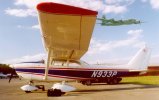
If one is of the age where they can collect Social Security they remember when a tail dragger had "conventional gear". Cessna fixed that! (Though once I did a three-pointer with the right main, right wingtip, and prop. Still have the trophy prop.)
I had a 172F for a couple of decades; it was built for USAF but they didn't take it, so it was full of extra gauges. No bare space in the panel! Cylinder head, exhaust, and carb temp gauges? Check! Manifold pressure? Yup. And the corporate pilot we bought it from in the nineties had added an ADF, and Loran. We added hail damage in a thunderstorm.
 

Attachments

  • 933p with B29.jpg
    933p with B29.jpg
    61.6 KB · Views: 11
I wasn't clear with that second note. It's not the CG. It's clearly a point way behind the CG, because of course 160 degrees is silly. But there is such a point, where a landing is controllable without differential brakes, and where outside of that range you're in trouble. I'm certain that's true because my landings weren't perfect, but I never spun it around because I never came in where I was out of alignment enough to require heroic - or any - braking.
That theoretical point behind the CG will vary even with the same airplane. Traction of the mains AND tailwheel will change it. Rudder authority (airspeed) will change it. Use of aileron will change it. Pitch attitude will change it. Brake efficiency will change it.

It comes down to keeping that airplane straight with the direction of travel no matter what. You can never be sure just how much crab you can deal with at any given time. For this reason, every crosswind landing brings risks, and sometimes you have to abort and go elsewhere or find a different runway. I once had to abort a landing in the 180, and land into the wind in a field adjacent to the runway. You do what you have to do. Running out of rudder is not funny.
 
Tricycle gear is like driving a car forward, conventional gear is like driving a car in reverse.

Right, or driving a forklift forward at max speed. :ihih:

For those interested, Harvey Plourde's book is great. Additionally, this is one of the best discussions of tailwheel ground handling physics I've seen committed to video:

 
Back
Top