What's the difference?- magneto timing

Will Kumley

Line Up and Wait
Joined
Aug 6, 2019
Messages
796
Location
Pacific Northwest
Display Name
Will
Looking at magneto timing and I see two very different pieces of equipment that accomplish the same thing but have a different form factor and price so I'm curious if the only real difference is the price and form factor or is there more to it?

ATS E50 is the larger, more expensive option:

But this is what I see most mechanics use:
 
I've got the cheaper one. It works fine, and is simple to operate. Don't know why one would spend more. I'm not using it these days because I'm currently running an emag and a lightspeed plasma 3.
 
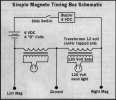
The old style used a buzzer to chop battery voltage up to make an AC signal that was then run through a couple of small transformers to step the 6 volts up to 100 or so to fire a pair of neon bulbs. The test leads shorted the transformer primaries though the points, and when the points opened the light came on. The one in the first picture appears to have LEDs now, and there is nothing on the front to tell you what the lights do when the points are open or closed. Confusion can happen. Here's a schematic:
1784246181979.png

The AC is necessary to detect the points opening or closing. The magneto's coil primary has a low resistance, and a DC signal would pass though it almost as easily as through the points. The AC runs into inductive reactance in that coil so that the current flow through the mag drops enormously when the points open, and the timer's transformer primaries are no longer effectively shorted.


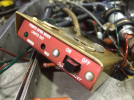
The newer style is much smaller and uses transistors to do something similar, but the lights work opposite to the old style. They go out when the points open.

1784246288197.png

A colleague gave me one of the new style when it didn't work anymore. I took the guts out and put in a tiny relay wired to act as a buzzer, and two audio transformers from transistor radios. Couple of LEDs. All junk-box stuff. Fired it with some AA batteries, and scratched out the "Points open when lights out" on the front panel. Lights come on when the points open, just like the older models.
 
The old style used a buzzer to chop battery voltage up to make an AC signal that was then run through a couple of small transformers to step the 6 volts up to 100 or so to fire a pair of neon bulbs. The test leads shorted the transformer primaries though the points, and when the points opened the light came on. The one in the first picture appears to have LEDs now, and there is nothing on the front to tell you what the lights do when the points are open or closed. Confusion can happen. Here's a schematic:
View attachment 153496

The AC is necessary to detect the points opening or closing. The magneto's coil primary has a low resistance, and a DC signal would pass though it almost as easily as through the points. The AC runs into inductive reactance in that coil so that the current flow through the mag drops enormously when the points open, and the timer's transformer primaries are no longer effectively shorted.


The newer style is much smaller and uses transistors to do something similar, but the lights work opposite to the old style. They go out when the points open.

View attachment 153498

A colleague gave me one of the new style when it didn't work anymore. I took the guts out and put in a tiny relay wired to act as a buzzer, and two audio transformers from transistor radios. Couple of LEDs. All junk-box stuff. Fired it with some AA batteries, and scratched out the "Points open when lights out" on the front panel. Lights come on when the points open, just like the older models.
Thanks, this is a great explanation. I'm a little surprised the new (smaller) style didn't just replace the old style altogether.
 
I use both types.

The “ new “ type version with an audio buzzer is easier to use than one without the feature. The clips on the leads tend to be small so adding test
leads with larger clips helps. Not suitable to test continuity.

The “ older” has larger clips and can be used to “ ring out” the ignition
switch wiring or other continuity tests. It’s easier to get false indications if a clip touches ground. Also you may think the mags are perfectly synched but what really happened is the ground clip fell off!
 
I wish my ATS E50 had external batteries; I pull them because I only use it 2-3x/year and I know they’ll leak & corrode the internals eventually. Have to open up the box each time.
 
I recently bought one of the "small" boxes, but for a long time I just used a piezo buzzer in series with a 9V battery. You can hear the tone change slightly when the points open.
 
I wish my ATS E50 had external batteries; I pull them because I only use it 2-3x/year and I know they’ll leak & corrode the internals eventually. Have to open up the box each time.

I do similar but for another reason.

Occasionally I’m driving along and hear a faint buzzing.

Something bumped it ON again!

Also find it helpful to tape switch OFF.
 
Back
Top