What impacts service ceiling?

Sure it does, to a point. TAS increases at higher altitudes with the same power available. Sure, you burn more in the climb the higher you go, but you'll go faster too. In theory, having about half of your trip or more at cruise is the way to go.
In the piston prop, maximum range does not change with altitude. Only the time and speed at which you achieve it do. In this, note max range is an AOA not an IAS, your IAS will reduce as you burn fuel. Once you’re trimmed for the max R AOA, you’ll need to slowly reduce power as you burn fuel losing weight so as to stay level and maintain maximum range, otherwise you’ll creep up in a slight climb.

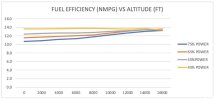
TAS increases with altitude but so too does power required hence fuel burn rate. Remember power required is drag aka thrust required times airspeed meaning TAS. So, for still air, no change in max range with altitude for the piston propeller. Which means we have means to chose more favorable winds. But I prefer to go faster than best range hence higher does help. Look at this Catherine Cavagnaro piece. While she says she prioritizes efficiency, that’s not true, she’s prioritizing speed first efficiency second. Look at her figure two. She’s generally looking at the 65% power but for max range we’re closer to the 45% curve for her plane. Notice the slope of that 45% line is flat.
IMG_1481.jpeg
https://www.aopa.org/news-and-media...lot/flying-smart-the-benefits-of-getting-high

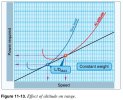
“The effect of altitude on the range of a propeller-driven aircraft is illustrated in Figure 11-13. A flight conducted at high altitude has a greater true airspeed (TAS), and the power required is proportionately greater than when conducted at sea level. The drag of the aircraft at altitude is the same as the drag at sea level, but the higher TAS causes a proportionately greater power required. NOTE: The straight line that is tangent to the sea level power curve is also tangent to the altitude power curve. The effect of altitude on specific range can also be appreciated from the previous relationships. If a change in altitude causes identical changes in speed and power required, the proportion of speed to power required would be unchanged. The fact implies that the specific range of a propeller-driven aircraft would be unaffected by altitude. Actually, this is true to the extent that specific fuel consumption and propeller efficiency are the principal factors that could cause a variation of specific range with altitude. If compressibility effects are negligible, any variation of specific range with altitude is strictly a function of engine/propeller performance.” - PHAK chapter 11
IMG_1478.jpeg

Is there plagiarism afoot?

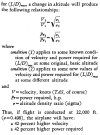
“If a change in altitude causes identical changes in velocity and power required, the proportion of velocity to power required would be unchanged. This fact implies that the specific range of the propeller powered airplane would be unaffected by altitude. In the actual case, this is true to the extent that power plant specific fuel consumption and propeller efficiency are the principal factors which could cause a variation of specific range with altitude. If compressibility effects are negligible, any variation of specific range with altitude is strictly a function of engine-propeller performance. The airplane equipped with the reciprocating engine will experience very little, if any, variation of specific range with altitude at low altitudes, There is negligible variation of brake specific fuel consumption for values of BHP below the maximum cruise power rating of the power plant which is the auto-lean or manual lean range of engine operation. Thus, an increase in altitude will produce a decrease in specific range only when the increased power requirement exceeds the maximum cruise power rating of the power plants. One advantage of supercharging is that the cruise power may be maintained at high altitude and the airplane may achieve the range at high altitude with the corresponding increase in TAS. The principal differences in the high altitude cruise and low altitude cruise are the true airspeeds and climb fuel requirements.” - Aerodynamics for Naval Aviators
IMG_1480.jpeg
 
The 65% power curve contradicts what you said. Approximately 11.5 NM/G at sea level and approximately 13 at 16k ft. That equals more range at altitude in my book (disregarding the effects of climb).
Not a ton of equations and words, just the data from the chart you posted.
 
The 65% power curve contradicts what you said. Approximately 11.5 NM/G at sea level and approximately 13 at 16k ft. That equals more range at altitude in my book (disregarding the effects of climb).
Not a ton of equations and words, just the data from the chart you posted.

No contradiction. 65% is faster than max R. 45% is much closer to max R and is consistent fuel across all altitudes while going faster, such as 65%, higher is better. 13 miles per gallon is more than 11.5 miles per gallon, we’re doing better higher while faster than max R. But the 45%, similar to max R, is flat across all altitudes just under 14 mpg. Just as I said.

In the piston prop, maximum range does not change with altitude...

So, for still air, no change in max range with altitude for the piston propeller… I prefer to go faster than best range hence higher does help…

Remember, a prop’s max R is the same as its best glide, most of us prefer to cruise faster than such.
 
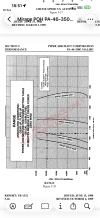
That specific range math is very fascinating. But then again only applies to very low power settings. Where you are trying to get maximum range, at the expense of airspeed which is often not practical. Here are the data on the PA46 Mirage, which do support your math. The max range power settings don’t have much variation in range by altitude. But the faster you go, the more range you get by going higher. Interesting though.IMG_3653.png
 
Wow, this thread is giving me horrid memories of sitting in aero classes. I’d suggest considering a more practical pilot perspective of original posted question. In simple terms max altitude is a function of thrust and lift, often in pilot speak, engine and wing limit. When Air density decreases (regardless if due to temp or altitude or humidity or combo thereof) there’s less fuel (air and gasoline) aka potential energy, for combustion…. Less air for wing to accelerate over top and impact lower side for less lift; and less air for prop to do same as wing (prop blades are just a vertical wing making its own relative wing). So you lose performance on 3 basic fundamentals.

THE MAX ALTITUDE is the most limiting of thrust or wing (which ever occurs first as you climb)….some planes will be wing limited others thrust limited.

There’s some other coefficients such as certification basis requirements how max altitudes are defined as mentioned earlier posts, but also something called a Buffett margin for larger aircraft cert basis or operator imposed limits. Essentially, as you climb the slow speed 1g stall speed increases, and high speed stall decreases…. So your safe speed envelope decreases with altitude, often referred to as coffin corner at higher altitudes where you can be within +/- 5 kts from a stall.

Remember that loading the wing increases stall speed. This loading can be by control surface movement or by turbulence…. So a published max altitude may be lower than the actual 1g max altitude the plane can maintain or be able to climb at a minimum rate…. An example is 1.3g max altitude will allow a 30% margin so that max altitude will allow “thick” enough air to sustain increased g load without getting a stall Buffett. This is also referred to as maneuvering speed margin to provide safe speed for wing loading during maneuvering.

There’s some other elements to this, but insignificant here. But I would argue a pilot really only needs to know that max altitudes are based on wing or thrust limits and how max altitudes are defined for their cert category, and difference in performance tables. Example would be flying in turbulence and AFM states you should use a 1.5g buffet margin max altitude for moderate turbulence, so you’d have a margin to sustain wing loading without stalling. This altitude may be 4k feet below the 1.0g stall buffet speed.
 
In the piston prop, maximum range does not change with altitude. Only the time and speed at which you achieve it do. In this, note max range is an AOA not an IAS, your IAS will reduce as you burn fuel. Once you’re trimmed for the max R AOA, you’ll need to slowly reduce power as you burn fuel losing weight so as to stay level and maintain maximum range, otherwise you’ll creep up in a slight climb.
OK, so you're talking about theoretical maximum range. If you follow the quotes back to the start of this part of the conversation, you'll see that we were talking about whether or not a piston aircraft can get RVSM approved. The answer is that they can, but they don't due to practical considerations.

Sure, fine, at Max-R AOA the difference in range with altitude is negligible, but we were in the middle of a conversation about the practical, not the theoretical. Nobody gets in an airplane and goes somewhere at max range AOA unless they're trying to set a record or go over a ridiculous amount of water. Practically speaking, most people run their engines in the 55-75% range in cruise, and when doing so, higher altitude (up to that roughly-half-in-cruise) does in fact increase range because you are going faster at the same power setting.

TAS increases with altitude but so too does power required hence fuel burn rate.
No. Power is the same (65% or whatever cruise setting you want). TAS increases because there is the same amount of power and roughly the same IAS, but less drag in the thinner air and higher TAS relative to IAS.

Look at this Catherine Cavagnaro piece. While she says she prioritizes efficiency, that’s not true, she’s prioritizing speed first efficiency second.
AKA, efficient use of *time*. Hey, I'm a Mooney guy and I love efficiency, but while maximizing fuel efficiency can be done, it comes at the expense of time. In the real world, most people want a combination of fuel efficient and time efficient, or they'd be driving a Prius instead of an airplane.
 
I linked to it and yea, way over the top for a low time pilot vy question….. I somehow felt compelled to add my 2 cents there, as well. I appreciate this is a forum for all to opine and have read some great posts and learned a few things new and interesting , but sometimes topics seem to go way off centerline and into the ditch….especially when student pilots ask questions in the training section looking for clear answers or info.
 
I linked to it and yea, way over the top for a low time pilot vy question….. I somehow felt compelled to add my 2 cents there, as well. I appreciate this is a forum for all to opine and have read some great posts and learned a few things new and interesting , but sometimes topics seem to go way off centerline and into the ditch….especially when student pilots ask questions in the training section looking for clear answers or info.
And also these threads take wider audiences of all levels; original posters aren’t owners. Though getting to energy management and AOA as the way isn’t complicated. Such makes flying so much more simple.
 
Back
Top