Weight and balance isn’t that damn hard!

Every major EFB out there has a W&B feature. Even if for some reason you forgot how to do it from your student pilot days, there’s tools to do it for you. No excuses.
Garbage in, garbage out.
 
Every major EFB out there has a W&B feature. Even if for some reason you forgot how to do it from your student pilot days, there’s tools to do it for you. No excuses.
This. GP has positions for every occupant, baggage, and fuel. Then it displays empty, ramp, taxi, take-off CG, landing, and zero fuel CGs, with options to display in a standard CG diagram, moment envelope, or station chart. Editable in table form or graphically.

I mean, it doesn't get any easier than that!

Garbage in, garbage out.
The same can be said for manual calculations. At least with the automatic stuff, the only likely failure point is the initial value entries. I think we've all screwed up the arithmetic a few times in the younger days of our aviation careers!
 
Garbage in, garbage out.
Well if you can’t manage to input weights into the tool, then doing it manually or using a spreadsheet is probably a bridge too far— it ain’t rocket science and I have no sympathy for anyone who is certificated and can’t perform basic flight planning functions..
 
Well, I don’t have first hand knowledge about the w&b portion of those programs. Is it universal or are there a bunch of templates for the various aircraft? If universal, the correct numbers must be inputted, if specific, the correct aircraft must be selected.

Either way, there are still potential ways of screwing it up.
 
GP has templates and I assume FF does as well. You still have to configure for a specific airframe but that’s pretty simple. Of course there is potential to goon it up but I argue that the more stubby pencil you skew towards that potential increases. The nice thing about EFBs are they show you graphically (as well as numerically) your weights and CG and flag any out of envelope conditions. Plus you can quickly change weights and locations and instantly see the impacts. I’ve load planned everything from Cessna 150s to C130/C141/C17/C5s manually. Today’s software makes it ridiculously simple.
 
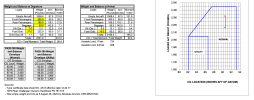
Here's my spreadsheet version. Yellow highlighted cells are inputs. Fixed data is from the TCDS and the last W&B done on the aircraft. Vertical line with red dots is a plot based on the inputs. Built this before I realized I could do it in GP.

Screenshot 2025-12-22 at 7.23.23 PM.png
 
There's gotta be a trigger for this rant. Spit it out!

Many eons ago, during my PP oral exam, the examiner took issue with how I computed weight and balance. The POH used a chart to calculate moments, with separate lines corresponding to each station.

Instead, I used the conventional approach: calculating moments by multiplying the weight at each station by its arm. The examiner said my method was incorrect. I knew that arguing with an examiner is never a good idea, so I apologized and redid the calculation using the chart - and arrived at the same answer. Everything went fine after that.

So yea, W&B is simple, but some people choose to make it complicated - that includes DPE's as well.
 

Attachments

  • W&B.png
    W&B.png
    115.7 KB · Views: 15
A few inches aft CG for most RC models would be totally unflyable - maybe an inch?
(In my training experience, introducing a full-scale pilot to RC flying is much more difficult than introducing a non-pilot. The full-scale guys apparently think they need to be moving the controls around constantly, for some reason.)
Only full sized guy I personally knew that learned RC later had no trouble with it. He used to fly for some 3 letter agency in some mountainous country far away from here, before we were officially really over there.

The problem I most heard from other instructors wasn't about control movement, it was that some had a lack of ability to orient themselves when the plane was headed toward them.
 
Well, I don’t have first hand knowledge about the w&b portion of those programs. Is it universal or are there a bunch of templates for the various aircraft?
In iFly, there were some templated aircraft, but you still had to QC.

In Garmin Pilot, there’s a much bigger library to import from. QC still needed.
bbd2db8049bb9ac11edd08839f294525.jpg


Once the template is imported and QC’d, you can enter via line item.
5e2e95999987da495072fe445e0be45d.jpg


Or graphically
06f82c28aae109746291722643c2b7f5.jpg

43bd480c8a58c9a44c5230101f2b3b0b.jpg

10b02c4412d4fa7e39a6dfe06c8a0e9f.jpg


So, there’s room for error, but absent WOW devices, no matter which way you do W&B, it’s an educated guess/estimate.

But failing to even compute W&B is inexcusable although many don’t do it.
 
All of the planes I've owned, it's pretty much impossible to load them out of range, unless I stacked gold bullion in the aft baggage compartment. Since I can't afford gold bullion anyway, I did a W&B once when I bought each planes wit four scenarios (most forward, most aft, heaviest, and lightest) just to have it on paper, tucked it behind the registration, and forgot about it.

But I agree that it should be trivially easy... it's just high school math, after all. For that matter, doing W&B calculations in PP ground school made the engineering statics class the following year pretty easy, too.
 
All of the planes I've owned, it's pretty much impossible to load them out of range, unless I stacked gold bullion in the aft baggage compartment. Since I can't afford gold bullion anyway, I did a W&B once when I bought each planes wit four scenarios (most forward, most aft, heaviest, and lightest) just to have it on paper, tucked it behind the registration, and forgot about it.
This particular airplane I’ve managed to fly an inch out of forward CG limit. Some mechanic did bad math about 3 supercededs before, and we had an edge loading case.

Fortunately we were able to recognize the problem (couldn’t arrest sink on landing), locate the source of the error (removing .1 lbs doesn’t move the cg 1.5 inches), and get it corrected.

Since then I’ve paged through the superceded empty weight/cg pages when I get in a new-to-me airplane. Turns out mechanics aren’t any better than pilots at weight and balance.
 
None of this teaches them how to calculate CG per the OP. It's one thing to know an aft CG is bad, it's another to be able to determine where your CG actually is. Knowing both is a requirement for even private pilot candidates.


A spreadsheet for a single W&B calculation is overkill, but works great for repetitive calcs and can quickly be set up to look like Form F's or whatever weight and balance format you like. Matlab is an awesome tool but is waaaaay overkill for this simple calc. Might as well "fire up the Cray" to sum a few moments and divide by weight.

Nauga,
bearing arms and weights
Cray Cray! One of my fav computers.
 
GP has templates and I assume FF does as well. You still have to configure for a specific airframe but that’s pretty simple. Of course there is potential to goon it up but I argue that the more stubby pencil you skew towards that potential increases. The nice thing about EFBs are they show you graphically (as well as numerically) your weights and CG and flag any out of envelope conditions. Plus you can quickly change weights and locations and instantly see the impacts. I’ve load planned everything from Cessna 150s to C130/C141/C17/C5s manually. Today’s software makes it ridiculously simple.
Any time the W&B changes on the Cherokee, I update the 4 versions I have on FF. Each starts with the TCDS numbers.
 
Here's my spreadsheet version. Yellow highlighted cells are inputs. Fixed data is from the TCDS and the last W&B done on the aircraft. Vertical line with red dots is a plot based on the inputs. Built this before I realized I could do it in GP.

View attachment 148350
That’s the one I used to use too, thanks!
 
All of the planes I've owned, it's pretty much impossible to load them out of range, unless I stacked gold bullion in the aft baggage compartment. Since I can't afford gold bullion anyway, I did a W&B once when I bought each planes wit four scenarios (most forward, most aft, heaviest, and lightest) just to have it on paper, tucked it behind the registration, and forgot about it.
The saying with 210's (like a Cherokee 6) is that if it fits, it flies. I've always considered this a bit cavalier but in my 210N, with a near 1600lb UL, the statement that Dana makes is darn near true. I can get it out to the very edge of the forward envelope if I have a heavy passenger up front, middle row seats removed, full fuel and nothing in the rear. I have had the sucker packed to the gills with two heavy passengers, filled with heavy rifle match gear, full fuel and had it at the MGLW...and it was in the middle 1/3 of the envelope...crazy. HOWEVER, I always perform a W&B before any flight as a matter of having a routine...like a weather briefing. If I have an accident, I don't want to give the investigators fodder for questioning ADM.

Oh...and I perform the W&B on ForeFlight. The last paper calculation was done in PP ground school.

 
one of my more spectacular private pilot oral exam failures...

problem one was he used the empty moment/1000 as the empty CG location. This resulted an extremely forward CG problem and on paper we were limited to only flying with half tanks of fuel. No amount of questioning how he and his instructor had regularly and successfully flown this very airplane with full tanks would result in light bulbs illuminating.

second he took the cruise speed from the POH in MPH and input it into Foreflight in Knots. The combo of these two things resulted him in planning a flight that would've resulted in fuel exhaustion about 20 miles before the planned fuel stop.
 
problem one was he used the empty moment/1000 as the empty CG location. This resulted an extremely forward CG problem and on paper we were limited to only flying with half tanks of fuel. No amount of questioning how he and his instructor had regularly and successfully flown this very airplane with full tanks would result in light bulbs illuminating.
At least his calculated CG was in the envelope, or at least in the airplane. I’ve seen a W&B come out in the airplane on the ramp behind ours. He didn’t even realize there was a problem.
 
The saying with 210's (like a Cherokee 6) is that if it fits, it flies. I've always considered this a bit cavalier but in my 210N, with a near 1600lb UL, the statement that Dana makes is darn near true. I can get it out to the very edge of the forward envelope if I have a heavy passenger up front, middle row seats removed, full fuel and nothing in the rear. I have had the sucker packed to the gills with two heavy passengers, filled with heavy rifle match gear, full fuel and had it at the MGLW...and it was in the middle 1/3 of the envelope...crazy. HOWEVER, I always perform a W&B before any flight as a matter of having a routine...like a weather briefing. If I have an accident, I don't want to give the investigators fodder for questioning ADM.

Oh...and I perform the W&B on ForeFlight. The last paper calculation was done in PP ground school.

Almost like Cessna designed it that way.
 
How many pilots actually compute W&B before flight?
 
Only slightly more seriously, us gray hairs grew up loading one wheel wheelbarrows… this stuff was intuitive. Not so much anymore, it’s just academic, although it sounds like you couldn’t coax out academic… but academic is WAY EASIER with intuition.
we also had quite few hours on Teeter Totters, or equivalent Board on a log or in my case a parked 2 wheel Hay wagon I was heavy enough to use as a Teeter Totter.
 
How many pilots actually compute W&B before flight?
I've done it for every new type I've flown. From there I know what the limits are, and I either avoid exceeding those or check if I get close.
 
I teach both mechanics and student pilots about W/B. The main challenges are:
~ Mental math - being able to do simple calculations in one’s head.
~ does the math make sense? Draw a simple profile of the plane, and a simple 4 column table. Can’t just plug in numbers- they need to make sense.
~ W/B is not just math problems. There are real consequences for improper loading. Students need to understand that and make the math meaningful
 
Only full sized guy I personally knew that learned RC later had no trouble with it. He used to fly for some 3 letter agency in some mountainous country far away from here, before we were officially really over there.

The problem I most heard from other instructors wasn't about control movement, it was that some had a lack of ability to orient themselves when the plane was headed toward them.

Put your back toward the plane, and look over your shoulder.
 
Put your back toward the plane, and look over your shoulder.
:) I kinda meant mentally, but that might work for some! I remember the typical RC guy being about the age of the typical private pilot, though, so "turning your head around to look over your shoulder" might be beyond some folks capabilities...
 
I learned that when rc aircraft is coming toward you, that for level flight you need to. Use the controller stick to prop up the low wing. Left wing low you need left stick. But it's been 30 years or so.
 
At the risk of sounding like an old fart (ok I resemble that characterization) you all are assuming that young adults can indeed perform 5th grade math. The innumeracy rate is appalling and it has only gotten worse in the last decade. I gave the 20-something receptionist at the doctor’s office $70 in cash (a 50, 10, and 2 5s) and she just kept shuffling the bills in her hand- it was clear that she had no clue how much money I gave her. Yes I know that’s anecdotal but I have dozens of other examples. To make matters worse, @TCABM gave us this really cool graphic where you can type in a bunch of data - but did you notice that it asks for how many gallons of oil? Ummm in all small aircraft I’ve flown, oil is measured in quarts. Find me one 20 something that knows how many quarts are in a gallon, and you’ll find the one person who can use that fancy tool.

/rant

On the other hand, I’m a student pilot, and all of my instructors are very young (at least to me) - one is trying and almost succeeding in growing his first mustache - and they are all intelligent and dedicated, so I have some hope.
 
but did you notice that it asks for how many gallons of oil? Ummm in all small aircraft I’ve flown, oil is measured in quarts. Find me one 20 something that knows how many quarts are in a gallon, and you’ll find the one person who can use that fancy tool
Throw in pecks, hogsheads, rods, chains, furlongs, bushels…acres. Don’t even get started in ranges and meridian lines and 1/4 of quarters of quarters and parcels in sections in townships…. Um what? It’s street address is… (those that know what I’m talking about will know).
 
you all are assuming that young adults can indeed perform 5th grade math.
I’m assuming that if he couldn’t do 5th grade math, that he would have paid more attention and maybe asked some relevant questions the previous week when it was covered in ground school.
 
I gave the 20-something receptionist at the doctor’s office $70 in cash (a 50, 10, and 2 5s) and she just kept shuffling the bills in her hand- it was clear that she had no clue how much money I gave her.
Or possibly she was struggling with how to tell you that handing someone rectangles of grubby green linen-paper in a physician's office isn't how business is usually conducted, and that you should just use a contactless electronic payment like everyone else from this century. ;)
 
A few inches aft CG for most RC models would be totally unflyable - maybe an inch?
(In my training experience, introducing a full-scale pilot to RC flying is much more difficult than introducing a non-pilot. The full-scale guys apparently think they need to be moving the controls around constantly, for some reason.)
When I was learning to fly RC, back when one had to build anything they planned to fly, I remember my mentor saying ‘A plane with the CG too far forward flies poorly. A plane with the CG too far back flies once.’
 
W & B is a trivial moment balance equation(s). Algebra 001.

Easy to make an excel spreadsheet that makes the loading graph and colors the boxes, though for most GA uses, a few known seating and baggage combos provides reasonable solution scenarios.

Yeah flying is technical and you do need to know a tiny bit of math.
 
Back
Top