USAF IP killed at Sheppard AFB

My son's a T6 IP...happens to be visiting home on leave this week.

I asked him (when momma bear wasn't around, and hopefully she doesn't come across the news report) if he had heard about it yesterday, of course he had. There were issues with the explosive charges that grounded much of the fleet just two years ago, so we'll have to wait and see on this. Just asked him if he'd heard anything further through the grapevine, negative. As the pin needs to be removed prior to being able to pull the ejection handle, and there's certainly no reason an experienced T6 pilot would do that on the ground- seems probable to me that this was some sort of malfunction as a zero-zero ejection is typically survivable if it is intentionally initiated and the pilot is properly positioned. Hopefully the investigators will determine the cause in very short order.

Prayers for the family and loved ones of Captain John Robertson, may he rest in peace.
 
Last edited:
Sad event RIP condolences to the family
 
This is the reason I donate monthly to T2T.org…Prayers to the family and hope they get this sorted out.
 
At least there is an answer…military stuff can kill you so fast…and anyone who has worn the uniform probably has an experience that should not have happened, that ended someone’s life or severely disabled a military member…I have more then a few…I hope this brings closure and steps to prevent future deaths. Donate to your favorite Org that takes care of families of service members that pay the price.
 
At least there is an answer…military stuff can kill you so fast…and anyone who has worn the uniform probably has an experience that should not have happened, that ended someone’s life or severely disabled a military member…I have more then a few…I hope this brings closure and steps to prevent future deaths. Donate to your favorite Org that takes care of families of service members that pay the price.
Yeah out of 38 in my flight school class, three are dead and a forth confined to a wheel chair (TBI blade strike). Then several others that I either knew in my unit or taught at Rucker.
 
I learned to fly at the Sheppard AFB Aero Club in the early 1980s. The club was located on the transient ramp in front of the Base Ops building. This was the ramp on which the transient Air Force aircraft would park.

Around 1982, a similar accident happened with a transient F4 on that ramp. I never heard why the ejection seat activated.
 
Just out of morbid curiosity, I wonder if it would be possible to determine number of lives saved versus those killed by ejection seats. Not trying to argue against them, just curious.

I know there is a similar conversation going on about aircraft hangar foam systems, dollars saved versus dollars lost due to inadvertent activations.
 
Just out of morbid curiosity, I wonder if it would be possible to determine number of lives saved versus those killed by ejection seats. Not trying to argue against them, just curious.
You'll have to define "saved...by ejections seats" and "killed by ejection seats." Does a successful ejection count as a save when the crew might have been able to land? Does a delayed ejection, ejection out of the envelope, or other procedural issue count as a kill? Does an obvious seat failure when the staying with the airplane would not have been survivable count as a kill? There are some statistics on survivability (regardless of necessity) here: https://www.navsea.navy.mil/Portals...tations/2-Parkin-USAF-Ejection-Statistics.pdf but they don't include things like the thread subject accident or the "famous" airshow S-3 that has been discussed here and elsewhere. In this presentation the aircraft with the *worst* survival rate is the U-2, 50% based on 2 accidents, and the overall survival rate is 92% in 72 mishaps. This report also does not present or include the number of fatalities in accidents involving ejection-seat airplanes where ejection was not attempted.

Anecdotally I can name handfuls of friends/co-workers/1st or 2nd-order acquaintances that have successfully ejected from a stricken airplane and survived, maybe a half-handful that did not survive due to delayed or OOE initiation or procedural errors, two or three that died or were injured as a result of seat problems they had no control over. I can only think of two or three ground incidents of the type that started this thread. Based on personal knowledge and endless system safety and NATOPS reviews I'd say the benefit of the seats far outweighs the risks.

Nauga,
who would like to remain seated

 
Just out of morbid curiosity, I wonder if it would be possible to determine number of lives saved versus those killed by ejection seats. Not trying to argue against them, just curious.
In general far more saved by ejection seats than lost by ejection seats. That being said, all ejection seats have parameters they work in. The GRU-7EA that I sat in for 2200+ hours was a zero-zero-seat but that was with no tailwind and with the aircraft level. It still saved a lot of folks out of parameter but those were bonuses.

What is hard is the folks that never pulled or waited too late. Far more have ridden a jet in without pulling the handle than have been saved. Every simulator check ride I did resulted in ejecting at some point. Understanding when it's not savable and getting out is an important metric to understand.
 
You'll have to define "saved...by ejections seats" and "killed by ejection seats." Does a successful ejection count as a save when the crew might have been able to land? Does a delayed ejection, ejection out of the envelope, or other procedural issue count as a kill? Does an obvious seat failure when the staying with the airplane would not have been unsurvivable count as a kill? There are some statistics on survivability (regardless of necessity) here: https://www.navsea.navy.mil/Portals...tations/2-Parkin-USAF-Ejection-Statistics.pdf but they don't include things like the thread subject accident or the "famous" airshow S-3 that has been discussed here and elsewhere. In this presentation the aircraft with the *worst* survival rate is the U-2, 50% based on 2 accidents, and the overall survival rate is 92% in 72 mishaps. This report also does not present or include the number of fatalities in accidents involving ejection-seat airplanes where ejection was not attempted.

Anecdotally I can name handfuls of friends/co-workers/1st or 2nd-order acquaintances that have successfully ejected from a stricken airplane and survived, maybe a half-handful that did not survive due to delayed or OOE initiation or procedural errors, two or three that died or were injured as a result of seat problems they had no control over. I can only think of two or three ground incidents of the type that started this thread. Based on personal knowledge and endless system safety and NATOPS reviews I'd say the benefit of the seats far outweighs the risks.

Nauga,
who would like to remain seated

In general far more saved by ejection seats than lost by ejection seats. That being said, all ejection seats have parameters they work in. The GRU-7EA that I sat in for 2200+ hours was a zero-zero-seat but that was with no tailwind and with the aircraft level. It still saved a lot of folks out of parameter but those were bonuses.

What is hard is the folks that never pulled or waited too late. Far more have ridden a jet in without pulling the handle than have been saved. Every simulator check ride I did resulted in ejecting at some point. Understanding when it's not savable and getting out is an important metric to understand.

Great responses both, and I appreciate the insight.

Nauga, you are right, it isn't an easy question to quantify, the statistics can be skewed by a lot of attributes. I guess I was thinking of a recent thread about the S-3 airshow accident, then this, and just got me thinking is the juice worth the squeeze. Probably safe to say yes it is. Honestly wouldn't surprise me if the DoD beancounters spent a million dollars researching this to justify the expense of ejection seats.
 
WTF? Why was he unstrapping while still taxiing?
 
Tons of people do it (unstrap in the taxi) every day. It's not right; this young man just happened to roll snake eyes. To be clear, the exceptional aspect of his in-taxi unstrapping that nobody else does on the regular, is unbuckling of any fittings of the harness proper (chest and groin D-rings). Most folks [who choose to unplug, they shouldn't be doing it] merely unplug from the seat. Nobody I know undoes their harness fittings until standing up from the physical seat. The potential for snags in these cramped sharp-cornered cockpits is very real. These accident, freak occurrence as it may, is tragic proof of that risk, even though there's merely circumstantial evidence that the chest ring is what punched him out. It's a good guess given the forensics.

Folks have punched themselves out from the T-6 in the past while on the ground. The ones who remained clipped to the seat were able to survive, as the seat is zero zero. The ones who punched under hard canopy of course, didn't make it, clipped to the seat or not.

I personally don't unplug from the seat at all until the aircraft has been parked, nor do I encourage/allow my student to do either. Granted that's placebo in the 38, as you cannot successfully punch with the canopy lid open anyways. But it's still a safer and conservative habit pattern to have. One that I ironically carry over from my days instructing in the T-6.

How do we honor his memory? In the beginning the rumor was that he died ejecting under canopy. Turns out he merely fell through the canopy on his way down. But in the interim, training bases enacted a foot stomp directive to not pull pins under canopy (a practice otherwise legal in the 38, due to addtional safe mechanisms the T-6 version of the seat lacks by contrast). So his death impacted our operations, and ever since his accident I now wait to clear the roof before pulling pins. May his death not be in vain in the memory of those who continue to fly.

As to the safety questions of the seat, in the Martin Baker side of the house, every single inflight ejection in the new seat have been successful. The ones that weren't in recent history had to to with ejecting too late on the ground approaching an obstacle at speed, or physically inverted while scraping on the ground, latter merely a subset of "ejecting too late". I trust my life with that seat. I much prefer it to the old seat, even though people complain about the lack of rear cockpit visibility.

As to flying a T-38 without a hot seat. hahaahahahahahhahhahhahaha. You first.
 
The sun shades change the dynamic. Before those, we armed the seats AS SOON as the engine was started, and safed them IMMEDIATELY after shutdown. No movement without a hot seat.

This arming/safing them at the hold short doesn’t sit with me well…

Tools
Armed and ready
 
WTF? Why was he unstrapping while still taxiing?

Like Hindsight said, super normal. I also don't unfasten my harness or anything until I'm out of the jet, but all the connections to the seat are disconnected shortly after safing it up after leaving the runway.

@Tools I agree with your take on a carrier flight deck, when you are broken down or conversely chocked and chained. You're armed anytime you aren't chained down (some people safe up if in the immediate vicinity of the island, aka the 6 pack, etc). But at a land field, I actually got a SOD in the RAG for not safing my seat quickly enough after getting off the runway. Pretty much an automatic SOD (in the FRS/dual'd up environment) if you enter the parking line armed up. Maybe it is a cultural shift in the last 20 years, I dunno. I normally arm up on the taxiway after leaving the line, and safe up right after exiting the active. That's definitely standard in the fleet nowadays.
 
WTF? Why was he unstrapping while still taxiing?
We did it all the time in the Prowler but usually waited to safe and unstrap until we were doing the hot brake checks (ashore, never until chained at the ship) - I usually just unstrapped the upper fittings and did the lowers and leg restraints when we parked. G-suit and 02 mask stayed plugged in until shut-down.

It required positive comms with all 4 crew. - "Safe top and bottom unstrapping" starting with the pilot - No way to put pins in at that point as the front seat MB's had 13 pins and back seats had 12. They were pulled by the crew on preflight and reinserted by the Plane Captains/AME's on return unless on a cross-country. You safed the upper handle with a small tab that flipped up and a lever between your legs to safe the bottom handle.

We armed the seats when chains came off on the ship and as part of the takeoff checks while taxing ashore.

This process worked from 1971-2019 with never an issue.
 
At least there is an answer…military stuff can kill you so fast…and anyone who has worn the uniform probably has an experience that should not have happened, that ended someone’s life or severely disabled a military member…I have more then a few…I hope this brings closure and steps to prevent future deaths. Donate to your favorite Org that takes care of families of service members that pay the price.
The average populace doesn't know the risks our armed forces members face every day. Training accidents occur often, but there's also the everyday dangers from moving heavy equipment and maintaining the naval and air fleets.
 
Far more have ridden a jet in without pulling the handle than have been saved.
On the civilian side...
I was wandering through the NTSB data base some years ago, and found more than one case where someone in an aerobatic aircraft, like a Pitts, where they spun into the ground while wearing a 'chute. I have to believe that they thought they were doing the right thing to recover from the spin and got "locked in" to one course of action and didn't consider any other. (In a Pitts, if you go stick forward, you get in an accelerated spin and the rudder won't stop the rotation until you pull the stick back to convert back to a normal spin.)

It's easy to think you see a solution and get fixated on trying to make that square peg get into that round hole - I know I've done it (in less demanding situations) and I've seen my engineering students do it as well.

Overconfidence?
 
S-3 community briefed COTAC (NFO) as the primary ejector. It was assumed the pilot was gonna fight the thing into the water.
 
S-3 community briefed COTAC (NFO) as the primary ejector. It was assumed the pilot was gonna fight the thing into the water.
That's what we briefed in a controlled ejection. ECMO 1 pulled. Other-wise first to the handle pulled. I flew a couple times with VS-24 and while the Escapac was a fine seat the A-4 with most flights a 1.2 even after a couple hours in the Hoover it was pretty bad!
 
S-3 community briefed COTAC (NFO) as the primary ejector. It was assumed the pilot was gonna fight the thing into the water.
When I flew in the F-14 back seat a couple of times with VF-124, the pilot briefed "If needed, I will call "Eject, Eject, Eject". You will not hear the third Eject because I will be gone."
 
When I flew in the F-14 back seat a couple of times with VF-124, the pilot briefed "If needed, I will call "Eject, Eject, Eject". You will not hear the third Eject because I will be gone."
It's an old joke. The F-14 (and lots of other multi-place tactical airplanes) have command ejection capability(1). If he initiates, you would have left about a half-second before him, whether you wanted to or not. (PS: You really should want to at that point)

OTOH, the A-6 did not get command eject until late in service life.(2) More than one Intruder crash resulted in a single fatality when only one crewmember left the airplane.

(1) initiating ejection from one seat initiates sequential ejection for all seats. ETA: Generally selectable and could be set such that if your back seater was a beanbag it could be set so that aft initiation did not eject the pilot. Everyone's probably heard of a demo flight where the back seater went for help and the pilot stayed behind.

(2) So late that the joke was the last Intruder would get fitted with command ejection just prior to its ferry trip to the boneyard.

Nauga,
handling it
 
Last edited:
from "Flight of the Intruder"

The command will be "eject, eject, eject." Three times, you got it?

Yes, "eject, eject, eject." Do I say roger or...just do it or what?

You even say "huh," you'll be talking to yourself...'cause I'll be gone.
 
And we had to always brief that language barrier when flying with the brown shoes heading to TPS. We use bailout for command of exectution, they use eject. We use eject for labeling/reading the checklist, you can see how that could be a CRM boo boo.

Like many industrial settings in civil life, ejection seats are dangerous business. We just normalize it cuz it's our duty to go forward, and human nature makes us complacent. That said, we lose more people to suicide than training accidents, which is a DOD-wide problem to be clear.
 
They are just ejecting from their perspective of reality.
 
It seems that over 6,000 people have lived long enough after ejecting to ask Martin Baker for a tie.


A bit more.

Seems that it's 7789 lives saved to date by Martin Baker seats.

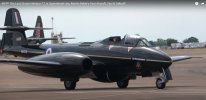
They probably still operate two Gloster Meteors for seat testing. G-JSMA (WA638) and G-JWMA (WL419). Notice the lack of a rear canopy. The Meteor saw operational service in WW2.
 

Attachments

  • Martin-Baker-Meteor.jpg
    Martin-Baker-Meteor.jpg
    147.8 KB · Views: 10
I was there for ejections 5997 through 6000. :p I was on deck waiting to hot-switch into our Prowler for Carrier Quals 31 Dec 1990 on Theodore Roosevelt off Bermuda prior to us heading at max speed to Desert Shield/Storm. The jet trapped, the arresting gear suffered an internal failure and they got normal pay-out and then it two-blocked and parted. They left the deck edge at about 50 KTS (normal cat shot was about 155 KTS).

It's not clear which front seater pulled first but the seats in the EA-6B fired in sequence (through the canopy) with left rear first and then in .4 second delays counterclockwise to avoid th seats hitting each other with the pilot getting a 1.2 second delay. The pilot (recently retired 2 star John "Oscar" Meir) recalls the nose of the jet hitting the water as his seat fired and next thing was the helo on top of him and the rescue swimmer jumping in.

Sair Dyce was in the left rear on his first arrested landing (How do you like Naval Air so far?) Tom Brumfield was in the right seat and said he felt the bang as the ballistic spreader gun fired opening the parachute and next thing seeing was how green the water was as his LPU inflated and popped him back to the surface.

Steve Schwing was in the right rear. He was the lightest guy in the crew and was still floating downwind in his chute behind the ship when everyone else was in the water. He had time to do all his IROK procedures and dropped his raft and splashed down. He'd lost his glasses but could see the ship and the helo and knew they were going for him so he stayed in the water instead of climbing in his raft as it was warm. About that time a gray fin went across a wave next to him. Into the raft quickly, sea die marker, radio, flares, smoke all used! The ship did an awesome job launching a motor whaleboat who came to get him (with an M-14 in hand for shark suppression). Alas, with his head barely above water and 5' seas it was one of the gray drop tanks that had ripped off the wing and was floating and had flipped over so the fin was up. He did take a little flack for that but life is about the stories.

The jet had less than 50 hours on it. We had picked it up from Grumman ourselves. My pilot and I were standing next to an E-2 by the island and the broken cable went 2' over our head and smashed the co-pilot's side window. That close to being decapitated. :oops:
 
Last edited:
Back
Top