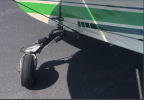
USAF ground looped a Skyraider II 10-5

I say the pilots are all over qualified on this airframe. Send them all off to crop dusting school first.
Yep, would also improve their turnaround time between passes. While they're at it maybe re commission a couple Stearmans to relearn some stick and rudder.
 
Didn't keep the stick back. Most of the best tailwheel pilots I know have groundlooped a time or two. Keep the stick back.
 
The pilots escaped safely!!!!

>these things have two pilots?
 
Everts got one of these and explored feasibility of using to take fuel to the villages in AK.

Apparently it’s a handful HEAVY. They don’t usually land heavy. The Air Force version probably normally lands fairly heavy, lots of “gear” on that plane. ISR, munitions, pods, etc.

I don’t know what tailwheel training they get, active duty guys are starting to get them first assignment. I know I’ve had at least one student get them. Gonna look into that.
 
I had a look at the training requirements for that operation - actually got asked to bid on it but decided it was above my capacity. Met some of them who were flying with Tac Aero at the time when they were at Llano taking a break from the Cubs there.

Nobody is touching those planes without a reasonable amount of training, so I'd rack that up to even OK tailwheel pilots can still get bit from time to time.
 
Last edited:
I say the pilots are all over qualified on this airframe. Send them all off to crop dusting school first.
The Air Force test pilot school arranges for students to fly unusual aircraft as part of their training. This has included EAA's B-17...multiengine prop taildragger. Some of them found it a handful....

Ron Wanttaja
 
Didn't keep the stick back. Most of the best tailwheel pilots I know have groundlooped a time or two. Keep the stick back.
tailwheel column in my logbook shows about 3800hrs of tailwheel, but about 1800 hrs of that is glider time, so 2000 hrs of airplane tailwheel time.
of the 2000 hrs I have 3 memorable groundloop events.

1st barely counts as a ground loop, I was landing as a gust front came through, was trying to beat the storm and lost. Taylorcraft and I did a nice 90 degree turn off the runway and stopped. Then had to have about 5 guys come out and walk it back to the tie down as there was no way I was going to taxi in the 30kt crosswind.

2nd was a Scout that upon landing the tailwheel shimmied and threw the steering spring off causing an uncommand right turn off the runway and back onto the taxiway going the opposite direction. Full left rudder and judicious use of left brake prevented any damage, beyond running over the taxi way light.

3rd was a Pacer. Pilot I was instructing touched down just enough sideways to initiate tailwheel shimmy. I asked him to raise the tail to stop the shimmy which he did. Then the airplane started to go left so he planted the tail hard on the runway which should not have been an issue but we believe either the shimmy or the putting the tail back down failed the vertical tailpost and cocked the tailwheel off to the side sending us into a ground loop to the right.
1791303933055.png

Brian
CFIIG/ASEL
 
The Air Force test pilot school arranges for students to fly unusual aircraft as part of their training. This has included EAA's B-17...multiengine prop taildragger. Some of them found it a handful....

Ron Wanttaja
My roommate went to the USAF test pilot school and got to fly a Hawker Hart biplane; I was quite jealous. Sadly, Eric lost his life in the crash of a Bombardier Challenger some years later.
 
The Air Force test pilot school arranges for students to fly unusual aircraft as part of their training. This has included EAA's B-17...multiengine prop taildragger. Some of them found it a handful....

Navy TPS uses Otters (or Otter) and Beavers with the occasional contract qualeval in thing like P-51, SNJ, Pitts, Extra...
Some* are more, er, 'dynamic' than others. The intent is to experience "sub-optimal" handling qualities, not get a civilian tailwheel endorsement or relevant operational training.

*both airplanes *and* students.

Nauga,
whose tail drags
 
Last edited:
The Air Force should bake 50 hours of Cub or Citabria time into the type transition for guys headed to this beast. Maybe finish with 10 hours in a T-6.
 
The Air Force should bake 50 hours of Cub or Citabria time into the type transition for guys headed to this beast. Maybe finish with 10 hours in a T-6.
The contracts were for a tiered approach, with minimum 10 hours in something like the Super Cub, moving up into a "medium tailwheel" followed by a minimum of 20 hours of "heavy tailwheel" transition before the AT. One of the things that was going to be an obstacle was that the last-tier IP would have to have a minimum of 500 hours of turbine tailwheel time. These were a selection of the requirements:

INSTRUCTOR QUALIFICATION REQUIREMENTS

Instructor pilots must have:
• Minimum 500 hours of dual instruction given in turbine tailwheel aircraft
Instructors must be qualified and experienced in training pilots in large tailwheel aircraft operations.

TRAINING CAPACITY REQUIREMENTS

The contractor must be capable of supporting:
• 2 students simultaneously
• 4 students per month
• 40 students per year
Training must be available throughout the entire period of performance.
I have regretted not trying a bit harder for the contract, but I would've had to go into massive debt or find a partner with deep pockets to make it happen and I've got a family reason to not move to Oklahoma.
I guarantee you it was a very lucrative contract, though.

Back to the topic of the OP, I'm sure someone is embarrassed about this, but maybe we'll also see that the whole "get back on the horse" deal comes back into the forefront with tailwheel "excursions" - it used to be less of a big deal when someone groundlooped and no one got hurt.
 
Last edited:
Everts got one of these and explored feasibility of using to take fuel to the villages in AK.

Apparently it’s a handful HEAVY. They don’t usually land heavy. The Air Force version probably normally lands fairly heavy, lots of “gear” on that plane. ISR, munitions, pods, etc.

I don’t know what tailwheel training they get, active duty guys are starting to get them first assignment. I know I’ve had at least one student get them. Gonna look into that.
They are not bad on a heavy landing. I’ve had to bring a couple back full because of dispersion system failures. Also did a couple jobs where I had to ferry a partial load to a far away place. Landed with a couple hundred gallons in the tank. Topped off water and fuel to get the field done and then recover back home.

Only thing different was carrying power into the flare and having a more standardized stable approach than necessary when empty. Stall speeds were a little higher when you have the equivalent of the airplane empty weight in the tank.
 
The Air Force should bake 50 hours of Cub or Citabria time into the type transition for guys headed to this beast. Maybe finish with 10 hours in a T-6.
Having recently got my tailwheel endorsement in a cub (and a Stearman), I believe the first 5-10hrs for any pilot, including Airforce, should be in a low and slow tailwheel without instruments. I Learned more, gained more confidence, and had more fun than any of my previous flying. (I now understand why J-3 cubs are so expensive lol).
 
Navy TPS uses Otters (or Otter) and Beavers with the occasional contract qualeval in thing like P-51, SNJ, Pitts, Extra...
Some* are more, er, 'dynamic' than others. The intent is to experience "sub-optimal" handling qualities, not get a civilian tailwheel endorsement or relevant operational training.

*both airplanes *and* students.

Nauga,
whose tail drags
USNTPS was also using the B-25 "Panchito" a few years ago as well. One afternoon as we were leaving the hangar, the wind was howling. I heard a round engine, and turned around to see their orange & white DHC Beaver taxiing out. They took off, climbed to about 1500-2000 AGL and proceeded to hover over the airfield! You never know what you're going to see at Trapnell Field.
 
They are not bad on a heavy landing. I’ve had to bring a couple back full because of dispersion system failures. Also did a couple jobs where I had to ferry a partial load to a far away place. Landed with a couple hundred gallons in the tank. Topped off water and fuel to get the field done and then recover back home.

Only thing different was carrying power into the flare and having a more standardized stable approach than necessary when empty. Stall speeds were a little higher when you have the equivalent of the airplane empty weight in the tank.

Taildraggers in general are not bad on landings, once you get the hang of it.

But when you are still learning ... different story.

If you were sloppy and let some yaw develop during rollout in a crosswind, I can see the extra weight increasing the lateral rotational inertia and making it harder to correct. Probably would have to be more aggressive on the brakes. But that is just a guess, since I do not have your experience.
 
Last edited:
Still better than the 19 million for the extras on the combat tractor

I've seen one of these up close and crawled around the cockpit. The weapons control station in the back is very complex. Given the capabilities bolted on and the low volume of production, the price does not surprise me. Dual Wescam balls, self designate laser and GPS, link 16, etc.
 
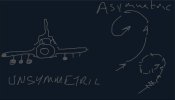
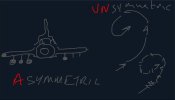
Further, is there possibility that they’re carrying unsymmetric loads?

(Unsymmetric meaning more stuff on one side distinctly different than asymmetric meaning rolling pull)
 
Might want to look up the definition of Asymmetric - hint your drawing on the left shows something that is asymmetric.
 
Might want to look up the definition of Asymmetric - hint your drawing on the left shows something that is asymmetric.

Nope. They needed to make a distinction and asymmetric was already taken via asymmetric g limits aka rolling pulls. Hence unsymmetric was coined. Especially as both can be used as adjective to load. But two different contexts of what load means.
 
Nope. They needed to make a distinction and asymmetric was already taken via asymmetric g limits aka rolling pulls. Hence unsymmetric was coined. Especially as both can be used as adjective to load. But two different contexts of what load means.
Yet another threadjack aside, who is "they" and when was this change adopted? There's been plenty of work done and documentation available on e.g. asymmetric stores carriage and flying qualities on asymmetric (sic) airplanes and configurations.

Nauga,
who didn't get the memo.
 
The first time I dropped a 2k lb bomb from the wing station of a 45k lb jet (s-3), I prepared for mayhem…

Turns out I could barely feel it leave the jet.

That being said, I’ve also flown 500k lb jets with a 1.5k lb assym fuel limit…. Turns out it’s more about stressing things than flying.

Also that being said I’ve never known a/c configurations to be knowingly OTHER THAN as balanced as possible, can’t imagine they allow it too far out of some sort of reasonable limits, and those limits are likely stress related more than controllability related.

I’ve never noticed my 120 being tougher solo than with a pax.

I agree with the real cause of this being “just one of those things”. Surely it’s attributable to something more useful than that, but not really worth THAT kind of scrutiny. It’s documented, if those documentation numbers show a real problem, more will be made of it. Ground loops while possibly expensive, aren’t super dangerous.
 
Nope. They needed to make a distinction and asymmetric was already taken via asymmetric g limits aka rolling pulls. Hence unsymmetric was coined. Especially as both can be used as adjective to load. But two different contexts of what load means.
They who wrote the Merriam-Webster dictionary define "unsymmetrical" as "asymmetric." If you're referring to some specialized technical definition, do you have a source that explains this meaning?
 
The first time I dropped a 2k lb bomb from the wing station of a 45k lb jet (s-3), I prepared for mayhem…

Turns out I could barely feel it leave the jet.
Did you every come back to the boat with one on the other side afterwards? Most of the emphasis (IME) on handling/testing with asymmetric stores was/is concerned with lower speeds and/or higher AOA.

Also that being said I’ve never known a/c configurations to be knowingly OTHER THAN as balanced as possible, can’t imagine they allow it too far out of some sort of reasonable limits, and those limits are likely stress related more than controllability related.
Hung stores and bringback are big drivers in opening up the lateral asymmetry envelope, as are oddball loadings required for operational considerations (like wider sensor FOV). You don't always get a vote, unless you want to send the racks and launchers with them :D

Nauga,
who remembers goofy gas
 
Last edited:
Nope, never did that, and honestly don’t remember there being a big restrictions against it, gotta check, curious now. Makes a lot of sense would be a MUCH bigger deal then.

Seems we came back with one external tank full of gas but not the other… would have the refueling store full for a hawk then recover immediately after his trap (wouldn’t be time to get it out).
 
@nauga @Lindberg

It’s been a while. Guess I got it backwards.

IMG_1709.jpeg

Better? Dug out an old NATOPS, unsymmetric g-limits (rolling pull), asymmetric stores

And, no, most definitely not a thread jack. An asymmetric load would absolutely help ground loop an air tractor. Especially with weight and if you hit the brakes, maybe not as much for the drag.
 
Nope, never did that, and honestly don’t remember there being a big restrictions against it, gotta check, curious now. Makes a lot of sense would be a MUCH bigger deal then.
It's highly model-dependent, as you might expect. ;)

Nauga,
avoiding any jokes about being hung
 
The weapons control station in the back is very complex. Dual Wescam balls, self designate laser and GPS, link 16, etc.
Gubmint in a nutshell. Millions spent for a marginal improvement. Coulda just left the light bar on the nose to get in alignment, and a grease pencil x on the windscreen. But, if it ain't broke they gotta try. :biggrin:
 
Dug out an old NATOPS, unsymmetric g-limits (rolling pull)...
I can probably guess the airplane, and later variants use the terminology "Acceleration limits - rolling maneuvers."

I can only imagine the discussion at a NATOPS conference. :rolleyes:

Nauga,
wordsmithing
 
Back
Top