TBM-700 - Monroe, WI

NealRomeoGolf

Final Approach
Joined
Apr 12, 2016
Messages
5,640
Location
Illinois
Display Name
NRG
Two dead trying to land in fog and low overcast. Word was the pilot was new to the plane. If I have the time stamps correct, METAR was:

KEFT 242315Z AUTO 17003KT 1/4SM FG OVC003 07/07 A2992 RMK AO2 T00670067

Approach was to runway 12. It has an RNAV but only LNAV minimums, which are 1 mile vis and 300. It also would have been dark. The track I saw online looked like they tried to go missed but something went wrong. Not sure why you'd try that approach anyway, especially if the plane was new to you. I was supposed to fly yesterday and scrubbed. Not a good day to fly around here.

 
Seems to be a lot of TBM LOC on go arounds. Horsepower? Automation?
 
Seems to be a lot of TBM LOC on go arounds. Horsepower? Automation?
Or possibly a combination of both. I know a TBM owner-pilot who is upgrading his beautiful ride because he's scared himself on approaches, and now wants to swap up to a TBM with auto-land.
 
Not that I'll ever fly behind a kerosene burner, but I'll pose the question anyway. Do turboprops like the TBM, PC, etc. take longer to spool up when you add throttle? Piston guys are used to near instant power when the throttle is pushed in, is it the same for these small TP aircraft or is there a delay in getting the power?
 
Only a couple arrivals between me and when this happened 25 hours later. There's a reason for that. Weather turned. New plane. Overcast. Night. Break the chain.

Also, forgot the notam.... 12 papi out of service.
 
Last edited:
Seems to be a lot of TBM LOC on go arounds. Horsepower? Automation?
Both. Lots of power, but earlier models didn’t have autothrottle. Some accidents seem to be somatogravic disorientation due to all the power being applied on go-around, others due to the throttle being left at low power settings with other combinations of automation and configuration during approach and/or go-around, resulting in a stall/spin.
 
Monroe (EFT) was consistently the worst ceilings and vis in the area (except for a couple observations at Platteville, 30nm to the west) for several hours prior to the flight. Note that this is the same slow-progressing system that produced similar conditions potentially associated with the crash of an Arrow at Quincy, IL the night before.
 
... is there a delay in getting the power?
I did a very small amount of pt6 driving in a Caravan. I would say the power comes up very quick. Certainly quicker than you would need on a stable approach to go around.
 
I did a very small amount of pt6 driving in a Caravan. I would say the power comes up very quick. Certainly quicker than you would need on a stable approach to go around.
I am very embarrassed to say that I did not know that Caravans sported a turboprop.
 
First the arrow down in Quincy, then the TBM down nearby in Monroe. Not sure why people aren't taking the crappy conditions in our region more seriously (tho probably easier to say that as a VFR guy where this flying is a hard NO).
 
it's because they are GODS. That "syndrome" transcends all wallet sizes.
Add to the list the recent Aztec accident 40 nm East of Poulson, MT.
 
Last edited:
Not that I'll ever fly behind a kerosene burner, but I'll pose the question anyway. Do turboprops like the TBM, PC, etc. take longer to spool up when you add throttle? Piston guys are used to near instant power when the throttle is pushed in, is it the same for these small TP aircraft or is there a delay in getting the power?

My experience with a PT-6-135 and now the TPE-331 is that a PT-6 at flight idle will take a second or two to respond to throttle advance, but not enough lag to matter. The TPEs are instant response. I don't have any experience with the larger PT-6's that power the TBM, but assume they are similar.
 
Or possibly a combination of both. I know a TBM owner-pilot who is upgrading his beautiful ride because he's scared himself on approaches, and now wants to swap up to a TBM with auto-land.

The Homesafe? That’s not auto land, that’s an emergency. It also doesn’t pick your airport, picks an airport. It also may overstress airplane as it’s for use in an emergency only and squawks 7700 and cannot be changed.

In the M600 SLS it specifically says it cannot be tested.
 
First the arrow down in Quincy, then the TBM down nearby in Monroe. Not sure why people aren't taking the crappy conditions in our region more seriously (tho probably easier to say that as a VFR guy where this flying is a hard NO).
Just a hunch, but I think both incidents have something to do with the fact that it's Thanksgiving week. I'd bet there's a whole plethora of get-there-i-tis happening this week. Certainly seems that way on the Cape today judging by the immense traffic on 6 that is not typical for the winter months.
 
Just a hunch, but I think both incidents have something to do with the fact that it's Thanksgiving week. I'd bet there's a whole plethora of get-there-i-tis happening this week. Certainly seems that way on the Cape today judging by the immense traffic on 6 that is not typical for the winter months.

Yup, unfortunately now thru new years is killing season for GA :-(
 
Anecdotal but the TBM in the early days had a tendency to roll over on unsuspecting pilots on a go around. Lots of torque, p factor, etc that if you pour a bunch of power in all at once and you’re slow with not enough right rudder it will bite you good.

An accident in the northeast from 10-15 years ago rings a bell caused by exactly that.
 
The Homesafe? That’s not auto land, that’s an emergency. It also doesn’t pick your airport, picks an airport. It also may overstress airplane as it’s for use in an emergency only and squawks 7700 and cannot be changed.

In the M600 SLS it specifically says it cannot be tested.
Ah, so that's it. Makes sense now. Apparently his wife sometimes flys with him often and he's pushing 60's y.o. She must figure if he dies, she just pushes the button!
 
Ah, so that's it. Makes sense now. Apparently his wife sometimes flys with him often and he's pushing 60's y.o. She must figure if he dies, she just pushes the button!

That’ll work! Just shouldn’t be used if pilot can’t land, it’s not a ‘it’s below minimums and above skill’ button lol.
 
That’ll work! Just shouldn’t be used if pilot can’t land, it’s not a ‘it’s below minimums and above skill’ button lol.
Sounds like a great candidate for the AOPA Pinch Hitter course
 
My experience with a PT-6-135 and now the TPE-331 is that a PT-6 at flight idle will take a second or two to respond to throttle advance, but not enough lag to matter. The TPEs are instant response. I don't have any experience with the larger PT-6's that power the TBM, but assume they are similar.
I’m flying an M600. There is really no meaningful delay. Perhaps a bit more than a piston, but hardly noticeable.
 
New owner of a M600 SLS with auto throttle and I gotta tell ya, these planes let your skills deteriorate. I’m struggling with ALLOWING the automation. I want to fly it, not monitor it.
I started flying the M600 back in 2023. Yeah, the autothrottle can definitely spoil you. I also have the same concern about getting rusty having all that automation. It is a good safety feature though.

Also, pulling it back to idle with the 5 blade results in bleeding off speed SUPER quick.
 
Per a post I saw from the PIC's friend on Facebook, they were brand new to the airplane and upgrading from a 182. That's a hell of an upgrade... And not one that should be taken into below-minimums weather!

Seems to be a lot of TBM LOC on go arounds. Horsepower? Automation?
Both. Lots of power, but earlier models didn’t have autothrottle. Some accidents seem to be somatogravic disorientation due to all the power being applied on go-around, others due to the throttle being left at low power settings with other combinations of automation and configuration during approach and/or go-around, resulting in a stall/spin.
Agreed. The TBM has a LOT of get-up-and-go. Compared to the 182 it would seem like an extreme pitch-up, and if your head wasn't straight it'd seem like you were rolling over. In this case, the plane began turning left immediately upon the go-around which is NOT part of the missed approach. Could have had something to do with torque not being corrected for, or the pilot might have been looking at the throttle when powering up (You cannot push the lever all the way forward in TBMs before the 960) and experienced a somatogravic illusion that would have felt like he was in a right bank. After that, their path is pretty nuts, very much looking like extreme spatial d.

Or possibly a combination of both. I know a TBM owner-pilot who is upgrading his beautiful ride because he's scared himself on approaches, and now wants to swap up to a TBM with auto-land.
That's... Not how that works. That's an emergency only feature.

Ah, so that's it. Makes sense now. Apparently his wife sometimes flys with him often and he's pushing 60's y.o. She must figure if he dies, she just pushes the button!
That's how it works. Needs a trip to the shop before it'll fly again.

Not that I'll ever fly behind a kerosene burner, but I'll pose the question anyway. Do turboprops like the TBM, PC, etc. take longer to spool up when you add throttle? Piston guys are used to near instant power when the throttle is pushed in, is it the same for these small TP aircraft or is there a delay in getting the power?
My experience with a PT-6-135 and now the TPE-331 is that a PT-6 at flight idle will take a second or two to respond to throttle advance, but not enough lag to matter. The TPEs are instant response. I don't have any experience with the larger PT-6's that power the TBM, but assume they are similar.
They respond pretty quickly as long as you're not all the way at idle. We always had a minimum of 10% power inside the FAF because of that. 20% is a good number for flying final. In that range, power lags only maybe 1/2 second behind the power lever at worst.
 
1/4 mile fog in that type I’d be looking for airliner airport with lead in lights and all.

Same for that Arrow. Night landing on narrow runways set in the corn fields in fog. Nope
 
Per a post I saw from the PIC's friend on Facebook, they were brand new to the airplane and upgrading from a 182. That's a hell of an upgrade... And not one that should be taken into below-minimums weather!
Just found out via Facebook that one of the pilots was an acquaintance, more of a friend of a friend, but I'm friends with him on Facebook... But now I'm confused because he used to have a 310. I knew he sold it and I hadn't asked whether he replaced it, but I thought he had stopped flying (not sure why). He was more of a boat guy and I never saw him post another plane pic after he sold the 310 (in 2016!!), but others have now posted pics of their adventures with him in airplanes and it appears that he had a 421 for the last couple of years. Not sure if he had anything between, and what that might have been.

These guys were relatively young - 43 and barely 41 (died 2 days after his 41st birthday). Sad.

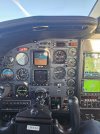
Here's a pic of the panel. To the right of what you see here was a second 750. His 421 had a G600, so this would have been a bit higher workload.

588241995_10106900056550358_2037379569996004412_n.jpg
 
Prelim is out.

Pilot was based at OSH but had family in Monroe, he told ATC that if they missed at Monroe they'd just head back to OSH, and ATC told them to fly runway heading and climb to 4,000 on the miss. Even on the plate, the initial part of the miss is a straight-ahead climb to 3000.

Everything appears to have been normal all the way through the approach... But I've gotta go with spatial disorientation on this one. Right at the miss, a left turn starts, and then corrects back to the right about 15 seconds later. If he was looking over to the right, either to set power or to unsuspend the GPS or something, the pitch up would have felt like a right turn, so correcting to the left would be the natural instinct. Then, he probably noticed the mistake, and there's a right turn.

The thing that is a bit weird, though, is that it almost looks like he was trying to circle to runway 20. Weather was 300 and 1/4, wind was 180 at 6 so it doesn't seem like he should have needed to, or been able to, but they got to where they were right across the street from the 20 threshold.

That's where the track really goes nuts. There appears to have been a near-aerobatic maneuver involving almost a 270-degree right turn and a near-vertical climb, all within a very small patch of ground. They went from facing SSE at 189 knots and 1100 feet to facing SW at 1600 feet and 129 knots in three seconds - That's 10,000 fpm climb. Six seconds later, they were facing east at 2700 feet and 45 knots (11,000 fpm climb), and appears to follow a ballistic trajectory eastbound from there, with the speed increasing by the time they peaked at 3000 feet, though the peak speed right before the crash was still only 83 knots.

The engine was developing power at the time of the crash.

Hopefully there's some usable data from the GTN 750s that they recovered to fill in the blanks in between the ADS-B hits.

The other thing, of course, was the decision to fly at all. KEFT had been below minimums for several hours before they took off... So why fly at all? :dunno: A 135 operation couldn't have done it, and the more I do the more I realize that some of the stuff in the air carrier regs is really smart... And I will never forget the following quote from @Fast n' Furious : "Rocks don't care which part of the regs you fly under."
 
Back
Top