Dredging up old thread here, but since I just bought a pressurised and de-iced Aerostar (although not a Superstar, just a mere 601P) and have now flown it about 30hrs I thought I'd add, just for posterity. I came from an old Commander without even IFR capabilities and/or an autopilot, so this has been a bit of a learning curve. The reasons I chose an Aerostar are:
Economy. I fly mainly long cross country flights and that's an area the Aerostar excels at. I did numerous calculations on fuel burn for various aircrafts and the Aerostar consistently came out down low of the legacy types. It also does that getting you there quicker. A diesel TwinStar or P2006T would be even cheaper in fuel, but they also cost about $400K more and are slower. Those two excluded, the Aerostar is hard to beat in pure MPG due to it's low drag profile and high flying capabilities. Reading directly from the POH I get 10.3gal/hr per side in fuel consumption at 2200rpm, at 25000ft doing 184 KTAS. This is ROP operation. At LOP, that could probably be even less. I don't know of many twins that can run 184 KTAS at 20gal/hr. That's almost what a Malibu would burn trying to keep up. I get 200kts on 25gals regularly if I want to go faster.
Simplicity. I knew I wanted pressurisation and semi-all weather capability. Flying high is key to long range economy. I looked at the pressurised Commanders, which would have been the most logical buy, but they all have annoying quirks and designs. The 680FP would have been the logical step up - and I could have had one for about the same money - but their gas guzzling geared engines and hydraulic pressurisation system are pretty much unsupported these days. The 685 is a huge beast and although it has bleed air pressurisation, it still suffers from the highly strung geared engines and is a rwy hogger (as the props are too small for its bulk). The last thing one wants in a Commander, as they're made for unimproved strips. Plus - do I really need to lug 9000 lbs of plane around when I fly by myself most of the time? Seems almost criminal from an environmental point of view. Although the Aerostar is a complex aircraft, crammed into a small place, the actual systems are pretty stock and can be serviced by most anyone. There are few quirks there. A good example is the elevator/rudder. They're all the same part and fully interchangeable.
Support. Aerostars are also well supported aircrafts, thanks to Aerostar Aircraft Inc in Idaho. They continually develop modifications and improvements for the aircraft. This means I can grow with the aircraft and make it adapt to my needs. In the future I would like to add many of the improvements available, like the aux tanks that will increase range to about 1500nm, winglets that will increase t/o performance by about 5% and reduce fuel burn by the same amount. Intercoolers that will improve hot and high performance, bigger brakes, various pressurisation improvements, bleed air heating, full de-ice etc. And if you add the 4-blade MT props, you even have reverse braking capabilities. I don't know of many piston powered aircraft that can do that. It ain't cheap, but if it floats your boat, you can do it.
Design. I like seeing the ground, and both the Commander and the Aerostar has the wing behind the cockpit window, giving a great view below. I love the eyebrow windows on the top, as they give me the opportunity to spot traffic above me, although they make the cockpit a sweat box at times.
Structural integrity. One of my biggest fears is structures breaking in the air. And that's one thing I have to worry less about in this machine. Aerostars were designed to be jets originally, so the structural integrity is second to none. The tail was stressed to 14G before it broke during certification. The main wing to well over 6G. And it has 3 main spars in it. Not only that, the surface skins on the wings are almost 3 times thicker than on normal spam cans. As far as I know there has only been one in-flight structural failure in an Aerostar recorded, so I feel much safer should I ever encounter really bad turbulence or (god forbid) a thunderstorm.
Those are the main reasons. There are some tradeoffs, though.
Tradeoff 1. They need more rwy than the Commanders. In fact at home airport, I could be between 700-900ft in altitude in a Vx climb with the old Commander as the rwy end slipped beneath the airplane. Forget that in an Aerostar. As they rotate, they have this mushy, shallow climb that takes some getting used to. That wing doesn't like to fly slow and it becomes an effort in getting rid of drag quickly to get to a speed where it likes to climb, which is around 117kts. In fact, this is the only aircraft I've flown where one gets rid of some flaps just after the gear comes up to transition the gap between redline and blue line. By the time the rwy end slips beneath me in the Aerostar, I'm barely at 4-500ft. After 117kts, the wing climbs great and you easily see up to 2000ft/min, but it's just that mushy transition period between rotation and 110-120kts. It's designed to go fast, not takeoff fast.
Tradeoff 2. I will miss going into smaller grass fields, camping etc and all that stuff I used to do with the Commander. It's still possible to go into a grass field, but it has to be long and it has to be smooth or else you might end up breaking stuff. The bush aspect is gone, if you wish. Although the gear on the Aerostar is actually pretty beefy.
Looks. Lastly, I don't think the Aerostar looks that good in normal paint schemes, to be honest. That
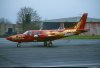
wasn't one of the reasons I wanted one. That bulby, pointy nose doesn't lend itself to horizontal and dividing paint schemes. And to be honest, that's 99% of the paint jobs out there, including mine. They look a lot better when they have vertical divisions of colour, or are just one colour. That just transforms them from a nosy thing that looks front heavy into a balanced swan. Like this one:
In my opinion, Aerostars tend to look better in paint schemes that have vertical divisions, rather than the usual horizontal stripes.
Finally - let's kill a few myths: The Aerostar flies absolutely fine on one engine. Just because the rudder looks small people have assumed it has bad single engine handling, but what they forget is that the engines sit much closer together than on any other twin. It doesn't need a big rudder. It's a pussycat on one engine. Stall is also benign. It has no stall warner and was certified without one because it gave such ample buffet warning before stalling. You can feel it come a mile away, so you'd have to be pretty un-attentive not to notice it.
Great aircraft, well built, like a little jetliner or sports car not deserving of the Deathstar or Scareostar names. I recommend them.