Steve Fossett and my use of SPOT communicators

Addition: the SPOT and InReach devices talk to the directly to the satellite network, which in turn interfaces to the internet and cell tower networks on the ground. As long as you have a clear view of the sky you will have communication to the outside world.

So do iPhones with the sat ability. I have used it to text while flying.
 
Don't forget ADSB-Out also.

Hard to justify another layer.
I dunno. Tons of my flying is outside of ads-b coverage. And it's the flying I most worry about from a SAR perspective as well. Mountains. Forests. Water.
 
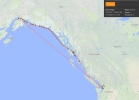
Because of this thread, I bought and use a Spot X. For the mountains around here or the other adventures I may find myself in, I like it. It is something like $10 a month that gives tracking as well as satellite texting. Last week this is my Spot track. ADSB aint gonna work up there. My wife was able to track the flight, and as I was flying over, I was able to text my buddy who is gillnetting South of Petersburg. So, for certain use cases, I think they are still very relevant.

aktrip.png
 
SPOT is unreliable in much of Alaska. Inreach is the popular choice up here. More often than not I just use my iPhone to check in. Satellite texting is awesome. I was about 40 miles NE of Cold Bay with a few others this weekend and our pickup plane had a mishap. We communicated smoothly with our iPhones while far from any cell coverage or civilization. I’ve turned off my Iridium sat phone because the iPhone is so good.

 
Because of this thread, I bought and use a Spot X. For the mountains around here or the other adventures I may find myself in, I like it. It is something like $10 a month that gives tracking as well as satellite texting. Last week this is my Spot track. ADSB aint gonna work up there. My wife was able to track the flight, and as I was flying over, I was able to text my buddy who is gillnetting South of Petersburg. So, for certain use cases, I think they are still very relevant.

View attachment 142847
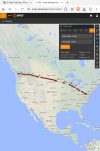
Take a look at the picture I have attached. It shows my trip from VA to MI and the return trip several days later. The return trip stopped short of my destination while I waited for the weather to pass. I somehow I didn't set the SPOT-X to record my last leg.

The thing is some of the return leg has missing track points. I have discussed this at some length with SPOT and I found out that the SPOT-X SPOT-4 and SPOT-3 have a vibration switch that is part of the tracking code to suspend tracking if no vibration occurs. On the SPOT-X the tracking icon is shown with a small pause button on top of it indicating that tracking has paused. If you are flying in SMOOTH air the tracking can be paused during your flight. Testing on my SPOT-X Shows the pause occurs after 15 minutes, but a SPOT tech told me the program is more aggressive at 5 minutes plus one more position. I don't know about that, but the paused tracking icon appeared after 15 minutes on my SPOT-X during my initial test.

How does Leidos Flight Service interpret this? If you have third party reporting to Leidos Flight Service, they are monitoring your SPOT points anytime you are on an active VFR flight plan. All other points are ignored. During an active VFR flight plan, SAR procedures start for the following reasons:
1. You are overdue to close your flight plan.
2. You have 4 SPOT tracking points showing no movement.
3. You have 4 consecutive missing track point intervals.
4. You have sent out a SPOT SOS. SAR starts immediately.

The tracking suspended feature is a potential problem if you are having Leidos Flight Service monitor your flght on an active VFR flight plan AND you are flying in smooth air. Leidos Flight Service uses the tracking ping interval as a guide as to when SAR procedures will begin. If you are tracking at 5-minute intervals, then 4 missed pings will occur in 20 minutes. If 10-minute intervals, then it's 40 minutes, and 15-minute intervals will be 1 hour.

I am also not sure what is required to reinstate tracking if it has been suspended. I thought I reset the tracking on my SPOT-X on the last leg of my trip home, but apparently not. My SPOT tech actually tested his personal SPOT-X on a picnic table by shaking it for 1 minute every 15 minutes, and tracking gave out a ping every 15 minutes. He told me the unit has to register vibration in each of 3 15-second intervals for tracking to reinstate. I am not sure what that means. I started my own test yesterday, but my testing is not yet complete. I will try just turning tracking off and back on after a suspended icon occurs, if that doesn't work I'll try a power down and reset it that way.

My SPOT technician has sent this up the chain for engineering to look at. This is the first time they have been made aware of a problem of this type. His initial reply was to suggest going to a SPOT-2, as there is no vibration based tracking suspension in that unit. I am considering it, but the added benefit of 2-way communication if an emergency actually occurs is a strong incentive to find an answer to this glitch.

I will keep you informed.

 

Attachments

  • Screenshot_20250715-042621_Chrome.jpg
    Screenshot_20250715-042621_Chrome.jpg
    585.7 KB · Views: 11
Last edited:
When Karen and I camp, we’re sometimes out of cellular range. Similarly, on backroads there’s often no cellular available for extended periods. At times like these the satellite capabilities of our iPhones - 15 and 16 Pro Max’s - are both handy for staying in touch with friends and family and could be invaluable if we broke down somewhere really remote. Apple’s implementation is quite elegant and easy to use.

54783869636_43c894dd79_z.jpg


If we camped a lot more, StarLink might be an option, but we can live without internet for short periods - at least without severe withdrawal symptoms.

Most of my flying is local these days, but I think I’d be comfortable with just the iPhone’s satellite capabilities in the case of a crash in a remote area out of cellular range.
 
Post ADSB post Apple 15 iPhone, should be easy to find you and easy for you to communicate via satellite. SPOT no longer.

The iPhone really works - have texted family from middle of nowhere no issues. Assume it’s 911 feature also can use satellite but hope to never need to learn if it’s true.
 
Back in the day I carried a hand held VHF radio. That and a low altitude chart always figured I could contact an airliner overhead.
 
Because of this thread, I bought and use a Spot X. For the mountains around here or the other adventures I may find myself in, I like it. It is something like $10 a month that gives tracking as well as satellite texting. Last week this is my Spot track. ADSB aint gonna work up there. My wife was able to track the flight, and as I was flying over, I was able to text my buddy who is gillnetting South of Petersburg. So, for certain use cases, I think they are still very relevant.
James,
I am glad you found this thread useful and you are using the SPOT-X with your wife and friends. I also use mine with my wife and family. She doesn't use the map feature as much, but she likes getting the SPOT OK messages when I depart and arrive. When we started using the first SPOT-1 it made a big difference for her peace of mind. We also used it to coordinate family transportation from our destination airport. Her dad often met us at the airport as we landed. I think a wilderness satellite commicator is a useful device that earns its keep, especially if it is reasonably priced. Say hello to your wife from us! Pete
 
So I have run a test on my SPOT-X by placing it on my truck and resetting the tracking periodically. I set an alarm on my phone to reset it every 1/2 hour but I got tied up with some errands for part of that time. The last two hours of the test is the most meaningful. During my test, I got something out of the cab and slammed the door. You can see on the data that increased the tracking time before it stopped.

I believe only the Tracking Points are relevant to Leidos Flight Services, but that may not be true. I know they see the OK messages when they are sent, but I don't know if they see the Stopped Moving messages. So my new plan is to send an OK message prior to starting the engine. Then begin tracking after the runup is complete, or while waiting just prior to taking the runway. After that I will check the tracking icon every time I switch tanks, about every 1/2 hour. I use my analog clock to determine which tank I am on. If the minute hand is on the right, I run on the right tank, if on the left, I run on the left tank. I have tracking set every 10 minutes, so Leidos will need 4 missed tracking points to begin SAR, that will take 40 minutes. From my testing, it doesn't take much vibration to keep the unit tracking before it is paused, possibly only one bump every 10 minutes or so, but it takes more vibration input to restart tracking once paused. That is why it is easier to stop tracking and restart it, rather than try to restart it by shaking the unit. In smooth air if tracking has paused, I should only miss 1 track point every 1/2 hour, not enough to begin SAR procedures. If tracking is still active, then no action is required. If tracking has paused, all I have to do it turn tracking off, wait 10 seconds, and then turn it on again without powering down the unit. That procedure seems to work from my testing. I seem to have a good plan that is easy to implement for the way I fly.

PS: If Leidos Flight Service is monitoring your Flight with an active VFR flight plan, you need to activate your VFR flight plan so that it becomes active after you leave the ground. One of the problems that has been identified is the SPOT-X sends out messages when you power up, when you start moving, and check OK and other messages . These are seen by Leidos Flight Service and mess up the tracking time interval, which in turn confuses the algorithm they use to begin SAR. There is little downside to activating your flight plan 10 minutes after being airborne, as SAR procedures won't kick in immediately anyway. My new procedure is to give more lead time to activate with enough delay to already be airborne when it becomes active. Also I power up and send my OK message prior to engine start up, and begin tracking after the runup, or just prior to taking the runway. This way Leidos ignores those messages at the beginning of my flight. I hope this helps.
 

Attachments

  • SPOT-X Test Screenshot 9-14-25.jpg
    SPOT-X Test Screenshot 9-14-25.jpg
    36.4 KB · Views: 5
Last edited:
I am glad you found this thread useful and you are using the SPOT-X with your wife and friends...

I really like it. Or something like it. I know some, here, prefer i-phone, etc. But I really think this has a different purpose. I put it on the glare shield and it will run for a week, if I forget it. Not so with an i-phone. It's purpose is to track and communicate if needed. I also have a phone, of course, and the elt as well as a plb that sits in a duffle. So, overkill it is! My plane is also very blocked on ADSB. So, authorities know where it is but friends and family have a harder time tracking it.

Here is a quick trip across the country in a twin. It missed a lot of reporting points, but it didn't always have a view of the sky. It seems pretty reliable, really. I'm all about the tech...Hah.


1000012792.jpg
 
I have concluded an email chain with a customer relations manager at SPOT/ Globalstar which has been ongoing for about a month. One of the good responses is this:

>>>>> SEPT 12 : Regarding your questions about timing. I completed testing with my personal SPOT X.

Powered it on and set it outside in my backyard, on a table. Each 15 minutes went outside and shook it for 1 minute and set it down. (test data omitted) In essence, what you are suggesting should work. While we will go into the details of the SPOT X functionality, I believe in your case, it is needed while we normally avoid this level of detail with customers.

Your SPOT X after entering suspended mode needs constant movement/vibration for 45 seconds, hence why above I state shook it for 1 minutes (ensuring I crossed the aforementioned threshold). >>>>>

There were more emails involved but these are the last two, giving you an idea where we are with SPOT / Globalstar.
resonse regarding the SPOT GenRarding your
>>>>>>

To: Sam at SPOT / Globalstar Sept 14 2025

I sent you a copy of my discussion of this issue to the Pilots of America website. I tried to give everyone the facts and paint your company in a good light at the same time. Focusing on the positive always gets better results than the negative.

I have a suggestion for you to pass on to your engineers. Why not program a special tracking time interval available for pilots that eliminates the vibration switch for that time interval only? My suggestion is 7.5 minutes per track. That means 8 tracking points per hour giving Leidos Flight Service 4 tracking points every 1/2 hour. Of course being a pilot and aircraft owner, I would like to get this option as cheaply as possible, hopefully at the same price per year but I'd be willing to fork over a small increase to get more reliability with Leidos Flight Service.

I think this is a reasonable idea that should be acceptable to pilots, Leidos Flight Service, and your engineering and sales people. That would give pilots two choices, a SPOT Gen2 or a SPOT-X with 7.5 minute tracking interval. You could also consider a shorter tracking interval for premium customers like 4 minutes, or 15 times per hour. It is a little fast but for use with Leidos Flight Service, as SAR would begin 16 minutes after a failed or stationary ping. Personally I think 30 minutes is pretty good for this application.

Let me know what you think. One Miracle at a time. Pete.

>>>>>>>>

Reply from Sam at SPOT/Globalstar

Thank you for your email.

At this time, the shared improvement suggested will not be implemented to the SPOT X; however, your provided feedback has been forwarded to our engineering team regarding the suspended tracking feature being a user controlled experience.

For your current SPOT X, use of the unit as you suggested will allow the device to send data. Powering on off and actioning tracking at set intervals to produce tracking data during smooth flights.

Again, thank you for your willingness to explore solutions and apologies in delays in responding as was out of office for several days.

Sincerely, Sam
>>>>>>>>

PS: If Leidos Flight Service is monitoring your Flight with an active VFR flight plan, you need to activate your VFR flight plan so that it becomes active after you leave the ground. One of the problems that has been identified is the SPOT-X sends out messages when you power up, when you start moving, and check OK and other messages . These are seen by Leidos Flight Service and mess up the tracking time interval, which in turn confuses the algorithm they use to begin SAR. There is little downside to activating your flight plan 10 minutes after being airborne, as SAR procedures won't kick in immediately anyway. My new procedure is to give more lead time to activate with enough delay to already be airborne when it becomes active. Also I power up and send my OK message prior to engine start up, and begin tracking after the runup, or just prior to taking the runway. This way Leidos ignores those messages at the beginning of my flight. I hope this helps.
 
Last edited:
Back
Top