Steam locomotive rail tracks

JohnWF

Pre-takeoff checklist
Joined
Aug 5, 2012
Messages
194
Display Name
John at Salida
Looking at old western movies showing steam locomotive tracks I often notice that there is a pair of rail inside the outer ones. These inside rails don't go far, and the ends slowly bend together to point a point on both ends of the inner pairs.

What purpose did those inner rails serve?
 
I'm not a locomotician but I did stay at a holiday inn once...

sounds like a switch to me.
 
Not sure where you are seeing them. Is that on a bridge? If so, they are guard rails to prevent a car from going too far off a track and destroying the bridge. The wheel that derails inside the gauge will be prevented from moving sideways.
 
KPTK is right...they're called guard rails. The help prevent derailment. Not just steam locomotive either.

ne82nd.jpg
 
They dont prevent the derailment, they prevent the derailed car from going off a bridge or taking out a bridge support.
 
I imagine said derailed car would also do a number on the ties and even railbed (but still beats taking out a bridge support)
 
The wheel flanges will chew up a wood tie to some extent but leave it serviceable in most instances. Not sure how concrete ties fare in a derailment.
 
I imagine said derailed car would also do a number on the ties and even railbed (but still beats taking out a bridge support)
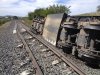
yes, it does. Sometimes it even pushes the sleepers (ties) together like an accordian. Here's one we had late last year that did that.

attachment.php
 

Attachments

  • accordian.jpg
    accordian.jpg
    231.8 KB · Views: 214
Nice view of the traction motors Jeff. :yes:
Can't tell from the picture if the tie are wood or concrete.
Locomotives tend to make bigger messes than cars/wagons.
 
Nice view of the traction motors Jeff. :yes:
Can't tell from the picture if the tie are wood or concrete.
Locomotives tend to make bigger messes than cars/wagons.
all concrete

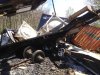
this was a fair size wagon mess, too. It's the high center of gravity wagons that come off first when you take a curve too fast. Then they drag off the locomotives.

To keep it slightly aviation related, one of the wagons was a tanker full of 100LL. After it went down the hillside it started leaking into a stream. Nothing else was touched for the first couple days while the environmental people concentrated on that one tanker.

attachment.php
 

Attachments

  • wagons.jpg
    wagons.jpg
    207.9 KB · Views: 202
Looking at old western movies showing steam locomotive tracks I often notice that there is a pair of rail inside the outer ones. These inside rails don't go far, and the ends slowly bend together to point a point on both ends of the inner pairs.

What purpose did those inner rails serve?

What you are seeing is a temporal incongruity in Hollywood:D, they didn't have those back then.;)

Otherwise as above....
 
If I never retube a steam locomotive boiler again it will be too soon.
 
Last edited:
don't forget the Shay engines used the gear teeth in the track to go up steep grades.
 
don't forget the Shay engines used the gear teeth in the track to go up steep grades.

There were several interesting drives used, cog wheels, worm drives... It was an interesting age for mechanical ingenuity.
 
Those track aligners are hell on the front end of a snow machine!
 
Those track aligners are hell on the front end of a snow machine!
no snowmobiles here, but it always strikes me as a little wierd on days like this photo, when you see a kangaroo nosing through the snow to graze. Those never struck me as snow-compatible animals before moving here.
 

Attachments

  • snow-1 sm.jpg
    snow-1 sm.jpg
    233.9 KB · Views: 39
Speaking of steam engines. Shot this bad boy near Hastings, NE 11 years ago.
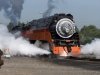
Flying back home through the Columbia Gorge from Idaho about three years ago years ago I happened upon ex-SP 4449 out on an excursion. I was in my Sport Cub, which made it easy to slow down and shoot through the open window.

IMG_1319.JPG


IMG_1323.JPG


Here she is leaving Portland Union Station on a cool, drizzly day in October 2012, on her last excursion before going into the shop for her periodic boiler inspection/teardown. The work may be completed in another year or so.

IMG_3859.JPG
 
You need to do some fact checking. I've never heard of a Shay used on a cog railway.

from wicki

After the basic Shay patents had expired, Willamette Iron and Steel Works of Portland, Oregon, manufactured Shay-type locomotives, and in 1927, Willamette obtained a patent on an improved geared truck for such locomotives.[8] Since "Shay" was a trademark of Lima, strictly speaking it is incorrect to refer to locomotives manufactured by Willamette and others as "Shays". Six Shay Patent locomotives, known as Henderson-style Shays, were built by the Michigan Iron Works in Cadillac, Michigan.
 
Where do you see cog railways in there?

I saw one mine spur rig that used a worm gear on a longitudinal shaft to drive the cogwheel. The one they had in use was a modern D/E unit, but off on a back track was an old steam unit rotting away that had a similar drive.
 
from wicki

After the basic Shay patents had expired, Willamette Iron and Steel Works of Portland, Oregon, manufactured Shay-type locomotives, and in 1927, Willamette obtained a patent on an improved geared truck for such locomotives.[8] Since "Shay" was a trademark of Lima, strictly speaking it is incorrect to refer to locomotives manufactured by Willamette and others as "Shays". Six Shay Patent locomotives, known as Henderson-style Shays, were built by the Michigan Iron Works in Cadillac, Michigan.
The gearing involved there transmits power from the steam cylinders to the drive wheels, not a gear connection between locomotive and track, as in a cog railway.
 
The gearing involved there transmits power from the steam cylinders to the drive wheels, not a gear connection between locomotive and track, as in a cog railway.

The one I looked at used an intemediate cog wheel in a truck between the rail and the longitudinal shafts. Whether any of this was Shay, I have absolutely no idea, but in function it was similar to the rig in the photo.
 
My understanding of the shay is that they could
- negotiate tight radius turns
- didnt lose traction if tracks were uneven
- If a single axle derailed, they could be put back on the track by the traincrew using hand- tools
As a result they were mostly a tool of the logging railroads
 
My understanding of the shay is that they could
- negotiate tight radius turns
- didnt lose traction if tracks were uneven
- If a single axle derailed, they could be put back on the track by the traincrew using hand- tools
As a result they were mostly a tool of the logging railroads

Logging and coal mining
 
Back
Top