shade tree engine mount repair

Aft of what's allowed on the chart by 5 inches. Hence why I asked "I wonder what the margin is" with regard to published vs tested CG envelope.

Yes, but... you DO want less elevator effectiveness. Remember, it pushes the tail down to pitch the nose up. You want it pushing down as little as possible.
Also, flaps might help. Deploying them moves the center of pressure aft, which will push the nose down a bit more.
Know it’s been done once with exceptional circumstances and exceptional pilot.

You’ll want full nose down moment which you’ll be requesting immediately after a dramatic pitch up likely to a stall. Airflow, angular momentum, and mental situation will all be against you. In a world where pilots still can’t stuff the nose down in a final overshoot to avoid spinning, I put very very low odds on a recovery from an engine physical loss situation.
 
IIRC a Piper Apache entered in the Powder Puff Derby had one engine mount
break. The cowling kept the engine in place.

I met a C-180 where the pilot could not reduce RPM unless MAP was substantially reduced. The lower engine mount/ firewall rubber bushings were missing and allowed the engine to be pivoted upward. The Governor Lever wore through the cowling and hook on it till MAP was reduced.
Borrowed time?
 
I know of only one documented case of the entire engine leaving the aircraft and the pilot surviving. 300-500 pounds departing will almost certainly have cg way behind aft limit.

Maybe Cub with huge elevator is exception, but a spam can with no engine is unlikely to be recoverable.
This has happened in NZ

C180 ZK-BQJ was registered to Rural Aviation 0n 1May1956 having previously been allotted the factory registration N4975A.

This aircraft joined the company's operational fleet, and was among those displayed by Rural Aviation at the Agricultural Aviation expo at Palmerston North in November 1956.

It then continued to work in the Taranaki area, and became the favorite mount of Don "Goose" Erceg. Both Don and ZK-BQJ became famous when the engine departed the airframe after propeller failure during a positioning flight on 1March1958, and Don was able recover control sufficiently to carry out a subsequent forced landing:
"In the vicinity of New Plymouth, New Zealand, in March 1958 a Cessna C-180, ZK-BQJ engaged in aerial topdressing suffered a propeller failure which threw one blade.
The resultant imbalance then threw the engine completely out of the airframe almost instantly.
As it departed the engine forced the top cowling over the windscreen, and also impacted the starboard main-wheel, cutting the tire.
The moment the engine came off the Cessna was thrown into a vertical snap roll, so rapidly that the pilot’s crash helmet was cracked when hitting the windscreen pillar!
Then followed a flat spin, from which normal spin recovery was successful.
To counter the pitch-up resulting from the rearward c of g change, the pilot applied full forward elevator, and lowered the flaps.
The ensuing flight path was controllable sufficiently to affect a successful force landing, with no further damage to the aircraft.
The free flying engine impacted in the farmer’s wood pile with no other damage to any person or property, but gave the farmer’s wife a severe fright as she hung out washing.
After a calming cup of tea, the pilot checked in with his operating company and reported that he needed a replacement aircraft, and when asked why, responded that the engine was missing.
“Have you checked the plugs?”
“No point, I can’t even find the engine!”
They took him at his word and duly arrived in a replacement aircraft, complete with engineer ready to replace plugs etc!".
Three days later after some remedial work, The 180 took off from the field and was ferried to maintenance for some rather more substantial work

 
Rollie Cole (Duane Cole's brother) in the 1960s had a 650 hp Pratt-Whitney engine that ripped out of his Stearman in an aerobatic practice flight at Rockford. There was no recovery.
 
iu


When the only "tool" some IA's use............................

similar to this?:

pen.jpg
 
I met a C-180 where the pilot could not reduce RPM unless MAP was substantially reduced. The lower engine mount/ firewall rubber bushings were missing and allowed the engine to be pivoted upward. The Governor Lever wore through the cowling and hook on it till MAP was reduced.
Borrowed time?
Poor inspections. I think there are mechanics unaware of those bushings in the firewall on those older airplanes.

1758042939594.png

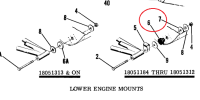
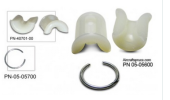
#6 is the bushing. #7 is a rubber pad. #8 and 9 are steel washers. #7 is a grounding strap. On the left is the newer style without the rubber stuff.
 
Actually the preceding are appropriate “ tools” for someone holding Inspection Authorization. The IA’s focus should be on Inspection and associated paperwork. This means they make work for other people.
In most cases this would be the A&P but possibly the owner.
Note: Every IA is also an A&P. When wearing the IA hat I visualize
handcuffs to focus on inspection and not repairs.
 
That’s it Dan! When #7 deteriorates it allows #8 to chew up the fitting.
The area is not the most accessible but that’s when it really needs a peek.
There are cheap scopes today that make this easier. Use care with the 70 year old brake hoses nearby!
 
Actually the preceding are appropriate “ tools” for someone holding Inspection Authorization. The IA’s focus should be on Inspection and associated paperwork. This means they make work for other people.
In most cases this would be the A&P but possibly the owner.
Note: Every IA is also an A&P. When wearing the IA hat I visualize
handcuffs to focus on inspection and not repairs.

Not sure why you can’t accept that when the easy IA test came out multitudes of A&P’s jumped in because they saw easy money in selling their signature. We even had one guy here that bragged about doing “$200 annuals”.

A single A&P/IA needs to open the plane up to inspect it. Last I checked that involved time and tools. I’ve seen planes that were painted years ago with annuals each year (in the log book) but yet the paint on the inspection cover screws had never been scratched or broken. And ADs signed off say on Cessna seat rails with the holes beyond dimension. And so on and so on.
 
Most of what I’ve seen is the owner or A& P does the opening/closing and if servicing is to be done at that time.

Integrity for sale? The IA has the responsibility to do a thorough inspection regardless of whether the venue is a nice hangar or an old barn. There has always been some folks that ignore this basis rule even in the old test era.
There was a “ Famous F____ “ that would do several hundred Annuals per year in addition to his airline job. Some of the newbies do at least as good a job as us old guys. The pencil whippers reputation gets around and most local IA’s know if “xxxx” did the last 5 Annuals they would get Writers Cramp with the discrepancies.

I’ve seen some of the concerns you mentioned. Note that on some aircraft some covers are not required to be opened for Inspections. Mooney published a chart showing Inspection and Access panels. I’d point this out to folks AFTER they opened all.!
 
Last edited:
Note that on some aircraft some covers are not required to be opened for Inspections.
A common source of disagreement on fabric covered aircraft is whether to cut out all the rings. Some openings are necessary for inspection. Others are only needed for tool access in case of repairs.
 
A common source of disagreement on fabric covered aircraft is whether to cut out all the rings. Some openings are necessary for inspection. Others are only needed for tool access in case of repairs.


I know someone that was burned on this. However; in 2025 I’m thinking that’s not right. On some aircraft you can remove the nav light and insert a a scope to check. Many will do a better job on the entire interior and provide a pic or video as well.
 
Fuel hoses and oil hoses could hold it on if not for the tornado of **** that would happen with the prop still spinning. Honestly I’d expect you have a good chance of not living long enough to worry about w&b.
They don't hold on for long. That is why the F1 air racers are required to have a cable to keep the engine on the airplane so there is a chance of landing
 
Back
Top