RV-15 still uses a Lycoming engine (instead of Rotax)

MountainDude

Cleared for Takeoff
PoA Supporter
Joined
Jul 29, 2011
Messages
1,466
Display Name
MountainDude
Home Airfield
KPDX
Given the uncertainty of 100LL and amazing performance of Rotax 916, I am puzzled by the Van's choice to use an IO-390 on their upcoming RV-15.
I would think a 916 would be a much better choice.
 
The 916 is only rated at 160hp for 5 minutes. IO390 while not turbo is 215.

Also, weight and balance issues with an engine 100+pounds lighter. It's why there's not a Rotax in a Cherokee.
 
I am puzzled by the Van's choice to use an IO-390
They achieve "total performance" by having slick airframes and adding even more ponies to the front. There is a reason there one non-aerobatic aircraft cruiser that uses minimal horsepower(rv-9) is already undergoing Rotax testing.

The 916 is only rated at 160hp for 5 minutes
By the time you are at 4000 feet above sea level, a Lycoming o320 160 horsepower engine will produce less horsepower than the Rotax 916is at 137. If you can climb to 4000 feet in under 5 minutes(if you takeoff at sea level in 59-degree weather), or you already live somewhere with high density altitude, the Rotax is worth looking at. Turbos make a lot of sense if you live out west. The biggest problem with them is their price, and they are not drop in o320 replacements due to CG.
 
Are there limits by Vans or FAA on what an owner can do, even though it’s experimental (EAB)? I thought I saw some reference to that a few years ago. Otherwise, experiment on paper or on the plane as you wish?
 
… The biggest problem with them is their price, and they are not drop in o320 replacements due to CG.
The premium you pay for a 916 is partly offset by the convenience of availability. There’s not a lead time if you need one tomorrow.
 
My engine shop guy rolls his eyes at the 390. Says it is mostly marketing and you can get the same performance out of a 360 with mods.

But marketing runs the world. I'm sure Vans did market studies when deciding on the RV-15 specs. Can only assume they concluded the Lycosaur would sell better and require less cost and risk on their part.
 
Are there limits by Vans or FAA on what an owner can do, even though it’s experimental (EAB)? I thought I saw some reference to that a few years ago. Otherwise, experiment on paper or on the plane as you wish?
No limits whatsoever. You could hang an r4360 on it if you beefed up the right places.;-)
 
I have way more interest in the Sonex High Wing than the RV15 but it too wasn't designed for a Rotax which is baffling. Sonex builders have been begging for years to get a fwf kit for a Rotax but they put that ridiculously short gear on them which makes a Rotax difficult. I never was a Rotax fan until owning a plane with the 912. Don't think I could ever go back to a Lycoming or Continental if I was building something new.
 
My engine shop guy rolls his eyes at the 390. Says it is mostly marketing and you can get the same performance out of a 360 with mods.

The same could be said for the O-360 and a modded O-320, but here we are.

Nauga,
who likes vanilla
 
They achieve "total performance" by having slick airframes and adding even more ponies to the front. There is a reason there one non-aerobatic aircraft cruiser that uses minimal horsepower(rv-9) is already undergoing Rotax testing.


By the time you are at 4000 feet above sea level, a Lycoming o320 160 horsepower engine will produce less horsepower than the Rotax 916is at 137. If you can climb to 4000 feet in under 5 minutes(if you takeoff at sea level in 59-degree weather), or you already live somewhere with high density altitude, the Rotax is worth looking at. Turbos make a lot of sense if you live out west. The biggest problem with them is their price, and they are not drop in o320 replacements due to CG.
Also there is a $10k rotax cost differential.... and while rotax engines are common... would you rather break down in a o-320 or a rotax??

Also also the 916 has all the things real pilots hate: PSRU and ECU
 
The same could be said for the O-360 and a modded O-320.

Nauga,
who likes vanilla

Agreed. My previous Decathlon had a modded 320 with 160hp pistons and it was a very nice combo. Considerably lighter than the Super D with 360.

But back to Vans. RVG has as much experience rolling out new models as anyone ever. He knows he can't fumble the football on this one. I'm not surprised he's being conservative. I wish him great success.
 
Are there limits by Vans or FAA on what an owner can do, even though it’s experimental (EAB)? I thought I saw some reference to that a few years ago. Otherwise, experiment on paper or on the plane as you wish?
No. As an E-AB aircraft the owner is free to do what they want. But by going with Vans suggested engine you get factory support, known performance figures, and a factory firewall forward kit.
 
By the time you are at 4000 feet above sea level, a Lycoming o320 160 horsepower engine will produce less horsepower than the Rotax 916is at 137. If you can climb to 4000 feet in under 5 minutes(if you takeoff at sea level in 59-degree weather), or you already live somewhere with high density altitude, the Rotax is worth looking at. Turbos make a lot of sense if you live out west. The biggest problem with them is their price, and they are not drop in o320 replacements due to CG.
The 15 is designed as a backcountry bush plane, not an X/C cruiser. As a result you want that HP on takeoff. Consequently HP comparisons at altitude are meaningless.
 
Also also the 916 has all the things real pilots hate: PSRU and ECU
Who are these people?

The 15 is designed as a backcountry bush plane, not an X/C cruiser. As a result you want that HP on takeoff. Consequently HP comparisons at altitude are meaningless.
I thought we already hit peak stolbro...
 
There is no replacement for displacement. My exp Cub has a hot-rodded IO-390 with a composite CS prop. My nephew had essentially the same airframe/wings with a hot-rodded IO-360 and the same prop It was lacking in thrust compared to mine. He quickly got rid of that plane and now has one with a 390. I have a few friends with similar Cubs with IO-409s, also with the same prop as me. Those planes are amazing. The 409 wasn’t an option when I built my plane.

There’s a segment of exp aviation that uses converted Yamaha snowmobile engines. Add a blower and they put out 300hp through a reduction unit. Very popular on very light airframes but not on Cubs and certainly not on heavier planes. Why? Engines don’t make thrust, props do. Little engines are limited to little, lightweight props. Choose your prop and then choose the engine to spin it.
 

Attachments

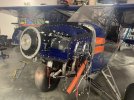
  • IMG_0813.jpeg
    IMG_0813.jpeg
    2.4 MB · Views: 24
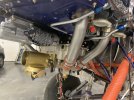
  • IMG_0827.jpeg
    IMG_0827.jpeg
    2.2 MB · Views: 23
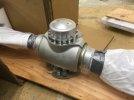
  • IMG_2944.jpeg
    IMG_2944.jpeg
    1.7 MB · Views: 23
The 15 is designed as a backcountry bush plane, not an X/C cruiser.
The RV-15 is literally a cross-country capable STOL aircraft. It has 140 knot cruising speeds, according to Van's. And yes, 140 knots is enough for cross-country flying.

As a result you want that HP on takeoff. Consequently HP comparisons at altitude are meaningless.
Most backcountry areas, other than Alaska, are literally in the mountains, where density altitude numbers matter. Granted, most people don't use their STOL plane for backcountry purposes, as discussed in that other thread about carbon cubs for sale. It just depends on where you live, if turbos make sense.

Anyway, the rv-15 is really cool; it just was not designed with less than <175hp in mind, so it makes no sense to add a <175hp engine to it. What is even cooler is that they now pre-dimple the kit, designed it around pop rivets and have even better instructions.

 
Last edited:
STOL 101. STOL airplanes share one important trait. Drag. STOL guys like drag. For flying machines the tool we use to manage drag is thrust.

When I takeoff in my Cub, my trim is all the way nose down and I use full flaps. Apply power, the tail comes up immediately, lower the tail, it’s flying. It happens fast and it requires lots of thrust. You may see Youtube STOL guys pull flaps at takeoff. In my Cessna I sometimes do the full flap thing. Given enough power/thrust, a Skywagon levitates off the ground nicely with full flaps at takeoff. Most of you have never experienced or utilized it but I expect I’ll read comments about why it’s a bad practice just the same. You don’t know what you don’t know.

Wing loading and power loading. When building STOL planes there’s a focus on weight. To a great extent weight is overcome by thrust. Every builder has to find his compromise. For guys that intend to fly at gross weight? Power becomes the priority. Not every STOL owner flies around empty to impress his friends.
 
Last edited:
The RV-15 is literally a cross-country capable STOL aircraft. It has 140 knot cruising speeds, according to Van's. And yes, 140 knots is enough for cross-country flying.


Most backcountry areas, other than Alaska, are literally in the mountains, where density altitude numbers matter. Granted, most people don't use their STOL plane for backcountry purposes, as discussed in that other thread about carbon cubs for sale. It just depends on where you live, if turbos make sense.

Anyway, the rv-15 is really cool; it just was not designed with less than <175hp in mind, so it makes no sense to add a <175hp engine to it. What is even cooler is that they now pre-dimple the kit, designed it around pop rivets and have even better instructions.
It was not designed with X/C in mind as a criteria— period. The fact it will do 140 is just a bonus.
 
Are there limits by Vans or FAA on what an owner can do, even though it’s experimental (EAB)? I thought I saw some reference to that a few years ago. Otherwise, experiment on paper or on the plane as you wish?
Someone modded their rv6 and made it a twin.
 
Copy and pasted from my own Operating Limitations-


After incorporating a major change as described in § 21.93, the aircraft owner is required to reestablish compliance with § 91.319(b) and notify the geographically responsible FSDO of the location of the proposed test area. The aircraft owner must obtain concurrence from the FSDO as to the suitability of the proposed test area. If the major change includes installing a different type of engine (reciprocating to turbine) or a change
of a fixed-pitch from or to a controllable propeller, the aircraft owner must fill out a revised FAA Form 8130-6 to update the aircraft's file in the FAA Aircraft Registration Branch. All operations must be conducted under day visual flight rules (VFR) conditions over a sparsely populated area in compliance with § 91.305. The aircraft must remain in flight test for a minimum of 5 hours. The FSDO may require additional time (more than 5 hours) depending on the extent of the modification. Persons nonessential to the flight must not be carried. The aircraft owner must make a detailed aircraft logbook and maintenance records entry describing the change before the test flight. Following satisfactory completion of the required number of flight hours in the flight test area, the pilot must certify in the records that the aircraft has been shown to comply with § 91.319(b). Compliance with § 91.319(b) must be recorded in the aircraft records with the
following, or a similarly worded, statement: "I certify that the prescribed flight test hours have been completed and the aircraft is controllable throughout its normal range of speeds and throughout all maneuvers to be executed, has no hazardous characteristics or design features, and is safe for operation. The following aircraft operating data has
been demonstrated during the flight testing: speeds VSO
_ and the weight _ _ and CG location _ SO at which they were oti"
 
There’s a segment of exp aviation that uses converted Yamaha snowmobile engines. Add a blower and they put out 300hp through a reduction unit. Very popular on very light airframes but not on Cubs and certainly not on heavier planes. Why? Engines don’t make thrust, props do. Little engines are limited to little, lightweight props. Choose your prop and then choose the engine to spin it.
At the same propeller rpm, the prop doesn't know the difference between a slow turning large displacement direct drive engine and a smaller fast turning with a redrive.

AFAIK none of the 91x engines are approved for aerobatics, which may be why you won't see them on most RVs.
 
You missed the point. The dominant props on exp IO-390s are Whirl Winds. Now Whirl Wind Aviation os gone and Whirlwind Propellor is producing them. You won’t find a Ww 200A on a Yamaha engine or see whatever the Yamaha guys are using on an IO-390. As for thrust? The WW 200A on an IO-390 will blow the Yamahas away, which is why guys with 2500# GWT planes are using 390s.
 
You missed the point. The dominant props on exp IO-390s are Whirl Winds. Now Whirl Wind Aviation os gone and Whirlwind Propellor is producing them. You won’t find a Ww 200A on a Yamaha engine or see whatever the Yamaha guys are using on an IO-390. As for thrust? The WW 200A on an IO-390 will blow the Yamahas away, which is why guys with 2500# GWT planes are using 390s.
Ok, so it's the prop that's the difference, not the engine displacement or crankshaft rpm.
 
Props make thrust.Torque turns the prop. You can decide for yourself how to balance them to suit your needs.
 
Someone modded their rv6 and made it a twin.
2 actually, although one crashed during a high speed taxi test gone awry that resulted in inadvertent flight. There’s also a radial powered RV-8. Plus tons of auto conversions from Subaru’s to LS1 crate motors. The FAA nor Van’s gives a crao on what a builder does as long as they follow the E-AB certification process which is mostly an exercise in properly filling out and submitting the requisite forms.
 
Last edited:
It was not designed with X/C in mind as a criteria— period. The fact it will do 140 is just a bonus.
I don't think this is true at all. Go read the Vans web site. Read all of the development updates. Sure, it's a bush plane, but it's also obvious that hitting the promised 140 kts cruise is very important to them. It's not a happy accident. It was a design point from day one.
 
The 15 is designed as a backcountry bush plane, not an X/C cruiser. As a result you want that HP on takeoff. Consequently HP comparisons at altitude are meaningless.
I don't think this is true at all. Go read the Vans web site. Read all of the development updates. Sure, it's a bush plane, but it's also obvious that hitting the promised 140 kts cruise is very important to them. It's not a happy accident. It was a design point from day one.

Also the cabin is tall and 47" wide. 140kts and a roomy cabin should make it nice cruiser. RV-6, 7, 9 are shoulder to should tight and little room to shift around.
 
The cabin is roomy, and the baggage area is huge. Someone said it’s designed to fit two mountain bikes without removing the wheels. It’s big enough to sleep in.
 
I don't think this is true at all. Go read the Vans web site. Read all of the development updates. Sure, it's a bush plane, but it's also obvious that hitting the promised 140 kts cruise is very important to them. It's not a happy accident. It was a design point from day one.
Well I’ve talked to Vans folks, was at the banquet when it was announced, and have examined the original prototype and the current iteration up close and personal. I stand by my assertion that X/C performance was not a primary design consideration.
 
Are there any spec's? Like wing area, empty weight, gross weight, wing span, stall speed, VNE?
 
When I was checking out the airplane at Oshkosh, I did hear one one the Van’s guy say that they did not fly the airplane to Oshkosh with the tundra tires that it was being displayed with. The 140 knot speed is with small tires, it’s down in the high 120’s with the big tires. Chose your mission.
 
Back
Top