Prop cable wonky

ateamer

En-Route
Joined
Dec 19, 2007
Messages
2,981
Location
Port St. Lucie, FL
Display Name
ateamer
Home Airfield
FD88
My plane has a vernier prop cable. When turning the knob to reduce RPM, it has normal tension for about two turns, then has almost no resistance. It holds RPM, but the tach needle does vary slightly (25 RPM). The governor (Hartzell) has less than 200 since overhaul.

Do vernier cable wear out, or develop sticky or “soft” spots?

I plan on scaring up an optical tach to verify the tach’s accuracy. An engine monitor is not economically feasible any time in the next few years.
 
Yes. Unfortunately not all vernier cables can be fixed. But if you even look to replace it, highly recommend McFarlane cables which can be serviced and repaired.
I had already considered that it may need replacement. If that’s the case, McFarlane would be the only choice.
 
When was it last replaced?

Dad's got very sticky when cycling the prop. Then finally wouldn't return to fine. Cut it apart and found the cable itself became unwound.

Got really lucky and I wish I just bought the damn thing myself sooner. If you have vernier mixture, you may consider replacing both as it's you'll already be there.
 
You can check your tach for less than $50 with this:


It has settings for 2 and 3 bladed props. It is extremely accurate and will read a perfect 3600 RPM on the 2-blade setting when pointed at a fluorescent light. It can be used from the cockpit during any phase of flight. No need for reflective tape on the prop. Since they are designed for RC planes with 6" props at 12" they work perfectly for 6' props at 12'. Check your indicated tach reading at 100 RPM intervals from 1500 to redline. The error is not consistent across the range. I would not be surprised if in that range your tach reads LOW by 100-200 RPM. If true, this means you were running at a much higher RPM than you thought. Post the correction chart in your cockpit.
 
Mechanical tachs wander and oscillate as they get older. Could be unrelated to the prop cable. A new Mitchell tach is a few hundred bucks and 30 minutes of labor.

Start by checking your cable connections at the prop governor and panel. Make sure the jam nuts on the rod end and cable housing are tight.

New engine control cables are cheap PM. I was advised to replace mine when I overhauled my engine, and that was good advice.

Check the rest of your cable connections at the engine while you are at it, and do so regularly. With every oil change is a good practice. Having a control cable fail or detach in flight can be exciting, and not in a good way.
 
Last edited:
Mechanical tachs wander and oscillate as they get older. Could be unrelated to the prop cable. A new Mitchell tach is a few hundred bucks and 30 minutes of labor.

Start by checking your cable connections at the prop governor and panel. Make sure the jam nuts on the rod end and cable housing are tight.

New engine control cables are cheap PM. I was advised to replace mine when I overhauled my engine, and that was good advice.

Check the rest of your cable connections at the engine while you are at it, and do so regularly. With every oil change is a good practice. Having a control cable fail or detach in flight can be exciting, and not in a good way.
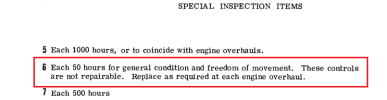
Cessna, for one at least, has this in their inspection guidelines in their service manuals:

1772993703457.png
1772993795773.png

That #6 under the Special Inspection item column:

1772993899088.png

Most are being run to failure. That's not smart at all, as you say.
 
Cessna, for one at least, has this in their inspection guidelines in their service manuals:

View attachment 150620
View attachment 150621

That #6 under the Special Inspection item column:

View attachment 150622

Most are being run to failure. That's not smart at all, as you say.

As an owner, developing a good oil change routine is one of the best things you can do for safety. Every 25 or 50 hours: decowl, change the oil, wash down the engine compartment, and check critical connections such as control cables and fluid hoses. Torque seal makes that easy. Run it up, check for leaks, and back to flying in confidence. So many owners are afraid of their machines and unaware of what they can do without an A&P.
 
You can check your tach for less than $50 with this:


It has settings for 2 and 3 bladed props. It is extremely accurate and will read a perfect 3600 RPM on the 2-blade setting when pointed at a fluorescent light. It can be used from the cockpit during any phase of flight. No need for reflective tape on the prop. Since they are designed for RC planes with 6" props at 12" they work perfectly for 6' props at 12'. Check your indicated tach reading at 100 RPM intervals from 1500 to redline. The error is not consistent across the range. I would not be surprised if in that range your tach reads LOW by 100-200 RPM. If true, this means you were running at a much higher RPM than you thought. Post the correction chart in your cockpit.

I have one of those velcro’d on my glareshield. Works pretty well except when I’m flying toward the sun in the morning or evening. Bright sunlight seems to blind it.
 
The governor (Hartzell) has less than 200 since overhaul.
I had a governor wander 25 up and 25 down after being in the prop shop, along with the prop for IRAN. We also put an overhauled engine on at the same time. Ended up taking the governor back to the prop shop and it took them about 2-3 hours to find the problem and change a bushing. It had been working fine before the first trip to the prop shop.
 
Back
Top