% power vs altitude, NA engines

MountainDude

Cleared for Takeoff
PoA Supporter
Joined
Jul 29, 2011
Messages
1,466
Display Name
MountainDude
Home Airfield
KPDX
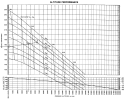
Where can I find trustworthy info on % power every 1000 feet, from sea level to 18K?
A graph with % power on the Y axis and altitude on the X axis would be great.

Is this accurate (note that X axis is in meters)? If it is, it would mean an engine could still have 60% power at 13,100 ft, which seems high. Assuming you run the rpm at 2300 instead of 2600, how much additional loss would there be (proportional to the rpm reduction?)?
 
I’m not sure exactly what you’re asking, but perhaps you’re looking for the performance charts of your particular engine?

% power would depend on manifold pressure too, which is a function of altitude and throttle opening. RPM is a function of your prop governor, but also plays a role in % power.

This is an example, if you scroll to the back pages:

Sorry if that’s too basic and not what you asked.
Thank you! Yes, I think the graphs on pages 33-41 explain exactly what I was asking. Here is a screen shot of one of them.
 

Attachments

  • Screenshot 2025-10-23 at 11.01.58 PM.png
    Screenshot 2025-10-23 at 11.01.58 PM.png
    605.1 KB · Views: 44
If I am interpreting it correctly, that engine has:
- 235 hp at sea level and 2500 rpm (full throttle)
- 187 hp (80%) at 4,000 ft and 2300 rpm (full throttle)
- 170 hp (72%) at 23" and 2300 rpm up to 7,000 ft
- 163 hp (70%) at 8,000 ft and 2300 rpm
- 140 hp (60%) at 12,000 ft and 2300 rpm
It looks like it loses 10% power every 4,000 ft, which is not bad at all.

I run mine at 24" and 2100 rpm when possible, which is 155 hp (65%).
 
One can go off the deep end with the charts in the manuals. I have already done this, so I'll save you the trouble: for a carbed 470, if you're leaned properly and have a fuel flow gauge, HP ~= 12.35 * gph.

A decent first order approximation from The Ted:

% power = (Current RPM/Max RPM) * (Current MP / 30")
 
If I am interpreting it correctly, that engine has:
- 235 hp at sea level and 2500 rpm (full throttle)
- 187 hp (80%) at 4,000 ft and 2300 rpm (full throttle)
- 170 hp (72%) at 23" and 2300 rpm up to 7,000 ft
- 163 hp (70%) at 8,000 ft and 2300 rpm
- 140 hp (60%) at 12,000 ft and 2300 rpm
It looks like it loses 10% power every 4,000 ft, which is not bad at all.

I run mine at 24" and 2100 rpm when possible, which is 155 hp (65%).
I know you are looking for detail, but in the absence of POH or engine manual information, the basic rule of thumb is 3%/1,000'.

Remember that in addition to reduced power, the airfoils (including prop) are also less efficient as altitude rises. We usually think of that in terms higher TAS compared to IAS, but combined with the power reduction, that also means loss of climb performance. Again, your manual is the guide but the rule of thumb is that your will lose about 8% of your fixed pitch prop climb performance/1000'. A little less, 7%, for a variable pitch prop.
 
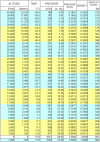
Here's a useful chart. Just relabel the second column as max MP.

Screenshot_20251024-104237.png
 
One can go off the deep end with the charts in the manuals. I have already done this, so I'll save you the trouble: for a carbed 470, if you're leaned properly and have a fuel flow gauge, HP ~= 12.35 * gph.

A decent first order approximation from The Ted:

% power = (Current RPM/Max RPM) * (Current MP / 30")
Sorry, I don't understand this: "HP ~= 12.35 * gph."
 
horsepower is approximately equal to 12.35 times your fuel flow in gallons per hour
Hmm, that is pretty far off the chart I posted earlier.
At 24/2100, I run at ~11 gph, which, according to the chart is 155hp, and only 136 hp according to your formula.
 
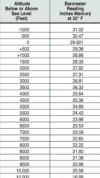
Max power rich of peak is limited by mass air flow, so power is going to be (actual MP/29.92")*(actual RPM/max RPM). Percentage of max MP based on altitude can be found in the attached chart under the Pressure Ratio column - 75% power is available up to nearly 8,000 feet, 65% is available up to around 11,500.

Max power lean of peak is limited by fuel flow. Fuel flow in gph * 14.9 = hp. Take this and divide by your max hp to get percent power. For example, in my Mooney, 12.2 gph * 14.9 = 181.78hp / 280 rated hp = 64.92%.

All that said - The actual power getting to the prop is also somewhat dependent on the speed of the combustion and the timing of peak pressure relative to TDC, so none of these calculations are perfect.


Standard Atmosphere pressure table.png
 
Max power lean of peak is limited by fuel flow. Fuel flow in gph * 14.9 = hp. Take this and divide by your max hp to get percent power. For example, in my Mooney, 12.2 gph * 14.9 = 181.78hp / 280 rated hp = 64.92%.
I could never figure out the pedigree of where the 14.9 number came from, aside from "Mike Busch said it works for the IO-550". I figured the O-470 would have a different coefficient due to its different compression ratio, which is why I tried to estimate it indepedently from the data in the manual.

GeorgeC,
uncalibrated
 
Last edited:
I could never figure out the pedigree of where the 14.9 number came from, aside from "Mike Busch said it works for the IO-550". I figured the O-470 would have a different coefficient due to its different compression ratio, which is why I tried to estimate it indepedently from the data in the manual.
There's more to it than "Mike Busch said so" but it's an imperfect number because it actually varies even in the same engine at different operating conditions.

The "HP = GPH * 14.9" is a rearranged equation for Brake Specific Fuel Consumption (BSFC). The article on it at Wikipedia is quite good if you take the time to read and understand it all.
 
Thank you!

GeorgeC,
and Cunningham's Law

It's not as complicated as it sounds.

Calorific value of avgas = 14.8×10^6 ft-lb/lb
Efficiency = 33%
6 lb/hr of avgas (or 1 gal/hr) will produce 0.33 x 6 x 14.8×10^6 ft-lb/hr
1 hp = 33,000 ft-lb/min = 60x33,000 ft-lb/hr
1 gal/hr will produce 0.33 x 6 x 14.8×10^6 / (60 x 33,000) hp = 14.9 hp

The key here is the 33% efficiency - which is too high for piston GA engines. Our engines are probably closer to 28%.

If you drop the efficiency to 28%, then you will have something closer to 12.5 hp/gph, not 14.9 hp/gph
 
Max power rich of peak is limited by mass air flow, so power is going to be (actual MP/29.92")*(actual RPM/max RPM). Percentage of max MP based on altitude can be found in the attached chart under the Pressure Ratio column - 75% power is available up to nearly 8,000 feet, 65% is available up to around 11,500.

Max power lean of peak is limited by fuel flow. Fuel flow in gph * 14.9 = hp. Take this and divide by your max hp to get percent power. For example, in my Mooney, 12.2 gph * 14.9 = 181.78hp / 280 rated hp = 64.92%.

All that said - The actual power getting to the prop is also somewhat dependent on the speed of the combustion and the timing of peak pressure relative to TDC, so none of these calculations are perfect.


View attachment 146593
This is an excellent explanation that makes sense (meaning, I dont have to remember any numbers or formulas; it's just simple ratios). Thank you.
 
It's not as complicated as it sounds.

Calorific value of avgas = 14.8×10^6 ft-lb/lb
Efficiency = 33%
6 lb/hr of avgas (or 1 gal/hr) will produce 0.33 x 6 x 14.8×10^6 ft-lb/hr
1 hp = 33,000 ft-lb/min = 60x33,000 ft-lb/hr
1 gal/hr will produce 0.33 x 6 x 14.8×10^6 / (60 x 33,000) hp = 14.9 hp
Ah, there it is. I knew I'd seen the full derivation somewhere. Thanks!

The key here is the 33% efficiency - which is too high for piston GA engines. Our engines are probably closer to 28%.

If you drop the efficiency to 28%, then you will have something closer to 12.5 hp/gph, not 14.9 hp/gph
I don't know that it's necessarily that bad. The article I linked earlier has a table with a bunch of efficiencies for a bunch of different types of engines. They only had two piston aircraft engines, but the Lyc O-235-L was 29.8% efficient and the Lyc IO-720 (the monster that's in the Comanche 400 and a couple other things) is 34.2% efficient.

I sure wish I could measure actual torque on my 550 to see what its efficiency is... Because I'm that kind of nerd. :D
 
If you drop the efficiency to 28%, then you will have something closer to 12.5 hp/gph, not 14.9 hp/gph
Now I don't feel so bad about my estimate of 12.35.

I sure wish I could measure actual torque on my 550 to see what its efficiency is... Because I'm that kind of nerd. :D
If only there were some kind of strain gauge...
 
Now I don't feel so bad about my estimate of 12.35.
Well, I think I'm very close with the 14.9 on my IO-550-G. It's derated to 280hp, so 65% is 182hp and 182/14.9 =12.215 and 12.2 is pretty much where I end up with the richest cylinder at least 10ºF LOP (it usually ends up more like 20-25, but as it continues to cool after I stop leaning, my engine monitor triggers at 10.)

If only there were some kind of strain gauge...
...that you could put on a certified airplane engine. ;)
 
Back
Top