Piper Arrow PA28R-180 versus -200

I've "hit for the cycle" on the Arrows, having flown all the major variants.

@k9medic for training the 180hp will be fine. Just be aware that there do still exist a few of them with the automatic gear extension system still installed - If you find one of those, rip it out right away. The 180 doesn't have much performance to spare, and if it decides to extend the gear on you during takeoff, you may find yourself returning to terra firma unexpectedly.

I don’t recall exactly which Arrows had tapered wings. My 1968 180hp Arrow I had Hershey bar wings.

Basically, the main Arrow variants are*:

PA28R-180 Arrow I. 180hp, Hershey Bar wing.
PA28R-200 Arrow II. 200hp, Hershey Bar wing.
PA28R-201 Arrow III. 200hp, tapered wing.
PA28RT-201 Arrow IV. 200hp, tapered wing, T tail.

Of course, there's also the PA28R-201T Turbo Arrow III and PA28RT-201T Turbo Arrow IV.

My favorite of them all is the III. The I/180hp is a bit of a dog performance-wise, but it does achieve the goal of swinging gear. It's kinda like flying an Archer with a 300-pound dude permanently installed in the back seat.

I've only flown one II, but it was the nicest-flying one of all because it was the old King Radios demonstrator bird, and they kept it maintained extremely well. Tight controls and nice interior and panel for the day.

The III was overall the best model IMO, because it performs well with the 200hp and tapered wing, and doesn't have any of the foibles of the IV.

The IV, with the T-tail, looks good but is not really fun to fly. Very little control authority on the horizontal tail when you're on the ground, so the controls are kinda floppy and you'll find that soft field takeoffs and landings can have some unexpected surprises. After manufacturing the IV for a while, Piper decided they agreed with me (hah) and reverted to the III, so all the newest Arrows (everything manufactured back to some time in the 90s I think) are Arrow IIIs in addition to the IIIs that were produced in the 70s.

As for the turbos, they use the same awful fixed-wastegate turbo system as the Seneca and Mooney 231. The *only* advantage of that system is that it was cheap to manufacture. That's it. With the fixed wastegate it's always boosting (and thus always hot), you're supposed to idle for 5 minutes prior to shutdown to cool it off, and the bearings still get coked up after a while. But at least it has a low critical altitude too... :rolleyes: Merlyn makes some add-ons to try to make this system suck less, but if you really want a turbo, get an airplane with a better system than the "bean counter's turbo".

* Edit: There's some additional info on the Wikipedia page about some unpopular and prototype variants too: https://en.wikipedia.org/wiki/Piper_PA-28_Cherokee#PA-28R_Arrow
 
Last edited:
I mean, the PA28 series is just poison pilled at this point on the wing related/repetitive ADs going forward. OEMs are trying to rid the market of the whole heap of these things, but people keep buying it cuz there's no affordable new alternative in this sclerotic market. ERAU's moral hazard stray bullets even took down some PA32s and the 28-235.
I respectfully disagree. Older PA28 (like their counterparts C150/152/172) are still the backbone of smaller flight schools. Most of the big pilot mills are using - what a surprise - the later models of PA28/C172. Yes, there are some Cirrus and from time to time you even find a Diamond or a Tecnam, but 90 % of the new training aircraft market is divided between Cessna and Piper. Without the current flight school orders in the order book Piper would be in a very rough financial condition.

There was/is nothing wrong with the current wing spar AD 2020-26-16. Some bad apples were sorted out, so the system worked just fine.

As a matter of fact, the NPRM AD-2024-0008-A announced in September 2024 with a comment period until November 2024 has not materialized (yet). In part because it was poorly worded and it was just plain nonsenses. Do not blame the FAA for this, the mess was created by Piper in the first place. Piper is doing currently a horrible job in drafting SB‘s and SL‘s with a lot of hard to explain errors. Just take the wing walk SL 1327, which just became the revisioned SL 1327J just a few days ago.

The aging fleet is not immune from issues of all kinds. Take the Cessna carry through spar AD 2023-02-17 or the Cessna doorpost AD 2020-18-01.

So every airframe has its very own caveats. New certified aircrafts are financially out of reach for most private participants in the market. So we have to work with what we have available. And as long as every year mishaps take out more aircrafts than new aircrafts are built, the fleet will shrink and increase the value of the survivors .
 
Fingernails on a chalkboard:

The plural of "aircraft" is "aircraft" - (I have no idea why).
 
To further refine the list of Arrows that flyingcheesehead had listed:
Arrow: 1967-1971 short body, short Hershey bar wing 30' span, 180hp (200hp option added 1968) 50gal capacity
Arrow II: 1972-1976 5" stretched body for more rear seat room, 26" added to Hershey Bar wingspan, 32.25' span, wider horizontal span, Dorsal fin fillet added, 180hp engine dropped - all were 200hp 50 gal fuel capacity
Arrow III: 1977- long body, taper wing of 35' wingspan , 77 gal fuel capacity, Was reintroduced in early 2000s, but discontinued again in late 2019
Turbo Arrow III: turbo became optional in '77 , using six cyl Continental TSIO-360 engine
Arrow IV: T-tail, long body, taper wing, 77 gal fuel
Turbo Arrow IV: T-tail, Uses Continental TSIO-360 engine
the 75 Arrow 2 carries 48 gallons - all usable
the 79 Arrow IV carries 72 gallons - but about 3 in each side are not usable
 
the 75 Arrow 2 carries 48 gallons - all usable
the 79 Arrow IV carries 72 gallons - but about 3 in each side are not usable
From online scans of various POH:

Arrow POH lists fuel capacity as 50gal (does not specify usable)
Arrow II POH states 48gal Usable, (but not a total capacity) https://wayman.edu/files/Piper_Arrow_II_POH.pdf
The Arrow III POH states 77gal capacity, 72 usable https://www.jasonblair.net/wp-content/uploads/2015/11/Piper-Arrow-PA28R-201.pdf
Arrow IV POH states 77gal capacity, 72 usable https://inflightpilottraining.com/wp-content/uploads/2018/08/PA28RT-201-POH.pdf

Then there's this:

Key Fuel Capacities by Model:
  • PA-28R-201 Arrow III & Turbo Arrow III: 77 Gallons Total (72 Gallons Usable)
  • PA-28R-201T Turbo Arrow III/IV: 77 Gallons Total (72 Gallons Usable)
  • PA-28R-200 Arrow II: 50 Gallons Total (48-49 Gallons Usable)
  • PA-28R-180 Arrow:
    50 Gallons Total
 
I did not realize that I could not provide links to POHs as documentation for my figures above as a <5 post forum newbie.

Regardless, look up the various POHs for your self
 
There are a lot of scanned POHs out there on the Internet, none of which I'd trust as official. Not because of malice, but because you can't be sure what someone put together over the years and what might be missing. I've never seen a known good POH for a PA-28 that doesn't list usable fuel somewhere. I'm not saying it it's not possible, I clearly haven't read all of them, but it's a pretty basic specification to leave out. In some old ones it might only be listed on the performance charts, from my memory.
 
The actual manufacturer-issued POHs are the only legal source of information regarding the aircraft. I had gleaned the information provided above from actual page scans of the various official Piper POHs. The fuel capacity figures I quoted are from the POH 'basic information' pages.
 
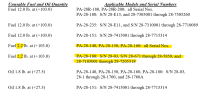
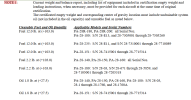
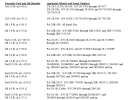
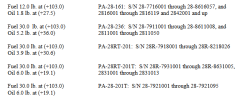
Fuel information can be found in the TCDS. For the PA28 series this is TCDS number 2A13.

PA28R-180 unusable fuel is apparently 2 gal. (1 gal. per tank).
 
The Piper 50gal tanks are 48 useable. Pretty sure that's across all models
 
Not a fan of any of them, but since all the 172RGs are wrung out, I'd get the Arrow III with the more forgiving wing and no T-tail. Since it will be presumably be flown two-up and not that far, considerations of efficiency and fuel tankage seem less important.
 
The Piper 50gal tanks are 48 useable. Pretty sure that's across all models
This is not true. My 75 Arrow II has 48 usable, but some of the earlier Cherokee models have very low unusable fuel. I really didn't want to look it up, but I did:

Straight from Note 1 in the TCDS:


1779897398561.png
 
Last edited:
Most straight wing Cherokees have two 25 gallon wing tanks. The Arrow is a Cherokee. Taper wings went to about 77 total gallons if I recall. Some straight wing Cherokees like the 235 also had the same inboard 25 gallon tanks with auxiliary tanks added outboard. So straight wing Arrow (xx0) = 50 gallons, tapered wing Arrow (xx1) = 77 gallons. OP probably wants the taper wing since training will occur although have never found the "it stops flying all at once" straight wing Cherokee to be hard to land nicely. But that's the scuttlebutt.
 
This is not true. My 75 Arrow II has 48 usable, but some of the earlier Cherokee models have very low unusable fuel. I really didn't want to look it up, but I did:

Straight from Note 1 in the TCDS:


View attachment 152307
I looked in the same place as you edited your post. You're right, it's all over the map anywhere from 2.2 to 30 lbs unuseable.
 
some of the earlier Cherokee models have very low unusable fuel.
This probably has more to do with the way the unusable fuel is calculated rather than any change in the tank design (as far as I know). This is opposite of some Cessna models where unusable fuel decreased in later years when a second set of ports were added.
 
I got my CFI in a 180 hp 1975 longer body Arrow. It was a dog. But, it did the job.
I also got my CFI in a PA28-180 (from 1968) and have a fond relationship with it. Ashtrays notwithstanding:)
 
This probably has more to do with the way the unusable fuel is calculated rather than any change in the tank design (as far as I know). This is opposite of some Cessna models where unusable fuel decreased in later years when a second set of ports were added.
I seriously doubt it has anything to do with how it is "calculated". Testing has to be done to determine how much fuel is usable, and I'm sure they measure and demonstrate it. I would guess it has to do with the location of the fuel line connection or some other physical difference in the geometry or arrangement of the fuel system (tanks, lines, etc.). I probably could ask AI to chase down the reason some of the early Cherokees had less than 0.5 gallons unusable.
 
The actual manufacturer-issued POHs are the only legal source of information regarding the aircraft. I had gleaned the information provided above from actual page scans of the various official Piper POHs. The fuel capacity figures I quoted are from the POH 'basic information' pages.
I didn't know that the TCDS wasn't a legal source of information.
1779921123188.png
1779921187658.png
1779921417850.png
 
I seriously doubt it has anything to do with how it is "calculated". Testing has to be done.
That is what I'm talking about. The certification requirements and testing methods having changed over the years.
 
Last edited:
I didn't know that the TCDS wasn't a legal source of information.
It still is and the go to document to validate a type certificate, however, there is some guidance when dealing with the TCDS note sections. Regardless, approved aircraft flight manuals didn't come onto the scene as an authoritative source for aircraft limitations until 1979 which is detailed in Part 91 and Part 21. But there were some earlier exceptions to those rules provided the information was approved by the FAA or CAA.
 
That is what I'm talking about. The certification requirements and testing methods having changed over the years.
After thinking about it more, and consulting AI (what a waste of time that was), I suspect you are right in that it has to do with some change(s) made to standards or procedures that affected how the planes were tested or how the information is reported, or perhaps simply some safety margin added by Piper. Whatever the reason, I was unable to find any specific reference for the difference.

I asked multiple AI chatbots to do a deep-dive and try to find why there is a difference in unusable fuel from the early Cherokees to the later models. Both Chatbots I used pushed multiple erroneous theories, none of which held water (fuel-injected v. carbureted, Hershey Bar v. tapered wing, FAA Order 8110.7, issued June 20, 1972, flight manual standards that changed in 1975, etc.). These AIs state these things as fact and only back down when challenged. I know a few people like that, and they are annoying. After I shot down every one of the proposed theories, Gemini finally admitted it just didn't know and could find no specific reference of when and why there is a difference.

Here is an excerpt from an exchange with Gemini where it proposed yet another new theory after I debunked the previous one. This theory was that a 1975 change to a GAMA POH standard included a safety cushion. The dates didn't make sense and there was no specific reference.

1779975040581.png​

 
Umm, why are we worried about unstable fuel? Presumably pilots are still landing with reserves. 1-2 gallons is not a reserve. Realistically you'll want to land with 5 a side remaining. So 40/50 is consumable perhaps.
 
Umm, why are we worried about unstable fuel? Presumably pilots are still landing with reserves. 1-2 gallons is not a reserve. Realistically you'll want to land with 5 a side remaining. So 40/50 is consumable perhaps.
I use usable as the base for the start of my math. Usable fuel, burn rate, gives me time w/o reserve, then subtract reserve time and an extra for safety and I'm good.
 
I have about 35 hours in the T-Tail Arrow. I think this is formally known as the Arrow IV (normally aspirated, fuel injected 200HP). I did not like it. It had a feeble rate of climb for a 200 HP retractible IMO, even when lightly loaded. Furthermore, there is an RPM range restriction, at least on the model I flew, somewhere around power settings that were particularly convenient to use on stabilized approaches. This was a hassle to deal with, particularly with instrument approaches where it become a real distraction and increased the workload. I did like the automatic gear deployment system. I like PA-28's, but not this one. I have heard from others that the non-T-tail models are more performant. On a positive note, I do remember to Arrow was a breeze to land, especially if one is coming from the Cessna world. This is a common trait of the PA-28 line and a good one. I'd recommend a Mooney for your needs. They tend to be less expensive and performance is their strong point IMO.
 
Last edited:
I have about 35 hours in the T-Tail Arrow. I think this is formally known as the Arrow IV (normally aspirated, fuel injected 200HP). I did not like it. It had a feeble rate of climb for a 200 HP retractible IMO, even when lightly loaded. Furthermore, there is an RPM range restriction, at least on the model I flew, somewhere around power settings that were particularly convenient to use on stabilized approaches. This was a hassle to deal with, particularly with instrument approaches where it become a real distraction and increased the workload. I did like the automatic gear deployment system. I like PA-28's, but not this one. I have heard from others that the non-T-tail models are more performant. On a positive note, I do remember to Arrow was a breeze to land, especially if one is coming from the Cessna world. This is a common trait of the PA-28 line and a good one. I'd recommend a Mooney for your needs. They tend to be less expensive and performance is their strong point IMO.
Pretty much describes all Cherokees. Yes they land themselves which seems to be why the flights schools and the students love them. Seems to be their primary calling card.
 
For all the talk of unusable fuel, who knows about quality control in the 1960's. I own a 1968 piper arrow. TCDS lists unusable fuel as 12 lbs (2 gallons). Some of the early variants of the Cherokee line listed 2.2 lbs (approx 3/8 gallon) as unusable. Well, the flight manual for my arrow lists unusable fuel as 2.2 lbs, contradicting the amount listed in the TCDS. And the weight and balance section is specifically serial numbered to my aircraft. Is it possible they installed the tanks from a straight legged Cherokee in my arrow? Perhaps.
 
Well, the flight manual for my arrow lists unusable fuel as 2.2 lbs, contradicting the amount listed in the TCDS.
For reference, the TCDS will take precedence over the POH when it comes to determining the certified empty weight of the aircraft. How you use the POH figure falls to you, but the 12 lbs unusable fuel is the regulatory value.
 
For all the talk of unusable fuel, who knows about quality control in the 1960's. I own a 1968 piper arrow. TCDS lists unusable fuel as 12 lbs (2 gallons). Some of the early variants of the Cherokee line listed 2.2 lbs (approx 3/8 gallon) as unusable. Well, the flight manual for my arrow lists unusable fuel as 2.2 lbs, contradicting the amount listed in the TCDS. And the weight and balance section is specifically serial numbered to my aircraft. Is it possible they installed the tanks from a straight legged Cherokee in my arrow? Perhaps.
It wouldn't be the first time there was a mistake in an early PA28 manual. I recall there being another one, I think it had to do with the yellow arc on the tachometer.
 
Ugh. I was so close...

Found what appeared to be a great buy on an Arrow and was set up to have my A&P/IA come do a quick pre buy on it today. Had a verbal offer in. It is due an annual in July so I figured we would do a quick look and tear it apart next month. The price was right to support this process and I was already pending funds for the purchase. Today was going to be sign the contract and plan for delivery.

That was the plan for today. Unfortunately, yesterday happened.

My A&P/IA sends me a text with a photo of a logbook entry. His text starts with "this bothers me." ANY text that starts like that is not good.

At the end of the day, I had to pass on another Arrow before we even got started. There is no way that I would be able to do a quick pre buy today with that type of concern already and have him feel comfortable doing an annual next month on my dime. If the plane is still for sale after I get back from my trips that I may be able to convince him to take a look.

Until then...
 
My A&P/IA sends me a text with a photo of a logbook entry. His text starts with "this bothers me." ANY text that starts like that is not good.
Not even going to tell us what the issue was? Rude!!
;)
 
Biggest thing was replacement and repair of some structural parts with used parts in areas the are known to be very prone to corrosion. He didn’t have the 337 to compare and with a compressed timeline to do a prebuy he was not willing to put me in that situation.

As he stated to me, it could be nothing but it could be replacement of thousands of dollars worth of parts next month when I get into it and I don’t want to put you in a situation where the next stop would be BAS.

His concern wasn’t necessarily a safety one but more of a long-term viability of the asset without having time to do a proper pre-by inspection. It was certainly not a reflection on the seller or the broker.

Kind of like get there-itis. I wanted to press the purchase and he was the voice of reason to hang tight when we had more time.
 
A bit of a bump and an update from earlier this year... In July, one of my main rental planes had an unfortunate event that resulted in it being declared a loss. With that loss, I decided to go a different direction with standardization of the rental "fleet."

Enter the beginning of this month and I now have a nice little 172B that we rent out to PPL students and I picked up a 172RG for use as a complex instrument and commercial trainer.

The 172B is a given, strong performer so I am not looking at ways to upgrate the 172RG just a little bit. Both planes will have waas GPS's installed in the next month or two. The RG has a 300A autopilot that I am getting back working. It cruises at 135TAS burning about 9,5 GPH so I am not really sure what else I could do to make improvements.

Open to suggestions!
 
Got a text from a friend "hey, the tail of your rental plane is falling off..." 30 seconds later a different friend texted "I think your plane is falling apart!"

From the renters, they got a nose wheel shimmy on their first landing. Checked it out, and flew 1.5 hours back to home airport and reported another nose wheel shimmy upon landing. Photos showed horizontal stabilator hind sheared 12 rivets and was canted about 25 degrees. Anticollision light and top dorsal was broken off and hanging by a wire.

All things point to a hard landing but we can't really determine. Insurance company totalled it.
 
Granted I've only ever flown clapped out 172RGs (do they come any other way?), but 135 true is impressive!
 
Back
Top