Pilatus down in northeast Wyoming

meh, single pilot airplane, definitionally not complex enough preclude single pilot recovery but allow dual pilot recovery. These things are overpowered saratogas, sorry if that offends the ego of owner/operators of the type. One could just admit upfront to a reflexive/emotional aversion against calling out pilot error causals, and dispense with the aliens/hypoxia/uncommanded full control deflections cope. Actually giving the airplane, for once, the benefit of the doubt.

Statistically, it wasn't aliens or control failure, it was rich man over his head spatial-D'ng to a hole on the ground. But I look forward to the 6-9 pages of
View attachment 132093

Crashing perfectly good airplanes seems to be a popular past-time for that particular demographic. Also getting very confused in IMC in general.
 
Far too many "autopilot pilots" out there. To me it's a point of pride to be able to fly as well as the autopilot does. I even once hand flew a whole leg up into the flight levels and back down, just because. (Maybe I was bored.)
I do the same from time to time, specifically to maintain proficiency. If things get too busy single-pilot I'll put it back on to reduce workload, but if it then decides to try to kill me in that environment it's time for "unable" and "request delay vectors".

I also tend to hand fly approaches past the FAF, but a lot of that just comes down to the old S-Tec in the 414 wanting to do S-turns down final... :skeptical:

My opinion has always been if you're going to try to fly an all weather airplane you'd better be a proficient all weather pilot. If you can't land the thing *somewhere* with nothing except ATC vectors and a working attitude indicator*, you're a passenger, not PIC.

* OK, over mountains a working nav source is probably needed, but the basic point stands. Train for systems failures, degrade gracefully, even if the airplane is bent in the ensuing landing there's no excuse for killing people in the process. Singles really shouldn't be going over mountains or oceans hard IFR in my opinion, but I know I'm in the conservative minority there.
 
Last edited:
Not sure there is enough data out there to make such a statement. The PC12 is a complex aircraft with a lot of potential failure modes, and this could have been out of the realm of the pilots ability to fix the problem. The way that big moveable horizontal stab works, if it went full deflection uncommanded, would be quite a handful. Much less the possibility of other fight control surface failures. Maybe this guy did screw up, but I would give the guy the benefit of the doubt until the final is out. Apparently he came out of a King Air, so not a NewB pilot.
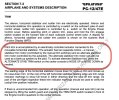
I was never aware that the PC-12 had a movable stabilizer. It doesn't appear to be so looking at pictures, and I cannot find anything on that. I'll check the manual later.
 
Crashing perfectly good airplanes seems to be a popular past-time for that particular demographic. Also getting very confused in IMC in general.

Eh, recreational pilot crash perfectly good simple airplanes in VMC all the time. Even kill people, too.

Nothing new under the sun.
 
Hitting the ground with a boatload of passengers due to incompetence was definitely below board.
There is a difference between skirting the law (which is what the original post was referencing) and being incompetent. You can be stupid or do something stupid and still be "above board" in regards to following rules and regulations. You can also perform poorly in an airplane despite being competent and experienced (see any of the crashes from highly experienced and apparently competent and current pilots that have happened in the last couple of years).
 
Than why bother with checkrides at all??

The biggest problem with checkrides is that they are point-in-time snapshot. Even given a rigorous, formal training program, professional aviators still occasionally bust one. Rare, yes; but the evidence stands.

The biggest benefit of a checkride is not validating the candidate’s competency, it’s the data gathering to validate performance of the system as a whole and identifying trends, then informing the community as a whole those things that need attention.

Unfortunately, at the recreational pilot level, there’s no structure or requirement to maintain anything other than currency, leaving it to the individual to be their own recurrent training program.

Ex: the number of instrument rated private pilots that incorporate an IPC on a recurring basis even though they may never require one to reset currency.
 
I was never aware that the PC-12 had a movable stabilizer. It doesn't appear to be so looking at pictures, and I cannot find anything on that. I'll check the manual later.
My understanding. I have a whopping hour and change in the PC12, so no expert. But here from the POH.

1 (44).jpg
 
He was actually a very religious guy and I’m 100% sure it was all above board. The pilot/owner and his wife were friends with the singing group and they were all going on an Alaskan cruise. Larry was a local guy, his youngest sister and I went all through school together. He had several businesses, and had been flying for quite some time, I don’t know his complete history, but he did have a King Air 90 in 2013 when I bought a Conquest. This accident has really shook up a lot of people in the area.
It will likely be pilot error, as most accidents are, but that doesn’t change the loss for all the families involved.
My comment was glib and uncalled for. I’m sorry for everyone grieving.
 
Exactly. And mandating passing tests doesn’t do anything for proficiency.
It does more to check that a pilot is proficient enough to pass the ride than, say, a random local CFI pencil-whipping a BFR because you offer to let him fly your big fancy whizbang stinky whiny airplane.

I wonder if this pilot had insurance.
 
It does more to check that a pilot is proficient enough to pass the ride than, say, a random local CFI pencil-whipping a BFR because you offer to let him fly your big fancy whizbang stinky whiny airplane.

I wonder if this pilot had insurance.
I’d bet he had insurance, and I’d bet his insurance mandated simulator training, so a random CFI pencil whip wouldn’t even be an option.

Most anybody can pass a checkride. Far too many plan to peak on the checkride and then regress rapidly because ACS standards are just “FAA BS” anyway.
 
Last edited:
True, but those skills don’t stick around after the checkride in far too many cases.
If you have a checkride every 6 months, you'd almost have to not fly to get that rusty.
I’d bet he had insurance, and I’d bet his insurance mandated simulator training, so a random CFI pencil whip wouldn’t even be an option.
You'd be surprised how many folks go bare at the high end.

The general standard for sim training for part 91 in a single-engine turboprop is only annually, though, and there's no checkride for them to worry about. Throw some rides in there and it'd be a lot better IMO.
 
Very possibly…that’s not part of the checkride, so it bears no relevance to your statement.


People who apply the standards that you seem to think will magically apply to the other 363 days a year (or 364 this year.)
Well... I'll just say that it's a helluva lot easier to pass the rides when you do things the right way all the time. Then, you just go fly and you're done.
 
As soon as a person or company has enough assets to self-insure, they will do so.
Apparently that’s well above the level of assets required to own and operate a jet, which theoretically is more than it takes to own and operate a turboprop, so…
 
105, Hornet ball, 7.5, on the gages…

(Rest of the air wing) snicker snicker

A coupla of y’all know what I’m talking about.

Tools, always on the gages
 
News is reporting today that the pilot declared an emergency with an autopilot failure.

relatively easy to fly until someone lulled into a false sense of security by a very capable airplane encounters a situation that they don’t possess the skills to fly themselves out of.


It’s happened to lots of people in Pilatus.

edit: I can think of 3 Pilatus accidents in the last several years that all started out with an autopilot failure, which should be an incredibly benign non-event.
 
Final Report - N357HE

NTSB probable cause: The pilot’s loss of control due to spatial disorientation while operating in instrument meteorological conditions, which resulted in an in-flight breakup. Contributing to the accident was the pilot’s distraction from the autopilot disconnecting due to an updraft from convective activity.
 
One thing comes to mind from training over the years, DO NOT try to overpower the AP, it will just make the Trim run extra hard in the opposite direction. Then when it does break loose, you have all that trim in the opposite direction. And if you killed the breaker, that probably means you do not have electric trim to bring it back.

With a Bank, sure correct while you're turning off the AP. But with Pitch, hit any and all of the switches that will disconnect the AP and then correct. You have no idea where the Trim is running to and pushing or pulling will really get you in a bad place.
 
A 2,000+ hour pilot gets spooked by the AP disconnecting and loses the airplane? That's a sobering thing to consider.....
This is the third or fourth time a PC-12 has broken up in flight because the autopilot disconnected in IMC. It appears the instrument flying skills possessed by some of the pilots graduating to this rather substantial aircraft may not have been much beyond the knowledge of how to engage the AP after takeoff.

The NTSB found no indication the pilot had received a weather briefing prior to departure on the accident flight. The pilot was 67 years of age, and this information was included in the final report:

The FAA Office of Aerospace Medicine published a research report titled “Spatial Disorientation in Fatal General Aviation Accidents (2003-2021)” in 2025. The study’s results showed that the majority of spatial disorientation accidents occurred during the en route portion of the flight. The pilot age group with the most accidents was between 60-69 years old, and identified that the type of airplane involved in these accidents is also an important consideration.

The analysis identified that most accidents involved single-engine aircraft, but that a growing number of accidents involving turboprop or turbojet aircraft occurred over the 19-year span, beginning largely around 2013. These complex aircraft are highly automated to accommodate single-pilot operations, which may lead to more reliance on autopilot.
 
Last edited:
That was my thinking. If you're IFR current in the aircraft, why is the AP disconnect a big deal?

[I say this as a Bonanza pilot who flies without an AP of any sort]
Consider the environmental conditions - potential turbulence and SLDs. How many of us hand-fly in those conditions very often? It’s certainly not the 6HITS in VMC or the sim or perhaps more docile weather we often use to maintain currency. And the higher performance nature can lead to getting behind the aircraft quickly, though he did do upset recovery training specific to that aircraft. Different in real-world conditions, though, especially if you haven’t done it recently or regularly.
 
More Occam for the chat. Waiting two years for the appeal to authority clowns to describe the water, is banal to a fault. The (instrument cross check) atrophy is real among the avionics doodad crowd, pros very much included. People keep handwaving it away (IMC hand flying atrophy masked behind automation on the daily) as no big deal...and they keep dying.

I just don't want the rEguLatOr to outlaw single-pilot IFR, which these case studies certainly don't help with.

ETA: Called it!
 
Back
Top